Published on : 30 Mar 2026
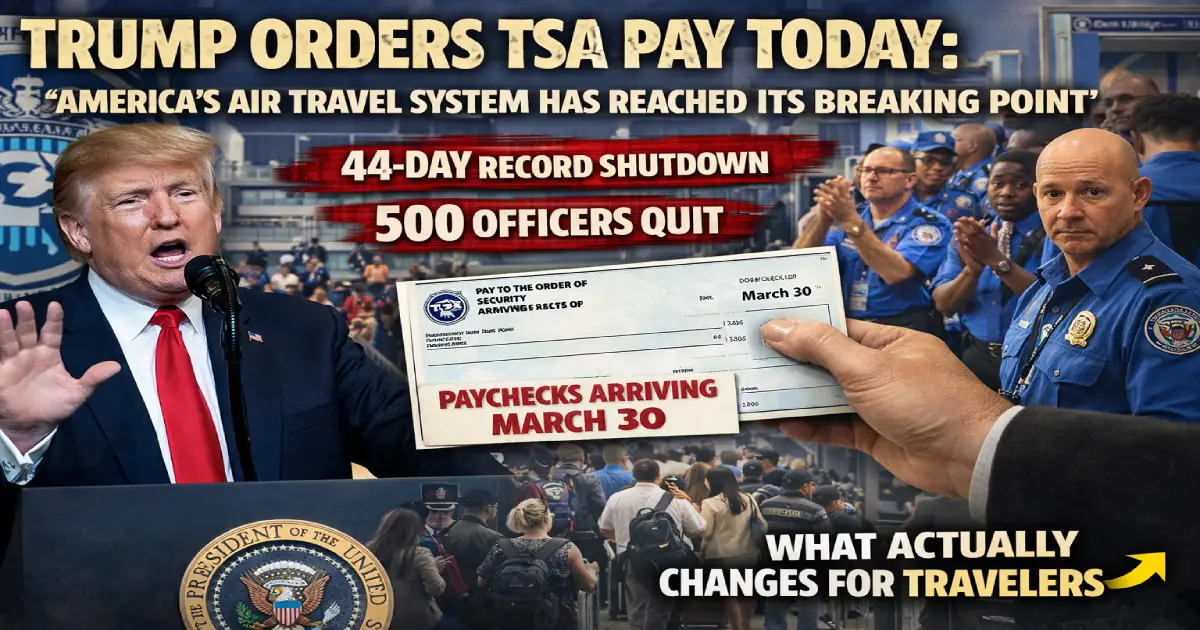
Trump TSA pay order DHS shutdown March 2026 — the pivot moment arrived Friday afternoon. After 44 days of 61,000 TSA officers working without pay, President Trump signed a White House memorandum directing the Department of Homeland Security to pay TSA employees immediately using funds with “a reasonable and logical nexus to TSA operations.” DHS confirmed paychecks should hit direct deposit accounts today — Monday, March 30. The DHS shutdown has not ended. Congress has not passed a funding deal. The House and Senate passed different bills on Friday and then left town on a two-week recess. But TSA officers — who have been losing homes, donating plasma, and quitting at record rates — are getting paid. Aviation security expert Sheldon Jacobson told TIME: airport delays “will come to a somewhat abrupt end” if officers return to work. Here is every confirmed detail, what it means for your travel this week, and what still hasn’t been resolved.
Published: March 30, 2026 Executive order signed: Friday, March 28, 2026 — afternoon Signed by: President Donald Trump — White House memorandum Full official title: “Paying Our Great Transportation Security Administration Officers and Employees” Trump’s exact words: “America’s air travel system has reached its breaking point. This is an unprecedented emergency situation.” DHS Secretary Markwayne Mullin: “TSA officers should begin seeing paychecks as early as Monday, March 30” Paychecks today: DHS sent messages to TSA officers Friday informing them they should “expect most of their backpay in their direct deposit starting on Monday, March 30” — CNN has viewed the message Return to work order: “All employees must return to work on their next scheduled workday” — starting Saturday March 29 — DHS confirmed Funds source: Two people familiar with plans say DHS will use funding from the “One Big Beautiful Bill Act” — Trump’s domestic policy package signed last summer — which provided $10 billion that can be used to support DHS mission Legal basis: 31 U.S.C. 1301(a) — funds must have “reasonable and logical nexus” to TSA operations TSA officers affected: ~61,000 total — ~50,000 transportation security officers at airports Paychecks missed: 3 full paychecks + 1 partial — since February 14 Total missed pay: Over $1 billion — acting TSA Administrator Ha Nguyen McNeill Congressional testimony Officers who quit: Nearly 500 transportation security officers — confirmed White House memo + NPR + Fortune Nationwide callout rate (Thursday): 11.8% — 3,450+ callouts — DHS confirmed JFK callout rate (peak): 33.6% — Boston Globe + DHS data Baltimore-Washington (BWI) callout rate: 37.4% — Boston Globe + DHS data Multiple airports: Greater than 40% callout rates — NPR confirmed DHS shutdown day: Day 44 as of Sunday — eclipsing the record 43-day shutdown last fall Shutdown start: February 14, 2026 500% increase in assaults on TSA officers since shutdown began — acting TSA Administrator McNeill Congressional testimony Congress status: Senate passed DHS funding bill Friday — House Speaker Johnson called it “a joke” — Senate Democratic leader Schumer said House GOP plan “dead on arrival in the Senate” — Congress now on two-week recess Senate Majority Leader Thune: Trump’s move “takes the immediate pressure off. But, you know, it’s a short-term solution” Aviation expert Sheldon Jacobson (TIME): “I suspect people will be showing up for work more consistently now, and these delays will come to a somewhat abrupt end” What still isn’t resolved: Long-term DHS funding — CISA, FEMA, Coast Guard non-immigration staff still unpaid — Congress in recess until mid-April What this does NOT do: Does not end the DHS shutdown — does not fund the rest of DHS — does not bring back the ~500 who quit TSA union concern: “If it’s only for a pay period, that’s not enough to bring them back. It has to be an extended pay for them to come back or want to stay” — TSA union representative Rep. Rosa DeLauro (D-CT): The action shows the Trump administration “made the conscious decision” not to pay TSA workers for 41 days
TravelTourister has covered the DHS shutdown across five articles since Day 13. Here is the complete arc — from partial paychecks to today’s executive order — in one place for every reader coming to this story for the first time.
February 14: DHS funding lapses. 61,000 TSA officers classified as essential workers — legally required to report to screening lanes without pay.
February 23: DHS briefly announces TSA PreCheck suspension — then reverses it within hours under pressure. PreCheck lanes remain operational throughout.
February 27 (Day 13): TSA officers receive first partial paycheck. TravelTourister publishes first DHS shutdown article. Standard lane waits beginning to build at major hubs.
March 5 (Day 20): Spring Break 10 days away. DHS shutdown survival guide published. Houston Hobby’s standard lane already running 90 minutes vs PreCheck’s 3 minutes.
March 9 (Day 24): Houston Hobby records 53% officer callout on a single Saturday — 47% the following Sunday. New Orleans line snakes through parking garage. 5-hour arrival warning issued.
March 13 (Day 27 — previously published as Day 27): First completely empty TSA paycheck issued. Airlines for America CEO Chris Sununu had specifically warned this date would be the crisis escalation point. TravelTourister publishes comprehensive survival guide — Hobby 90 min vs PreCheck 3 min — airport by airport.
March 22–23: Air Canada Express CRJ collides with fire truck on Runway 4 at LaGuardia. Two pilots killed. Assaults on TSA officers have increased 500% since the shutdown began — acting TSA Administrator McNeill testifies to Congress.
Week of March 24: Acting TSA Administrator McNeill testifies before Congress: “TSA officers are now losing their homes and cars, struggling to put food on the table, and are experiencing all-around financial catastrophe.” She warns of potential airport closures if callouts continue. At a House hearing Wednesday, she describes TSA workers donating plasma to make ends meet.
March 26 (Thursday): Trump announces he will sign executive order. Senate Republicans had been pushing him to declare national emergency to free funds. Senate Appropriations Chair Collins publicly says funding exists that can be used legally to pay TSA.
March 27 (Friday evening): Senate passes DHS funding bill funding most of DHS excluding ICE. House Speaker Johnson calls it “a joke” minutes later. Trump signs the executive memorandum the same evening — directing DHS Secretary Mullin to pay TSA using any funds with a nexus to TSA operations. Congress leaves town for a two-week recess.
Today, March 30: Paychecks arrive. 44-day record broken. DHS shutdown continues.
The White House memorandum is specific in its direction and deliberately vague in its funding source. Trump directed the Secretary of Homeland Security to “use funds that have a reasonable and logical nexus to TSA operations to provide TSA employees with the compensation and benefits that would have accrued to them if not for the Democrat-led DHS shutdown, consistent with applicable law, including 31 U.S.C. 1301(a).”
The “reasonable and logical nexus” language is the key phrase — it gives DHS Secretary Mullin significant discretion to designate which existing appropriated funds qualify. Two people familiar with the plans told CNN that DHS intends to use funding from the “One Big Beautiful Bill Act” — Trump’s sweeping domestic policy package signed last summer — specifically the $10 billion pot designated to “support the DHS mission to safeguard US borders.”
The constitutional and legal questions this raises are significant. Bobby Kogan, senior director of federal budget policy at the Center for American Progress, told CNN that the bill does not mention TSA anywhere — it was written for immigration enforcement. Using it to pay airport security screeners requires a creative legal interpretation of “safeguarding borders.”
Rachel Snyderman, managing director of the economic program at the Bipartisan Policy Center, noted that the bill gives the DHS secretary the power to deem what activities support safeguarding the border. That discretionary language is likely what DHS is relying on.
The practical implication: this pay is funded through a one-time legislative appropriation being reinterpreted for a purpose Congress did not explicitly intend. Once that $10 billion is drawn down — across ICE, CBP, Secret Service, Coast Guard military personnel who are already being paid from it — the TSA funding question reopens.
Senate Majority Leader Thune acknowledged this directly: “It takes the immediate pressure off. But it’s a short-term solution.”
Aviation security and safety expert Sheldon Jacobson of the University of Illinois told TIME: “I suspect people will be showing up for work more consistently now, and these delays will come to a somewhat abrupt end.”
The logic is straightforward: the primary mechanism driving 3–5 hour wait times at major airports was financial hardship causing callouts. JFK’s 33.6% callout rate and Baltimore’s 37.4% rate — the two highest in the country — were not caused by illness or staffing shortages. They were caused by officers who simply could not afford to show up and work for free any longer. Once paychecks arrive, the calculation changes.
If officers return to their scheduled shifts this week, checkpoint throughput at the worst-affected airports can normalise within 3–5 days. The 11.8% nationwide callout rate that was recorded on Thursday — compared to a pre-shutdown baseline of approximately 2% — would need to return to baseline for wait times to normalise. That will not happen overnight.
TSA union representative Harmon-Marshall told CNN: “If it’s only for a pay period, that’s not enough to bring them back. It has to be an extended pay for them to come back or want to stay.”
Officers who quit — nearly 500 — do not return automatically. The executive order does not rehire anyone. Officers who left for private sector jobs do not suddenly have their TSA positions back. The staffing gap created by 44 days of attrition cannot be filled by a paycheck — it requires new hires, training, and credentialing that takes weeks to months.
Additionally, AFGE regional VP Carlos Rodriguez expressed concern about consistency: “This back and forth about all these decisions changing is confusing the TSA officers, so they’re possibly thinking like, ‘Okay, are we getting paid or are we not?'”
| Timeframe | Expected Airport Experience |
|---|---|
| Today (March 30) | Paychecks arrive — callout rates may begin dropping within 24–48 hours |
| Tuesday–Wednesday | Gradual normalisation at highest-callout airports (JFK, BWI, ATL) — still elevated, not normal |
| By next weekend | If officers return at scale — wait times should approach manageable levels (30–45 min standard) |
| This week standard lanes | Still elevated — arrive 2.5 hours before departure — PreCheck still strongly recommended |
| PreCheck lanes | Still the fastest option — even as standard lanes recover |
| 500 who quit | Do not return — understaffing persists until replaced |
The traveler’s practical guidance for this week:
✈️ Still use PreCheck — even as conditions normalise, PreCheck lanes will be faster for weeks ✈️ Arrive 2.5 hours before departure — not yet back to standard 2-hour recommendation ✈️ Check TSA wait times before leaving: tsa.gov/travel/security-screening/waitimes ✈️ Expect variability — normalisation will not be uniform across airports — JFK and BWI have the highest callout rates and will normalise last
Kimberley Fondren, a TSA agent in Memphis, Tennessee, facing the threat of eviction — working her second shutdown in six months — told CNN on Sunday morning: “I’m thankful that we are finally going to get what we are owed. At the end of the day, this is a very important job… it’s a career, really. And that’s what everyone wants, is a stable career.”
Acting TSA Administrator McNeill, in her Congressional testimony Wednesday, described the full picture of what 44 days without pay produced: officers losing homes and cars, struggling to feed families, donating plasma to cover bills. She confirmed a 500% increase in assaults on TSA officers since the shutdown began — frustrated, hours-long-wait passengers directing anger at the people working without pay to screen them.
The Baltimore-Washington International Airport scene on Friday — the day the executive order was signed — was described by CNN reporters on the ground: the security line stretched the length of the terminal building, snaked around inside, extended outside. Southwest employees were playing “The Macarena” and “Who Let the Dogs Out” on speakers. Handing out water. That was the breaking point Trump’s memo described.
The executive order solves one problem: TSA officers get paid. It does not solve:
❌ DHS funding: The Department of Homeland Security remains unfunded. CISA (cybersecurity), FEMA (emergency management), and non-immigration Coast Guard staff are still working without pay. The executive order explicitly covers only TSA.
❌ Congressional deadlock: Senate passed a bill. House rejected it. Congress is on two-week recess. Senate Democratic leader Schumer said the House GOP plan would be “dead on arrival in the Senate.” House Democratic leader Jeffries said the Senate bill would clear the House if Speaker Johnson allowed a vote — “This could end, and should end, today.” It did not end. It will not end before mid-April at the earliest.
❌ The 500 who quit: Nearly 500 transportation security officers left their positions permanently. They do not return with today’s paycheck. Every new hire requires 4–6 weeks of training and credentialing. The staffing level that existed on February 14 will not be restored for months.
❌ Funding sustainability: The $10 billion “One Big Beautiful Bill” pot being used is shared across ICE, CBP, Secret Service, and Coast Guard. TSA’s draw on this fund will reduce what is available for other DHS priorities. Congress is the only permanent solution.
❌ The broken trust: TSA union representatives are clear that one paycheck — or even a period of paychecks — does not automatically repair the retention damage of 44 days without pay. Many officers who stayed did so out of legal obligation as essential workers, not loyalty. That relationship has been tested in a way that affects long-term staffing stability.
The DHS shutdown began February 14, 2026 — the day DHS funding lapsed — as a consequence of a political standoff over immigration enforcement. Democrats withheld DHS funding to demand changes to ICE operations following the killing of two US citizens by federal immigration agents in Minneapolis in January. Republicans refused to restrict ICE. DHS — the agency that includes both ICE and TSA — was caught in the middle.
For 44 days, Republicans blamed Democrats for the shutdown. Democrats blamed Republicans for refusing reasonable ICE reforms. TSA officers — essential workers with no vote in the matter — bore the full financial cost of a legislative standoff that had nothing to do with airport security.
Trump’s executive order, which refers throughout to the “Democrat-caused shutdown” and the “Democrat-led DHS shutdown,” does not resolve the political dispute. It sidesteps it — temporarily — by finding a creative funding mechanism that Congress did not explicitly authorise for this purpose.
Whether that mechanism survives legal challenge, how long the $10 billion pot lasts when shared across multiple DHS functions, and what happens to CISA, FEMA, and the Coast Guard in the meantime are questions that remain entirely open.
Trump signed the executive order. TSA paychecks are arriving today. After 44 days — the longest DHS-only shutdown in American history, breaking the 43-day record set last fall — the officers who kept showing up without pay are finally getting paid.
The DHS shutdown is not over. Congress is on two-week recess. House and Senate remain at an impasse. The ~500 officers who quit are not coming back today. The legal basis for the funding mechanism will be challenged. And the underlying political dispute — ICE enforcement, judicial warrants, immigration policy — has not moved one inch.
But for the 61,000 TSA officers who have been donating plasma, facing eviction, and choosing between groceries and the job they are legally required to show up to: today is the day the paycheck arrives. Aviation expert Jacobson says the delays will “come to a somewhat abrupt end.” The union is more cautious. The truth is probably somewhere between.
If you are flying this week: still use PreCheck, still arrive 2.5 hours early, still check TSA wait times before you leave home. Recovery will take days, not hours. But the direction has changed.
For More Resources:
Related Articles — The Complete DHS Shutdown Series:
Posted By : Vinay
This article is provided for general informational purposes only and is based on information available at the time of publication. Travel advisories, airline schedules, airport operations, visa requirements, government regulations, and other travel-related information are subject to change without prior notice. While Travel Tourister makes reasonable efforts to verify information using official announcements, government publications, airline and airport communications, and other reliable sources, we cannot guarantee that all information remains complete, accurate, or up to date at all times. Readers should independently verify any information that may affect their travel plans with the relevant airline, airport authority, government agency, embassy, or other official source before making travel, financial, or other decisions. Travel Tourister shall not be liable for any direct or indirect loss, inconvenience, or damages arising from the use of or reliance on the information contained in this article. Nothing in this publication constitutes legal, immigration, financial, or professional travel advice. If you believe any information in this article is inaccurate or outdated, please contact our editorial team. We review all credible correction requests promptly and update our content whenever appropriate.
Lastest News
2nd Floor, 39, Above Kirti Club, DLF Industrial Area, Kirti Nagar, New Delhi, Delhi 110015



Travel Tourister is a leading Travel portal where we introduce travellers to trusted travel agents to make their journey hasselfree, memorable And happy. Travel Tourister is a platform where travellers get Tour packages ,Hotel packages deals through trusted travel companies And hoteliers who are working with us across the world. We always try to find new and more travel agents and hoteliers from every nook and corners across the world so that you could compare the deals with different travel agents and hoteliers and book your tour or hotel with the one you have chosen according to your taste and budget.
Copyright © Travel Tourister, India. All Rights Reserved

 Call
Call Enquiry