Published on : 13 Apr 2026
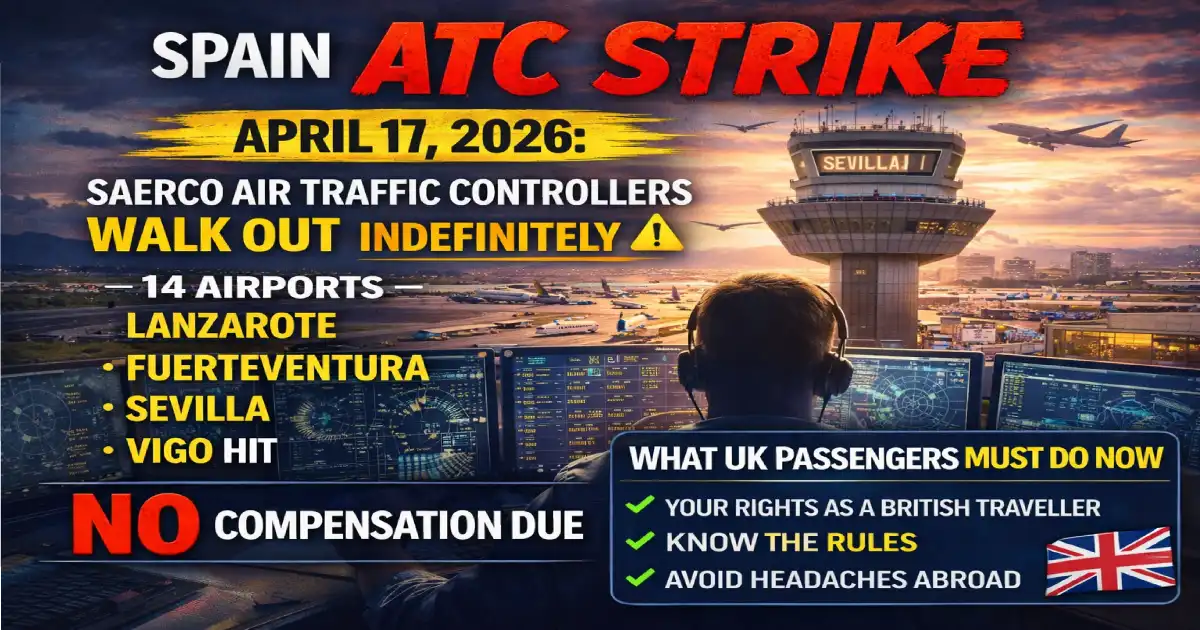
Four days from now, a second Spanish aviation crisis begins — and this one is more dangerous for passengers than the Groundforce dispute that paralysed Easter.
Starting right at midnight on Friday, April 17, air traffic controllers in SAERCO-managed towers in Spain have announced an indefinite strike, raising the risk of disruption in 14 airports across the country. The strike, which was advised by the Union of Air Traffic Controllers (USCA) and Workers’ Commissions (CCOO), stems from long-standing administrative issues, including staff shortages, work overload and irregular schedules.
This is a completely separate crisis from the Groundforce baggage handlers’ dispute. SAERCO’s strike targets the people who guide aircraft through the sky — and that changes everything about what passengers are owed. Unlike the Groundforce situation, where some compensation routes remain open, an ATC strike is classified as an extraordinary circumstance under EU law. As air traffic control strikes are classed as “extraordinary circumstances”, airlines are not usually required to pay compensation for delays or cancellations, although they must still offer rebooking or refunds.
If you have a holiday booked to Lanzarote, Fuerteventura, Sevilla, Vigo, La Palma, A Coruña or any of the other 14 affected airports from April 17 onward — read every word of this article before you travel.
Published: April 13, 2026 Strike starts: Midnight Friday April 17, 2026 (00:00 CET) Duration: Indefinite — no end date Unions: USCA (Union of Air Traffic Controllers) + CCOO (Workers’ Commissions) Target company: SAERCO (private air navigation service provider) Airports affected: 14 — full list below Root cause: Staff shortages, work overload, irregular schedules, failed collective agreement negotiations What airlines owe: Rebooking or refund — but NO fixed cash compensation Minimum services: Will be ordered by Spain’s government — extent TBC Mediation status: USCA/CCOO requested mediation via SIMA before filing — meetings with SAERCO were repeatedly postponed or cancelled, triggering the strike notice Existing Groundforce status: Suspended for talks since April 8 — but resumption Monday April 13 if no deal confirmed CRITICAL WARNING for Lanzarote + Fuerteventura: Both airports face DUAL strike risk — SAERCO ATC from April 17 AND potential Groundforce resumption
The Groundforce strike — which ran throughout Easter and affected 12 Spanish airports with baggage handler walkouts — was disruptive. Bags were delayed. Check-in slowed. Turnarounds extended. But the aircraft still flew. Passengers still arrived at their destinations, often on time or close to it. And for some disruption types within the Groundforce dispute, compensation avenues remained open.
The SAERCO ATC strike is categorically different. Air traffic controllers are the people who manage the movement of every aircraft in the airspace they control. When they walk out:
Flights cannot depart. Without a controller clearing your aircraft for pushback, taxi and takeoff, the aircraft does not move. This is not a slower process — it is a stopped process.
Flights cannot land. Aircraft approaching an airport managed by a striking tower may be held in holding patterns or diverted to alternative airports entirely.
Every airline is equally affected. The Groundforce dispute was company-specific — it hit airports where Groundforce operated. The SAERCO dispute hits every airline flying to or from every one of the 14 affected airports simultaneously. Ryanair, easyJet, Jet2, TUI, British Airways, Vueling, Iberia — there is no carrier that can reroute around an ATC strike at the destination airport.
The indefinite duration is the most dangerous element. An ATC strike with no end date means no reliable rebooking window. If you rebook from April 17 to April 18, the strike may still be in progress. If you rebook to April 20, same risk. The dispute will run until SAERCO agrees a collective agreement with USCA and CCOO — and before issuing the strike notice, union representatives attempted to reopen talks with SAERCO. However, they say scheduled meetings were repeatedly postponed or cancelled, leaving key issues unresolved. The two sides are not close to a deal.
The strike will affect 14 airports across Spain including: Madrid-Cuatro Vientos, Lanzarote, Fuerteventura, La Palma, El Hierro, La Gomera, Castellón, Burgos, Huesca, Ciudad Real, Vigo, A Coruña, Jerez and Seville.
Here is what each airport means for UK travellers specifically:
| Airport | IATA | Significance for UK passengers | Risk level |
|---|---|---|---|
| Lanzarote | ACE | One of the UK’s busiest Canary Islands routes — Ryanair, easyJet, Jet2, TUI all operate here | 🔴 HIGHEST |
| Fuerteventura | FUE | Major UK beach holiday destination — Ryanair, easyJet, Jet2, TUI all operate here | 🔴 HIGHEST |
| La Palma | SPC | Popular Canary Islands destination — primarily UK charter and easyJet | 🟠 HIGH |
| El Hierro | VDE | Smallest Canary island — inter-island traffic, limited direct UK | 🟡 MODERATE |
| La Gomera | GMZ | Very small island airport — inter-island only | 🟡 LOW (UK) |
| Sevilla / Seville | SVQ | Major UK city break destination — easyJet, Ryanair, Vueling from London Gatwick, Luton, Stansted, Manchester | 🔴 HIGH |
| Jerez de la Frontera | XRY | Sherry country, gateway to Cádiz — Ryanair, Vueling | 🟠 MODERATE |
| Vigo | VGO | Galicia — Ryanair from London Stansted, Manchester | 🟠 MODERATE |
| A Coruña | LCG | Galicia — Ryanair, Vueling | 🟠 MODERATE |
| Castellón | CDT | Valencia region — primarily domestic and charter | 🟡 LOW |
| Burgos | RGS | North-central Spain — limited international | 🟡 LOW |
| Huesca | HSK | Pyrenean ski gateway — limited international | 🟡 LOW |
| Ciudad Real | CQM | Central Spain — primarily domestic | 🟡 LOW |
| Madrid-Cuatro Vientos | LECU | General aviation, not commercial — minimal passenger impact | 🟡 MINIMAL |
The standout UK risk airports are Lanzarote, Fuerteventura, La Palma and Sevilla. These four airports collectively handle hundreds of UK flights every week. Lanzarote and Fuerteventura alone carry millions of British holidaymakers annually — they are year-round, not seasonal, destinations precisely because the Canary Islands sit in warm Atlantic air that makes them viable in April, May and beyond.
Passengers planning on flying into and out of Lanzarote and Fuerteventura in the Canary Islands may face even bigger issues as both ground handling staff and air traffic controllers will be staging walkouts there.
This is the most dangerous combination on the list. Both Lanzarote (ACE) and Fuerteventura (FUE) appear on both the Groundforce list (baggage handlers) AND the SAERCO list (ATC controllers). If Groundforce resumes its indefinite strike pattern while SAERCO controllers are simultaneously walking out, Lanzarote and Fuerteventura face:
The compounding effect at Lanzarote is not hypothetical — it has precedent. Eurocontrol has warned of impending “moderate to high delays in Lanzarote and Fuerteventura due to the air traffic controllers’ strike.” Air traffic controllers at the control towers operated by Saerco have been on strike for several months because their private employer refuses to negotiate a new collective agreement for wages and working conditions.
This is a critical piece of context: SAERCO controllers at Lanzarote have been engaging in intermittent strike action for months. The April 17 announcement is not the beginning of a new dispute — it is the escalation of an existing one to a formal, named, indefinite action across all 14 SAERCO airports simultaneously. The unions have been patient. They are no longer.
SAERCO (Sociedad Anónima Española de Control y Organización) is a private company that provides air navigation services at a number of Spanish airports — primarily regional and island airports that are not managed directly by ENAIRE, Spain’s main state-owned air traffic control provider. ENAIRE manages the towers at the largest Spanish airports including Madrid-Barajas, Barcelona, Malaga, Palma, Alicante, and the main Canary Islands airport at Tenerife. SAERCO manages the towers at the 14 airports on the list above.
The unions say the dispute stems from long-standing structural issues, including staff shortages, work overload and irregular scheduling practices. They warn that accumulated fatigue and stress among controllers could affect operational concentration, prompting the move toward strike action after failed attempts to resume negotiations. Among the outstanding topics are the definition of actual staffing levels, how absences are covered, fatigue management protocols and the criteria used to design shift schedules.
Critically, workers are demanding sufficient staffing levels in all control towers, respect for rest periods, and working conditions compatible with safety and professionalism. The air traffic controllers’ representatives emphasise that their demands “are not economic in nature,” as they are not requesting salary increases or more vacation time, but rather “an increase in staffing levels to guarantee operational safety.”
This framing matters enormously. The SAERCO dispute is not a pay dispute — it is a safety dispute. The unions are arguing that understaffed towers create fatigue-related safety risks. That makes it significantly harder for SAERCO management or the Spanish government to simply reject the demands and issue minimum service orders that override the strike. When controllers frame a dispute in terms of operational safety rather than wages, the political and legal dynamics shift.
USCA and CCOO state that the conflict has been built up over several years, describing an improvisational method of organising the staff and their workloads. The unions also claim that these conditions undermine work-life balance and create an atmosphere of instability for the workers.
Under Spanish law, essential public services — including air traffic control — must maintain minimum service levels during strikes. The Ministry of Transport will issue a minimum services order before April 17 specifying what percentage of operations must continue.
However, there are two important caveats that UK passengers need to understand:
Caveat 1 — Minimum services do not protect your specific flight. A minimum services order might guarantee, for example, that 60% of commercial flights can operate. But it does not specify which 60%. Airlines make commercial decisions about which flights to operate within that reduced capacity. Your flight may or may not be in the operating 60%. The only way to know is to check your specific flight status the day before and on the day of travel.
Caveat 2 — SAERCO controllers believe current minimum services orders are too high. This is the specific grievance at Lanzarote that has been running for months. Controllers claim the Ministry has set “abusive minimum services” that prevent them from exercising their effective right to strike. However, due to this, the striking has increased and delays were seen on Saturday, particularly at Fuerteventura airport, as they strive to get their point across.
In other words: SAERCO controllers are escalating precisely because minimum services orders have diluted previous strikes. The April 17 formal indefinite action is an attempt to force SAERCO to negotiate by making the disruption more severe and sustained than previous partial actions. The controllers intend the April 17 strike to bite harder than anything before it.
This is the most important legal point in this entire article, and the one most likely to catch UK travellers by surprise.
ATC strikes are extraordinary circumstances. You are NOT entitled to fixed cash compensation.
Under EU Regulation 261/2004 (and its UK equivalent, UK261, which mirrors EU261 post-Brexit), airlines are required to pay fixed compensation when a flight is delayed by 3+ hours or cancelled at their fault. The amounts are:
However, there is a complete exemption for “extraordinary circumstances” — events outside the airline’s control that could not have been avoided even if all reasonable measures had been taken. ATC strikes by third parties (i.e., not the airline’s own staff) are consistently classified as extraordinary circumstances by European courts.
This is the fundamental difference between the SAERCO strike and the Lufthansa UFO cabin crew strike that happened on April 10:
| Strike type | Compensation | Duty of care |
|---|---|---|
| Airline’s own staff (e.g. Lufthansa UFO, easyJet France UNAC) | ✅ Up to €600 / £520 APPLIES | ✅ Applies |
| Third-party ATC (e.g. SAERCO, ENAV Italy, Spain Groundforce) | ❌ NO cash compensation | ✅ Still applies |
What you ARE entitled to, even with no cash compensation:
✅ Rebooking onto the next available flight to your destination at no additional cost — on the same or alternative routing ✅ Full refund if you choose not to travel (you can claim a complete refund on your ticket) ✅ Right to care during the wait — meals and refreshments for delays of 2+ hours, hotel accommodation and transport for overnight waits, when the overnight stay is a direct consequence of the disruption ✅ Right to information — airlines must provide written notice of the reason for cancellation and your rights
What you are NOT entitled to:
❌ Fixed cash compensation of €250–€600 / £220–£520 ❌ The right to demand the airline rebook you onto a competitor’s aircraft (though many airlines will do this voluntarily as a commercial courtesy) ❌ Compensation for consequential losses such as hotel bookings at the destination, car hire, event tickets, or travel insurance excesses (these must be claimed through travel insurance if you have appropriate cover)
Does travel insurance cover ATC strikes?
Most comprehensive travel insurance policies do cover flight cancellations and delays caused by industrial action, including ATC strikes — but only if the policy was purchased before the strike was publicly announced. The SAERCO strike was publicly announced on approximately April 7-8, 2026. If you purchased travel insurance after that date, your insurer may apply a “known event” exclusion and refuse your claim. If you purchased insurance before April 7, you should have coverage subject to your policy terms.
Check your policy wording specifically for: “industrial action,” “strike action,” “ATC disruption,” or “extraordinary circumstances.” Call your insurer if you are unsure — before April 17, not after.
Lanzarote (ACE): Ryanair (from London Stansted, Manchester, East Midlands, Leeds Bradford, Liverpool, Bristol, Glasgow, Edinburgh, Birmingham, Dublin), easyJet (from London Gatwick, London Luton, Manchester, Bristol, Glasgow, Edinburgh, Newcastle), Jet2 (from Birmingham, Bristol, Edinburgh, Glasgow, Leeds Bradford, Manchester, Newcastle, East Midlands, Belfast International), TUI Airways (from multiple UK airports)
Fuerteventura (FUE): Ryanair, easyJet, Jet2, TUI — virtually identical UK carrier mix to Lanzarote
La Palma (SPC): easyJet (from London Gatwick, Manchester), TUI, Jet2 — smaller volume but dedicated UK leisure traffic
Sevilla (SVQ): Ryanair (from London Stansted, Manchester, Edinburgh, Dublin), easyJet (from London Gatwick, London Luton, Manchester, Bristol, Newcastle, Belfast), Vueling (via Barcelona connections), Iberia Express
Vigo (VGO): Ryanair (from London Stansted, Manchester)
A Coruña (LCG): Ryanair (from London Stansted, Manchester)
Action for each airline:
If you booked a package holiday (flight + hotel, or flight + transfers, or a full-inclusive) through TUI, Jet2 Holidays, On the Beach, easyJet Holidays, or any other ATOL-protected tour operator — your rights are significantly stronger than those of passengers who booked flights independently.
Under the UK Package Travel and Linked Travel Arrangements Regulations 2018 (which implements the EU Package Travel Directive into UK law), your tour operator — not just the airline — has legal responsibility for your complete holiday. This means:
✅ If your flight is cancelled, the tour operator must offer you an alternative package of equivalent or higher quality at no extra cost — or a full refund of the complete package price (including accommodation and transfers, not just the flight) ✅ If no alternative package is available, you are entitled to a full refund of everything you paid ✅ The tour operator cannot simply cancel your flight and leave you to sort out your hotel independently ✅ ATOL protection means your money is protected even if the tour operator becomes insolvent
The key practical difference: independent flight bookers get a refund of the flight ticket only. Package holiday bookers get a refund of the entire holiday. If your Lanzarote all-inclusive cost £2,400 per person, and the flight is cancelled, a package booking means you recover the full £2,400. An independent flight booking means you recover only the flight element — you must then separately battle your hotel and insurance for the remainder.
Call your tour operator’s dedicated disruption line as soon as you receive a cancellation or significant delay notification — do not use the airline’s passenger line, as the tour operator has separate and stronger obligations.
✅ Check if your flight is at a SAERCO-operated airport. Use the table above. If you have a flight from April 17 onward to Lanzarote, Fuerteventura, Sevilla, La Palma, Vigo, A Coruña or Jerez — you are in the affected window.
✅ Check your travel insurance policy. Was it purchased before April 7-8, 2026? If yes — you likely have strike coverage. If purchased after — call your insurer now to understand your position before April 17.
✅ Look up your airline’s Spain travel waivers. Ryanair, easyJet, Jet2 and TUI all issue Spain disruption waivers during confirmed strike periods. Log into your booking and check for a waiver that allows free date changes. If one is live, and you have flexibility, moving your travel dates is the cleanest solution.
✅ If you are a package holiday customer — call your tour operator today. Understand whether they will activate alternative arrangements if the flight is cancelled. Get their disruption hotline number and save it.
✅ Monitor your airline email and app notifications daily. Airlines typically begin pre-cancelling or retiming flights 24–48 hours before a confirmed strike. If your flight is cancelled, act immediately — the earlier you rebook, the more availability exists on alternative dates.
✅ Check SIMA mediation outcome. As a preliminary step, USCA and CCOO have requested mediation through the Interconfederal Mediation and Arbitration Service. The outcome of this process may determine whether further negotiations take place before the strike begins. A successful mediation session before April 17 could delay or cancel the strike. Watch Spanish aviation news and your airline’s travel advisory pages for any last-minute resolution announcement.
✅ If flying to Lanzarote or Fuerteventura — pack essentials in cabin baggage. Both airports face dual strike risk (ATC + potential Groundforce resumption). If Groundforce resumes on Wednesday April 15, bags at these airports may already be delayed before the ATC strike even starts on April 17.
If travelling on or after April 17 to a SAERCO airport and your flight has not been cancelled in advance:
✅ Check your flight status from 6AM the morning of departure. Do not arrive at the airport for a flight that has been pre-cancelled.
✅ Allow extra time. If your flight is operating under minimum services, the airport will be congested as fewer slots are available and passengers from cancelled flights seek rebooking at customer service desks.
✅ If your flight is delayed 2+ hours — ask for meal vouchers. This is your duty-of-care right under EU261 regardless of extraordinary circumstances.
✅ If your flight is cancelled — ask immediately for rebooking on the next available flight to your destination. Request this in writing (email or app confirmation). If the airline cannot rebook you on a same-day service, ask explicitly: “What is your earliest available rebooking date?” Get it confirmed in writing.
✅ If rebooking would cause an overnight stay — ask the airline for hotel accommodation and transfers. For ATC-strike cancellations, this is a grey area: duty of care applies when the overnight wait is caused by the cancellation, but some airlines argue the extraordinary circumstances exemption removes this obligation. Push firmly, keep your hotel receipts, and escalate to the Civil Aviation Authority (UK) if refused.
Spain has been in a sustained aviation labour crisis since late March 2026. What began as the Groundforce baggage handlers’ dispute (launched March 30, affecting 12 airports) has now been joined by a second, structurally different and potentially more serious industrial action at 14 airports operated by a different company in a different sector of the aviation chain.
The Groundforce talks are ongoing following the April 8 suspension, with meetings continuing this week. Whether Groundforce resumes its Mon/Wed/Fri strike pattern depends entirely on whether those talks produce a signed agreement. As of Sunday April 13, no deal has been confirmed.
If Groundforce resumes while SAERCO controllers are simultaneously striking from April 17, Spain will face its most complex aviation labour crisis in years — with the two most critical airport functions (ground handling and air traffic control) both disrupted at overlapping airports, with no compensation route for passengers affected by either.
The overlap airports are the most dangerous: Lanzarote and Fuerteventura appear on both strike lists. Passengers booked to these two islands from April 17 onward face the highest risk concentration in Spanish aviation this spring.
| Date | Event | Risk level |
|---|---|---|
| Mon April 13 | Groundforce — talks ongoing, status unknown | 🟠 Watch |
| Wed April 15 | Groundforce — possible resumption if no deal | 🟠 High if resumes |
| Thu April 17 00:00 | SAERCO ATC strike begins — indefinite | 🔴 Confirmed |
| Fri April 17 onward | ATC strike active at 14 airports | 🔴 Active |
| Mon April 20 | Groundforce next potential Mon strike | 🟠 Risk |
| Until deal reached | SAERCO/CCOO/USCA — no end date confirmed | 🔴 Ongoing |
Related Articles:
Posted By : Vinay
This article is provided for general informational purposes only and is based on information available at the time of publication. Travel advisories, airline schedules, airport operations, visa requirements, government regulations, and other travel-related information are subject to change without prior notice. While Travel Tourister makes reasonable efforts to verify information using official announcements, government publications, airline and airport communications, and other reliable sources, we cannot guarantee that all information remains complete, accurate, or up to date at all times. Readers should independently verify any information that may affect their travel plans with the relevant airline, airport authority, government agency, embassy, or other official source before making travel, financial, or other decisions. Travel Tourister shall not be liable for any direct or indirect loss, inconvenience, or damages arising from the use of or reliance on the information contained in this article. Nothing in this publication constitutes legal, immigration, financial, or professional travel advice. If you believe any information in this article is inaccurate or outdated, please contact our editorial team. We review all credible correction requests promptly and update our content whenever appropriate.
Lastest News
2nd Floor, 39, Above Kirti Club, DLF Industrial Area, Kirti Nagar, New Delhi, Delhi 110015



Travel Tourister is a leading Travel portal where we introduce travellers to trusted travel agents to make their journey hasselfree, memorable And happy. Travel Tourister is a platform where travellers get Tour packages ,Hotel packages deals through trusted travel companies And hoteliers who are working with us across the world. We always try to find new and more travel agents and hoteliers from every nook and corners across the world so that you could compare the deals with different travel agents and hoteliers and book your tour or hotel with the one you have chosen according to your taste and budget.
Copyright © Travel Tourister, India. All Rights Reserved

 Call
Call Enquiry