Published on : 13 Apr 2026
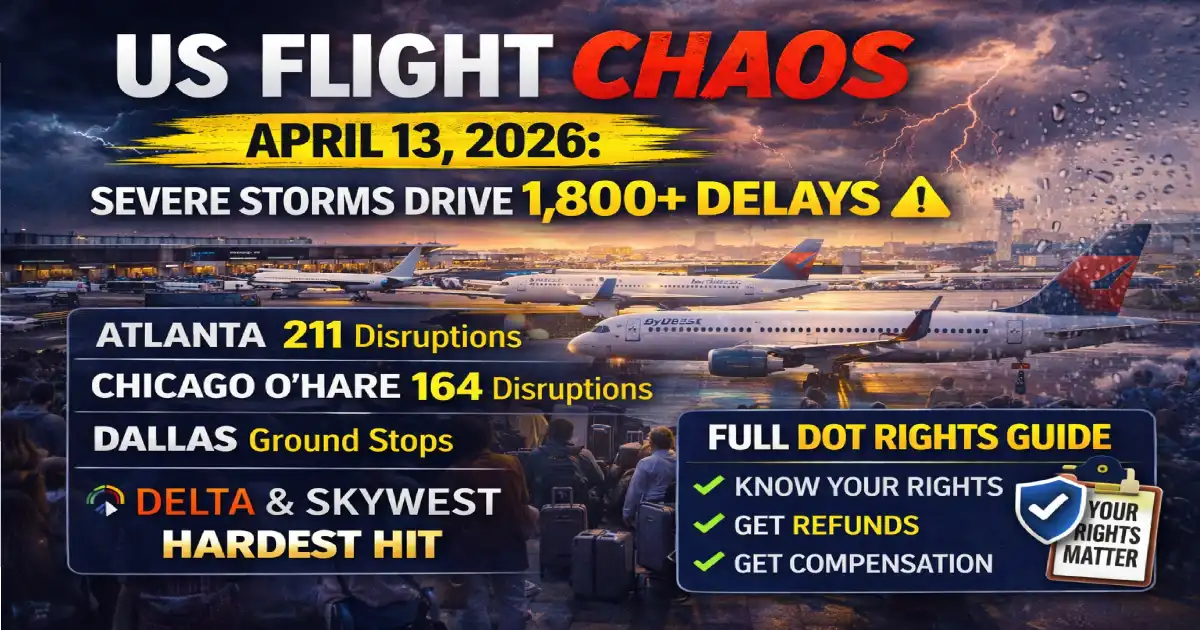
Spring has arrived — and so has America’s most disruptive storm system of April. A major severe weather outbreak is sweeping the Central United States today, battering airports in Dallas, Chicago, St. Louis, and Oklahoma City with heavy thunderstorms, high winds, and the possibility of isolated tornadoes. The result: 79 cancellations and 1,759 delayed flights affecting major airports in Atlanta, Chicago, New York, Los Angeles, and St. Louis — with Delta Air Lines recording the most disruptions of any single US carrier at 26 cancellations and 131 delays. Atlanta Hartsfield-Jackson faced 177 delays and 34 cancellations on April 12, with concurrent challenges at Chicago O’Hare, Los Angeles International, Houston Bush, and New York airspace creating nationwide congestion that limited alternative routing options. Today the storm system pushes further east. Here is the complete picture — every airport, every carrier, and exactly what you are owed.
Published: April 13, 2026 🔴 ACTIVE DISRUPTION National Total: 1,800+ disruptions (79+ cancellations · 1,759+ delays) Weather Cause: Severe thunderstorm system — Central US moving east — ground stops at Dallas, Chicago, St. Louis, Oklahoma City Worst Airport by Cancellations: Atlanta Hartsfield-Jackson (ATL) — 23+ cancellations + 88+ delays Worst Airport by Delays: Chicago O’Hare (ORD) — 7+ cancellations + 157+ delays Worst Carrier by Cancellations: Delta Air Lines — 26 cancellations + 131 delays Other Hardest Hit: SkyWest (8 cancels + 76 delays) · Endeavor Air/DAL (4 cancels + 39 delays) · Alaska Airlines (4 cancels + 35 delays) Major US Hubs Hit: ATL · ORD · JFK · LAX · STL · OKC · DFW · IAH TSA Shutdown: Day 58 — DHS still unfunded, 500+ officers resigned Storm Status: Active — ongoing threat of additional severe weather through tomorrow
A major severe weather event is currently affecting travel across the United States, particularly impacting airports in the Central US. The storm system, expected to continue through next week, has already caused significant delays and cancellations, with more disruptions expected due to ongoing storm conditions — especially for passengers in major cities such as Dallas, Chicago, St. Louis, and Oklahoma City.
This is not a typical spring shower pattern. The storm system triggering today’s US flight chaos has the following characteristics that make it uniquely damaging to aviation:
Severe thunderstorms + ground stops. This disruption is a result of a combination of factors, including severe storms, high winds, and the possibility of isolated tornadoes, all of which have caused significant operational issues at airports. FAA Ground Delay Programs are active at multiple Central and Southern US airports, meaning inbound aircraft are being held at their origin cities before departure — creating a nationwide domino effect even at airports under clear skies.
The cascade mechanism. A single thunderstorm burst grounding flights in Houston or Dallas for even one hour can leave aircraft and crews out of position for the entire day, affecting departures in other states long after the immediate weather threat clears. Today, the storm is affecting multiple hubs simultaneously — the rarest and most damaging scenario for US aviation networks.
Post-Easter positioning still unresolved. The US system has been operating in partial recovery mode since Easter week (April 3–7) — the most disruptive Easter travel period in modern US aviation history. Airlines targeted Monday–Tuesday April 13–14 for near-normal operations, contingent on no further weather events entering key flight corridors. Travel Tourister Today’s storm system is exactly the weather event those recovery plans could not survive.
The numbers in context. Today’s 1,800+ disruptions represent approximately 10–12% of all scheduled US flights — far above the 2–4% typical on normal spring days. More than 2,000 flight cancellations and delays across the United States are disrupting travel, as storms sweeping through key regions collide with already stretched airline operations and crowded spring schedules.
23 cancellations + 88 delays = 111 total disruptions
Hartsfield-Jackson Atlanta International Airport is experiencing the highest number of disruptions today, with 23 cancellations and 88 delays.
Atlanta’s position as the world’s busiest airport and Delta Air Lines’ primary global hub means every disruption here radiates outward with disproportionate force. On days like April 7, when more than 300 flights in and out of Atlanta ran late, the result was a wave of missed connections and rolling disruptions on routes linking the hub with cities such as New York, Chicago, Miami, Orlando, Dallas and Los Angeles. Today follows that same pattern.
Atlanta airport delays didn’t remain confined to the Southeast. High-capacity domestic corridors to New York, Los Angeles, Chicago, and Houston all experienced secondary disruptions as aircraft positioned late into those hubs. International routes suffered acute consequences — transatlantic service from Atlanta to London and Frankfurt faced particular strain.
Most disrupted Atlanta routes today:
Delta’s EU261/UK261 exposure at ATL: Delta operates transatlantic flights from Atlanta to London, Paris, and Amsterdam. If your Delta ATL–LHR, ATL–CDG, or ATL–AMS flight is delayed 3+ hours or cancelled and the cause is within Delta’s control (crew, mechanical — NOT weather), EU261/UK261 entitles you to €300–€600 per person. Weather disruptions reduce this obligation but duty of care (meals, accommodation) remains.
Contact Delta: 1-800-221-1212 | delta.com | Fly Delta app
7 cancellations + 157 delays = 164 total disruptions
Chicago O’Hare International Airport is heavily affected, with 7 cancellations and 157 delays. As one of the busiest airports in the US, this has caused ripple effects, particularly for flights heading to or from major cities.
Chicago O’Hare has become a flashpoint for April 2026 air travel disruption, as repeated weather shocks and operational strains radiate delays and cancellations across the United States and into Europe. A volatile stretch of late March and early April weather in the Midwest set the conditions for O’Hare’s latest meltdown, with severe storms and heavy rain around Chicago triggering multiple ground stops and ground delay programs.
Today’s storm system is again directly affecting the Chicago corridor. O’Hare’s delay count of 157 — the highest of any US airport today — reflects the airport’s position as the convergence point for weather coming in from the Central US storm track (St. Louis, Oklahoma City, Dallas) and the residual pressure from the post-Easter positioning failure that has never fully resolved.
Most disrupted O’Hare routes today:
Contact United (ORD primary hub): 1-800-864-8331 | united.com Contact American (ORD major presence): 1-800-433-7300 | aa.com
Combined 50+ disruptions and building
New York’s three major airports are recording elevated disruption as weather cascading from the Midwest hits the Northeast corridor. New York area airports are facing combined cascading effects as weather systems move northeastward.
Newark note: Newark remains under its FAA-mandated flight cap through October 24, 2026 — 72 operations per hour maximum. With today’s weather pushing more rebooking requests into the New York system, Newark has zero slack to absorb demand. Passengers whose flights are diverted or cancelled in the New York area and who need to rebook today should prioritise checking JFK availability before Newark — JFK has more operational flexibility.
Active ground stop — storm system directly overhead
Dallas is the epicentre of today’s storm track. Dallas is one of the cities experiencing the most severe impact from severe storms, high winds, and the possibility of isolated tornadoes. American Airlines, which operates DFW as its largest global hub, is absorbing the primary Dallas impact. Southwest Airlines, which operates Love Field as its primary hub, is simultaneously affected.
The DFW cascade chain: Every American Airlines flight that cannot depart DFW on time creates a late inbound at its destination, which then cannot turn around on schedule, which delays the return departure. American’s DFW network touches nearly every US city — the 157 O’Hare delays and 88 Atlanta delays you are seeing today are partly expressions of DFW cascade effects arriving at downstream hubs.
Contact American (DFW): aa.com | 1-800-433-7300 — American has issued a travel waiver for DFW-affected passengers scheduled today — check aa.com/travelinfo for fee-free rebooking options.
Storm directly above — ground delay programs active
The storm system is causing travel headaches especially for passengers in major cities such as Dallas, Chicago, St. Louis, and Oklahoma City. St. Louis Lambert and Oklahoma City Wiley Post are both experiencing active FAA Ground Delay Programs today — meaning inbound flights from across the country are being held at their origins before departure, creating the upstream pressure that feeds into the O’Hare and Atlanta delay numbers.
26 cancellations + 131 delays = 157 total disruptions
Delta Air Lines is experiencing the most disruptions, with 26 cancellations and 131 delays. As one of the largest carriers in the US, these disruptions are likely having a far-reaching effect on travel.
Delta’s concentration at Atlanta — the storm’s worst-hit hub — makes it structurally the most exposed carrier on days like today. Delta also operates the most transatlantic services from both Atlanta and JFK, meaning today’s domestic chaos will translate into downstream European disruption by tonight and tomorrow morning.
Delta passengers: ✅ Use the Fly Delta app — Delta leads the industry in proactive disruption notification ✅ For controllable delays of 3+ hours: meal vouchers are available — ask explicitly at the gate or via chat ✅ For transatlantic delays or cancellations to EU/UK destinations: EU261/UK261 rights apply if disruption is within Delta’s control
8 cancellations + 76 delays = 84 disruptions
SkyWest recorded 8 cancellations and 76 delays, contributing to the overall disruption.
SkyWest is the critical piece that most passengers don’t see. As the dominant regional carrier operating on behalf of Delta (Delta Connection), United (United Express), American (American Eagle), and Alaska Airlines at smaller US cities, SkyWest’s disruptions are the mechanism by which today’s storm in Chicago and Atlanta reaches cities like Boise, Spokane, Colorado Springs, and dozens of other markets. When SkyWest cannot fly its Delta Connection segments out of Atlanta, the passengers in those smaller cities cannot reach their connections at ATL for international or transcontinental flights.
SkyWest passengers: If your ticket shows a Delta, United, American, or Alaska flight number but your plane is actually operated by SkyWest, your rights and rebooking options sit with the mainline carrier — not SkyWest directly. Contact Delta, United, American, or Alaska as appropriate.
Endeavor Air is Delta’s wholly-owned regional subsidiary, primarily operating the Atlanta hub feeding routes to smaller southeastern and mid-Atlantic cities. With Atlanta in disruption, Endeavor is absorbing the local Atlanta cascade — flights between ATL and cities like Tallahassee, Greenville, Knoxville, and Augusta are all affected.
Alaska Airlines’ April 13 disruptions are concentrated on its West Coast network, where cascade effects from the nationwide storm system are arriving as late inbounds from the Midwest and Southeast. Alaska is also navigating its merger integration with Hawaiian Airlines, which adds scheduling complexity on Hawaii routes in particular.
United is absorbing today’s O’Hare storm impact across its entire Chicago hub network. United’s Newark operations remain under the FAA cap, further reducing the airline’s ability to reroute Chicago passengers through its East Coast hub.
Many passengers are confused by why their New York flight is delayed when the storm is in Oklahoma City. Here is the mechanism:
Step 1: Thunderstorms develop over Dallas, St. Louis, and Oklahoma City — the FAA issues Ground Delay Programs halting inbound traffic at those airports.
Step 2: An aircraft due to fly Dallas → Chicago is now held in Dallas for 90 minutes while the ground stop is active.
Step 3: That aircraft eventually arrives in Chicago 90 minutes late, with a crew that has now been on duty 90 minutes longer than planned.
Step 4: The same aircraft was scheduled to fly Chicago → New York that afternoon. It now departs 90 minutes late. The New York arrival is 90 minutes late.
Step 5: In New York, that aircraft was scheduled to fly New York → Boston tonight. It now departs 90 minutes late. Boston arrivals are disrupted.
Step 6: At each step, some crew members hit their FAA duty time limits and cannot legally continue. The airline must cancel rather than operate with an illegal crew. A cancellation is created that did not exist at step 1.
This staffing pinch explains why cancellations accompany delays — airlines eventually cancel flights rather than operate them illegally or strand crews in unsuitable conditions.
This chain is why today’s 79 cancellations seem disproportionate to a storm that most passengers in New York or Miami cannot even see from their windows.
Mandatory under DOT rules regardless of cause (including weather):
✅ Full cash refund to your original payment method if you choose not to travel — even on non-refundable fares. This is federal law. Do not accept a voucher if you want cash. ✅ Rebooking on the next available flight at no additional cost. ✅ File at transportation.gov/airconsumer if any airline refuses your cash refund.
✅ Meal voucher — ask explicitly at the gate. Airlines will not proactively offer this. You must ask. ✅ Hotel accommodation if the delay causes an overnight stay within airline control. ✅ Keep all receipts for meals, transport, accommodation during controllable delays.
Today’s primary cause is severe weather — which is outside airline control. This means:
❌ No mandatory cash compensation for weather-caused delays under US law ✅ Rebooking or refund rights still fully apply regardless of cause ✅ Some airlines voluntarily offer meal vouchers even for weather delays — Delta, JetBlue, Southwest, and Alaska all do this; ask at the counter
The airline control test: If your flight is delayed because your specific aircraft is late due to weather, that’s a weather delay (no compensation). If your flight is delayed because the airline doesn’t have a crew (they ran out of available pilots due to the day’s chaos), that IS within airline control — and the meal voucher + compensation obligations apply.
For EU or UK-operated flights departing ORD or ATL today:
✅ Lufthansa passengers from ORD: EU261 protections apply if delay is within Lufthansa’s control ✅ Delta from ATL to LHR/CDG/AMS: UK261 and EU261 protections apply if delay is controllable ✅ Cash compensation: €250–€600 per person depending on flight distance ✅ Duty of care: Meals, hotel, and 2 communications regardless of cause ✅ File EU261 claims at: aviationadr.org.uk (UK) | lufthansa.com | delta.com
Delta’s Customer Commitment voluntarily extends beyond DOT minimums. For delays of 3+ hours within Delta’s control:
✅ Meal vouchers or Delta e-gift cards at airport ✅ Hotel vouchers for overnight controllable delays ✅ Miles compensation in some cases — check the Fly Delta app ✅ Delta’s 24-hour customer support: 1-800-221-1212
Step 1 — Check your flight via app, not departure boards. Open the Fly Delta app, United app, American app, or Southwest app. Departure boards update every 5–10 minutes; apps update every 30–60 seconds. On a day like today, 60-second advantage is real.
Step 2 — If you are connecting through Atlanta or Chicago — call NOW. Do not wait until you are at the airport. Connection passengers at ATL and ORD are already facing missed windows. If your booked connection is under 90 minutes, call your airline now to explore rebooking options before you reach the airport. Rebooking priority is given to passengers who call before the cancellation is formally announced.
Step 3 — Weather waiver — check your airline’s website. American Airlines has issued a waiver for DFW; Delta for ATL; United for ORD. These waivers allow fee-free rebooking within defined date windows. Check aa.com/travelinfo, delta.com/travel-alerts, or united.com/travel-alerts before doing anything else.
Step 4 — Dallas Love Field (Southwest) passengers. Southwest’s point-to-point network from Dallas Love Field is directly in the storm. Southwest has zero interline agreements — a cancelled Southwest flight cannot be rerouted onto American, Delta, or United. Your options are rebooking within Southwest’s network or a full cash refund. Call 1-800-435-9792.
Step 5 — Keep every receipt. Even for weather-caused disruptions where mandatory compensation does not apply, many airlines will process goodwill claims. The DOT Fly Rights rules also evolve — documenting your experience protects you for future regulatory changes. Save screenshots of your delay notification, any communications, and all expenditure receipts.
Today’s disruption is not a one-off event. It is the latest pulse in a sustained pattern. Flight disruption data from early April 2026 shows a sharp rise in delays and cancellations across at least seven countries, as weather systems, airspace constraints and staffing strains converge at the start of the busy spring travel period.
In the United States specifically, three structural weaknesses are being exposed repeatedly this spring:
1. No slack in the network. Airlines cannot absorb weather delays without cascading cancellations. Staffing constraints amplify the problem. Pilot and flight attendant fatigue regulations, combined with crew scheduling complexities, mean that irregular operations quickly exhaust available crew reserves.
2. TSA capacity still below pre-shutdown levels. The DHS shutdown that began February 14 has left 500+ TSA officers resigned and checkpoints running below pre-crisis staffing. Day 58 today. When weather causes increased passenger volume at rebooking desks and alternative departure gates, security queues spike because the staffing buffer that used to handle surge volume is gone.
3. Spring storm season is only beginning. With more spring storms expected as April progresses, travel specialists suggest that this latest wave of chaos may not be the last of the season. The peak severe weather period for the Central US runs April through June. The conditions that caused today’s ground stops will repeat — possibly multiple times before summer.
Monday April 13, 2026: a major Central US storm system is driving 1,800+ flight disruptions nationwide — 79 cancellations and 1,759+ delays. Atlanta Hartsfield-Jackson is the worst airport by cancellations (23 cancels + 88 delays). Chicago O’Hare is worst by delays (157 delays + 7 cancels). Delta Air Lines is hardest hit with 26 cancellations and 131 delays. Ground stops are active at Dallas, Chicago, St. Louis, and Oklahoma City. Weather-caused disruptions mean no mandatory cash compensation — but all passengers retain the right to a full cash refund or free rebooking regardless of cause. Delta, American, and United have travel waivers active for affected airports — check airline websites now before going to the airport.
The storm is moving east. Check your flight. Call your airline. Don’t wait for the gate announcement.
Airline contacts & travel waivers:
Related Articles:
Posted By : Vinay
This article is provided for general informational purposes only and is based on information available at the time of publication. Travel advisories, airline schedules, airport operations, visa requirements, government regulations, and other travel-related information are subject to change without prior notice. While Travel Tourister makes reasonable efforts to verify information using official announcements, government publications, airline and airport communications, and other reliable sources, we cannot guarantee that all information remains complete, accurate, or up to date at all times. Readers should independently verify any information that may affect their travel plans with the relevant airline, airport authority, government agency, embassy, or other official source before making travel, financial, or other decisions. Travel Tourister shall not be liable for any direct or indirect loss, inconvenience, or damages arising from the use of or reliance on the information contained in this article. Nothing in this publication constitutes legal, immigration, financial, or professional travel advice. If you believe any information in this article is inaccurate or outdated, please contact our editorial team. We review all credible correction requests promptly and update our content whenever appropriate.
Lastest News
2nd Floor, 39, Above Kirti Club, DLF Industrial Area, Kirti Nagar, New Delhi, Delhi 110015



Travel Tourister is a leading Travel portal where we introduce travellers to trusted travel agents to make their journey hasselfree, memorable And happy. Travel Tourister is a platform where travellers get Tour packages ,Hotel packages deals through trusted travel companies And hoteliers who are working with us across the world. We always try to find new and more travel agents and hoteliers from every nook and corners across the world so that you could compare the deals with different travel agents and hoteliers and book your tour or hotel with the one you have chosen according to your taste and budget.
Copyright © Travel Tourister, India. All Rights Reserved

 Call
Call Enquiry