Published on : 25 Apr 2026
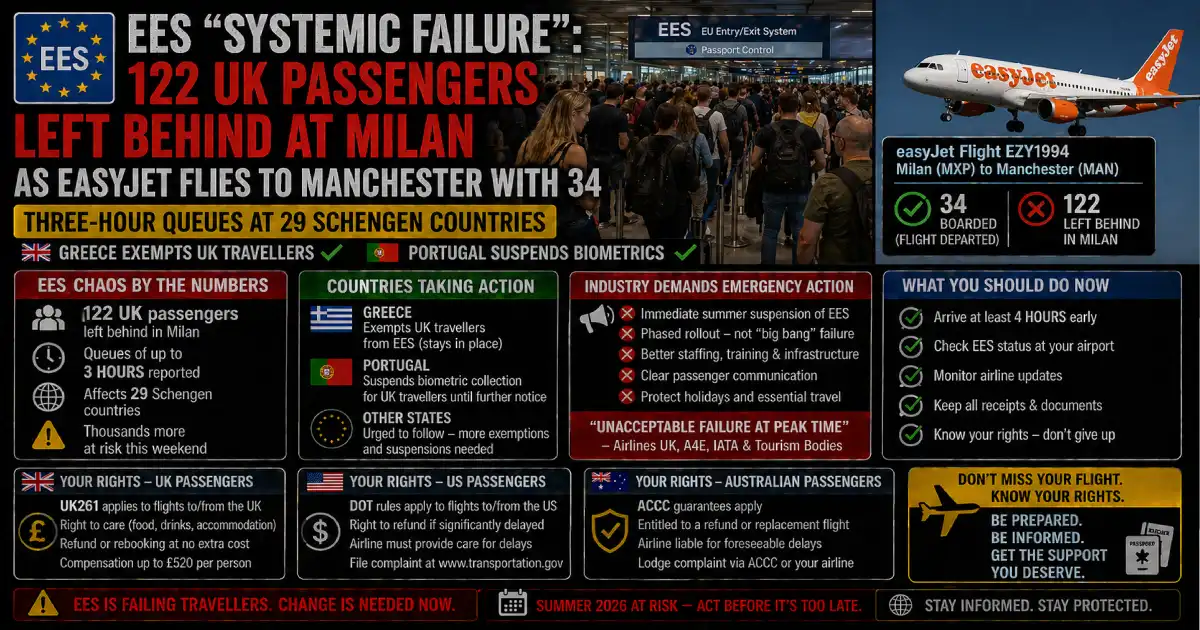
The most important travel story of 2026 for anyone planning a European holiday this summer: On Sunday April 13, 2026, at Milan Linate Airport, easyJet flight EJU5420 to Manchester departed with only 34 of its 156 booked passengers on board. The remaining 122 travellers — including families with children — were left behind due to severe delays at passport control triggered by the full implementation of the European Union’s new Entry/Exit System (EES). easyJet kept the aircraft at the stand for nearly an extra hour, hoping more travellers would clear passport control. Crew duty limits then approached, and the airline departed to avoid disrupting later flights across its network. The airlines group A4E went further in a separate statement, calling the situation a “systemic failure” rather than a teething problem. “The EES rollout this weekend told a different story: disruption and excessive waiting time — all outside airlines’ control, leading to delays and missed flights.” The Milan incident is the most extreme documented case of EES chaos — but it is not isolated. Similar scenes have been reported at Rome Fiumicino, Venice Marco Polo, Paris CDG, Palma, Barcelona, and dozens of other airports across all 29 Schengen countries. With peak summer travel approaching and the queues showing no sign of resolution, every UK, US, Canadian, and Australian passenger planning European travel in 2026 must understand what has changed — and how to protect themselves.
Published: April 25, 2026 Incident: easyJet flight EJU5420, Milan Linate (LIN) → Manchester (MAN), Sunday April 13, 2026 Booked passengers: 156 · Boarded: 34 · Left behind: 122 (78% of the flight) EES Live Date: April 10, 2026 — full mandatory implementation across all 29 Schengen countries Queue times reported: 2–4 hours at peak · 7 hours at Lisbon (December 2025 worst case) Countries affected: All 29 Schengen states + Iceland, Norway, Switzerland, Liechtenstein Countries outside EES: Ireland · Cyprus · UK (inbound to UK not yet implemented) Greece: 🟢 EXEMPTED British passport holders from biometric registration — April 18, 2026 Portugal: 🟡 Partially suspended biometrics at Lisbon, Porto, Faro departures — April 13, 2026 Who must comply: All non-EU/non-Schengen passport holders — including UK, US, Canadian, Australian, New Zealand, Indian, and all other non-EU nationals easyJet response: Described border delays as “unacceptable” — offered free rebooking or £19.91 refund (tax only) Industry verdict: ACI Europe + Airlines for Europe (A4E) — joint statement calling it “systemic failure” Demand: Allow full EES suspension through end of summer 2026 at congested airports New recommended arrival time: 3–4 hours before departure at major Schengen hubs Cash compensation from airline: ❌ NOT available — EES is a government function, not airline-controlled
The EU Entry/Exit System is the European Union’s new digital border control programme, replacing the traditional ink stamp in non-EU passports with a comprehensive biometric database. The Entry/Exit System replaces manual passport stamping with digital records of every entry, exit, and refusal at Schengen borders. It applies to all non-EU travelers, including British citizens, entering any of the 29 participating countries for short stays of up to 90 days within a 180-day period. When crossing the border, travelers must submit biometric data, including facial scans and fingerprints, alongside their passport details. The data is stored for three years and checked again on departure.
The system went fully live at 00:01 CET on April 10, 2026 — after a phased rollout that began October 12, 2025. Problems had already surfaced during that staged launch. Portugal suspended the system fully in Lisbon in December 2025 after queues reached seven hours, Gran Canaria experienced system crashes, and some locations reported processing time increases of 70%.
Despite this evidence of unreadiness, the European Commission proceeded with full mandatory implementation. Before the full launch, border authorities had the option to suspend EES entirely when queues became unmanageable. That option was removed on April 10. Now only a partial suspension — which allows officials to skip biometric collection but not the full digital check — is permitted.
The result was immediate and catastrophic. Within hours of going live on April 10, airports across the Schengen area were in crisis. Passengers faced waits of up to three hours at border control, missed flights, and spent thousands finding their own way home. The chaos was immediate, widespread, and, according to the aviation industry, entirely predictable.
The Hume family from Leeds — Max Hume, 56, a teacher, his wife Lynsey, 46, and their 13-year-old son Archie — arrived at the terminal nearly three hours before the scheduled departure, heeding easyJet’s advice to allow extra time for the new border checks. Just days earlier, on their arrival in Italy, they had already endured queues of over an hour.
Three hours early. Following airline guidance. Still stranded.
Passport control only opened at 9:15am, and no gate was initially assigned for the Manchester flight. While passengers heading to London on other flights were allowed through more quickly, those bound for Manchester were held back.
When processing finally began, officials demanded full biometric scans — fingerprints and facial images — from everyone, even though many had already provided these on entry to the Schengen area. The EES, which became fully operational on Friday April 10, is designed so that once biometrics are collected on entry, only one additional check should be needed on exit. In practice at Linate, the system was enforced inconsistently and with inadequate resources: just two officers and a single biometric machine were in operation, despite 16 machines being available at the airport.
“There were two officers and one biometric machine,” Hume told The Independent. “Every single person. But there were about 16 machines that could have been used automatically, and they didn’t open them.”
easyJet flight EJU5420 left Milan Linate for Manchester with only 34 of its 156 booked passengers. The airline held the flight for nearly an hour before departing, but crew limits forced it to leave without most of the passengers who had been stuck in passport control lines.
One family spent more than £1,600 to take a connecting flight via Luxembourg, which would get them home 24 hours late.
At the easyJet desk, the family was told they had been recorded as “no-shows.” The airline’s live chat informed Hume that airport processes were “not our responsibility.”
EasyJet offered a refund of £19.91 — the tax portion of their tickets — and a rebooking option costing £330 per person for a flight five days later. The family ended up booking flights to Luxembourg, an overnight hotel stay, then a connecting flight to Manchester the next morning. Total cost: over £1,600. “Gutted, upset, let down, absolutely shattered and poorer, much poorer,” Hume told The Independent as he boarded his flight to Luxembourg.
Others faced overnight stays in airports or emergency travel to different cities in search of available flights. Some families had bills of up to £2,000 for alternative travel. Air conditioning failing to cool mounting crowds meant several travellers reportedly suffered from heat exhaustion.
Adam Hoijard from Wirral also arrived three hours early with his family. He spent £1,000 on replacement flights to London Gatwick and described it as “atrocious.” His five-year-old son was later found “lying in bed crying” following the ordeal.
This was not a single family’s bad day. Accounts from stranded travelers describe families forced to purchase expensive replacement flights, some paying over £1,000 per ticket to reach their final destinations via alternative European hubs. Others were rerouted to London instead of Manchester, while some faced multi-day waits for the next direct service. Medical incidents were also reported, with witnesses describing passengers becoming unwell during extended waits in densely packed queues.
The Milan incident was the most extreme — but it was not the only one. On the first day of full EES operations alone, one UK-bound flight left with 51 passengers missing, while another reached gate closing with zero passengers present and 12 still on their way 90 minutes later.
| Location | Date | Incident | Passengers Affected |
|---|---|---|---|
| Milan Linate (LIN) | April 13 | easyJet EJU5420 departs with 34 of 156 | 122 stranded |
| Milan (multiple) | April 10–13 | Ryanair flights depart with empty rows | Multiple incidents |
| Paris CDG/Orly | April 10 | Parafe e-gates incompatible with UK/US passports until late March | Widespread |
| Palma (PMI) | April 10+ | 3–4 hour queues reported by Which? travel editor | Widespread |
| Rome Fiumicino | April 10+ | Multiple incidents, similar to Milan | Ongoing |
| Venice Marco Polo | April 10+ | Confirmed disruptions | Ongoing |
| Barcelona (BCN) | April 10+ | Processing times up 70% at peak | Ongoing |
| Lisbon (LIS) | Dec 2025 | 7-hour queues — system suspended for 3 months | Hundreds stranded |
| Gran Canaria (LPA) | 2025–2026 | System crashes during phased rollout | Multiple incidents |
| Brussels (BRU) | April 21+ | Delta advisory: arrive 3.5 hours early | Ongoing |
Similar scenes have been reported at Rome Fiumicino and Venice Marco Polo, but Linate’s lack of airside transfer capacity amplified the chaos.
This is the single most actionable piece of information for UK passengers planning European holidays:
On April 18, 2026, Greece confirmed that British passport holders are exempt from biometric registration at all Greek airports and seaports, with immediate effect from April 10. UK nationals will receive a traditional passport stamp rather than undergoing fingerprint or facial scan enrolment. Greece is currently the only Schengen country offering this — but the exemption is described as being in place “until further notice.”
What this means practically: If you fly to Athens, Thessaloniki, Heraklion, Corfu, Kos, Rhodes, Santorini, Mykonos, or any other Greek airport — you will not face EES biometric queues at arrival OR departure. Your passport will be stamped as normal. No fingerprints, no facial scan, no 3-hour queue.
The caveat: The exemption is “until further notice” — meaning Greece can reinstate EES biometric requirements at any time. Check the latest status at gov.uk/foreign-travel-advice/greece before you travel.
If you are considering Spain vs Greece for your summer holiday — given current EES conditions, Greek airports are operationally smoother than Spanish ones. This is a material booking consideration for 2026.
To address challenges posed by the new European border control system, Portugal’s PSP has suspended biometric data collection at departures in Lisbon, Porto, and Faro airports. The measure is intended to prevent passengers from missing flights. Departures now follow the traditional security model without photo and fingerprint collection. Biometrics remain mandatory at arrivals.
What this means: Flying home from Lisbon, Porto, or Faro? Your departure queue should be significantly shorter than at unreformed Schengen airports. Arrivals into Portugal still require full EES biometric registration.
The PSP spokesperson stated that the suspension is targeted and that the goal is to protect passengers’ right to board on time in a system that is still struggling to reach full operational maturity.
The aviation industry’s response to EES chaos has been unusually direct and unified. Two major industry bodies — representing virtually every airline and airport in Europe — have jointly called it a failure.
ACI EUROPE and Airlines for Europe issued a joint statement calling on the European Commission and EU member states to immediately introduce greater flexibility in how EES operates. The airlines group A4E went further, calling the situation a “systemic failure” rather than a teething problem. “The EES rollout this weekend told a different story: disruption and excessive waiting time — all outside airlines’ control, leading to delays and missed flights.” A4E’s proposed fix: allow full and partial suspension of EES through the end of summer wherever wait times become excessive.
An easyJet spokesperson told the BBC that the border delays caused by the implementation of EES were “unacceptable.” “We continue to urge border authorities to ensure they make full and effective use of the permitted flexibilities for as long as needed while the European Entry/Exit System is implemented, to avoid these unacceptable border delays for our customers.”
The European Commission’s response has been notably weaker. The Commission said that it is closely monitoring operations and working with member states to share best practices. Officials said that countries have the option to partially or fully suspend the system in exceptional circumstances to manage congestion. It has not ordered a suspension, not reduced the scope of the system, and not extended the full-suspension window that expired on April 10.
Member states can partially suspend EES operations where necessary during a period of an additional 90 days with a possible 60-day extension to cover the summer peak. In plain English: airports can skip the biometric fingerprint and facial scan portion of the check in extreme circumstances — but they cannot suspend EES entirely the way they could before April 10.
The practical result: the system is slower than before, harder to bypass, and cannot be fully turned off even when queues reach three hours. Summer is coming.
EES applies to every non-EU, non-EEA passport holder entering or leaving the Schengen area. This includes:
| Nationality | Must use EES? | Notes |
|---|---|---|
| 🇬🇧 UK (British) | ✅ Yes | Except in Greece (exempted April 18) |
| 🇺🇸 USA | ✅ Yes | All US passport holders |
| 🇨🇦 Canada | ✅ Yes | All Canadian passport holders |
| 🇦🇺 Australia | ✅ Yes | All Australian passport holders |
| 🇳🇿 New Zealand | ✅ Yes | All NZ passport holders |
| 🇮🇳 India | ✅ Yes | All Indian passport holders |
| EU nationals | ❌ No | EU/EEA/Swiss passports exempt |
| 🇮🇪 Ireland | ❌ No | Ireland outside Schengen — not affected |
| 🇨🇾 Cyprus | ❌ No | Cyprus outside Schengen — not affected |
The ETIAS connection: ETIAS — the EU’s equivalent of the US ESTA, requiring pre-travel authorisation — is expected to launch in late 2026, six months after EES went fully live. If you are planning European travel in late 2026 or 2027, you will need BOTH an EES biometric registration AND an ETIAS pre-travel authorisation.
This is the most important section for every passenger reading this article — because the answer is not what most people expect.
Travel insurance with disruption coverage is recommended for all UK-Schengen travel during this adjustment period.
Under EU261/UK261, cash compensation applies when flight cancellations or delays are caused by circumstances within the airline’s control. EES is a government border control function — it is definitively not within the airline’s control. An easyJet spokesperson said that “due to delays in EES processing by border authorities, some passengers departing from Milan Linate yesterday experienced very long waiting times.” The spokesperson tied the long waits directly to EES processing by border authorities and said the problem lay beyond easyJet’s control.
This means: if you miss your flight because of EES queues, the airline does not have to pay you €250–€600 per person in cash compensation. They are not legally required to.
easyJet’s response to the Milan incident was to offer free rebooking — but on a flight five days later. Most passengers found this unacceptable and booked alternatives independently at their own cost. While easyJet offered free rebooking options, compensation was not guaranteed, as the airline maintained that the delays were “outside of our control.”
If your airline offers rebooking, ask specifically:
Travel insurance “missed departure” cover is your primary remedy for EES-related missed flights. However:
Some travel insurance policies do have cover for “travel delay” or “missed departures,” but even then you would need to clarify whether it covers you for a missed departure because of border queues.
Key questions to ask your insurer before travelling:
The Milan passengers who spent £1,000–£2,000 on replacement flights should immediately file insurance claims with as much documentation as possible — including: arrival time at the airport, time they reached the front of the EES queue, the airline’s written rebooking offer (which establishes they were not “no-shows”), and any receipts for alternative flights, hotels, and ground transport.
If your insurer rejects the claim citing that you should have arrived earlier, escalate to the Financial Ombudsman Service (FOS) in the UK — there is a reasonable argument that arriving 3 hours early constitutes adequate preparation when airlines themselves had advised 2–3 hours.
The European Commission, the Foreign Office, Linate airport, and the Milan Border Police had not responded to requests for comment at the time of reporting. Passengers seeking reimbursement from Italian border police or the EU directly face a long, complex legal process with uncertain outcomes. Focus your energy on insurance and airline rebooking first.
The old standard for international departures at European airports was 2 hours before flight time. That standard is now dangerously inadequate for non-EU passengers at most Schengen airports. Here is the updated framework:
| Airport / Country | Recommended Arrival Before Departure | Notes |
|---|---|---|
| Greece (all airports) | 2 hours | UK passengers: biometrics suspended — normal passport stamping |
| Portugal (LIS, OPO, FAO departures) | 2 hours | Biometrics suspended at departures — arrivals still full EES |
| Netherlands (AMS) | 3.5–4 hours | High volume, consistent queues |
| France (CDG, ORY, NCE, LYS) | 3.5–4 hours | Parafe e-gates incompatible with UK/US until late March — now fixed but still slow |
| Italy (LIN, FCO, VCE, MXP, NAP) | 4 hours | Milan Linate incident — 16 machines, 1 operational |
| Spain (MAD, BCN, AGP, PMI, ACE, FUE) | 3.5–4 hours | Processing times up 70% at peak |
| Belgium (BRU) | 3.5 hours | Delta advisory: arrive 3.5 hours before departure |
| Germany (FRA, MUC, BER) | 3–3.5 hours | Better staffed but high volume hubs |
| Switzerland (ZRH, GVA) | 3 hours | Schengen-associated, EES applies |
| All other Schengen airports | 3 hours | Minimum — build in more at peak periods |
The strategic tip that saved passengers at Milan: Go straight to security and passport control after check-in, and shop or eat only after you clear both. Avoid tight connections that depend on quick border checks. Do not browse duty-free, do not stop for coffee, do not check your gate board until you are through passport control. Every minute in the departures hall before EES is a minute of risk.
Pre-registration via the EU Travel app: The EU has launched a “Travel to Europe” mobile app. In some countries, you can pre-load your passport data and even a facial scan up to 72 hours before arrival to shave minutes off your kiosk time. Download it now if you are travelling to Europe in 2026.
Industry bodies ACI Europe and Airlines for Europe have jointly warned the European Commission that passengers could face significant waits at peak summer border points. During the winter rollout phase, processing times already increased by up to 70% at some airports, with waits of up to three hours at peak periods — and that was before full mandatory enforcement kicked in.
The scale of the summer challenge: European airports handle 300–400 million passengers per summer quarter. A significant percentage are non-EU nationals subject to EES. If each of those passengers adds even 5 extra minutes to departure processing, the aggregate delay across the network is measured in millions of hours.
According to the Commission spokesperson, member states can partially suspend EES checks for up to 90 days after the rollout is complete, with a possible 60-day extension. This is foreseen in the legislation and will give member states the necessary tools to manage potential extended queues.
The industry wants the full suspension option restored. The Commission has not moved on this. Until one of them blinks — or a political incident forces the issue — passengers are operating in a system that is acknowledged by airlines, airports, and consumer groups as fundamentally unprepared for summer volumes.
| Resource | Link / Contact |
|---|---|
| EU Travel to Europe app (pre-register biometrics) | Available on App Store and Google Play |
| Greece EES exemption confirmation | gov.uk/foreign-travel-advice/greece |
| Portugal EES partial suspension | theportugalnews.com (confirmed April 13, 2026) |
| easyJet rebooking / disruption claim | easyjet.com → Manage Booking |
| Ryanair disruption / rebooking | ryanair.com → My Trips |
| British Airways EES guidance | ba.com → Travel Information |
| UK CAA passenger rights | caa.co.uk/passengers |
| Financial Ombudsman Service (insurance disputes) | financial-ombudsman.org.uk |
| ETIAS information (launching late 2026) | etias.com |
| ACI EUROPE EES update | aci.aero |
| Airlines for Europe (A4E) statement | a4e.eu |
| ABTA (travel agent guidance) | abta.com/know-your-rights |
| FlightAware (live flight status) | flightaware.com |
| Travel insurance — missed departure | Check policy wording before travel |
easyJet flight EJU5420 departed Milan Linate for Manchester with 34 of 156 booked passengers on April 13. The remaining 122 travellers — including families with children — were left behind due to severe delays at passport control triggered by the EU’s new Entry/Exit System. The aviation industry called it a “systemic failure.” ACI EUROPE and Airlines for Europe have demanded emergency suspension powers through summer 2026. Greece has exempted British passport holders entirely. Portugal has suspended biometrics at departures from Lisbon, Porto, and Faro. The rest of Europe’s 29 Schengen countries are operating EES with queues of 2–4 hours at peak — and summer has not started yet.
Your eight-point EES protection plan before every European trip:
Related Articles:
Sources: BBN Times (easyJet EJU5420 full incident report — Hume family account, 122 stranded, April 13, 2026), Euronews (A4E “systemic failure” statement, easyJet BBC statement, Simon Calder eyewitness account, April 14, 2026), ETIAS.com (full EES incident timeline — £1,600 Luxembourg family, £19.91 refund offer, April 13–21, 2026), IBT UK (122 passengers stranded, £2,000 bills, heat exhaustion reports, April 2026), ACI EUROPE and A4E (joint statement — February 11, 2026 pre-launch warning; April 10, 2026 emergency suspension demand), ABTA (commission contact for summer suspension measures), easyJet (official statement to BBC — delays “unacceptable,” border authority responsibility)
Posted By : Vinay
This article is provided for general informational purposes only and is based on information available at the time of publication. Travel advisories, airline schedules, airport operations, visa requirements, government regulations, and other travel-related information are subject to change without prior notice. While Travel Tourister makes reasonable efforts to verify information using official announcements, government publications, airline and airport communications, and other reliable sources, we cannot guarantee that all information remains complete, accurate, or up to date at all times. Readers should independently verify any information that may affect their travel plans with the relevant airline, airport authority, government agency, embassy, or other official source before making travel, financial, or other decisions. Travel Tourister shall not be liable for any direct or indirect loss, inconvenience, or damages arising from the use of or reliance on the information contained in this article. Nothing in this publication constitutes legal, immigration, financial, or professional travel advice. If you believe any information in this article is inaccurate or outdated, please contact our editorial team. We review all credible correction requests promptly and update our content whenever appropriate.
Lastest News
2nd Floor, 39, Above Kirti Club, DLF Industrial Area, Kirti Nagar, New Delhi, Delhi 110015



Travel Tourister is a leading Travel portal where we introduce travellers to trusted travel agents to make their journey hasselfree, memorable And happy. Travel Tourister is a platform where travellers get Tour packages ,Hotel packages deals through trusted travel companies And hoteliers who are working with us across the world. We always try to find new and more travel agents and hoteliers from every nook and corners across the world so that you could compare the deals with different travel agents and hoteliers and book your tour or hotel with the one you have chosen according to your taste and budget.
Copyright © Travel Tourister, India. All Rights Reserved

 Call
Call Enquiry