Published on : 28 Apr 2026
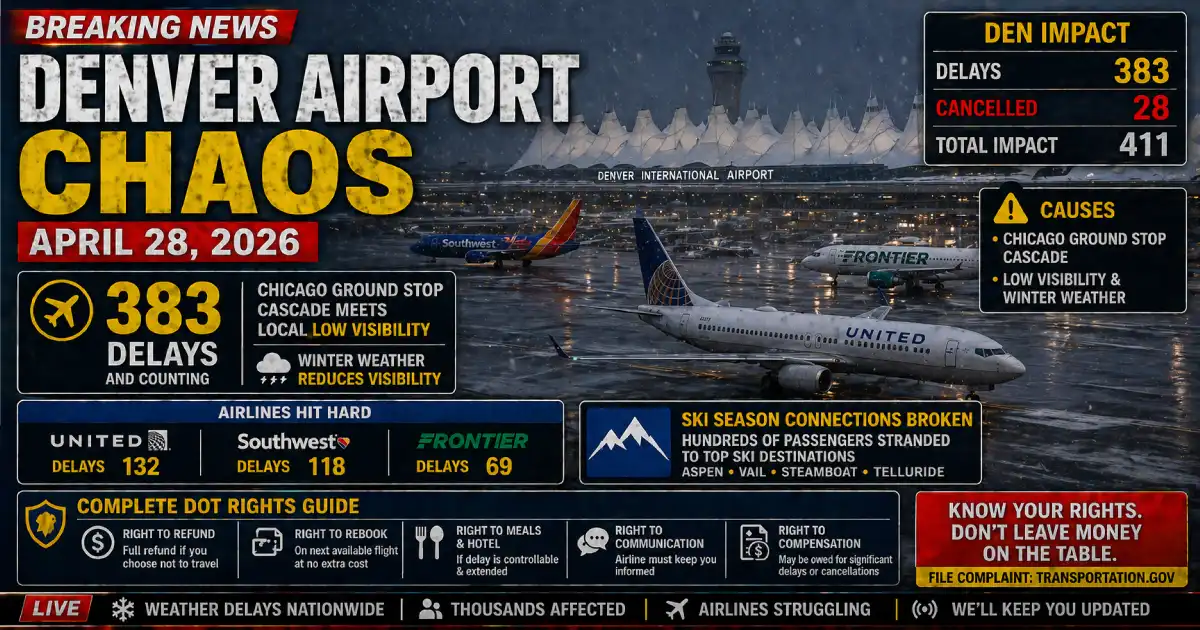
Breaking — April 28, 2026: Denver International Airport is recording 383 delays today — making it the worst-affected secondary hub in the United States on what is shaping up as one of the most disruptive aviation days of 2026. The FAA warned this morning of low visibility forecast in Denver, and that warning has fully materialised into compounding operational chaos at America’s fourth-busiest airport. Denver is not the source of today’s national crisis — Chicago O’Hare’s full ground stop under a severe Level 3 weather system is the trigger — but Denver is absorbing the cascade harder than any other secondary hub in America, because it sits at the precise intersection of two separate disruption forces hitting simultaneously: the national Chicago network cascade and its own independent local low-visibility FAA advisory. United Airlines, Southwest Airlines, and Frontier Airlines are all absorbing severe disruption at their shared Denver hub. Flights to New York, Los Angeles, Chicago, Seattle, and international connections via Newark and Dulles are all broken. For passengers connecting through Denver from Colorado’s ski resorts today: your connection risk is near-certain.
Published: April 28, 2026 — Tuesday (Day 28 of post-Easter US crisis) Airport: Denver International Airport (DEN) — Denver, Colorado Today’s Denver Total: 383 delays TravelTourister O’Hare article) National Context: 5,581 delays + 353 cancellations = 5,934 total US disruptions — one of the most disruptive single aviation days of 2026 Denver’s National Ranking: #1 worst secondary hub nationally · #5 overall behind ORD (1,488), MDW (192), ATL (292) Primary Carriers Affected: United Airlines · Southwest Airlines · Frontier Airlines Root Cause 1: FAA low visibility warning — materialised fully — Ground Delay Programme active Root Cause 2: Chicago O’Hare full ground stop cascade — aircraft and crew stranded in Chicago FAA Morning Warning (confirmed): Thunderstorms at ORD/MDW · Low visibility at DEN · Wind at LAS · Low clouds at SEA — every single FAA warning today has materialised Routes Broken: New York (JFK/EWR) · Los Angeles (LAX) · Chicago (ORD) · Seattle (SEA) · London (via EWR/IAD) · Mountain West feeders Ski Season Connection Risk: Eagle County (EGE) · Aspen (ASE) · Telluride (TEX) feeders all high-risk today Denver as Frontier’s only hub: Every single Frontier flight in America is affected Denver Ground Stop: FAA ground stop issued for low visibility this morning — later lifted — but Ground Delay Programme remains active, residual cascade ongoing Other Major Disrupted Airports Today: Atlanta (292) · Phoenix (283) · Washington D.C. (224) · Boston (170) · Seattle · Detroit · San Diego Worst Carrier Nationally: Southwest Airlines — 1,334 delays + 18 cancellations Worst Cancellations Nationally: SkyWest Airlines — 111 cancellations Day in crisis: Day 28 — new record for sustained US aviation disruption post-Easter DOT rights: Full cash refund mandatory for all cancellations — 7 business days to credit card
Denver International Airport has a specific vulnerability that makes it the most dangerous secondary hub to connect through on any day when both Chicago and Colorado weather deteriorate simultaneously. Today, both deteriorated at exactly the same time. Understanding the mechanics of this double hit is the most important thing any DEN passenger can do — because it determines which delays will qualify for DOT compensation and which will not.
Chicago O’Hare alone logged 1,228 delays and 260 cancellations as severe weather triggered a full ground stop. The mechanics of how that becomes a Denver problem are precise:
United Airlines operates Denver as its third-largest hub after Chicago O’Hare and Newark. On any normal morning, dozens of United aircraft depart ORD on their first sector of the day and fly to Denver, where they become the inbound aircraft for westbound departures to Los Angeles, Seattle, San Francisco, and Las Vegas. This morning, those ORD aircraft did not leave Chicago. The full O’Hare ground stop — triggered by the Level 3 severe weather system packing damaging winds, hail, and flooding — held them on the ground at Terminal 1.
The mechanics of a hub cascade work like this: United operates 585 delays today — many on aircraft that should have arrived from ORD this morning and never did. Those aircraft are not in Houston, not in Denver, not in Washington Dulles — they are still in Chicago. The Denver-bound flight that should have departed at 08:30 cannot depart because the aircraft that was supposed to fly it from ORD is on the ground at Terminal 1. That delay is now a Denver delay. And a Phoenix delay. And a Boston delay. All from a single ORD aircraft that hasn’t moved.
The compensation consequence: Delays caused by aircraft not arriving from Chicago because of ORD’s weather are operational cascade delays — meaning the cause at Denver is not local weather at DEN but operational disruption at ORD. This distinction matters enormously for DOT compensation claims, as explored in the rights section below.
Independently of Chicago, the FAA issued a low visibility advisory specifically for Denver this morning — and it materialised. A ground stop was put in place because of low visibility but was later lifted. The exact cause of the low visibility was not disclosed, but a forecast from the National Weather Service for Denver said the city would be hit by patchy fog in the early morning. Later on Monday, there is a chance of showers and thunderstorms.
Denver International sits at 5,430 feet above sea level on the Colorado High Plains — a location that makes it uniquely vulnerable to rapid, unpredictable weather changes. The airport’s configuration — featuring multiple parallel runways and a sprawling taxiway system — means that sudden wind direction changes force rapid adjustments to landing and departure sequences. These operational pivots consume valuable time and create cascading delays throughout the departure bank.
Low visibility conditions demand maximum safety margins. When researchers report visibility under a quarter mile and ceiling below 50 feet, operations shift from normal departure flows to highly constrained Ground Delay Programmes and airborne holds. At DEN, these protocols activated this morning automatically. Even after the ground stop lifted mid-morning, the Ground Delay Programme remained active — meaning inbound aircraft were still being metered into Denver at a slower rate than normal, feeding the departure queue buildup.
The combined result: Two separate disruption mechanisms, each capable of producing 150–200 delays on its own, hit Denver at exactly the same time. The result is 383 delays — not a simple addition of the two problems, but an amplification, because aircraft that arrived late from Chicago due to cascade then faced a Denver airport that was itself operating under reduced capacity.
United is Denver’s dominant carrier — operating its third-largest hub at DEN with connections to virtually every major US city and to international destinations via Newark (EWR) and Washington Dulles (IAD). United Airlines recorded 585 delays and 12 cancellations nationally today. The Denver portion of that is the largest single-airport contribution.
United’s DEN routes most broken today:
✈️ Denver → New York (JFK/EWR): United’s transcontinental link. Multiple daily services. All running delayed as the Chicago cascade prevents eastbound aircraft from reaching Denver on time.
✈️ Denver → Los Angeles (LAX): United’s busiest westbound DEN corridor. Morning departures delayed — afternoon cascade likely to build.
✈️ Denver → Chicago O’Hare (ORD): The most ironic pairing today — flights from Denver to Chicago are delayed not just because of ORD’s chaos but because the aircraft that would fly that sector is not in Denver. It is still in Chicago.
✈️ Denver → Seattle (SEA): United’s Pacific Northwest connection. Running delayed.
✈️ Denver → Washington Dulles (IAD): Key government travel and international connection hub. United’s Dulles operation is the gateway for transatlantic departures to London Heathrow, Frankfurt, and Paris CDG. A delayed DEN→IAD arrival pushes back the international departure banks.
✈️ Denver → London (via EWR): Passengers on itineraries that route Denver → Newark → London Heathrow face the highest international cascade risk today. United’s ORD disruption is cascading into Newark and Dulles transatlantic departures. If your Newark–Heathrow departure this evening is on an aircraft that should have arrived from Chicago this morning and didn’t — you face a direct transoceanic cascade.
🇬🇧 UK passengers on United transatlantic connections via Denver: Check FlightAware for your inbound aircraft’s current position right now. If your ORD or DEN feeder flight is showing a delay of 90+ minutes, your transatlantic departure tonight is at elevated risk. Contact United’s UK line (0800 888 555) proactively now.
🇦🇺 Australian passengers: United DEN→SFO→SYD connections via San Francisco are at elevated risk today. SFO’s ongoing structural capacity problems (FAA runway ban + Runway 1R construction through October) compound whatever arrives from Denver. If you have a DEN→SFO connection today with less than 90 minutes at San Francisco, assume missed connection risk and call United now.
United travel waiver (CONFIRMED ACTIVE): United issued a waiver: “If your flight is affected, you can reschedule your trip and we’ll waive change fees and fare differences. Your new flight must be a United flight departing between April 25, 2026 and April 29, 2026. Tickets must be in the same cabin and between the same cities as originally booked.”
✅ Use this waiver now — do not wait at the gate. Rebook via the United app → Manage Reservations → Change Flight. The waiver means no fees, no fare difference.
Contact United at DEN: united.com → My Trips | 1-800-864-8331 | United Club Denver: Concourse B (post-security)
Southwest Airlines led all US carriers today with 1,334 delays against 18 cancellations — the largest single-carrier delay count of any airline in the US on April 28. Denver is one of Southwest’s busiest mountain-west hubs, and today’s 383-delay DEN figure includes a significant Southwest contribution.
Southwest’s point-to-point network normally insulates it from hub cascade failures — a Southwest disruption in Chicago does not automatically cascade into Denver the way a United disruption does, because Southwest doesn’t operate ORD as a hub. However, the sheer scale of today’s national disruption has overwhelmed even Southwest’s more resilient architecture. Southwest’s point-to-point routing model — which bypasses traditional hub connections — typically insulates it from hub-driven cascades, but the sheer scale of Chicago’s weather event has overwhelmed even Southwest’s more resilient network architecture.
Southwest’s most affected DEN routes today:
Critical Southwest note: Southwest has zero interline agreements with other carriers. If Southwest cancels your flight, the airline cannot rebook you onto United, Delta, or Frontier. Your options are: rebook within Southwest’s own network, or request a full cash refund. There is no third option.
Contact Southwest at DEN: southwest.com → Manage Reservations | 1-800-435-9792 | Southwest app (fastest rebooking)
Frontier Airlines operates Denver as its primary and almost exclusive hub — essentially every Frontier flight in America either originates, terminates, or connects at DEN. With 383 delays at its only hub, Frontier’s entire national operation is running behind schedule today. There is no diversification, no alternative hub, no spare capacity elsewhere. When DEN has a crisis day, Frontier has a crisis day.
The connection mathematics at DEN today: Frontier’s model relies on tight 30–40 minute turnarounds at its Denver hub. An aircraft arriving 45 minutes late from Phoenix does not turn around for its Denver→Chicago departure on time. That Chicago departure then arrives late into Midway — which is already recording 180 delays. The Frontier passenger connecting in Denver today from any inbound short-haul flight has near-certain missed connection risk.
Take the screenshot NOW: If you are a Frontier passenger and your app is showing a delay notification, screenshot it the moment it appears. This is your primary evidence for any DOT refund or travel insurance claim. Frontier’s customer service process requires documentation of the delay notification timestamp.
Frontier has no travel waiver published today (confirmed as of writing). This means all standard DOT rules apply: cancellation → full cash refund within 20 business days; operational delay → meals and duty of care.
Contact Frontier at DEN: flyfrontier.com → My Trips | 1-801-401-9000
April 28 falls within the final weeks of Colorado’s ski season. Vail Mountain and Aspen Snowmass both operate through early May 2026. Returning ski groups flying home today face a compounding series of risks that makes today one of the most difficult ski-season travel days of the entire winter.
The three affected mountain airports:
🎿 Eagle County Regional Airport (EGE) — Gateway to Vail and Beaver Creek Eagle County sits at 6,548 feet elevation, 30 miles west of Vail. It is served by United Express (SkyWest) and American Airlines on select routes. All EGE flights connect through Denver. With United Express (SkyWest) recording the highest cancellation counts of any regional carrier nationally today — SkyWest recorded the highest cancellation count of any carrier today at 111 flights grounded — the EGE feeders into Denver are among the highest-risk regional operations in the country right now.
🎿 Aspen/Pitkin County Airport (ASE) — Gateway to Aspen Snowmass ASE is one of the most operationally challenging commercial airports in the United States — sitting at 7,820 feet in a narrow valley surrounded by mountains. It requires specially qualified pilots and is extraordinarily sensitive to weather. Any low visibility or wind advisory at ASE immediately grounds operations. ASE connects to Denver and Dallas. With DEN under pressure today, ASE→DEN connections are high risk.
🎿 Telluride Regional Airport (TEX) — Gateway to Telluride TEX sits at 9,070 feet — the highest commercial airport in North America. Its single runway requires specific aircraft types and strict weather minimums. TEX operates primarily via United Express connections through Denver. Today’s conditions make TEX→DEN one of the riskiest connection pairings in the country.
If you are flying home from any Colorado ski resort today: ✅ Check your feeder flight’s status before leaving the resort — do not drive 45 minutes to the airport to find the flight is cancelled ✅ If your EGE, ASE, or TEX feeder is cancelled, call United immediately (1-800-864-8331) for rebooking onto the next available DEN connection — not a same-day DEN connection if DEN is still disrupted at 383 delays ✅ Consider whether it is worth extending your stay by one night if your airline’s waiver allows — the network disruption peak may ease significantly by Wednesday April 29
Today’s 383-delay figure at Denver does not resolve overnight. The positioning failures generated today carry forward:
Aircraft out of position: United, Southwest, and Frontier aircraft that ended Tuesday in the wrong city or wrong gate assignment will begin Wednesday in disarray. Crews that hit duty-hour limits today will be unavailable for their Wednesday first sectors. The domino effect of 383 delays does not produce 383 clean recoveries overnight.
The weather forecast: The National Weather Service forecast for Denver shows possible showers and thunderstorms continuing through Tuesday afternoon and evening — meaning the recovery that typically begins after a morning weather event resolves may itself be disrupted.
The national network context: Today is Day 28 of the post-Easter US aviation disruption streak — the longest sustained disruption sequence since COVID recovery in 2022. Southwest Airlines led all carriers with 1,334 delays; SkyWest Airlines recorded the highest cancellations at 111. The aircraft and crews across the entire national network are now 28 days into a continuous depletion of positioning reserves. Recovery from a 5,934-disruption day like today typically takes 2–3 days of clean weather before the network approaches anything resembling normal operations.
Passengers with Wednesday DEN flights: Check your Wednesday flight status tonight before going to bed. If your Wednesday United or Southwest flight is on an aircraft that is currently stuck in Chicago due to today’s cascade, your Wednesday morning departure is also at risk. Use FlightAware to track where your specific aircraft tail number is right now.
Today’s Denver delays have two different legal causes — and the cause of YOUR specific delay determines your compensation rights:
If your delay is caused by DEN low visibility (weather at Denver): ⚠️ Airlines can claim extraordinary circumstances for weather at DEN — meaning the duty-of-care obligation (meals, refreshments) may not be legally required. However, major carriers (United, Southwest) typically provide meal vouchers voluntarily regardless of cause.
If your delay is caused by Chicago cascade (aircraft not arriving from ORD): ✅ This is an operational cascade delay — the cause at Denver is not weather at DEN, it is the airline’s operational positioning failure following the ORD disruption. This is within the airline’s operational framework, making duty-of-care obligations more clearly applicable.
How to determine which applies to you: Ask your airline gate agent or call the customer service line: “Is this delay caused by weather conditions here at Denver, or by a late-arriving aircraft from another city?” Get the answer in writing if possible — ask the agent to note it in your flight record.
Under DOT automatic refund rules: ✅ Full cash refund to your original payment method — within 7 business days for credit cards, 20 calendar days for other methods ✅ Free rebooking on the next available flight — same airline ✅ No vouchers forced — if the airline offers a voucher, you can say: “I am requesting a full cash refund to my original payment method under the DOT automatic refund rule.”
For SkyWest passengers (ticketed as United Express): Contact United at 1-800-864-8331. Your ticket is a United (UA) code. United controls rebooking rights — SkyWest does not.
| Delay Length | Your Right |
|---|---|
| 2+ hours (operational cause) | Meals, refreshments, communication facilities |
| 3+ hours domestic | Right to full refund and option not to travel |
| 5+ hours | Unconditional refund — leave the airport if you choose |
1. Open FlightAware and check your inbound aircraft Go to flightaware.com → search your flight number → click the aircraft tail number. See where your inbound aircraft physically is right now. If it has not yet departed Chicago, add that full delay to your expected DEN push-back time. This gives you a real departure estimate that is more accurate than any departure board.
2. United passengers: check for your active waiver in the app United has confirmed an active travel waiver for ORD/DEN-affected flights. Open the United app → My Trips → look for a “Travel Alert” banner. The waiver allows fee-free same-day rebooking on United flights April 25–29 between the same cities.
3. Frontier passengers: screenshot every delay notification immediately Frontier’s customer service process requires documentation. Screenshot your delay push notification with the timestamp visible the moment it arrives. This is your claim evidence.
4. Build 90-minute minimum connections at DEN today Denver’s official minimum connection time is 35–45 minutes domestic. Today, with 383 delays across the airport, those minimums are operationally meaningless. Any connection shorter than 90 minutes today carries near-certain missed-connection risk. Call your airline now if your DEN connection is under 90 minutes and request rebooking onto a flight with a longer buffer.
5. Ski resort passengers: do not drive to mountain airports without checking first If you are at Vail, Aspen, or Telluride heading home today, call your airline’s customer service line before leaving your accommodation. Driving 45 minutes to Eagle County, 30 minutes to Aspen, or 60 minutes to Telluride to find a cancelled feeder flight is an avoidable waste of your travel day. Confirm your feeder flight status first.
The Bottom Line: Denver’s 383 delays today are the product of two simultaneous hits — Chicago’s full ground stop cascading nationally, and Denver’s own independent low visibility advisory materialising exactly as the FAA warned it would. United, Southwest, and Frontier are all absorbing severe disruption at their shared hub. Frontier’s entire national operation runs through Denver — making today the most exposed day for Frontier passengers of the entire April 2026 crisis. Colorado ski season connections from Eagle County, Aspen, and Telluride are at near-certain missed-connection risk. United has an active travel waiver; use the app, not the gate queue. Check FlightAware for your inbound aircraft before leaving home. And if you are connecting through Denver to London via Newark tonight — call United now, because the ORD cascade is heading directly for your transatlantic departure.
For More Resources:
Related Articles:
Posted By : Vinay
This article is provided for general informational purposes only and is based on information available at the time of publication. Travel advisories, airline schedules, airport operations, visa requirements, government regulations, and other travel-related information are subject to change without prior notice. While Travel Tourister makes reasonable efforts to verify information using official announcements, government publications, airline and airport communications, and other reliable sources, we cannot guarantee that all information remains complete, accurate, or up to date at all times. Readers should independently verify any information that may affect their travel plans with the relevant airline, airport authority, government agency, embassy, or other official source before making travel, financial, or other decisions. Travel Tourister shall not be liable for any direct or indirect loss, inconvenience, or damages arising from the use of or reliance on the information contained in this article. Nothing in this publication constitutes legal, immigration, financial, or professional travel advice. If you believe any information in this article is inaccurate or outdated, please contact our editorial team. We review all credible correction requests promptly and update our content whenever appropriate.
Lastest News
2nd Floor, 39, Above Kirti Club, DLF Industrial Area, Kirti Nagar, New Delhi, Delhi 110015



Travel Tourister is a leading Travel portal where we introduce travellers to trusted travel agents to make their journey hasselfree, memorable And happy. Travel Tourister is a platform where travellers get Tour packages ,Hotel packages deals through trusted travel companies And hoteliers who are working with us across the world. We always try to find new and more travel agents and hoteliers from every nook and corners across the world so that you could compare the deals with different travel agents and hoteliers and book your tour or hotel with the one you have chosen according to your taste and budget.
Copyright © Travel Tourister, India. All Rights Reserved

 Call
Call Enquiry