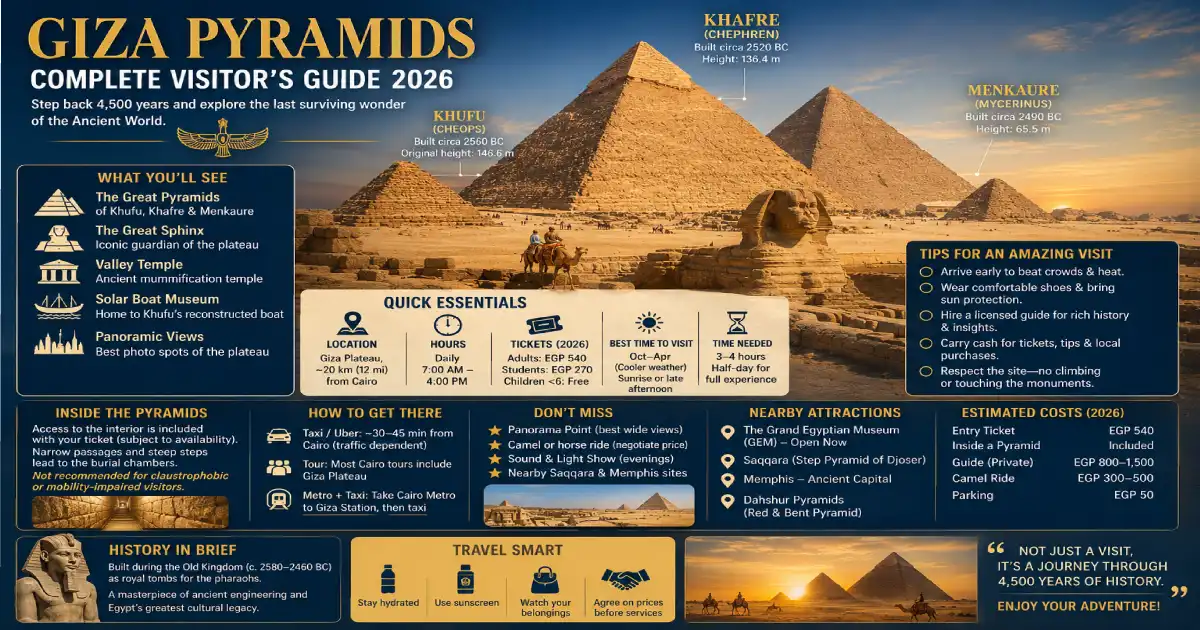
Standing before the Great Pyramid of Giza, you realize that photographs simply cannot capture the overwhelming sense of scale and history. These aren’t just ancient structures—they’re time machines that transport you 4,500 years into the past, to an era when pharaohs commanded armies of workers to create monuments that would outlast civilizations.
I’ve visited the Giza Pyramids three times, and each visit revealed something new—not just about ancient Egypt, but about how to actually experience these wonders without the frustration many tourists encounter. The difference between a magical pyramid visit and a disappointing one often comes down to preparation, timing, and knowing exactly what to expect.
This comprehensive guide covers everything you need to know about visiting the Giza Pyramids: when to visit, what to see, how to avoid scams, whether you should go inside the Pyramids of Giza, and practical tips that separate informed travelers from confused tourists standing in the wrong ticket line.
The Giza Pyramid Complex represents humanity’s most ambitious ancient architectural achievement. Built during Egypt’s Fourth Dynasty (circa 2580-2510 BCE), these structures have survived longer than any other of the original Seven Wonders of the Ancient World.
Key Facts:
The Giza Plateau spans approximately 160,000 square meters and includes far more than just pyramids:
| Structure | Function | Construction Date | Current State |
|---|---|---|---|
| Great Pyramid (Khufu) | Pharaoh’s tomb | c. 2580-2560 BCE | Largely intact, missing outer casing |
| Pyramid of Khafre | Pharaoh’s tomb | c. 2570 BCE | Retains some original limestone casing at peak |
| Pyramid of Menkaure | Pharaoh’s tomb | c. 2510 BCE | Smallest of the three, partially intact |
| Great Sphinx | Guardian statue | c. 2558-2532 BCE | Weathered but recognizable |
| Queens’ Pyramids | Royal family tombs | Various dates | Three smaller pyramids near Khufu |
| Valley Temple | Mummification site | c. 2570 BCE | Partially preserved |
| Solar Boat Museum | Royal vessel display | Boat from 2500 BCE | Museum built 1982 |
The Statistics That Stagger:
Why It’s Special: The Great Pyramid held the title of world’s tallest human-made structure for 3,800 years—until Lincoln Cathedral’s spire was completed in 1311 CE. Its construction precision astounds modern engineers: the base is level to within 2.1 cm (less than 1 inch), and the sides align almost perfectly with the cardinal directions.
What You’ll See:
Visitor Experience: Standing at the base, craning your neck to see the apex, you realize photographs don’t capture the overwhelming physical presence. Each block is larger than a person. The engineering precision becomes tangible—these aren’t rough-hewn stones but precisely cut blocks fitted with remarkable accuracy.
Key Features:
Why It’s Memorable: Khafre’s pyramid is the only one that still has some of its original smooth white limestone casing at the top, giving visitors a glimpse of how all three pyramids once appeared—gleaming white in the desert sun, visible from miles away.
What You’ll Experience:
Historical Note: Khafre was Khufu’s son. Some Egyptologists believe he deliberately built his pyramid on higher ground to make it appear larger than his father’s, though it’s actually slightly smaller.
Dimensions:
Why Visit: Though smaller, Menkaure’s pyramid offers a more intimate experience. You can walk around it completely in 10-15 minutes, appreciating details impossible to see on the larger pyramids. The use of red granite for the lower courses creates beautiful color contrast.
What Makes It Different:
Practical Advantage: If you’re on a tight budget or short on time, Menkaure’s pyramid offers the most accessible interior experience at a lower entry cost.
The Great Sphinx represents one of ancient Egypt’s most iconic and mysterious monuments.
Physical Specifications:
Unanswered Questions:
What You’ll Notice: The Sphinx has suffered significant weathering over millennia. The limestone body shows extensive erosion, with the head better preserved due to being carved from harder stone. Recent restoration work has stabilized the structure, though you can see where modern repairs meet ancient stonework.
Best Viewing Points:
Historical Context: For much of history, the Sphinx was buried in sand up to its shoulders. It has been excavated and re-excavated multiple times, most recently in 1925. Ancient records show pharaohs conducting clearing operations over 3,000 years ago.
From Cairo:
| Transport Method | Duration | Cost (USD) | Best For | Considerations |
|---|---|---|---|---|
| Uber/Taxi | 30-45 min | $10-20 | Convenience, Direct route | Negotiate price beforehand, avoid taxi touts |
| Organized Tour | Half/Full day | $40-150 | Stress-free, Guided experience | Less flexibility, group pace |
| Metro + Taxi | 60-75 min | $2-5 | Budget travelers | More complex, saves money |
| Private Driver | 30-45 min | $30-60 | Comfort, Multi-stop itinerary | Higher cost, more control |
| Bus | 60-90 min | $1-2 | Ultra-budget | Crowded, time-consuming |
Recommended Option: For most visitors, Uber or a pre-arranged taxi offers the best balance of cost, convenience, and flexibility. Agree on the round-trip price including waiting time (usually $25-40 for 4-5 hours).
Main Entrance (East Side):
Sphinx Entrance:
Pro Tip: Enter through the Main Entrance early morning, exit through Sphinx Entrance to avoid retracing your steps.
| Ticket Type | Price (Foreign Tourists) | Price (Students with ID) | What’s Included |
|---|---|---|---|
| General Admission | 540 EGP (~$17.50) | 270 EGP (~$8.75) | Pyramid complex grounds, exterior viewing of all structures, Sphinx |
| Great Pyramid Interior | 900 EGP (~$29) | 450 EGP (~$14.50) | Entry inside Khufu’s pyramid (limited daily tickets) |
| Khafre Pyramid Interior | 100 EGP (~$3.25) | 50 EGP (~$1.60) | Entry inside Khafre’s pyramid |
| Menkaure Pyramid Interior | 100 EGP (~$3.25) | 50 EGP (~$1.60) | Entry inside Menkaure’s pyramid |
| Solar Boat Museum | 100 EGP (~$3.25) | 50 EGP (~$1.60) | Ancient boat display (separate location) |
| Photography Permit | FREE | FREE | Personal cameras allowed (no professional equipment) |
Important Notes:
Where to Buy:
Smart Buying Sequence:
This is the question every visitor asks. The answer depends on your expectations, physical condition, and claustrophobia tolerance.
What Going Inside Actually Means:
When you decide to go inside the Pyramids of Giza, you’re not entering vast chambers with hieroglyphics and treasures like Hollywood depicts. Instead, you’ll navigate narrow, steep passages through solid rock to reach largely empty burial chambers. The experience is about the physical connection to ancient construction—touching the same stones that workers laid 4,500 years ago.
The Journey Inside:
Physical Requirements:
What You’ll Actually See:
What You WON’T See:
Honest Assessment: The interior is fascinating from an engineering perspective—you’re literally inside one of humanity’s greatest architectural achievements. But it’s not visually spectacular. If you’re claustrophobic, have knee/back problems, or expect Indiana Jones-style chambers, skip it. The exterior experience is equally impressive.
My Personal Experience: First visit, I went inside. It was hot, crowded, physically challenging, and… absolutely worth it for the sheer “I’m inside the Great Pyramid” factor. Second visit, I skipped it and spent more time exploring the complex grounds—equally satisfying. Third visit, I went inside Khafre’s pyramid instead (less crowded, similar experience).
Why Consider These Instead:
Khafre’s Pyramid:
Menkaure’s Pyramid:
Value Comparison: If experiencing the interior is important but you’re budget-conscious or want to avoid extreme crowds, Khafre or Menkaure offer 80% of the experience at a fraction of the cost and hassle.
| Season | Months | Pros | Cons | Crowd Level |
|---|---|---|---|---|
| Winter (Peak) | Dec-Feb | Mild temperatures (15-25°C), comfortable | Most crowded, highest prices | Very High |
| Spring | Mar-May | Pleasant mornings, good photography light | Gets hot by April-May (30-35°C) | High |
| Summer (Low) | Jun-Aug | Fewer tourists, better prices | Extreme heat (35-45°C), dangerous midday | Low-Medium |
| Fall | Sep-Nov | Comfortable temps return, fewer crowds | Still warm in early September | Medium |
Best Overall: October-November or February-March (comfortable weather, moderate crowds)
Budget Travelers: June-August (cheaper, but prepare for extreme heat)
Sunrise (6:00-8:00 AM):
Mid-Morning (8:00-11:00 AM):
Midday (11:00 AM-3:00 PM):
Late Afternoon (3:00-5:00 PM):
Night (Sound & Light Show):
My Recommendation: Arrive at opening (8 AM) or 30 minutes before sunrise. You’ll have 2-3 hours of good conditions before crowds and heat become overwhelming.
The Camel/Horse Ride Scam:
The Fake Guide Scam:
The “Closed Today” Scam:
The Photography Scam:
The Overpriced Souvenir Scam:
Effective Strategies:
What NOT to Do:
Sun Protection (Critical):
Hydration:
Comfort Items:
Practical Necessities:
Photography:
Leave These Behind:
Classic Shots:
Timing for Light:
Camera Settings:
Drone Policy: Drones are strictly prohibited throughout the Giza complex. Violators face confiscation and potential legal issues.
Solar Boat Museum:
Grand Egyptian Museum:
Saqqara:
Memphis:
Plan minimum 3-4 hours for a comprehensive visit including all three pyramids, the Sphinx, and basic exploration. Add 1-2 hours if entering pyramid interiors. Photography enthusiasts should allocate 5-6 hours for proper lighting and composition opportunities. Guided tours typically last 3-4 hours. For a relaxed pace with lunch nearby, dedicate a full half-day (4-5 hours). Avoid rushing—these monuments deserve time to appreciate properly. Most visitors underestimate and feel rushed; better to have extra time than leave wishing you’d stayed longer.
Yes, you can technically enter all three pyramids in a single visit, but it’s physically exhausting and expensive. Each interior requires 15-30 minutes of steep climbing through narrow passages in hot, humid conditions. Most visitors choose one pyramid interior (typically Khufu’s Great Pyramid for the iconic experience, or Menkaure’s for budget and accessibility). Entering multiple pyramids provides diminishing returns—they’re similar inside, with empty chambers and stone passages. If you’re determined to see multiple interiors, combine Khafre and Menkaure (both 100 EGP each) for better value than Khufu alone (900 EGP). Consider your physical stamina, claustrophobia tolerance, and budget before committing to multiple entries.
Yes, the Giza Pyramids are generally very safe for tourists. The complex has heavy security presence including tourist police, metal detectors, and surveillance. Violent crime against tourists is extremely rare. The primary safety concerns are: heat exhaustion (bring 2-3 liters of water, avoid midday in summer), minor scams (overpriced souvenirs, camel ride demands), pickpocketing in crowded areas (use money belt, stay alert), and aggressive vendors (firmly decline, keep walking). Women traveling solo may experience more harassment from touts—travel with a guide or group to minimize this. Egyptian tourism police specifically protect tourist sites. Follow basic travel safety precautions and you’ll have a secure visit.
Both have advantages depending on your preferences and experience level. Choose a tour if: you want stress-free logistics (transportation, tickets, timing), prefer expert historical commentary, feel uncomfortable negotiating or handling aggressive vendors, have limited time (tours optimize efficiency), or are traveling solo and want group security. Go independent if: you want flexibility in timing and pace, prefer early morning or late afternoon visits (most tours run midday), are budget-conscious (tours cost $40-150 vs $20-30 independent), want to avoid groups and tourist restaurant stops, or have specific photography goals. First-time Egypt visitors often prefer tours; return visitors typically go independent.
Yes, the Giza Pyramids are visible from various points in western Cairo on clear days, particularly from elevated locations. However, air pollution and haze often obscure views, especially during summer months. You can see the pyramid tips from some Cairo hotels and restaurants, but these distant views pale compared to visiting the actual complex. Some visitors mistakenly think seeing pyramids from Cairo hotels means they don’t need to visit—this is incorrect. The experience of standing at the base, walking around the structures, and experiencing their scale cannot be replicated from distance. Budget at least a half-day to visit the complex properly. The 13 km journey from central Cairo takes 30-45 minutes.
Dress for extreme sun exposure and heat while respecting Egyptian cultural norms. Recommended: Lightweight, breathable long pants or maxi skirt (protects from sun, culturally appropriate), loose long-sleeve cotton shirt (better sun protection than sunscreen alone), comfortable closed-toe walking shoes (lots of sand, uneven ground), wide-brimmed hat, and sunglasses. Avoid: Shorts (cultural respect and sun protection), tank tops (women especially), revealing clothing, sandals (sand gets uncomfortable), dark colors (absorb heat), tight clothing (limits movement, traps heat). While the pyramids aren’t a religious site requiring strict dress codes, modest clothing reduces harassment from vendors and shows cultural respect. Bring layers—mornings can be cool (winter) while afternoons are scorching.
Yes, but facilities are limited and often below Western standards. Bathrooms are located at the main entrance complex and near the Sphinx viewing area. Expect squat toilets in most locations, inconsistent toilet paper availability, and basic cleanliness. Bring your own tissues or toilet paper, hand sanitizer, and small bills for attendants (5-10 EGP tip expected). Some facilities charge small fees (5 EGP). Private restrooms at the Solar Boat Museum and visitor center cafeterias are generally cleaner. Plan bathroom stops before entering the complex and at designated facilities. There are NO bathrooms inside pyramid interiors or at remote viewpoints. Consider using hotel or restaurant facilities before arriving at the complex.
Yes, you can bring your own food and non-alcoholic beverages to the Giza Pyramids complex. In fact, bringing 2-3 liters of water per person is essential—on-site vendors charge inflated prices (20-30 EGP for water vs 5-10 EGP elsewhere). Pack snacks and lunch to avoid overpriced tourist cafeterias serving mediocre food. Find shaded areas near the pyramids for breaks—though shade is limited. Avoid bringing foods requiring refrigeration (extreme heat). Dispose of trash properly in designated bins. Alcohol is prohibited. Some organized tours include lunch, but it’s typically at tourist restaurants with high prices and average quality. Independent visitors save money and have more flexibility by bringing their own provisions.
The Giza Pyramids complex has very limited wheelchair accessibility. The grounds feature sand, uneven ancient paving, and no paved pathways in most areas. The main entrance and some viewing areas near the pyramids have been improved with ramps, but most of the complex remains inaccessible. Wheelchair users can access: the main entrance plaza, viewing areas for photographing pyramids from a distance, and the Sphinx viewing platform (with assistance). NOT accessible: pyramid interiors (steep, narrow passages), walking around pyramid bases, most viewpoints, and sandy areas. Consider hiring a private guide who can arrange accessible transportation within the complex and identify the most accessible viewpoints. Many wheelchair users report successful visits with proper planning and assistance.
Total costs vary significantly based on choices. Budget visit: General admission 540 EGP (~$17.50), independent transport $10-20, water/snacks $5, total ~$35-45 per person. Standard visit: General admission + one pyramid interior (~$21), guided tour $50-80, or independent with Uber transport $15-25, lunch $10-15, total ~$60-100 per person. Comprehensive visit: Guided full-day tour including pyramids, Sphinx, Solar Boat Museum, lunch, and transport: $100-150. Add these costs: Great Pyramid interior 900 EGP (~$29), photography with camel/horse props $5-20 (negotiable), souvenirs $10-50+, Sound & Light Show $20-30. Student discounts require valid ISIC card (50% off). Budget-conscious travelers can experience the complex thoroughly for $40-50; those wanting premium experiences with guides and pyramid interiors should budget $100-150.
The Giza Pyramids represent more than ancient tombs—they’re humanity’s declaration that we can achieve the impossible. Standing before these monuments, you’re not just seeing stones; you’re witnessing the culmination of vision, determination, and skill that created structures outlasting empires.
Whether you choose to go inside the Pyramids of Giza or experience them solely from the exterior, prepare properly, visit at optimal times, and approach with realistic expectations. The difference between a magical pyramid visit and a disappointing one comes down to preparation.
Arrive early, bring water, wear sun protection, ignore touts politely but firmly, and give yourself time to simply sit and absorb the magnitude of what you’re experiencing. These pyramids have stood for 4,500 years—they’ll wait a few extra moments while you truly appreciate them.

As an upcoming travel agent I got much support from travel tourister. We are getting very good leads from travel tourister and they mend our website which is also very commendable.... Excellent work Hope to do more business forward.... Thanks and regards CEO,Andaman Unlocked
Rating:
10/20/2018
As an upcoming travel agent I got much support from travel tourister. We are getting very good leads from travel tourister and they mend our website which is also very commendable.... Excellent work Hope to do more business forward.... Thanks and regards CEO,Andaman Unlocked
Rating:
10/20/2018
2nd Floor, 39, Above Kirti Club, DLF Industrial Area, Kirti Nagar, New Delhi, Delhi 110015



Travel Tourister is a leading Travel portal where we introduce travellers to trusted travel agents to make their journey hasselfree, memorable And happy. Travel Tourister is a platform where travellers get Tour packages ,Hotel packages deals through trusted travel companies And hoteliers who are working with us across the world. We always try to find new and more travel agents and hoteliers from every nook and corners across the world so that you could compare the deals with different travel agents and hoteliers and book your tour or hotel with the one you have chosen according to your taste and budget.
Copyright © Travel Tourister, India. All Rights Reserved






 Call
Call Enquiry