Published on : 11 Jun 2026
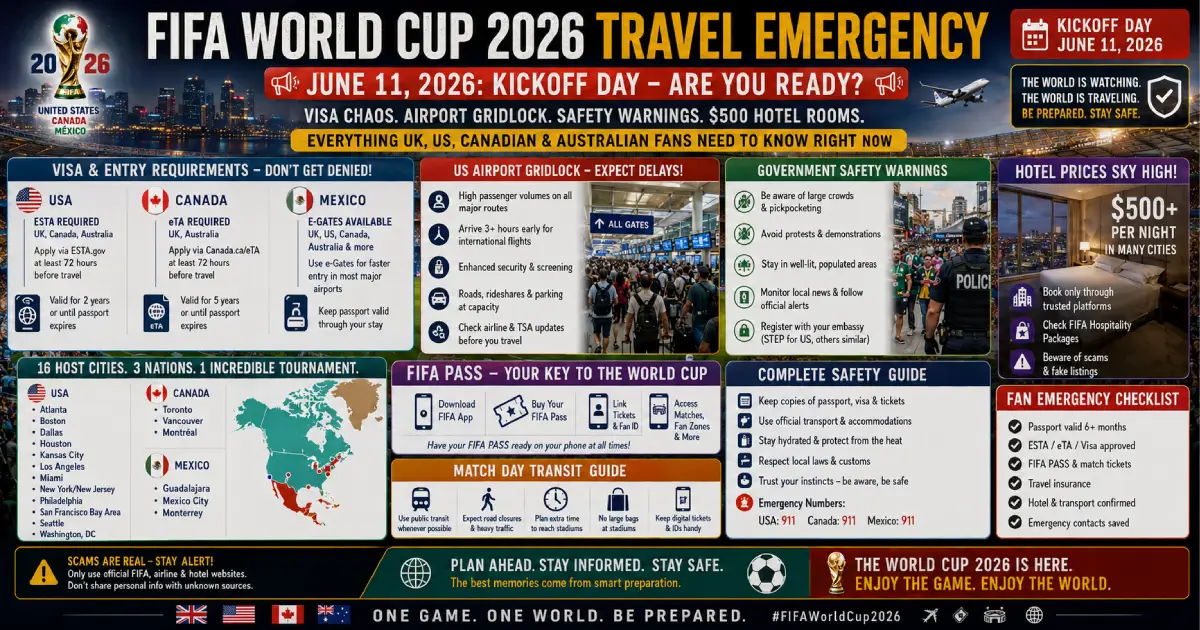
The wait is over. The FIFA World Cup 2026 kicks off TODAY — June 11, 2026 — at Estadio Azteca in Mexico City, the most iconic football stadium on earth. And for millions of fans who are flying in this week, this month, or right now: the travel realities are more complex than any World Cup has ever been.
The FIFA World Cup 2026 runs from June 11 to July 19, 2026, with 104 matches across 16 host cities in the United States, Canada, and Mexico. For international fans, this tournament crosses three countries with different immigration systems, different airport risk profiles, and different entry requirements that have nothing to do with the ticket in your pocket.
The scale is unlike anything North American aviation has managed before. FIFA expects between five and ten million people travelling to the United States, Canada, and Mexico for the tournament — generating what the organisation projects as $30.5 billion in total economic output.
There are things you need to know before you fly. Things you need to know before you get to the airport. And things — if you are travelling today — you need to act on right now. This guide covers all of them.
Published: June 11, 2026 — Thursday (KICKOFF DAY · Tournament Day 1 of 39) Tournament dates: June 11 – July 19, 2026 Host nations: United States (11 cities) · Canada (2 cities) · Mexico (3 cities) Total matches: 104 · Group stage + knockout rounds Opening match: Mexico vs — Estadio Azteca, Mexico City, TODAY June 11 Final: MetLife Stadium, East Rutherford, New Jersey — July 19, 2026 Highest-risk US airports: Dallas–Fort Worth · Chicago O’Hare · New York JFK/LGA/EWR US entry — visa waiver (ESTA): $40.27 — UK, Australia, NZ, EU and 39 other countries US entry — B1/B2 visa: $185 application fee — all other nationalities FIFA PASS: Priority visa appointment system — for ticketed fans needing US visa Canada eTA: CAD $7 — visa-waiver country nationals Mexico tourist entry: Visa-free for UK, US, Canadian, Australian, NZ nationals Hotel prices: $200–$1,200/night in US host cities — up 30–60% vs normal Safety warnings: France · Germany · Ireland · Canada have issued formal US travel advisories FAA match day protocol: Ground Delay Programmes active at host city airports on match days Emergency assist (US entry): COMPASS — CBP’s virtual assistant for World Cup travellers
The FIFA World Cup 2026 begins at Estadio Azteca in Mexico City today — the same stadium where Diego Maradona’s hand of God and goal of the century were scored in 1986, and the same stadium where the 2026 final’s prologue is now written.
For fans arriving in North America this week, the travel environment they are landing into is significantly more complex than any World Cup host has previously generated:
Aviation analysts warn that major host-city airports may experience high summer travel volumes, making early flight bookings and flexible itineraries essential. Travel between host cities — whether by plane, train, or bus — may involve long journeys, border crossings between the United States, Canada, and Mexico, and coordination of transit passes for domestic travel.
Security tightening across the United States has intensified as the World Cup begins. Drone threats have become a major concern at large events, and the US has already moved to strengthen counter-drone protection at all 11 American host venues. Airport screening times are elevated, stadium security requirements are strict, and visa checks at ports of entry are thorough.
This guide draws on official advice from the Australian Government’s Smartraveller, the US Department of State, Global Affairs Canada, FIFA’s official tournament communications, and host-city transit authorities.
For most fans from the United Kingdom, Australia, New Zealand, and European Union countries, entry to the United States for the World Cup is governed by the Electronic System for Travel Authorization (ESTA) — not a visa. ESTA covers nationals of 42 visa-waiver programme countries for stays of up to 90 days for tourism and short-term business.
ESTA facts every UK/Australian/NZ fan needs:
If you have a new passport since your last ESTA: Your old ESTA is void. Apply for a new one immediately at esta.cbp.dhs.gov. Do not travel on an old ESTA with a new passport — you will be denied boarding at check-in.
ESTA does not guarantee entry: A US ESTA or B-1/B-2 visa does not guarantee entry — admissibility is decided by the US Customs and Border Protection officer at your port of arrival. Bring your match ticket confirmation, hotel booking, and return flight details. Border officers may ask for any of these.
The US State Department has paused immigrant visa processing from 75 countries, including some of the world’s top soccer nations, like Brazil and Nigeria. For fans from countries that require a full US visitor visa — and there are many, including large football nations across Africa, South Asia, and parts of South America — the process is genuinely difficult.
The US Department of State created the FIFA Priority Appointment Scheduling System (FIFA PASS) for World Cup visitors who need a B-1/B-2 visa. FIFA PASS gives those who purchased a FIFA World Cup 2026 ticket the chance to interview for a US visa before the World Cup begins.
What FIFA PASS is — and is not:
FIFA PASS does not guarantee visa approval. Ticket holders must still qualify for a visa and pass security screening. FIFA PASS information must match the visa application — name, passport number. Mismatches may prevent access to priority appointments. Nationals of competing countries who purchased tickets by April 15, opted into FIFA PASS, and meet all visa eligibility requirements are eligible.
FIFA PASS gives those who purchased a FIFA World Cup 2026 ticket the chance to bypass appointment backlogs that in some US consulates stretch 300+ days. If you need a US visa and have not yet used the FIFA PASS system, use it immediately — the tournament has started.
For fans still waiting on visas: The tournament runs until July 19. Matches continue for 39 days. If your visa application is still in process, use the FIFA PASS portal at travel.state.gov to expedite your appointment. The COMPASS virtual assistant at cbp.dhs.gov/compass is the official CBP tool for quickly checking entry requirements.
The US State Department will waive the visa bond requirement for certain World Cup travellers — specifically for nationals of competing countries who purchased tickets by April 15 and meet all visa eligibility requirements.
Canada’s official guidance says fans enter as regular tourists — there is no special World Cup visa. Requirements depend on your passport. Visa-exempt countries — apply for an eTA (Electronic Travel Authorization) online. It costs CAD $7 and is usually approved within minutes. Visa-required countries — apply for a Canadian visitor visa (Temporary Resident Visa). Processing times vary from weeks to months depending on your country, so apply early. When filling out your eTA application, write “FIFA World Cup 26” in the free-text space under Background Questions. A match ticket does not guarantee entry — Canadian border officers make the final decision.
Canada’s World Cup cities: Toronto (BMO Field) and Vancouver (BC Place). UK, Australian, New Zealand, and US citizens are all in visa-waiver countries for Canada — your eTA covers the Canadian portion of your trip.
The opening match is TODAY at Estadio Azteca in Mexico City. Mexico is the easiest host nation from an entry perspective for most World Cup fans.
Nationals of the UK, United States, Canada, Australia, New Zealand, and the European Union do not require a visa for Mexico for tourism stays of up to 180 days.
However, today’s specific warning: Mexico City has issued a fresh travel advisory warning tourists and football fans of potential disruptions as the nation prepares to host the 2026 FIFA World Cup. The alert comes in response to planned protests by a teachers’ union that could affect Mexico City International Airport (AICM) and surrounding routes. Authorities have urged all travellers to allow extra time for their journeys and maintain close communication with airlines and tour operators to avoid delays.
Transportation hubs outside Mexico City may also experience temporary congestion due to rerouted traffic from the capital, making coordination essential for smooth travel.
Mexico’s e-Gates at airports: Mexico implemented e-Gates at major airports providing automated immigration entry for eligible travellers over 18 years old entering for tourism purposes with electronic passports from designated countries. Qualified nationalities include Australia, Canada, United Kingdom, United States, and 20 other countries. World Cup attendees can use e-Gates at Mexico City, Cancún, Guadalajara, Puerto Vallarta, San José del Cabo, and Querétaro airports.
Dallas is hosting the most matches of any single US venue — 9 games including several knockout rounds.
Dallas-Fort Worth International Airport has been ranked as the riskiest US airport for World Cup travel. AT&T Stadium in Arlington is hosting nine matches — the highest of any single venue. A previous study by AirAdvisor ranked DFW as one of the top US airports for the longest severe delays, over 180 minutes, averaging 324.7 minutes per severe delay incident.
Today’s DFW disruption figure — 531 delays on June 10 alone — confirms this assessment. For any fan whose World Cup itinerary routes through Dallas, allow a minimum 4-hour buffer for domestic connections. On match days, the FAA has confirmed Ground Delay Programmes will be in effect at DFW.
DFW match day ground transport: AT&T Stadium is in Arlington — between Dallas and Fort Worth. There is no direct public transit from DFW to AT&T Stadium. The most practical options are: rideshare (Uber/Lyft, $25–60 each way in normal conditions, $80–200+ surge pricing on match days) or parking at the stadium (pre-purchase required — matchday walk-up is extremely limited).
MetLife Stadium hosts the World Cup Final on July 19 — the most important single day in the tournament’s 39-day run. The stadium is also hosting group stage and knockout matches throughout.
New York JFK recorded a 10% rate of flights running at least an hour late during peak summer periods, heavily bottlenecked by the congested airspace it shares with nearby Newark and LaGuardia.
JFK recorded 18 cancellations + 100 delays on June 8, 122 delays + 6 cancellations on June 9, and continues at elevated disruption on June 10–11. For fans arriving for New York matches, allow minimum 2-hour domestic connection buffers and plan for ground transport in advance.
MetLife Stadium match day transit: NJ Transit trains from New York Penn Station to Meadowlands Sports Complex on match days — approximately $20–$25 round trip per person (pre-purchase strongly recommended — match day queues are extreme). Rideshare from Midtown Manhattan: $40–100 normal conditions, $150–300+ surge pricing on match days.
Chicago O’Hare (ORD) recorded 428 delays and 6 cancellations on June 10 alone — today’s second-worst US hub. Chicago is in the high-risk tier for World Cup travel connections.
Chicago O’Hare saw one in seven flights delayed by over an hour during peak summer travel periods — a statistic that makes it one of the most reliably disrupted airports in the US.
Soldier Field match day transit: The Chicago elevated rail (CTA Red Line to Roosevelt, then Green/Orange Line to Museum Campus/11th Street) connects downtown Chicago to Soldier Field. Cost: $2.50 each way. Travel time: approximately 30–40 minutes from the Loop.
LA’s SoFi Stadium in Inglewood is the West Coast showpiece, with the official FIFA Fan Festival at the LA Memorial Coliseum running June 11–15 to open the tournament. Budget $250–$450/night for accommodation; Santa Monica offers coastal views, downtown LA gives better transport links.
Los Angeles International Airport (LAX) is the primary arrival gateway. LAX recorded 337 delays on June 5 (Day 66) and continues under elevated disruption. The newly opened LAX People Mover connects LAX to the Metro K (Crenshaw) Line — which continues to Inglewood, making SoFi Stadium reachable via public transit for the first time.
SoFi Stadium transit: LAX People Mover → Metro K Line → Inglewood transit station (~20 min from LAX, approximately $1.75). Alternatively, rideshare from DTLA: $35–70 normal, much higher on match days.
In the Bay Area, matches play at Levi’s Stadium in Santa Clara, 40–50 minutes from San Francisco by Caltrain or VTA Light Rail. For culture, base yourself in SF’s Union Square or SoMa. For convenience, choose a hotel in Santa Clara or San Jose.
San Francisco International Airport (SFO) recorded 342 total disruptions on June 5 and 309 on June 9 — one of the most disrupted US airports this month. For fans routing through SFO, allow generous connection buffers and consider Oakland International (OAK) or San Jose Mineta (SJC) as less congested Bay Area alternatives.
Miami International (MIA) is in the high-risk tier for World Cup travel. Miami International has been plagued by severe summer weather patterns and heavy international passenger surges, placing it among the highest-risk US World Cup airports.
Florida’s summer thunderstorm season — which runs June through September — overlaps exactly with the World Cup tournament period. Afternoon thunderstorms at MIA are an almost daily occurrence in July. Build significant weather delay buffers into Miami travel plans.
Hard Rock Stadium transit: Hard Rock Stadium is in Miami Gardens — 15 miles north of downtown Miami. Miami’s Metrorail does not reach the stadium directly. Pre-purchased parking ($40–80/match) or rideshare is the primary option.
Atlanta’s Hartsfield-Jackson (ATL) is Delta Air Lines’ primary global hub and the busiest airport in the world by passenger count. High volumes mean high delay risk during match days. The stadium is conveniently connected to downtown Atlanta via MARTA rail.
Match day transit: MARTA Gold/Red Line to Vine City or West End Station. Cost: $2.50. Travel time from downtown: 10–15 minutes.
Seattle is pedestrian-friendly, walkable, and genuinely beautiful. Must-visit: Pike Place Market, the Space Needle, and the Museum of Pop Culture (MoPOP). Matches play at Lumen Field, which is directly connected to the waterfront and walkable from downtown.
Seattle-Tacoma International (SEA) is Alaska Airlines’ hub — generally well-managed but subject to summer peak pressure. Lumen Field is within walking distance of downtown Seattle hotels and accessible via Link Light Rail.
Boston Logan (BOS) has been recording congestion delays throughout June. Gillette Stadium is in Foxborough, approximately 30 miles south of Boston.
Foxborough transit: Commuter rail from South Station to Foxboro on match days only — check MBTA.com for match day service schedules. Travel time approximately 55 minutes. Rideshare from downtown Boston: $40–80 normal, higher on match days.
Arrowhead Stadium in Kansas City is one of the loudest venues on Earth. The city’s Fan Festival takes place at the Power & Light District in downtown KC.
Kansas City International (MCI) is a regional airport without the chronic congestion of major hub airports — one of the lower-risk US World Cup airports for flight disruption. However, ground transport options from the airport are limited to rideshare and taxi.
Houston Bush Intercontinental (IAH) is United Airlines’ second-largest hub. NRG Stadium is accessible via the Metropolitan Transit Authority of Harris County (METRO) Red Line from downtown Houston.
🇨🇦 CANADA — 2 HOST CITIES
Toronto (BMO Field): Toronto Pearson (YYZ) has been recording 64–400 disruptions per day throughout early June 2026. BMO Field is accessible via the TTC streetcar from downtown Toronto. Allow generous connection buffers at Pearson.
Vancouver (BC Place): Vancouver International (YVR) is Canada’s Asia-Pacific gateway — generally well-managed. BC Place is accessible via SkyTrain Canada Line from YVR Airport directly — one of the tournament’s most convenient airport-to-stadium transit options.
🇲🇽 MEXICO — 3 HOST CITIES
Mexico City (Estadio Azteca): Opening match TODAY. Mexico City International Airport (AICM) is the primary gateway. Teachers’ union protest disruption warning active as of today — allow extra time. Estadio Azteca is accessible via Metrobús or Metro Line 2.
Guadalajara (Estadio Akron): Miguel Hidalgo International Airport (GDL) is Mexico’s second airport. Guadalajara is Mexico’s second city — more manageable than Mexico City for crowd volumes.
Monterrey (Estadio BBVA): Monterrey’s General Mariano Escobedo International Airport (MTY). Iberia just launched the first-ever Madrid–Monterrey nonstop service (June 3), significantly improving European access to this venue.
For football fans booking flights from London, Manchester, or Edinburgh, the risk isn’t necessarily departing the UK — it’s what happens upon landing in America. A single summer thunderstorm in Chicago or an air traffic control jam at JFK can trigger a cascading nightmare of delayed flights, stranded luggage, and missed connecting flights to secondary host cities.
The FAA has issued a specific safety plan for the World Cup period. The FAA confirmed that Ground Delay Programmes will be in effect when a GDP is in active status at host city airports — aircraft must depart within 5 minutes of their assigned Expect Departure Clearance Time. VFR arrivals should expect lengthy delays and potential holding during peak traffic periods surrounding match days.
The three rules for managing World Cup aviation risk:
Rule 1 — Never book a tight connection through a high-risk US hub on a match day. Dallas, Chicago, New York, and Miami are all high-risk on match days. A 90-minute domestic connection that works in April does not work on a DFW match day in July. Build 3–4 hour minimum buffers.
Rule 2 — Book the earliest morning flight to your match venue. Sports travel experts are urging UK fans to alter their booking strategies ahead of the tournament. If your World Cup itinerary requires a connection through high-risk hubs like Dallas, Chicago, or New York, building a massive buffer into your travel plans is essential. Early morning departures have the lowest delay rates — the system is in recovery mode from overnight and early morning aircraft positioning. By afternoon, the day’s accumulated delays are cascading.
Rule 3 — Pre-book all ground transport before match day. Do not rely on rideshare apps at stadium-adjacent areas on match days. Surge pricing on Uber and Lyft at major US venues during World Cup matches will be extreme — $100–$300+ for journeys that normally cost $20–40. Pre-booked match day transit via official venue shuttle, commuter rail, or pre-paid parking is the only reliable option.
France, Germany, Ireland, and Canada have issued formal travel warnings to their citizens citing US civil unrest and security concerns ahead of the World Cup.
This does not mean the US is unsafe — millions of international visitors travel to the United States every year without incident. But these government advisories signal that specific situations — large public gatherings, politically charged environments, localised protests near fan zones — warrant awareness and planning.
What the advisories specifically warn about:
Practical safety steps for international fans: Follow local police, airport, and stadium guidance. Avoid restricted zones and report unattended bags or suspicious activity. Carry digital and printed copies of key documents — hotel bookings, ticket details, travel insurance, and emergency contacts.
Government travel advice links:
Hotels: $200–$1,200/night depending on host city. Budget $1,400–$4,000 for seven nights at most US venues. Return economy fares to a US host city typically run $900–$1,800 outside the tournament window, but climb 30–60% from mid-June through mid-July.
The headline hotel price picture, however, has a nuanced counterpoint: Roughly 80% of hotels in key American host markets are tracking significantly below initial demand forecasts. Because event organizers are dumping unfulfilled room blocks back onto the market, hotel inventories in host cities are seeing sudden price drops and newly available rooms.
This means the dynamic on accommodation has shifted since early 2026. Hotels that were blocked by event organizers and held at premium rates are now being released back to the open market — meaning that if you search for accommodation TODAY in Dallas, Chicago, or New York, you may find better availability and pricing than existed two months ago.
Where to search: Booking.com, Hotels.com, and Google Hotels now all show real-time availability including released event blocks. If your host city dates are flexible by even one night, the difference in price can be $100–300/night.
Alternative accommodation: Airbnb and Vrbo have significant inventory in host city areas — particularly in suburban locations within 20–30 minutes of venues. For fans on a budget, a house or apartment rental 15 miles from the stadium (with access to match-day transit) can represent substantial savings versus central hotel pricing.
Fans should follow a simple travel checklist. Check visa rules first. Confirm passport validity — all host nations require a passport valid for six months beyond your stay. Book official tickets only through trusted platforms. Monitor airline updates and airport advisories. Carry digital and printed copies of key documents — hotel bookings, ticket details, travel insurance, and emergency contacts.
The 10-point World Cup travel checklist:
1. Visa / ESTA / eTA: Have you confirmed your entry documents for EVERY country your itinerary visits? ESTA for US, eTA for Canada (if applicable), no visa required for Mexico (most nationalities).
2. Passport validity: Valid for 6+ months beyond July 19, 2026? Confirm now.
3. FIFA PASS (if applicable): If you need a US B-1/B-2 visa, have you accessed the FIFA PASS priority appointment system at travel.state.gov?
4. COMPASS (CBP): Use CBP’s COMPASS tool at cbp.dhs.gov/compass to verify your specific entry situation officially.
5. Match tickets: Saved in the FIFA app, not just email. Stadium entry is typically via the FIFA Tixs app — test it works before match day.
6. Ground transport pre-booked: NJ Transit for MetLife. Caltrain for Levi’s. MARTA for Atlanta. LA Metro K Line for SoFi. Match day rideshare = unpredictable surge pricing.
7. Travel insurance: Travel insurance will be useful because delays, missed connections, and medical needs may increase during peak tournament periods. Allow 4–8% of total trip cost for travel insurance.
8. Government alerts subscribed: Register your travel with your home country’s notification service (UK FCDO, Australian Smartraveller, Canadian Registration of Canadians Abroad).
9. Airport buffer time: Allow 3–4 hours for domestic US connections at high-risk hubs on match days. 2.5 hours for direct international arrivals.
10. Emergency contacts saved: Your airline’s customer service number, your country’s embassy or consulate in each host city, FIFA’s fan assistance service, and your travel insurer’s 24-hour emergency line.
For a typical fan attending two to three matches, total spend usually breaks down as follows:
| Category | Typical cost |
|---|---|
| Return economy flights | $900–$1,800 from Europe/Australia |
| Hotel (7 nights) | $1,400–$4,000 per person (US host city) |
| Match tickets (2–3 games) | $120–$600 (group stage), $1,490–$32,970 (final) |
| Ground transport | $50–$150/week public transit; much more on match days |
| Food and drink | $40–$80/day in US cities; $25–$50/day in Mexico |
| ESTA (if applicable) | $40.27 |
| Canadian eTA (if applicable) | CAD $7 |
| Travel insurance | 4–8% of total trip cost |
| Visa fee (if B1/B2 required) | $185 US application fee |
| Host city | Stadium | Airport code | Risk level | Key transit option |
|---|---|---|---|---|
| Dallas/Arlington | AT&T Stadium | DFW | 🔴🔴🔴🔴🔴 | Rideshare only — pre-book |
| New York/NJ | MetLife Stadium | JFK / EWR / LGA | 🔴🔴🔴🔴 | NJ Transit match day trains |
| Chicago | Soldier Field | ORD / MDW | 🔴🔴🔴🔴 | CTA Green/Orange Line |
| Los Angeles | SoFi Stadium | LAX | 🔴🔴🔴 | Metro K Line via People Mover |
| San Francisco | Levi’s Stadium | SFO | 🔴🔴🔴 | Caltrain to Santa Clara |
| Miami | Hard Rock Stadium | MIA | 🔴🔴🔴 | Rideshare — pre-book early |
| Atlanta | Mercedes-Benz | ATL | 🔴🔴🔴 | MARTA Gold/Red Line |
| Seattle | Lumen Field | SEA | 🔴🔴 | Link Light Rail + walk |
| Boston/Foxborough | Gillette Stadium | BOS | 🔴🔴 | MBTA match day commuter rail |
| Kansas City | Arrowhead Stadium | MCI | 🔴 | Rideshare (lower risk airport) |
| Houston | NRG Stadium | IAH | 🔴🔴 | METRO Red Line |
| Toronto | BMO Field | YYZ | 🔴🔴🔴 | TTC streetcar |
| Vancouver | BC Place | YVR | 🔴🔴 | SkyTrain Canada Line direct |
| Mexico City | Estadio Azteca | AICM | 🔴🔴🔴 | Metrobús / Metro Line 2 |
| Guadalajara | Estadio Akron | GDL | 🔴🔴 | Taxi / rideshare |
| Monterrey | Estadio BBVA | MTY | 🔴🔴 | Taxi / rideshare |
| Resource | Link |
|---|---|
| US ESTA application | esta.cbp.dhs.gov |
| US visa (B1/B2) | travel.state.gov |
| FIFA PASS priority visa | travel.state.gov → FIFA World Cup 2026 Visas |
| CBP COMPASS assistant | cbp.dhs.gov/compass |
| Canada eTA | canada.ca/en/immigration-refugees-citizenship/services/visit-canada/eta |
| FAA World Cup aviation plan | faa.gov/fifaworldcup2026 |
| Official FIFA match info | fifa.com/worldcup |
| UK FCDO US travel advice | gov.uk/foreign-travel-advice/usa |
| Australian Smartraveller US | smartraveller.gov.au |
| Canadian registration | travel.gc.ca |
Related Articles:
Posted By : Vinay
This article is provided for general informational purposes only and is based on information available at the time of publication. Travel advisories, airline schedules, airport operations, visa requirements, government regulations, and other travel-related information are subject to change without prior notice. While Travel Tourister makes reasonable efforts to verify information using official announcements, government publications, airline and airport communications, and other reliable sources, we cannot guarantee that all information remains complete, accurate, or up to date at all times. Readers should independently verify any information that may affect their travel plans with the relevant airline, airport authority, government agency, embassy, or other official source before making travel, financial, or other decisions. Travel Tourister shall not be liable for any direct or indirect loss, inconvenience, or damages arising from the use of or reliance on the information contained in this article. Nothing in this publication constitutes legal, immigration, financial, or professional travel advice. If you believe any information in this article is inaccurate or outdated, please contact our editorial team. We review all credible correction requests promptly and update our content whenever appropriate.
Lastest News
2nd Floor, 39, Above Kirti Club, DLF Industrial Area, Kirti Nagar, New Delhi, Delhi 110015



Travel Tourister is a leading Travel portal where we introduce travellers to trusted travel agents to make their journey hasselfree, memorable And happy. Travel Tourister is a platform where travellers get Tour packages ,Hotel packages deals through trusted travel companies And hoteliers who are working with us across the world. We always try to find new and more travel agents and hoteliers from every nook and corners across the world so that you could compare the deals with different travel agents and hoteliers and book your tour or hotel with the one you have chosen according to your taste and budget.
Copyright © Travel Tourister, India. All Rights Reserved

 Call
Call Enquiry