Published on : 16 Jul 2026
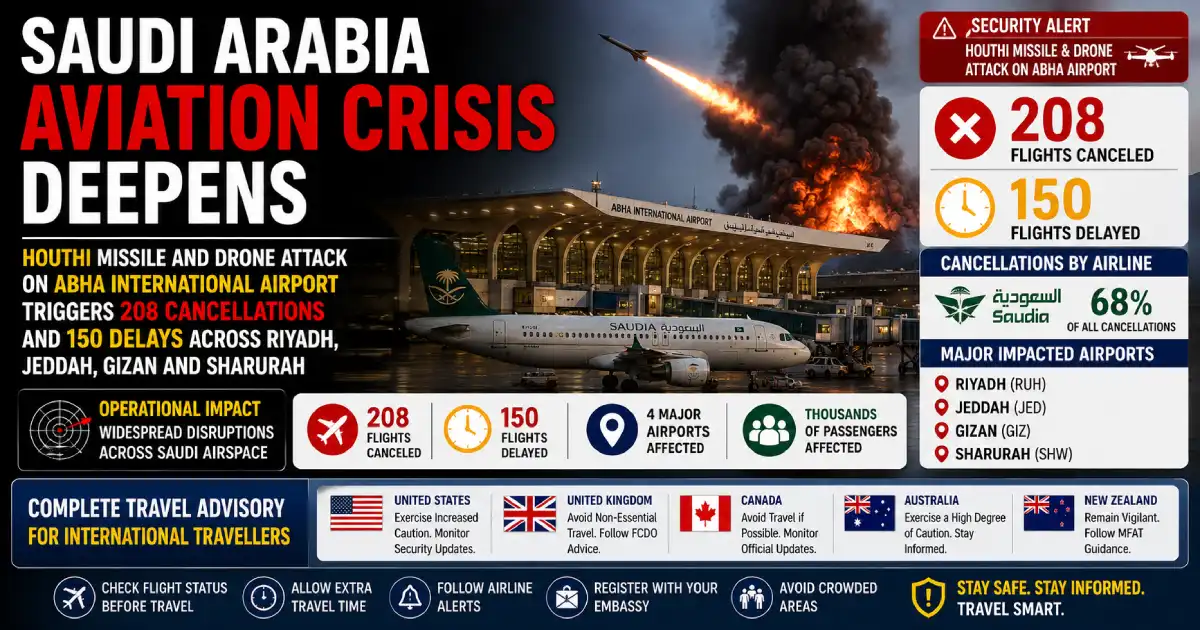
A missile and drone attack on a civilian international airport has plunged southern Saudi Arabia’s aviation network into its most serious security-driven disruption in years — and three days later, the ripple effects are still spreading.
Saudi Arabia’s aviation network is now in its fourth consecutive day of disruption following a Houthi missile and drone attack on Abha International Airport, with 208 flights cancelled and 150 delayed today across Riyadh, Jeddah, Abha, Gizan, and Sharurah. Abha itself remains the epicenter, recording the highest cancellation total of any airport at 51, while King Khalid International Airport in Riyadh reported the highest combined disruption at 54 cancellations and 83 delays. Saudia, the national carrier, has absorbed by far the largest share of the impact — 142 cancelled flights, or roughly 68% of all cancellations recorded today — with flyadeal, Flynas, and FlyDubai also affected.
The disruption traces directly to a rapid escalation in the Yemen conflict on Monday, July 13, when airstrikes struck the runway at Sanaa International Airport in Houthi-controlled territory, followed within hours by Houthi forces launching ballistic missiles and drones at Abha International Airport in southern Saudi Arabia. Saudi air defences intercepted the incoming projectiles and no casualties were reported on either side of the exchange — but the psychological and operational impact on one of the Gulf’s busiest aviation corridors has proven far more durable than the attack itself.
Published: July 16, 2026 — Thursday (Day 4 of Disruption · Attack Occurred July 13) National total today: 208 cancellations + 150 delays across Saudi Arabia Worst-hit airport (cancellations): Abha International (AHB) — 51 cancellations Worst-hit airport (combined): King Khalid International, Riyadh (RUH) — 54 cancellations + 83 delays Also affected: King Abdulaziz International, Jeddah (JED) · Gizan Regional (GIZ) · Sharurah (SHW) · Najran (EAM) Hardest-hit airline: Saudia — 142 cancellations (≈68% of national total) Also disrupted: flyadeal · Flynas · FlyDubai · Air Arabia · Gulf Air · Qatar Airways (delays only, no cancellations) · Etihad Airways Trigger event: Houthi missile and drone attack on Abha International Airport, Monday, July 13, 2026 Preceding event: Airstrikes on Sanaa International Airport runway earlier the same day — attribution disputed Casualties: None reported from either exchange Interception status: Saudi air defences confirmed intercepting inbound projectiles targeting the southern region Houthi statement: Warned airlines against operating through Saudi airspace “until the blockade on Sanaa International Airport is lifted” GACA passenger rights: ✅ Full refund or free rebooking guaranteed for airline-cancelled flights Transit visa option: ✅ 96-hour digital stopover visa available for stranded international transit passengers via Saudia/Flynas
The chain of events began Monday, July 13, when airstrikes struck the runway at Sanaa International Airport, in territory controlled by Yemen’s Houthi movement. The attribution is genuinely contested: Yemen’s internationally recognized government said the strike was carried out to prevent an Iranian aircraft from landing at Sanaa — specifically, a flight intended to return a Houthi delegation from Tehran following the funeral of Iran’s late Supreme Leader. The Houthis, for their part, blamed Saudi Arabia directly for the strike.
Within hours, the Houthi movement claimed it had launched ballistic missiles and drones at Abha International Airport in southern Saudi Arabia, describing the action as retaliation. A senior Saudi-led coalition spokesperson confirmed that air defences had intercepted ballistic missiles aimed at the kingdom’s southern region. No casualties were reported at either airport. Houthi military spokesman Brig. Gen. Yahya Saree subsequently issued a video statement warning airlines against operating through Saudi airspace until what he described as the blockade on Sanaa International Airport is lifted — a warning that itself has become a factor in airlines’ ongoing operational caution, independent of any further attacks.
This is not the first time Abha has found itself in this position. The airport, located close to the Yemen border in Saudi Arabia’s Asir province, has been targeted in missile and drone attacks during earlier phases of the conflict, including incidents in 2019, 2021, and 2022. Its proximity to the border has made it one of the region’s most closely watched aviation hubs whenever cross-border tensions rise — but this week’s escalation is being described by multiple outlets as the most serious since a Saudi-led coalition struck Houthi-controlled areas several years ago, effectively ending a period of informal de-escalation.
A key point for travellers trying to understand this story: an airport does not need to be physically damaged, or even directly hit, for flights to be disrupted at this scale. Even successfully intercepted missiles and drones trigger a cascade of precautionary operational responses — airlines cancelling or delaying services out of caution, aviation authorities issuing airspace advisories, carriers rerouting aircraft away from sensitive corridors, and crews and aircraft being repositioned to manage knock-on effects across the network. These decisions ripple outward across an airline’s entire schedule even when the airport infrastructure itself remains fully intact.
That is exactly the pattern visible in today’s numbers. Saudia’s disruption is concentrated on core domestic trunk routes — Jeddah–Abha, Riyadh–Gizan, and Riyadh–Najran among them — corridors that form the backbone of Saudi Arabia’s domestic network and are difficult to route around given Abha and Gizan’s remote southern locations.
Abha recorded 51 cancellations today, the highest total of any Saudi airport, continuing what regional coverage has described as the airport being effectively out of service for the fourth consecutive day since the attack. Saudia accounted for the largest share of cancelled services, with flyadeal, Flynas, and FlyDubai also affected. flydubai confirmed cancelling scheduled Dubai–Abha services in the days immediately following the attack, and Saudia has suspended multiple services connecting Abha with both Riyadh and Jeddah.
Riyadh’s main airport recorded 54 cancellations and 83 delays today, the highest combined disruption total in the country. As Saudi Arabia’s capital and primary domestic hub, Riyadh is absorbing significant knock-on congestion from displaced Abha and Gizan traffic, with passengers from cancelled southern services converging on Riyadh and Jeddah in search of alternative routings.
Jeddah has recorded some of the highest cancellation shares of the disruption period, at times accounting for nearly a quarter of the national total. Saudia, flyadeal, and Flynas represent the bulk of affected services here.
These smaller regional gateways, all located in Saudi Arabia’s southern border region alongside Abha, have seen some of the highest cancellation rates as a share of total operations, reflecting their proximity to the conflict zone and airlines’ heightened caution operating in the area.
Under Saudi Arabia’s General Authority of Civil Aviation (GACA) regulations, passengers are entitled to a full ticket refund or free rebooking if their flight is cancelled by the airline, regardless of cause. Saudi Arabia does not follow the EU261/UK261 compensation framework, so cash compensation is not guaranteed — but the refund and rebooking rights apply straightforwardly.
If you’re an international traveller transiting through Riyadh or Jeddah and facing an extended delay, Saudi Arabia offers a 96-hour digital stopover visa, processable when booking with Saudia or Flynas, allowing you to leave the airport and stay in a local hotel rather than waiting out a lengthy delay in the terminal.
If you have upcoming travel through Abha, Gizan, Najran, or Sharurah, avoid booking connections under 4 hours through these airports while the security situation remains active — these regional gateways are subject to sudden operational changes. Choosing earlier-in-the-day flights, when operational buffers are typically larger, may reduce the risk of being caught in afternoon or evening schedule unwinding.
Given the fluid security situation, UK, US, Canadian, Australian, and New Zealand travellers with plans involving southern Saudi Arabia should check their respective government’s current travel advisory before departure — advisories are being actively updated as the situation develops.
Industry analysts covering the disruption note that flight schedules across Riyadh, Jeddah, and Abha are likely to remain in flux over the coming days as airlines, aviation authorities, and security planners continue reassessing the threat picture. If missile activity subsides and no further infrastructure damage is detected, carriers could gradually restore cancelled frequencies, prioritizing high-demand domestic and trunk regional routes first. However, the broader diplomatic picture remains unresolved — the dispute over Sanaa International Airport access, and the collapse of the informal de-escalation arrangement that had held for several years, suggests this is a developing situation rather than an isolated event.
| Airline | Action | Phone |
|---|---|---|
| Saudia | saudia.com → Manage Booking | +966 92 000 2222 |
| Flynas | flynas.com → Manage Booking | +966 92 000 6000 |
| flyadeal | flyadeal.com → Manage Booking | +966 92 000 6603 |
| Qatar Airways | qatarairways.com → Manage Booking | +974 4023 0000 |
GACA official updates: gaca.gov.sa UK FCDO travel advisory: gov.uk/foreign-travel-advice/saudi-arabia US State Department advisory: travel.state.gov
Related Articles:
Posted By : Vinay
This article is provided for general informational purposes only and is based on information available at the time of publication. Travel advisories, airline schedules, airport operations, visa requirements, government regulations, and other travel-related information are subject to change without prior notice. While Travel Tourister makes reasonable efforts to verify information using official announcements, government publications, airline and airport communications, and other reliable sources, we cannot guarantee that all information remains complete, accurate, or up to date at all times. Readers should independently verify any information that may affect their travel plans with the relevant airline, airport authority, government agency, embassy, or other official source before making travel, financial, or other decisions. Travel Tourister shall not be liable for any direct or indirect loss, inconvenience, or damages arising from the use of or reliance on the information contained in this article. Nothing in this publication constitutes legal, immigration, financial, or professional travel advice. If you believe any information in this article is inaccurate or outdated, please contact our editorial team. We review all credible correction requests promptly and update our content whenever appropriate.
Lastest News
2nd Floor, 39, Above Kirti Club, DLF Industrial Area, Kirti Nagar, New Delhi, Delhi 110015



Travel Tourister is a leading Travel portal where we introduce travellers to trusted travel agents to make their journey hasselfree, memorable And happy. Travel Tourister is a platform where travellers get Tour packages ,Hotel packages deals through trusted travel companies And hoteliers who are working with us across the world. We always try to find new and more travel agents and hoteliers from every nook and corners across the world so that you could compare the deals with different travel agents and hoteliers and book your tour or hotel with the one you have chosen according to your taste and budget.
Copyright © Travel Tourister, India. All Rights Reserved

 Call
Call Enquiry