Published on : 15 Sep 2026
By Travel Tourister | Updated Sep 2026
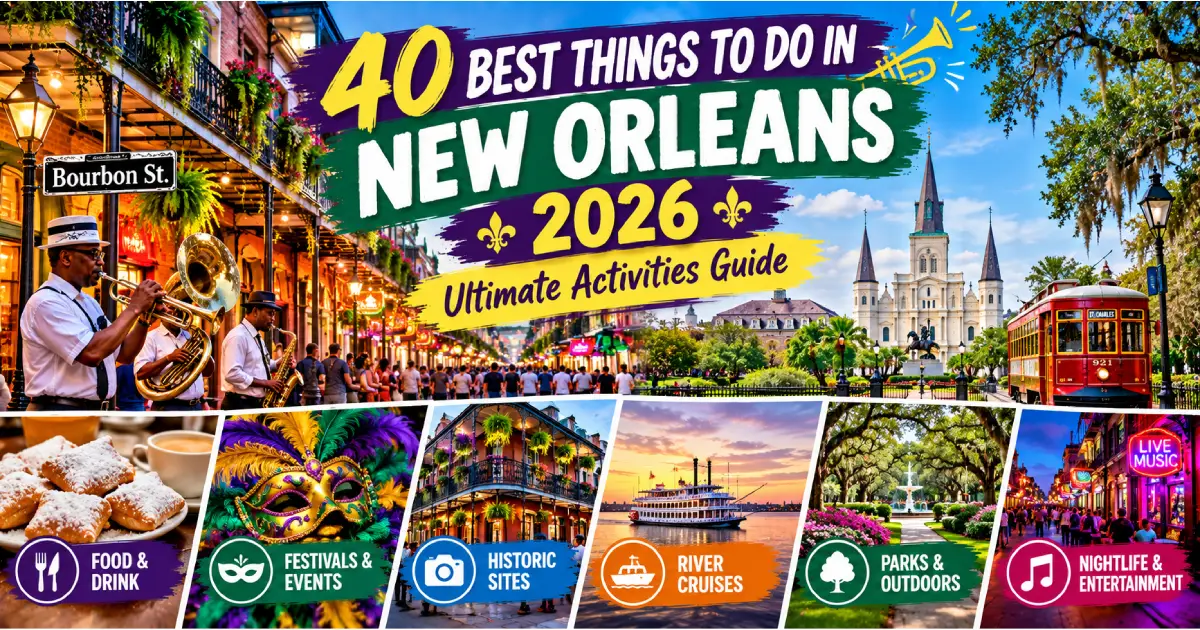
New Orleans is America’s most singular city — a place that belongs to no recognizable category of American urban experience, operating on its own specific logic of food, music, architecture, and cultural identity that 300 years of French, Spanish, African, Caribbean, and American layering has produced and that no other US city has replicated despite persistent attempts. The best things to do in New Orleans in 2026 begin with understanding what makes the city specifically extraordinary rather than simply different: the French Quarter’s 18th and 19th century Creole townhouse architecture (iron-lace balconies overhanging narrow streets, the specific compressed urban scale of a city built when walking was the primary transport mode, and the pastel plaster facades that the Mediterranean-heritage builders brought from France and Spain), the music (not merely jazz — though Preservation Hall’s nightly traditional jazz sessions and the Frenchmen Street clubs’ living New Orleans music scene are irreplaceable — but the specific New Orleans musical DNA that runs from Congo Square’s 19th-century slave gatherings through Louis Armstrong’s Storyville birth through the blues, R&B, and funk traditions that the city continues to generate), and the food (the most specifically distinctive American regional cuisine — the gumbo, the étouffée, the po’boy, the beignet, the muffuletta, and the bread pudding that New Orleans specifically invented and that the city’s restaurant culture from Antoine’s and Galatoire’s through Commander’s Palace through the emerging Bywater neighborhood chefs maintains at a collectively extraordinary level).
New Orleans in 2026 is simultaneously the most historically complex and the most immediately pleasure-oriented destination in the United States — a city where the French Quarter’s Bourbon Street excess and the Garden District’s Greek Revival mansions coexist within 15 minutes’ walk, where the world’s finest Creole restaurant serves a $75 turtle soup and a $3 plate lunch café serves the same quality of red beans and rice on the same block, and where a Tuesday afternoon can begin with a cemetery tour of Lafayette Cemetery No. 1, transition through a Commander’s Palace jazz brunch, and end with a Frenchmen Street second-line parade — all without any of these experiences feeling incongruous with each other. This guide covers the 40 best things to do in New Orleans for every type of 2026 visitor.
For related guides, see our Best Restaurants in New Orleans 2026, New Orleans vs Nashville 2026, Best Food Cities USA 2026, and Places to Visit in New Orleans 2026.
| # | Activity | Category | Cost | Best Time | Book Ahead? |
|---|---|---|---|---|---|
| 1 | French Quarter Walk | Architecture/Culture | Free | Morning | No |
| 2 | Preservation Hall Jazz | Music | $20–$35 | Nightly | Yes |
| 3 | Frenchmen Street Live Music | Music | Free–$15 cover | 9 PM–2 AM | No |
| 4 | Commander’s Palace Jazz Brunch | Dining | $65–$95/person | Saturday–Sunday | Yes (weeks ahead) |
| 5 | Café Du Monde Beignets | Food | $5–$8 | Any time | No |
| 6 | Garden District Walking Tour | Architecture | Free (self-guided) | Morning | No |
| 7 | Lafayette Cemetery No. 1 | History | Free | Daytime | No |
| 8 | St. Louis Cathedral | Architecture | Free | Daytime | No |
| 9 | National WWII Museum | Museum | $31 | Year-round | No |
| 10 | Steamboat Natchez Cruise | River | $42–$55 | Daily | No |
| 11 | Mardi Gras (February/March) | Festival | Free (parades) | Feb/March | Yes (hotel 6+ months) |
| 12 | Jazz Fest (April/May) | Festival | $90–$110/day | Late April–May | Yes |
| 13 | Bourbon Street Evening Walk | Nightlife | Free | Evening/Night | No |
| 14 | Magazine Street Shopping | Shopping | Free to browse | Daytime | No |
| 15 | Audubon Zoo | Zoo | $22 | Year-round | No |
| 16 | City Park | Park | Free | Year-round | No |
| 17 | New Orleans Museum of Art (NOMA) | Museum | $15 | Year-round | No |
| 18 | Crescent Park River Walk | Park | Free | Morning/Evening | No |
| 19 | St. Charles Avenue Streetcar | Transport | $1.25 | Year-round | No |
| 20 | Bourbon Street Daiquiri Bars | Food/Drink | $8–$15 | Afternoon/Evening | No |
| 21 | Po’Boy Lunch at Domilise’s | Food | $12–$18 | Lunch | No |
| 22 | Bywater Neighborhood Walk | Culture | Free | Morning | No |
| 23 | Voodoo Spiritual Temple Visit | Culture | Free/Donation | Daytime | No |
| 24 | New Orleans Ghost Tour | Tour | $20–$35 | Evening | Yes |
| 25 | Swamp Tour from New Orleans | Nature | $35–$55 | Year-round | Yes |
| 26 | Plantation Tour (Oak Alley) | History | $25–$35 | Year-round | Yes |
| 27 | French Market Browse | Shopping/Food | Free | Daily | No |
| 28 | Second Line Parade (Sunday) | Culture | Free | Sundays year-round | No |
| 29 | New Orleans Cooking Class | Food | $75–$125 | Year-round | Yes |
| 30 | Congo Square (Armstrong Park) | History/Music | Free | Daytime | No |
| 31 | Sazerac Bar at the Roosevelt | Drinks | $16–$22/cocktail | Evening | No |
| 32 | Warehouse Arts District | Art/Culture | Free | Daytime | No |
| 33 | Ogden Museum of Southern Art | Museum | $15 | Year-round | No |
| 34 | Tulane and Loyola Campus Walk | Architecture | Free | Daytime | No |
| 35 | New Orleans Pharmacy Museum | Museum | $5 | Tue–Sat | No |
| 36 | Muffuletta at Central Grocery | Food | $15–$18 | Lunch | No |
| 37 | Bourbon House Oysters | Food | $18–$30 | Lunch/Dinner | No |
| 38 | Bayou St. John Walk | Nature/Culture | Free | Morning | No |
| 39 | New Orleans Historic Voodoo Museum | Culture | $7 | Daytime | No |
| 40 | Steamboat Jazz Cruise | Music/River | $55–$75 | Evening | Yes |
Cost: $20 (general); $35 (reserved front seats) | Location: 726 St. Peter Street, French Quarter | Hours: Shows nightly at 8 PM, 9 PM, and 10 PM | Duration: 45 minutes per show | Book: Yes — tickets sell out weeks ahead at preservationhall.com | Season: Year-round
Preservation Hall is the single most specifically important address in New Orleans music — the 1750s-era French Quarter building that has operated as a dedicated traditional New Orleans jazz venue since 1961, when the Preservation Hall Jazz Band was formed specifically to maintain the acoustic, ensemble New Orleans jazz tradition against the commercial pressures that were eliminating it from the city’s clubs. The Hall’s specific character: 400 square feet of performance space with deliberately minimal infrastructure (the performers play on a raised platform, the audience stands or sits on wooden benches, and the acoustic sound of the unamplified brass and reed instruments fills the room without any electronic enhancement), creating the most intimate large-audience jazz encounter available in the United States.
The Preservation Hall Jazz Band (the rotating ensemble of New Orleans musicians who perform the three nightly sets — the specific musicians varying by set but maintaining the collective improvisational tradition of New Orleans ensemble jazz) represents the authentic continuation of the musical form that Louis Armstrong, Sidney Bechet, and Kid Ory developed in the Storyville-era New Orleans of the early 20th century. The music is not recreation or nostalgia — it is the living continuation of a form that New Orleans maintains more specifically and more authentically than any other city on Earth.
Practical tips: The general admission ($20, standing or basic seating) lines begin forming 30–45 minutes before each show — arriving 45 minutes before your chosen show time provides reasonable position in the hall. The reserved front-bench tickets ($35, purchased online in advance) provide guaranteed seating but not necessarily better audio positioning — the Hall’s small scale means sound quality is excellent from all positions. The 8 PM first show is typically the most crowded; the 10 PM show plays to a smaller, more specifically music-focused audience and often has a slightly more adventurous set.
Insider tips: After the Preservation Hall show (especially after the 9 PM or 10 PM sets), walk directly to Frenchmen Street (7 minutes on foot through the French Quarter) to continue the evening with the living New Orleans music scene that Preservation Hall represents in its most historic form.
Cost: Free to walk the street; $5–$15 cover charges at specific clubs | Location: Frenchmen Street, Marigny neighborhood (7 min walk from French Quarter) | Best time: 9 PM–2 AM | Season: Year-round | Character: Multiple clubs in a single block, live music in every venue simultaneously
Frenchmen Street is where New Orleans musicians actually perform for each other and for the city’s music community — a three-block stretch in the Marigny neighborhood immediately adjacent to the French Quarter where approximately a dozen clubs (the Spotted Cat, the d.b.a., the Blue Nile, the Maison, Three Muses, and various others) operate simultaneously with live music every night, the bands playing jazz, blues, funk, brass band, and the various hybrid forms that the New Orleans tradition generates.
The specific Frenchmen Street experience: walking the street itself provides the most immediately striking live-music density available at any three-block stretch in the United States — the sound of simultaneous live bands from multiple clubs creating an outdoor music environment in the street between the venues, the informal street performers (brass bands, solo buskers, and spontaneous second-line dancers adding to the acoustic environment), and the specific neighborhood character (local residents, musicians, and music lovers rather than the tourist-concentrated Bourbon Street crowd) creating an atmosphere of genuine musical community.
The key clubs:
The Spotted Cat: The most specifically jazz-focused Frenchmen club — the small stage in the corner, the excellent cocktails, and the consistent quality of the jazz booking (typically mainstream to Latin jazz programming) make it the most reliably Preservation-Hall-equivalent Frenchmen Street experience for visitors specifically seeking traditional jazz.
d.b.a.: The most eclectic Frenchmen programming — jazz, funk, brass band, and the various New Orleans hybrid forms, with specifically strong brass band bookings. The outdoor seating area (the bar’s rear patio) provides a music experience partially shielded from the street noise.
The Blue Nile: Two-floor venue with the most R&B-focused Frenchmen programming — the upstairs terrace provides the best elevated view of the street’s simultaneous music activity available from any fixed position.
Three Muses: The best food alongside Frenchmen music — the small plates (the chicken liver mousse, the grilled oysters, and the vegetarian small plates are the kitchen’s most consistently executed) paired with the jazz programming make Three Muses the most specifically food-and-music combined experience on the street.
Insider tips: The Frenchmen Street Art Market (the outdoor art market that operates at the Frenchmen-Chartres intersection on weekend evenings, local artists selling paintings, prints, and crafts in the open air) provides a specifically New Orleans arts market experience alongside the music — browsing the market while the club music provides the acoustic backdrop is the most complete Frenchmen Street evening experience.
Cost: Free | Location: Armstrong Park, St. Ann Street at N. Rampart, Tremé | Best time: Daytime | Historical significance: The birthplace of American popular music
Congo Square (the open field within Armstrong Park, one block from the French Quarter’s edge, where enslaved Africans were permitted to gather on Sundays throughout the French and Spanish colonial period for music, dance, and cultural practice) is the single most historically significant single outdoor space in American music history — the specific location where African musical traditions (the drumming, the call-and-response singing, the communal dance forms that European American culture elsewhere suppressed) maintained their continuity in the New World through the specific legal permission that Louisiana’s Code Noir extended and that no other American colony’s slave laws allowed.
The Congo Square gathering tradition (operating from approximately 1720 through the 1820s, the gatherings attracting enslaved people from throughout the Louisiana Territory alongside free people of color and various observers) maintained the African musical DNA that subsequently infused the New Orleans musical tradition: the polyrhythmic drumming that became jazz’s rhythmic foundation, the call-and-response vocal tradition that became the blues’ structural basis, and the communal improvisational character that both forms inherited. Without Congo Square’s specific maintenance of these traditions, the argument is made — compellingly — that American popular music as it exists globally today would not exist in its current form.
The Tremé context: Congo Square sits in the Tremé — America’s oldest surviving African American neighborhood, the community of free people of color whose cultural and musical traditions formed the most direct bridge between Congo Square’s African heritage and the jazz that emerged from those traditions. Walking the Tremé (St. Bernard Avenue, N. Rampart Street, and the surrounding blocks) before or after the Congo Square visit provides the most complete engagement with the specific community whose cultural identity the square represents.
Cost: $90–$110/day (single day pass) | Location: Fair Grounds Race Course | Dates: Last weekend of April + first weekend of May (approximately 10 days total — check nojazzfest.com for 2026 exact dates) | Book: Yes — single day passes at nojazzfest.com, 2–4 months ahead for best prices | Character: The world’s finest single-city music festival
The New Orleans Jazz and Heritage Festival (Jazz Fest) — 10 days across two weekends in late April and early May at the Fair Grounds Race Course — is the most comprehensive celebration of American music culture available at any single annual event: 12 stages operating simultaneously across the Fair Grounds’ 145-acre site, presenting jazz, blues, gospel, Cajun, zydeco, R&B, funk, rock, and the dozens of hybrid forms the city generates, alongside the most comprehensively New Orleans-focused food market of any music festival (the Jazz Fest food vendors — local restaurants presenting their signature dishes in the festival-food format — constitute a food event of significant quality in their own right).
The Jazz Fest experience beyond the music: The Heritage area (the crafts market presenting Louisiana artisans in jewelry, clothing, folk art, and traditional crafts), the cooking demonstrations (Louisiana chefs presenting the specific techniques of Creole, Cajun, and Louisiana French cooking in a demonstration format), and the Gospel Tent (the single most emotionally powerful performance space at Jazz Fest — the traditional New Orleans Black church gospel tradition at its most communally engaged, the audience participation transforming the performances into collective religious experiences rather than passive concerts) together provide the most comprehensive single-location encounter with Louisiana cultural heritage available at any event.
Insider tips: The Jazz Fest’s food vendors (the fair food that is specifically not generic festival food — the crawfish étouffée, the cochon de lait po’boy, the strawberry shortcake, and the Crawfish Monica pasta whose recipe is Jazz Fest-exclusive) require specific planning to experience completely — arriving early, identifying the priority food lines, and eating in the mid-morning (before the midday lines develop) provides the most enjoyable food access at the festival.
Cost: Free (self-guided); $20–$35 (guided walking tour) | Duration: 1.5–2 hours | Best time: Morning (7–10 AM for quietest streets) | Season: Year-round
The French Quarter (the Vieux Carré — the original city plat established 1718, the 13 x 6 block grid that survives remarkably intact as the most complete example of pre-American colonial urban architecture in the United States) is the primary reason for New Orleans’ specific visual identity — the Creole townhouse architecture (the ground-floor commercial spaces opening directly onto the banquette [sidewalk], the residential upper floors with their iron-lace balconies extending over the street, and the interior courtyards behind the street facades providing the semi-private garden spaces that the hot Louisiana climate required) creating a streetscape of specific Mediterranean character unavailable in any other American city.
The key architectural addresses:
Royal Street (the most architecturally distinguished French Quarter street — the antique shops and galleries occupying the most elaborately ironworked Creole townhouses, the specific streetscape providing the most complete French Quarter architectural immersion from a single continuous walk)
Chartres Street (the street connecting the St. Louis Cathedral with the Ursuline Convent at the Quarter’s eastern end — the most historically layered single New Orleans street, the Pontalba Buildings, the Cabildo, the Presbytère, and the Cathedral all visible within a single block of the Jackson Square)
Bourbon Street in daytime (the specific quiet of Bourbon Street before 5 PM — the hosing down of the previous night’s residue, the shuttered club fronts, and the relative emptiness of the street creating a specific architectural visibility that the evening’s crowd obscures)
The hidden courtyards: The French Quarter’s most specifically extraordinary architectural spaces are invisible from the street — the interior courtyards of the Creole townhouses (accessible through the carriageway passages [porte-cochères] visible at ground level throughout the Quarter when the gate is open) provide the most authentically Mediterranean spaces in the city. The Cornstalk Hotel courtyard (915 Royal Street), the Beauregard-Keyes House garden (1113 Chartres Street, open to guided tours), and the Hermann-Grima House (820 St. Louis Street) all provide accessible courtyard experiences.
Cost: Free | Location: Jackson Square, French Quarter | Hours: Daily 8 AM–4 PM | Duration: 30–45 minutes
The St. Louis Cathedral (the triple-steepled Roman Catholic cathedral on the Jackson Square’s north side — the oldest continuously operating Catholic cathedral in the United States, the current building dating from 1850 but the site in continuous religious use since 1727) and the Jackson Square that it faces (the public park containing the Andrew Jackson equestrian statue, surrounded by the Pontalba Buildings [the 1840s apartment buildings whose cast-iron galleries constitute the most elaborate example of the ironwork tradition in the Quarter], the Cabildo [the former Spanish colonial government building, now a Louisiana State Museum], and the Presbytère) together constitute the most architecturally complete single public space in New Orleans.
The Pontalba Buildings: The two identical red-brick apartment buildings flanking the Cathedral across the Jackson Square (Upper Pontalba on the St. Ann side, Lower Pontalba on the St. Peter side) were built by the Baroness Micaela Almonester de Pontalba in 1849–1850 — the specific iron galleries (the AP monogram cast into the gallery railings, the elaborate foliate and figural ironwork panels supporting the galleries) representing the largest single example of New Orleans cast-iron architecture and the specific model from which the subsequent Garden District and uptown ironwork tradition developed.
The street performers: The Jackson Square perimeter (the public space between the iron fence surrounding the square and the Decatur Street riverfront) maintains the most concentrated single assembly of New Orleans street performers available at any location — tarot readers, portrait artists, living statues, brass bands, and various performance traditions operating simultaneously on the square’s brick apron from morning through evening.
Cost: $5–$8 (café au lait and order of 3 beignets) | Location: 800 Decatur Street, French Quarter | Hours: Open 24 hours | Season: Year-round | Crowd: Significant at all hours; worst 9 AM–3 PM
The Café Du Monde (the open-air café at the French Market’s river end, operating continuously since 1862 — the river breezes through the covered open-sided seating area, the white-and-green striped awnings, and the perpetual cloud of powdered sugar drifting from the beignet tables creating the most specifically iconic single New Orleans café experience) serves two things: café au lait (strong chicory coffee mixed with hot scalded milk in a 1:1 ratio — the specific chicory character giving the coffee a slightly bitter, roasted flavor that the milk softens into the most specifically New Orleans coffee preparation available) and beignets (the square French doughnuts, deep-fried to a specific puffy lightness and buried in powdered sugar — the powdered sugar quantity specifically engineered to guarantee sugar on clothing regardless of care).
The beignet experience’s specific character: the powdered sugar cloud that arrives with the plate and the near-impossibility of consuming beignets without coating one’s clothing in white — a specifically New Orleans dining hazard that the establishment has made no effort to reduce and that has become part of the ritual’s identity. Wearing dark clothing to Café Du Monde is the specific wardrobe decision that the powdered sugar situation recommends against.
Insider tips: The Café Du Monde at 6–7 AM (before the tourist flow begins and after the late-night revelers have departed) provides the most specifically local-atmosphere version of the experience — New Orleans residents stopping for their morning café au lait alongside the international visitors, the river visible beyond the levee, and the French Quarter’s morning quiet creating the most genuinely contemplative version of the ritual.
Cost: Free (self-guided) | Access: St. Charles Avenue Streetcar from the French Quarter ($1.25) | Duration: 1.5–2 hours | Best time: Morning | Season: Year-round
The Garden District (the uptown neighborhood developed by the American merchant class who arrived after the Louisiana Purchase in 1803 — the Americans who could not penetrate the Creole French Quarter society building their own residential district upriver, the Greek Revival and Italianate mansions they built on the former plantation lands becoming the most concentrated example of antebellum American residential architecture in the South) provides the most architecturally spectacular single New Orleans residential walk: the block after block of fully restored Greek Revival mansions (the white-columned porticoes, the deep wrap-around galleries [verandas], and the mature live oaks creating a canopy of Spanish moss above the wide St. Charles Avenue and the parallel Garden District streets).
Key Garden District addresses:
Commander’s Palace (1403 Washington Avenue): The turquoise Victorian restaurant with the white shutters — the most celebrated single New Orleans restaurant address, in continuous operation since 1893, the Saturday and Sunday jazz brunches the most specifically New Orleans single-meal experience available (see Dining section below)
Lafayette Cemetery No. 1 (1400 Washington Avenue): The above-ground cemetery directly across from Commander’s Palace — the above-ground brick tombs (required by the high water table that makes below-ground burial impractical in New Orleans) creating the most atmospheric single cemetery in New Orleans and the filming location for multiple major films and television productions set in the city
The Briggs-Staub House (2605 Prytania Street): The most specifically Gothic Revival building in the Garden District — the pointed arch windows and the castle-like silhouette distinguishing it from the Greek Revival majority
Anne Rice’s former home (1239 First Street): The vampire author lived in the Garden District throughout the period of her most celebrated work — the connection between the neighborhood’s atmospheric Victorian-Gothic character and the fictional New Orleans that Rice created is immediately apparent from the house’s specific setting
Cost: Free to explore | Access: Walk from the French Quarter (25 min) or Uber/taxi | Duration: 1–2 hours | Best time: Morning and afternoon | Character: Artists, chefs, vintage shops, the most specifically contemporary New Orleans neighborhood energy
The Bywater (the neighborhood immediately downriver from the Marigny and Frenchmen Street, historically a working-class Creole community and now New Orleans’ most specifically creative neighborhood — the influx of artists, chefs, and cultural workers displaced from other neighborhoods by post-Katrina prices creating a neighborhood of converted shotgun houses [the specific single-file room layout that New Orleans workers’ housing employed — “shotgun” because a bullet fired through the front door would travel through every room and exit the back door], creative businesses, and the most interesting concentration of independent restaurants in the city outside the French Quarter) provides the most specifically local-feeling New Orleans neighborhood experience available to visitors.
Key Bywater addresses:
Cost: Free | Access: Walk from the French Quarter (5 min) | Duration: 1–1.5 hours | Character: The musical heartland of New Orleans
The Tremé (the neighborhood immediately north of the French Quarter, across Rampart Street — the oldest continuously inhabited African American neighborhood in the United States, the home community of the free people of color whose specific cultural position in 19th-century New Orleans [neither enslaved nor fully equal to the white Creole establishment] produced the musical and cultural hybrid that became jazz) is the most historically significant neighborhood in American music history outside of a recording studio.
The Tremé’s specific walking circuit: the Armstrong Park entrance (the park named for Louis Armstrong, Tremé-born, the park’s grounds incorporating Congo Square) → St. Augustine Church (the oldest African American Catholic church in the United States, founded 1842 by the Tremé community’s free people of color) → the Backstreet Cultural Museum (1116 Henriette Delille Street — the museum documenting the Mardi Gras Indian tradition, the second-line parade culture, and the jazz funeral tradition of the Tremé community, the most specifically invaluable single New Orleans cultural institution for understanding the music and cultural traditions that the neighborhood originated).
Cost: $65–$95/person (food; cocktails additional) | Location: 1403 Washington Avenue, Garden District | Hours: Saturday–Sunday 10 AM–1:30 PM (brunch); lunch and dinner weekdays | Book: 2–4 weeks ahead for weekend brunch — commanderspalace.com | Dress code: Smart casual (jackets appreciated but not required)
Commander’s Palace (the turquoise Victorian mansion in the Garden District, in continuous operation as a restaurant since 1893 — the training ground for Emeril Lagasse, Paul Prudhomme, Jamie Shannon, and virtually every major figure in modern New Orleans restaurant culture over three generations) provides the most specifically New Orleans single dining experience available at any restaurant in the city: the Saturday and Sunday jazz brunch (the live jazz band moving table to table through the dining rooms while the kitchen produces its most ambitious Sunday service), the 25-cent martinis at brunch (the most specifically Commander’s Palace tradition — the restaurant’s gesture toward the pre-Prohibition drinking culture that New Orleans maintained more continuously than any other American city), and the turtle soup au sherry (the Commander’s Palace dish most specifically irreplaceable — the rich, dark soup served with a sidecar of dry sherry to add at the table, the specific flavor that Commander’s turtle soup achieves through its specific recipe having no equivalent at any other New Orleans restaurant).
What to order: The turtle soup au sherry (essential), the Commander’s salad prepared tableside (the restaurant maintains the tableside preparation tradition that most New Orleans establishments have abandoned), the Gulf fish in whatever preparation the current kitchen offers (Commander’s relationship with Louisiana Gulf fishermen providing the most specifically Gulf-sourced seafood of any major New Orleans restaurant), and the bread pudding soufflé (the dessert most specifically associated with Commander’s Palace, the soufflé achieving the airy lightness that the bread pudding’s standard dense format doesn’t approach).
Cost: $15–$18 (whole muffuletta, sufficient for 2) | Location: 923 Decatur Street, French Quarter | Hours: Tuesday–Sunday 9 AM–5 PM | Season: Year-round | Cash only
The muffuletta (the Sicilian sesame-seed round bread sandwich stuffed with layers of Italian cured meats [salami, ham, mortadella] and provolone cheese, topped with the specific olive salad [chopped green and black olives, giardiniera, and Italian herbs in olive oil] that makes the New Orleans muffuletta distinct from all Italian sandwich equivalents) was created at the Central Grocery in 1906 by Salvatore Lupo, the Sicilian immigrant who understood that the Sicilian workers in the French Market wanted a portable lunch that would sustain a full day’s work. The Central Grocery’s muffuletta (made on the same bread from the same olive salad recipe since 1906, the bread absorbing the olive oil over the 30 minutes between ordering and optimal eating) remains the definitive version — the original from which every New Orleans imitation derives.
Insider tips: The Central Grocery muffuletta is best eaten 30 minutes after purchase — the olive salad’s oil needs time to penetrate the bread’s crumb, the moisture softening the sesame crust slightly and melding the flavors in a way that eating immediately doesn’t achieve. Purchase the sandwich, walk to the Crescent Park riverfront (5 minutes), and eat there after the olive oil has had the necessary absorption time.
Cost: $12–$18 | Location: 5240 Annunciation Street, Uptown | Hours: Monday–Friday 10 AM–7 PM; Saturday until 6 PM; closed Sunday | Cash only | Access: Streetcar to Audubon, then walk or Uber
Domilise’s (the po’boy shop operating from a converted front-porch house in Uptown since 1918 — the second-generation Domilise family maintaining the original recipe and the original counter service format) serves the most specifically celebrated shrimp po’boy in New Orleans: the fresh Gulf shrimp fried in the specific Creole breading (the cornmeal-based seasoned breading that creates the specific texture and flavor distinct from the standard American battered shrimp), on the specific New Orleans French bread (the Leidenheimer bakery loaf — the most important single ingredient in any New Orleans po’boy, the bread’s specific crust-to-crumb ratio and the slightly yielding texture that holds up to dressed condiments without becoming soggy being the key variable that separates New Orleans po’boys from all imitation formats).
“Dressed” po’boys: The standard New Orleans po’boy is “dressed” — lettuce, tomato, pickles, and mayonnaise applied to the bread before the protein. “Undressed” is the exception at Domilise’s. The specific New Orleans hot sauce (Crystal or Tabasco, the restaurant provides both) applied at the table completes the po’boy to its optimal form.
Cost: $12–$18 | Location: 1631 Oretha Castle Haley Boulevard, Central City | Hours: Lunch Monday–Friday | Character: Workforce training restaurant, authentic soul food
Café Reconcile (the workforce training restaurant in the Central City neighborhood — the program training at-risk New Orleans youth in restaurant skills, the restaurant’s proceeds supporting the training program) serves the most specifically New Orleans soul food lunch in the city: the red beans and rice (served on Mondays by tradition throughout New Orleans — the Monday red beans tradition dates from the 19th-century practice of setting the beans on to simmer while doing laundry, the slow-cooked red kidney beans with pickled pork the most specifically New Orleans weekday staple), the fried chicken, and the rotating daily plate lunch specials that constitute the most authentic Creole home-cooking tradition available at any restaurant in the city.
Dates: Fat Tuesday (the day before Ash Wednesday — late January to mid-March depending on the Easter calendar; check mardigrasneworleans.com for 2026 exact date) | Parade season: Approximately January 6 (Twelfth Night) through Fat Tuesday | Cost: Free (parades are public events); accommodation CHF 300–600+/night | Book: Hotel 6–12 months ahead | Character: The most elaborately organized free public celebration in the United States
New Orleans Mardi Gras (the Catholic pre-Lenten festival that the French colonial settlers established in the early 18th century and that has grown across three centuries into the world’s most elaborately organized free public celebration — approximately 70 parade krewes, 1.4 million annual visitors, and the specific culture of the “throw” [the plastic beads, doubloons, stuffed animals, and specialty items that parade float riders throw to the crowd] creating a public celebration without precise equivalent in any other American or European city) provides the single most intense and most specifically New Orleans single experience available at any time of the year.
The parade schedule: Mardi Gras parades run across approximately 12 days before Fat Tuesday (the “season” beginning with the larger krewes approximately 2 weekends before Fat Tuesday and intensifying through the final weekend), the parade routes primarily along St. Charles Avenue in Uptown and Canal Street in the CBD, with the French Quarter maintaining its specific Mardi Gras character (no floats permitted in the narrow Quarter streets — the Quarter celebration is a street party rather than a parade experience).
The most important krewes:
Endymion (Saturday before Mardi Gras): The largest single Mardi Gras parade — the 2,000+ float riders, the Super Krewe scale, and the Canal Street route providing the most spectacle-dense single parade experience
Bacchus (Sunday before Mardi Gras): The celebrity-celebrity-friendly krewe (the celebrity king tradition includes actors, musicians, and athletes specifically invited to ride as parade celebrities) — the most internationally famous after Endymion
Zulu (Fat Tuesday morning): The historically significant all-Black krewe whose specific Zulu coconut throw (hand-painted coconuts, individually decorated and handed rather than thrown — the most sought-after single Mardi Gras throw) and whose specific Fat Tuesday route (beginning at the Zulu Social Aid and Pleasure Club headquarters and proceeding through the Tremé and uptown) represents the most specifically New Orleans of all Mardi Gras parade experiences
Rex (Fat Tuesday midday): The oldest established Mardi Gras parade krewe, the Rex organization’s King of Carnival title the most historically significant in the Mardi Gras tradition, the parade’s traditional route on St. Charles Avenue and Canal Street providing the day’s most classically organized parade experience
Cost: $31 (adults); $20 (children 5–15) | Location: 945 Magazine Street, Warehouse District | Hours: Daily 9 AM–5 PM | Duration: 3–5 hours | Book: Online advance purchase recommended for peak season
The National WWII Museum (designated by Congress as America’s official World War II museum, located in New Orleans because the Higgins landing craft — the boats used in virtually every Pacific and European amphibious landing — were designed and built in New Orleans by Andrew Higgins’s Higgins Industries) is consistently ranked among the finest history museums in the United States and one of the ten finest in the world: the collection (the largest WWII artifact collection in North America, the oral history archive of veteran accounts, and the specific immersive exhibition design that places visitors in the specific physical and emotional context of specific WWII experiences) and the Beyond All Boundaries 4D cinema experience (the Tom Hanks-narrated documentary produced specifically for the museum, using archive footage, dramatic recreation, and the museum’s own oral history interviews to create the most comprehensive available cinematic narrative of the war’s Pacific and European theaters) together create a museum experience of extraordinary quality.
What to prioritize: The Road to Tokyo and Road to Berlin permanent exhibitions (the two primary exhibitions covering the Pacific and European theaters respectively — the chronological walk-through format allowing 2 hours for the most thorough engagement with each), the BB-61 USS Iowa tour (the restored Iowa-class battleship, an additional ticket but the most tangible single WWII artifact encounter available at the museum), and the “Final Mission: USS Tang Submarine Experience” (the mini-submarine experience recreating a WWII submarine patrol — 30 minutes, additional ticket, the most specifically immersive single museum attraction).
Cost: $15 (adults); free (children under 5) | Location: City Park | Hours: Tuesday–Sunday 10 AM–5 PM (Friday until 9 PM) | Duration: 2 hours | Access: Streetcar to City Park, then walk
NOMA (the New Orleans Museum of Art, founded 1910 in City Park’s Beaux-Arts building) provides the most comprehensive fine art collection in Louisiana: the French and American Impressionist holdings (the specific New Orleans connection to French Impressionism through the Degas family — Edgar Degas spent 5 months in New Orleans in 1872–73, painting 17 works including the famous “A Cotton Office in New Orleans” now in the Musée des Beaux-Arts de Pau, and the NOMA’s documentation of his New Orleans stay being the most specific available), the African art collection (one of the finest in the American South), and the Sydney and Walda Besthoff Sculpture Garden (the 5-acre outdoor sculpture garden adjacent to the museum — free admission, the most specifically beautiful outdoor public art space in Louisiana, the live oaks and lagoons providing a specifically New Orleans setting for the Rodin, Miró, and contemporary sculpture).
Cost: $42–$55 (day cruise); $70–$85 (dinner cruise) | Location: Toulouse Street Wharf, French Quarter | Duration: 2 hours (day cruise); 3 hours (dinner cruise) | Book: steamboatnatchez.com | Season: Year-round
The Steamboat Natchez (the authentic steam-powered sternwheel riverboat, the last of the Mississippi River’s steamboat fleet still operating with an authentic steam engine — the calliope [the steam organ visible at the boat’s stern, audible throughout the French Quarter when playing] playing traditional New Orleans music as the boat departs and returns to the dock) provides the most historically authentic single Mississippi River experience available from New Orleans: the 2-hour day cruise traveling upriver past the Garden District levee and returning, the steam engines’ specific mechanical character (visible through the engine room observation window, the massive pistons and connecting rods operating at walking-pace speed), and the Jazz Band (the live traditional jazz band performing on the upper deck throughout the cruise) creating a river experience that connects directly with the 19th-century Mississippi commercial culture that made New Orleans the most important port city in North America.
Cost: $35–$55 (various operators) | Access: Hotel pickup available from most operators; alternatively, self-drive 45 min to the Honey Island Swamp or Bayou Segnette areas | Duration: 2 hours | Book: Yes | Season: Year-round | Wildlife: Alligators, egrets, roseate spoonbills, turtles
The swamp tour (the flat-bottomed boat excursion into the Louisiana bayou and swamp landscape surrounding New Orleans — the cypress swamps of the Honey Island Swamp, the Manchac Swamp, or the Atchafalaya Basin depending on the specific operator) provides the most specifically Louisiana natural experience available within day-trip distance of the city: the alligators visible from the boat at close range (the flat-bottomed pontoon boats approaching to within 2–3 meters of alligators basking on cypress logs, the guide’s specific alligator-calling technique [marshmallow baiting is used by most operators] bringing alligators to the boat), the cypress trees’ specific Spanish-moss aesthetic (the ancient bald cypresses standing in the dark water, their knees [the root protrusions that supply air to the underwater root system] visible around the base, creating the most specifically Southern Gothic landscape available at any natural site adjacent to a major US city), and the egrets, roseate spoonbills, turtles, and water birds that the Louisiana bayou habitat supports in extraordinary diversity.
About Travel Tourister Travel Tourister’s destination specialists have experienced New Orleans across all seasons and all occasions — from Preservation Hall 10 PM sets and Frenchmen Street Spotted Cat jazz nights through Commander’s Palace 25-cent martini jazz brunches and Café Du Monde 6 AM beignet mornings to Mardi Gras Zulu coconut catches, Jazz Fest Gospel Tent gospel services, Congo Square historical meditations, and Honey Island Swamp alligator close encounters — to deliver the most practically honest and most completely researched guide to the best things to do in New Orleans for 2026 visitors.
Posted By : Vinay
Latest Article
2nd Floor, 39, Above Kirti Club, DLF Industrial Area, Kirti Nagar, New Delhi, Delhi 110015



Travel Tourister is a leading Travel portal where we introduce travellers to trusted travel agents to make their journey hasselfree, memorable And happy. Travel Tourister is a platform where travellers get Tour packages ,Hotel packages deals through trusted travel companies And hoteliers who are working with us across the world. We always try to find new and more travel agents and hoteliers from every nook and corners across the world so that you could compare the deals with different travel agents and hoteliers and book your tour or hotel with the one you have chosen according to your taste and budget.
Copyright © Travel Tourister, India. All Rights Reserved

 Call
Call Enquiry