Published on : 15 Sep 2026
By Travel Tourister | Updated Sep 2026
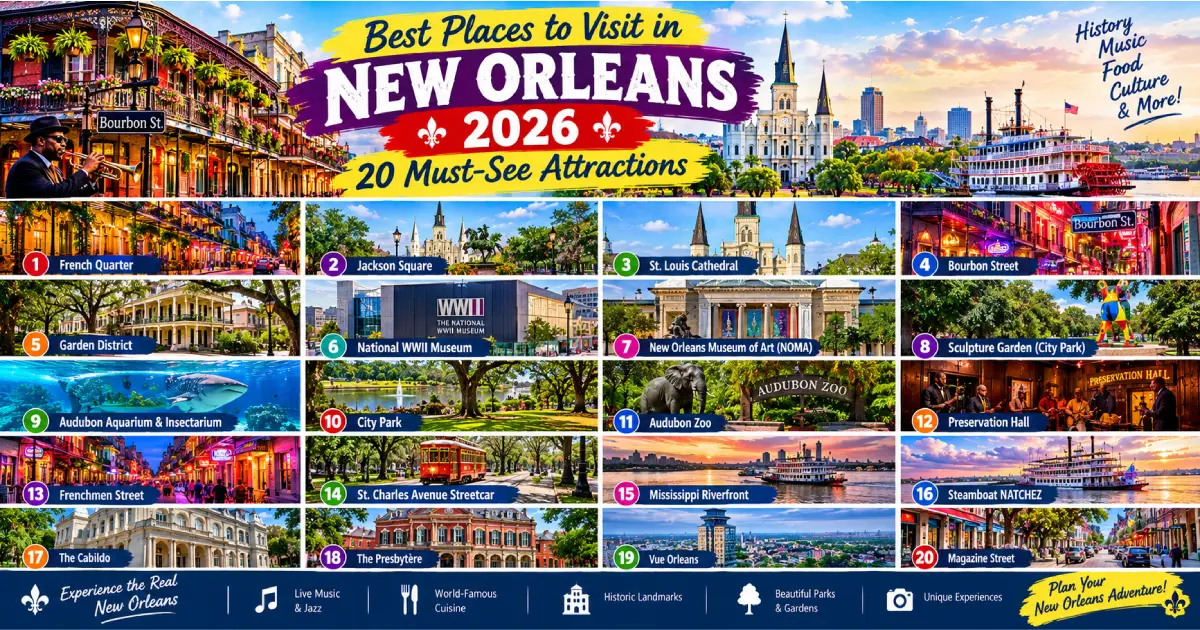
New Orleans packs more genuinely irreplaceable places into a walkable, compact city than any other American destination — a city of approximately 380,000 residents whose 1.3-square-mile French Quarter alone contains more architecturally significant buildings, more historically charged addresses, more specifically music-and-food-defined spaces, and more sheer atmosphere per city block than most American cities achieve across their entire downtown footprint. The best places to visit in New Orleans in 2026 reflect the city’s specific layering: the French Quarter’s 18th and 19th century Creole architecture (the only surviving example of French colonial urban design at this scale and completeness in the United States), the Garden District’s antebellum Greek Revival mansions (the Americans who arrived after the Louisiana Purchase building their own residential district in the architectural tradition of their home states, the result being the most concentrated example of ante-bellum residential architecture in the South), the Tremé’s African American cultural heritage (the oldest continuously inhabited African American neighborhood in America, the birthplace of jazz and the second-line parade tradition), and the Mississippi River itself (the reason New Orleans exists — the most important commercial waterway in North American history, the river whose specific crescent bend gave the city its nickname [the Crescent City] and whose levee system is the reason the city survives below sea level).
What makes New Orleans’ places specifically different from those of other major American cities is their density and their interrelationship — the French Quarter, the Tremé, the Garden District, and the Warehouse Arts District are not isolated attractions requiring car travel between them but walkable, connecting neighborhoods whose specific characters provide the most complete urban-cultural immersion available at any American city destination. Understanding that places in New Orleans are experienced most specifically on foot and most completely across multiple consecutive days (the specific morning character of each neighborhood — the French Quarter hosing down before the tourists arrive, the Garden District quiet under the live oak canopy, the Tremé’s early morning before the tours begin) reveals the city’s character in a way that the list-ticking approach misses entirely.
For related guides, see our Things to Do in New Orleans 2026, Best Restaurants in New Orleans 2026, Best Time to Visit New Orleans 2026, and New Orleans Travel Guide 2026.
| Place | Type | Cost | Best For | Duration |
|---|---|---|---|---|
| French Quarter (Vieux Carré) | Historic Neighborhood | Free | Architecture, atmosphere, culture | Half day–full day |
| Garden District | Historic Neighborhood | Free | Mansions, Commander’s Palace, cemetery | 2–3 hours |
| Lafayette Cemetery No. 1 | Cemetery | Free | Above-ground tombs, Garden District | 45 min |
| St. Louis Cathedral | Cathedral | Free | Historic church, Jackson Square | 30 min |
| Jackson Square | Public Square | Free | Street performers, Pontalba Buildings | 30–45 min |
| National WWII Museum | Museum | $31 | American WWII history | 3–5 hours |
| New Orleans Museum of Art (NOMA) | Museum | $15 | Fine art, sculpture garden | 2 hours |
| Congo Square / Armstrong Park | Historic Site | Free | Music history, civil rights | 30 min |
| Tremé Neighborhood | Historic Neighborhood | Free | Jazz origins, second lines | 1–2 hours |
| Frenchmen Street | Music District | Free–$15 | Live music nightly | Evening |
| Preservation Hall | Music Venue | $20–$35 | Traditional jazz | 45 min show |
| St. Louis Cemetery No. 1 | Cemetery | Free with tour ($20) | Most famous NOLA cemetery | 1 hour |
| City Park | Urban Park | Free | NOMA, botanical garden, oak trees | 2–3 hours |
| Audubon Park | Urban Park | Free | Live oaks, Audubon Zoo | 1–2 hours |
| Magazine Street | Shopping Street | Free to browse | 6 miles of shops, cafés | Half day |
| Crescent Park | Riverfront Park | Free | Mississippi River views | 1 hour |
| Warehouse Arts District | Arts District | Free to explore | Galleries, WWII Museum, dining | 2–3 hours |
| Bywater Neighborhood | Creative Neighborhood | Free | Street art, restaurants, local life | 1–2 hours |
| Oak Alley Plantation | Historic Site | $25–$35 | 300-year-old live oak alley | Half day (day trip) |
| Steamboat Natchez Wharf | Riverfront | $42–$55 | Mississippi River, history | 2 hours |
Cost: Free to explore | Access: Walking from most downtown hotels; streetcar on Canal Street | Best time: Early morning (7–9 AM) and evening | Duration: Half day minimum; full day for complete exploration | Year-round
The French Quarter (the Vieux Carré — the “old square,” the original 1718 city plat established by Jean-Baptiste Le Moyne de Bienville that survives as the most complete example of French and Spanish colonial urban architecture in the United States) is the foundation upon which every New Orleans experience rests. The 13 x 6 block grid of the Quarter — bounded by the Mississippi River, Canal Street, North Rampart Street, and Esplanade Avenue — contains within it the full range of New Orleans experience: the historic (the St. Louis Cathedral and the Cabildo representing the oldest continuously active religious and governmental institutions in the Mississippi Valley), the musical (Preservation Hall’s traditional jazz, the bars whose live music spills onto Bourbon Street), the culinary (Antoine’s, Galatoire’s, Arnaud’s, Central Grocery), and the atmospheric (the iron-lace balconies, the hidden courtyards, and the specific New Orleans street energy that the Quarter maintains 24 hours a day in a way that no other American neighborhood replicates).
The Quarter’s specific architectural vocabulary:
The Creole townhouse (the ground-floor commercial space opening directly onto the banquette [New Orleans term for sidewalk], the residential upper floors with the iron-lace balconies projecting over the street) represents the most concentrated surviving example of French-colonial-adapted-by-Spanish-reconstruction urban architecture in North America. The specific iron-lace tradition (the cast iron and wrought iron balcony railings, columns, and galleries that proliferate throughout the Quarter — the result of rebuilding after the two major fires [1788 and 1794] that destroyed the original French wood-frame construction, the Spanish colonial administration’s rebuilding using the local ironwork tradition that enslaved African craftsmen developed) creates the visual signature that makes the French Quarter immediately recognizable to anyone who has spent even a single afternoon there.
The Quarter by time of day:
Early morning (6–9 AM): The Quarter’s most locally-populated hours — the hosing down of Bourbon Street’s previous night (the municipal cleaning crews working systematically through the entertainment district before the tourist flow begins), the coffee at Café Du Monde with the river breezes before the day’s heat builds, and the architecture visible without the crowd obscuring the building facades. The specific morning light on the Royal Street ironwork (the low-angle sun raking across the balcony details from the east) is the most photographically complete version of the French Quarter visual.
Mid-morning to afternoon: The tourist peak — the walking tours departing from Jackson Square, the Bourbon Street bars opening for brunch service, and the French Market active with its vendor mix. The best strategy: the interior attractions (St. Louis Cathedral, the Cabildo, the Old Ursuline Convent) during the heat of the afternoon when the exterior is least pleasant.
Evening and night: The Quarter’s most specifically famous incarnation — the Bourbon Street entertainment district in full operation, Preservation Hall’s nightly shows, and the specific interplay of the formal restaurant culture (the white tablecloth service at Antoine’s and Galatoire’s) with the informal street culture (the daiquiri bars, the Lucky Dog carts, and the street musicians) that coexist within the same few blocks.
Key French Quarter streets:
Royal Street: The most architecturally distinguished Quarter street — the antique shops, art galleries, and fine-dining restaurants in the most elaborately ironworked Creole townhouses, the streetcar tracks (removed in the 1960s but the rail pattern visible in the paving) providing a specific historical layer beneath the street surface. The Royal Street musical tradition (the street musicians who perform on the Royal Street banquette during the daytime hours, the acoustic environment created by the narrow street canyon amplifying their sound) provides a specifically musical urban walking experience.
Chartres Street: The historical spine of the French Quarter — the St. Louis Cathedral, the Cabildo, the Presbytère, the Napoleon House (the 1797 mansion whose owner offered it as a New Orleans residence for Napoleon Bonaparte, an offer that reached Napoleon but that circumstances prevented his accepting), and the Old Ursuline Convent (the oldest surviving building in the Mississippi Valley, 1752) all on or immediately adjacent to Chartres Street in a single walkable sequence.
Bourbon Street: The most famous and most specifically complicated French Quarter street — the entertainment district’s neon and noise (the clustered bars, the open-container culture, the daiquiri dispensaries, and the specific social energy of Bourbon Street after dark) occupying the street surface while the upper stories maintain their specific 19th-century residential character. Bourbon Street in the daytime (the specific quiet before 4 PM, the architecture visible above the bar signs, and the occasional glimpse of the courtyard gardens through open gates) reveals the specific residential scale that the evening obscures.
Insider tips: The French Quarter’s most extraordinary spaces are invisible from the street — the interior courtyards (porte-cochères [carriage passages] through the ground floor leading to walled courtyard gardens) of the Creole townhouses visible only when a gate stands open. The Hermann-Grima House (820 St. Louis Street, guided tours available), the Beauregard-Keyes House (1113 Chartres Street), and the Cornstalk Hotel (915 Royal Street) all provide courtyard access — the walled gardens with their banana trees, bougainvillea, and wrought-iron fountains representing the most specifically Mediterranean spaces in New Orleans.
Cost: Free | Location: Decatur Street at St. Peter Street, French Quarter | Hours: Cathedral daily 8 AM–4 PM | Duration: 30–45 minutes | Year-round
Jackson Square (the park named for Andrew Jackson, whose 1815 Battle of New Orleans victory is commemorated by the Clark Mills equestrian statue at the park’s center — the first equestrian statue cast in the United States in which both hind legs are off the ground [previously considered an engineering impossibility], the specific audacity of the casting reflecting the triumph it commemorates) is the visual and civic heart of the French Quarter: the Cathedral’s triple steeples rising behind the square to the north, the Pontalba Buildings flanking the east and west sides, the Mississippi River visible to the south beyond the Decatur Street traffic and the Moonwalk levee promenade.
The St. Louis Cathedral: The most continuously active Catholic church in the United States (in religious use since 1727, the current building dating from 1850 — the third structure on the site after the 1788 and 1794 fires destroyed the predecessors), the Cathedral’s specific importance in New Orleans’ civic and religious life is visible in its central position in the French Quarter’s urban plan: the city’s founders specifically positioned the Cathedral, the Cabildo (government), and the Presbytère (church administration) in a deliberate expression of the relationship between religious and civil authority that French colonial urban planning consistently expressed.
The Pontalba Buildings: The identical red-brick apartment buildings flanking the Cathedral across Jackson Square’s east and west sides (Upper Pontalba on the St. Ann side, Lower Pontalba on the St. Peter side) were built in 1849–1850 by Baroness Micaela Almonester de Pontalba — the daughter of Don Andrés Almonester y Roxas (the Spanish colonial benefactor who funded the rebuilding of both the Cathedral and the Cabildo after the 1788 fire). The Pontalba Buildings’ cast-iron galleries (the most elaborate single example of New Orleans decorative ironwork — the AP monogram [Almonester-Pontalba] cast into the gallery railings, the foliate and figural panels supporting the gallery floor) set the visual standard for the subsequent development of New Orleans ironwork throughout the uptown neighborhoods.
The street performers: The Jackson Square apron (the brick-paved area between the park’s iron fence and the river-side Decatur Street) maintains New Orleans’ most concentrated assembly of street performance: tarot readers, portrait artists in multiple styles, living statues, traveling musicians, and spontaneous brass band performances creating the most continuously animated public space in the French Quarter throughout the day.
Cost: $20 (guided tour required since 2015 — free solo entry no longer permitted to preserve the tombs from vandalism) | Access: St. Louis Street at Basin Street, just outside the French Quarter | Tours: Multiple operators; book at saveourcemeteries.org | Duration: 1 hour | Year-round
St. Louis Cemetery No. 1 (the oldest surviving cemetery in New Orleans, established 1789 on land immediately outside the original French Quarter boundary — the above-ground burial tradition that defines New Orleans cemetery culture originates here, the high water table making below-ground burial impractical and the subsequent tradition of above-ground brick tombs becoming the most visually distinctive single New Orleans landscape element) is simultaneously the most historically significant and the most architecturally elaborate cemetery in New Orleans: the specifically above-ground “oven tombs” (the wall niches in the cemetery’s perimeter walls, each containing multiple interments in a system that reuses the same niche across generations — the oldest remains pushed to the back as new burials are added, the specific system providing perpetual family tomb access within a finite physical space), the family tombs (the free-standing brick and plaster structures ranging from simple whitewashed vaults to elaborate neo-classical monuments), and the Society tombs (the large communal tombs maintained by the various ethnic benevolent societies — the Portuguese, Italian, and other immigrant communities — that provided burial for their members who couldn’t afford individual family tombs).
The Marie Laveau connection: The tomb identified (with debated certainty) as the burial site of Marie Laveau (the 19th-century Voodoo Queen whose specific influence on New Orleans’ spiritual and cultural life across the mid-19th century was extraordinary — the specific power attributed to her being simultaneously practical [she operated as a hair salon owner with access to New Orleans’ most powerful households] and spiritual [her specific practice of Louisiana Voodoo, a syncretic blend of West African Vodun, Haitian Vodou, and French Creole Catholicism]) is the most visited single tomb in St. Louis Cemetery No. 1 and possibly the most visited single grave marker in the United States.
Homer Plessy and the civil rights connection: The cemetery contains the tomb of Homer Plessy (the New Orleans Creole man whose 1892 deliberate violation of Louisiana’s Separate Car Act — riding in a whites-only railway car to challenge the law — resulted in the Supreme Court’s 1896 Plessy v. Ferguson decision that established the “separate but equal” doctrine and sanctioned Jim Crow segregation for 58 years until Brown v. Board of Education overturned it in 1954). The specific civil rights resonance of Plessy’s tomb (marked since 2022 with a monument acknowledging his role) in the context of a New Orleans cemetery maintained by the historically-Black community creates the most specifically civil-rights-charged single New Orleans historic site.
Cost: Free (self-guided walking) | Access: St. Charles Avenue Streetcar from Canal Street ($1.25) | Best time: Morning (8–11 AM) | Duration: 2–3 hours | Year-round
The Garden District (the uptown neighborhood developed by the American merchant class who arrived after the Louisiana Purchase in 1803 — the specific geographic expression of the cultural separation between the Creole French Quarter society and the American newcomers who built their own residential district on the former plantation lands between the original city and the Faubourg Sainte-Marie) provides the most architecturally spectacular residential neighborhood experience in the American South: the block after block of fully restored Greek Revival, Italianate, and Gothic Revival mansions on First, Second, Third, and Fourth Streets between St. Charles and Magazine.
The Garden District’s specific architectural identity:
The Greek Revival mansion (the white-columned portico, the deep wrap-around gallery, and the mature live oak canopy that the neighborhood’s 19th-century planting has developed into an overhead cathedral of Spanish moss and oak limbs) represents the most specifically American architectural statement available in New Orleans — the deliberate contrast with the French Quarter’s Mediterranean Creole tradition expressing the cultural ambition of the American merchants who wanted their own neighborhood to demonstrate their wealth and their specifically Anglo-American cultural identity.
Key Garden District addresses:
Commander’s Palace (1403 Washington Avenue): The turquoise Victorian restaurant — the most celebrated single New Orleans restaurant address (see Best Restaurants in New Orleans for full dining detail)
The Briggs-Staub House (2605 Prytania Street): The most specifically Gothic Revival building in the Garden District — the pointed arch windows and the crenellated parapet creating a castle-like silhouette that distinguishes it from the Greek Revival majority and that provides the neighborhood’s most specifically atmospheric single building photograph
The Carroll-Crawford House (1315 First Street): The most elaborate single Garden District mansion — the Italianate detailing, the double-gallery facade, and the specific cast-iron fence (one of the finest examples of decorative iron fencing in the neighborhood) creating the most photographically complete Garden District mansion composition
Anne Rice’s former residence (1239 First Street): The Gothic-style house where the vampire author lived and wrote throughout the period of her most celebrated work — the specific connection between the neighborhood’s Victorian-Gothic atmosphere and the fictional New Orleans of Rice’s novels is immediately apparent from the house’s setting among the mature live oaks
Insider tips: The Garden District walking experience is specifically most rewarding on a weekday morning (the neighborhood is primarily residential — the weekend brings tourists and the specific social self-consciousness that tourist presence creates, while the weekday morning provides the neighborhood in its genuinely inhabited character, the gardeners working, the residents walking their dogs, and the specific quiet of a functioning New Orleans residential neighborhood).
Cost: Free | Location: 1400 Washington Avenue (directly across from Commander’s Palace) | Hours: Mon–Fri 7 AM–2:30 PM; Sat 7 AM–noon | Duration: 30–45 minutes | Character: Most atmospheric New Orleans cemetery for non-guided visit
Lafayette Cemetery No. 1 (the Garden District cemetery established 1833 for the American uptown community — the above-ground tomb tradition of St. Louis Cemetery No. 1 maintained here in a more park-like setting, the mature trees (the ancient live oaks, the crepe myrtles, and the oleanders growing within the cemetery enclosure providing shade and a botanical character unusual in a cemetery context) and the Garden District’s specific residential character making it the most accessible single New Orleans cemetery for a self-guided, reflective visit.
The cemetery’s specific film and television identity (the filming location for Anne Rice’s “Interview with the Vampire,” for “Double Jeopardy” [1999], and for various episodes of “NCIS: New Orleans”) makes it familiar to international visitors before they arrive, but the actual physical experience (the compressed space of the tomb rows, the Spanish moss hanging from the cemetery’s live oaks, and the specific quietness of a walled cemetery in the middle of a residential neighborhood) exceeds the filmed version’s atmospheric quality.
Cost: $1.25 (exact change) | Route: Canal Street to Carrollton Avenue, through the Garden District and Uptown | Hours: 24 hours | Duration: Full route approximately 50 minutes one-way | Character: National Historic Landmark — the oldest continuously operating street railway system in the world (since 1835)
The St. Charles Avenue Streetcar (the olive-green car that has been operating on the St. Charles Avenue route since 1835 — the oldest continuously operating street railway system in the world, National Historic Landmark since 1973) provides the most historically continuous single public transport experience available in the United States: the wooden seats, the specific mechanical sound of the electric motor and the tracks, and the St. Charles Avenue route (through the CBD, the Garden District, and the Uptown oak canopy that the streetcar passes beneath for the entirety of its uptown stretch) create a transport experience of genuine historic character.
The streetcar as orientation tool: the St. Charles Avenue route from Canal Street through the entire Garden District and Uptown provides the most efficient single introduction to New Orleans’ uptown geography — the CBD, the Lower Garden District, the Garden District proper, the Tulane and Loyola campus area, and the Carrollton residential neighborhood all visible in sequence from the streetcar’s windows.
Cost: Free | Location: Armstrong Park, St. Ann Street at N. Rampart Street, Tremé | Hours: Park open during daylight | Duration: 30 minutes | Historical significance: The most important single site in American music history
(See full description in Things to Do in New Orleans 2026 — the Congo Square section provides the most detailed available treatment of this specific location’s historical significance)
Congo Square (the open field within Armstrong Park where enslaved Africans were permitted to gather on Sundays throughout the French and Spanish colonial period — the only such gathering space permitted in colonial North America, the specific legal protection of the Louisiana Code Noir providing the opening for the maintenance of African musical traditions that subsequently became jazz, blues, and R&B) is the most historically important single outdoor space in American music history.
Armstrong Park context: The park (named for Louis Armstrong, born in the Tremé in 1901) surrounds Congo Square within a public green space that also contains the Mahalia Jackson Theater for the Performing Arts (the performance venue named for the New Orleans-born gospel singer who became the most important gospel voice in American music history) and various monuments to the New Orleans musical tradition. The park’s specific design (the winding paths through the oak trees, the lagoon reflecting the park’s vegetation, and the specific quietness of a park that sits immediately adjacent to the French Quarter’s busiest edge without sharing its character) creates the most contemplative single New Orleans outdoor space.
Cost: Free | Access: Walking from the French Quarter (5 min across Rampart Street) | Duration: 1–2 hours | Character: America’s oldest African American neighborhood, jazz birthplace
The Tremé (the neighborhood occupying the land between the French Quarter’s Rampart Street boundary and the Esplanade Avenue boundary with the Marigny — the historic community of free people of color whose specific cultural and social position in 19th-century New Orleans created the conditions for jazz’s development) is the most historically significant neighborhood in American music history and the most specifically charged single New Orleans walking experience for visitors who understand what they’re walking through.
The Tremé walking circuit:
St. Augustine Church (1210 Governor Nicholls Street): Founded 1842 by the Tremé community’s free people of color — the oldest African American Catholic church in the United States, the specific congregation whose cultural and social life provided the formal institutional foundation for the music and cultural practices that the Tremé neighborhood subsequently generated
The Backstreet Cultural Museum (1116 Henriette Delille Street): The most essential single New Orleans museum for understanding the city’s music and cultural traditions — the Mardi Gras Indian suits (the handmade beaded and feathered costumes of the Black Mardi Gras Indian tradition, each suit requiring hundreds of hours of construction and costing $10,000–$30,000, destroyed after each Mardi Gras and rebuilt for the next), the second-line parade documentation, and the jazz funeral tradition materials provide the most comprehensive available encounter with the specifically African American New Orleans cultural traditions that the mainstream tourism industry underrepresents
Tremé Creole Gumbo Festival (November): The annual free music and food festival in Armstrong Park celebrating the Tremé’s food and music traditions — the most specifically local of New Orleans’ annual festivals and the event most specifically attended by the Tremé community itself
Cost: Free (street); $5–$15 cover charges at specific clubs | Location: Frenchmen Street, Marigny neighborhood | Best time: 9 PM–2 AM | Season: Year-round
(See full description in Things to Do guide — this is the most important music destination in New Orleans for visitors seeking the living tradition rather than the tourist-facing version)
Frenchmen Street provides the most concentrated live-music density of any street in the United States — the simultaneous operation of 10+ clubs within a three-block stretch creating an outdoor music environment in the street between the venues that is as specifically New Orleans as any single enclosed space in the city.
Cost: $31 adults | Location: 945 Magazine Street, Warehouse District | Hours: Daily 9 AM–5 PM | Duration: 3–5 hours | Awards: TripAdvisor’s #1 Museum in the USA multiple years
(See full description in Things to Do guide)
America’s official World War II museum — consistently ranked among the finest history museums in the world, the Beyond All Boundaries 4D cinema (narrated by Tom Hanks), and the specific New Orleans connection (the Higgins landing craft, designed and built in New Orleans, used in virtually every Pacific and European amphibious operation) creating the most internationally significant museum experience in Louisiana.
Cost: $15 (museum); Free (sculpture garden) | Location: City Park | Hours: Tuesday–Sunday 10 AM–5 PM | Duration: 2 hours (museum); 1 hour (sculpture garden)
NOMA (the New Orleans Museum of Art in City Park’s Beaux-Arts building) and the adjacent Sydney and Walda Besthoff Sculpture Garden (the 5-acre outdoor sculpture collection — free admission, the most beautiful outdoor public art space in Louisiana, the 90 sculptures by Rodin, Miró, Henry Moore, and contemporary artists placed among the live oaks and lagoons of City Park in a specifically New Orleans landscape setting) together provide the most complete fine arts experience in New Orleans: the French and American Impressionist holdings inside (with the specific Degas-New Orleans connection — the artist spent 5 months in New Orleans in 1872–73 and the museum’s documentation of this stay is the most complete available), and the outdoor sculpture collection outside providing the most specifically contemplative public art space in the city.
The sculpture garden specifically: The Besthoff Sculpture Garden’s free admission (no museum ticket required for the outdoor collection) makes it one of the finest free single New Orleans attractions — the specific combination of the sculpture collection’s quality (the Rodin bronze, the Miró painted bronze, and the various contemporary works placed throughout the garden’s 5 acres) with the City Park live oak setting (the 800-year-old Dueling Oaks at the garden’s edge, the Spanish moss, and the lagoon reflections) creating a specifically beautiful New Orleans outdoor experience at no cost.
Cost: $15 | Location: 925 Camp Street, Warehouse District | Hours: Wednesday–Monday 10 AM–5 PM (Thursday until 8 PM) | Special: Ogden After Hours — Thursday evenings with live music and bar service
The Ogden Museum of Southern Art (the museum dedicated specifically to visual art from the American South — the most comprehensive single collection of Southern painting, sculpture, photography, and folk art available at any museum in the region, the Clementine Hunter folk paintings [the Louisiana plantation worker whose self-taught visual art constitutes one of the 20th century’s most extraordinary bodies of American folk painting] being the collection’s most specifically irreplaceable holding) provides the most focused engagement with the specific visual art tradition that the American South has generated — a tradition that the major national museums consistently underrepresent relative to its actual quality and significance.
Ogden After Hours: The Thursday evening programming (5–8 PM — live music in the museum atrium, bar service, and the permanent collection accessible in the evening’s specific atmospheric lighting) provides the most specifically New Orleans museum experience available: art, live music, and cocktails in a single sustained evening event.
Cost: Free | Location: 1 Palm Drive | Hours: Dawn to dusk | Size: 1,300 acres | Best time: Morning | Season: Year-round
City Park (the 1,300-acre public park in the Mid-City neighborhood — larger than New York’s Central Park, established 1854 on the former Allard Plantation land) provides New Orleans’ most complete outdoor urban experience: the Dueling Oaks (the group of live oak trees estimated at 800+ years old, their massive limbs extending horizontally in the specific form that ancient Southern live oaks develop, the Spanish moss hanging from every branch creating the most atmospherically Southern landscape in the city), the City Park lagoons (the canal and lagoon system running through the park’s southern section, the rowing boats available for rental on weekend mornings providing the most peaceful water access in New Orleans), the New Orleans Botanical Garden (the 10-acre Depression-era WPA garden featuring the most complete single collection of Louisiana-climate ornamental plantings available at any public garden in the state), and the Carousel Gardens Amusement Park (the 1906 Carousel — a National Historic Landmark, the most specifically historic single amusement ride in Louisiana, the hand-carved horses and the original mechanical calliope maintained in operational condition).
Insider tips: City Park in the early morning (before 9 AM) provides the most specifically local New Orleans outdoor experience — the joggers, the dog walkers, and the various New Orleans residents who use the park as a daily outdoor space rather than an attraction, the morning light on the Dueling Oaks creating the most dramatically lit version of the ancient trees available at any time of day.
Cost: Park free; Zoo $22 | Location: 6500 Magazine Street, Uptown | Hours: Park dawn to dusk; Zoo daily 10 AM–5 PM | Access: St. Charles Streetcar to Audubon stop
Audubon Park (the 350-acre Uptown park between St. Charles Avenue and the Mississippi River — named for the naturalist John James Audubon, who spent significant time in Louisiana documenting the specific bird species of the Louisiana bayou country that populate the Birds of America series) provides the most specifically Uptown New Orleans outdoor experience: the walking and jogging path that circuits the park’s live-oak-canopied interior (the specific Uptown residential character of the surrounding neighborhood visible through the park’s open boundaries), the golf course (the oldest public golf course in Louisiana), and the Audubon Zoo (the most nationally recognized single New Orleans cultural institution by visitor surveys — the Louisiana Swamp exhibit [the specifically Louisiana habitat recreation, including alligators in a naturalistic setting, Louisiana birds, and the specific cypress-and-swamp plant community] being the zoo’s most specifically New Orleans offering).
Cost: Free | Location: Chartres Street at Mazant Street, Marigny/Bywater | Hours: Dawn to dusk | Duration: 1 hour | Character: The best Mississippi River access in the city
Crescent Park (the riverfront linear park running along the Mississippi’s east bank from the Marigny through the Bywater — opened 2015, the most comprehensively designed public riverfront access in New Orleans, the specific design [the elevated pedestrian bridge providing a dramatic entrance from Chartres Street to the river level, the river-edge promenade providing views of the Mississippi’s full width, and the Rusty Rainbow Bridge providing both a viewing platform and an historic industrial artifact in the former railroad bridge frame]) provides the finest public Mississippi River experience available in New Orleans: the river’s specific scale visible from the promenade (the 300-meter-wide brown river, the cargo ships passing at close range, and the Louisiana’s specific flat horizon visible across the opposite bank creating the most immediate encounter with the geographic fact that defines New Orleans — its position at the foot of the continent’s primary drainage system).
Cost: Free to explore | Location: Between the French Quarter and the Garden District, centered on Magazine Street, Julia Street, and Camp Street | Duration: 2–3 hours | Best time: Thursday (Ogden After Hours) and Saturday (galleries open)
The Warehouse Arts District (the former commercial warehouse neighborhood between the French Quarter and the Garden District that has been progressively converted to galleries, restaurants, and cultural institutions since the 1984 World’s Fair used the area as its primary venue) provides New Orleans’ most specifically contemporary cultural experience: the Julia Street gallery corridor (the concentration of contemporary art galleries on Julia Street constituting the most significant single gallery street in the Gulf South), the National WWII Museum, the Ogden Museum of Southern Art, and the Contemporary Arts Center (the performing arts and visual art venue in a converted warehouse whose programming constitutes the most adventurous single New Orleans contemporary arts program).
The Julia Street gallery corridor: On the first Saturday of each month (the New Orleans Arts District Gallery Night — galleries open late, wine served, the specific gallery-hopping culture that New Orleans’ contemporary art community maintains on this specific evening), the Julia Street galleries provide the most concentrated engagement with New Orleans’ contemporary visual art scene available at any single event.
Cost: Free | Access: Walk from the French Quarter (25 min) or Uber | Duration: 1–2 hours | Character: Artists, chefs, the most specifically creative New Orleans neighborhood
The Bywater (the neighborhood immediately downriver from the Marigny — historically a working-class Creole community, now the most specifically creative New Orleans neighborhood, the shotgun houses converted to studios, restaurants, and the specific Bywater small-business mix that includes Bacchanal Wine, the Bywater Brew Pub, and the various independent coffee shops and specialty retail that the neighborhood’s creative-class influx has supported) provides the most specifically non-tourist New Orleans neighborhood experience: the street art (the murals covering the walls of the converted shotgun houses throughout the neighborhood, the most concentrated single outdoor mural collection in New Orleans), the food (Bacchanal, Maurepas Foods, and the Joint representing three of the finest neighborhood restaurants in the city), and the specific Bywater pace (slower than the French Quarter, more residential in character, more specifically reflective of the actual New Orleans that residents inhabit rather than the performance of New Orleans that the tourist-facing spaces present).
Cost: $25–$35 | Location: Vacherie, Louisiana (60 miles west of New Orleans) | Access: Organized day trips from New Orleans; rental car | Duration: 2–3 hours on site | Season: Year-round | Historical context: Significant discussion of enslaved labor required
Oak Alley Plantation (the antebellum sugar plantation on the Mississippi River Road west of New Orleans — the 28 three-hundred-year-old live oak trees forming the quarter-mile alley from the river levee to the Greek Revival mansion creating the most cinematically recognized single Louisiana plantation landscape) provides the most specifically atmospheric antebellum plantation landscape accessible as a day trip from New Orleans. The property’s current interpretation (the plantation’s educational program, significantly updated in recent years, now specifically centering the experience of the enslaved people who built and worked the plantation — the slave quarters, the Enslaved People’s Memorial, and the specific educational programming addressing the plantation economy’s human cost) provides a more historically complete and more morally honest plantation visit than the “moonlight and magnolias” tourism that the earlier interpretation offered.
Cost: $35–$55 | Access: 45-minute drive from New Orleans | Duration: 2 hours on water | Season: Year-round | Wildlife: Alligators, herons, egrets, roseate spoonbills, turtles
(See full description in Things to Do guide)
The Louisiana swamp tour (the flat-bottomed boat into the cypress swamp and bayou landscape that surrounds New Orleans — the alligators, the Spanish-moss cypresses, and the specific Louisiana bayou ecology providing the most immediately non-urban natural experience available within day-trip distance of the city) is the single most consistently recommended New Orleans day activity for visitors who have never experienced the Louisiana wetland environment.
About Travel Tourister Travel Tourister’s destination specialists have explored every neighborhood in this guide across multiple New Orleans visits — from French Quarter morning architecture walks before the crowds arrive and Jackson Square sunset tarot-reader observations through Garden District live-oak canopy streetcar rides and Lafayette Cemetery self-guided wanderings to Congo Square historical mediations, Tremé Backstreet Cultural Museum Mardi Gras Indian suit encounters, Frenchmen Street Spotted Cat jazz nights, NOMA sculpture garden early morning walks, and Crescent Park Mississippi River afternoon contemplations — to deliver the most honestly researched and most practically useful guide to New Orleans’ best places for 2026 visitors.
Posted By : Vinay
Latest Article
2nd Floor, 39, Above Kirti Club, DLF Industrial Area, Kirti Nagar, New Delhi, Delhi 110015



Travel Tourister is a leading Travel portal where we introduce travellers to trusted travel agents to make their journey hasselfree, memorable And happy. Travel Tourister is a platform where travellers get Tour packages ,Hotel packages deals through trusted travel companies And hoteliers who are working with us across the world. We always try to find new and more travel agents and hoteliers from every nook and corners across the world so that you could compare the deals with different travel agents and hoteliers and book your tour or hotel with the one you have chosen according to your taste and budget.
Copyright © Travel Tourister, India. All Rights Reserved

 Call
Call Enquiry