Published on : 15 Sep 2026
By Travel Tourister | Updated Sep 2026
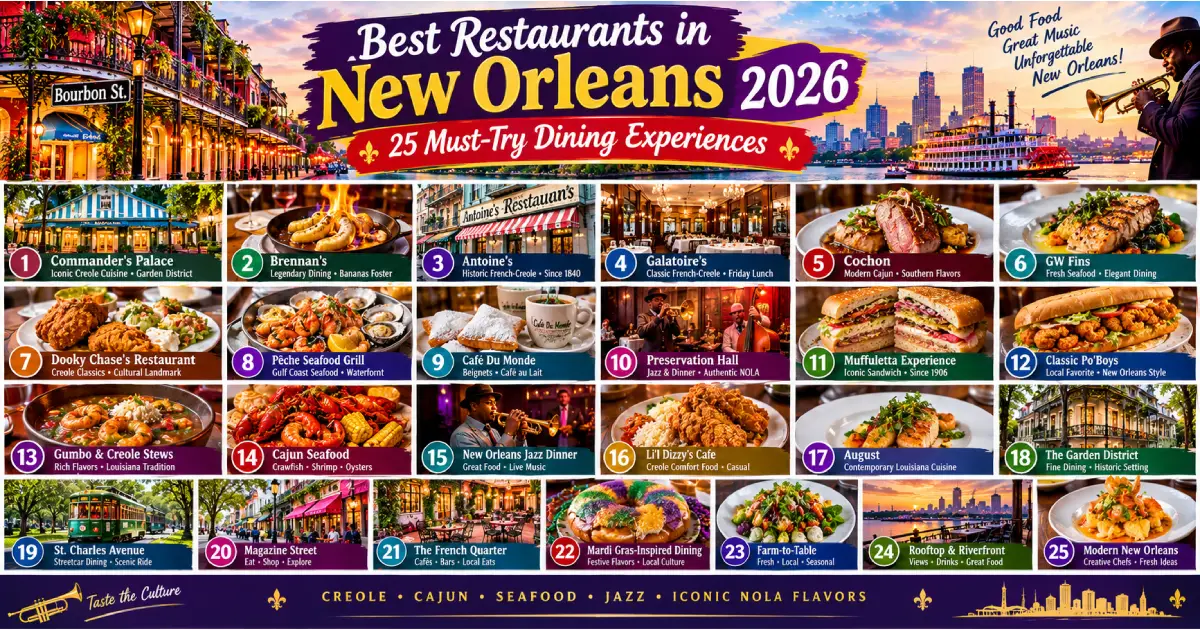
New Orleans has the most distinctive and most specifically irreplaceable regional food culture in the United States — a culinary identity so deeply rooted in the specific convergence of French haute cuisine technique, Spanish seasoning traditions, African ingredient knowledge and cooking methods, Caribbean spice culture, and the extraordinary natural pantry of the Louisiana Gulf and bayou system that it cannot be replicated outside the city and cannot be understood without tasting it in the specific context of the city’s dining culture. The best restaurants in New Orleans in 2026 span the full spectrum of this food tradition: the grand Creole institutions (Antoine’s, Galatoire’s, Arnaud’s, Commander’s Palace — the restaurants that have been serving the specific haute Creole preparations for 100+ years, the turtle soup, the pompano en papillote, the Oysters Rockefeller, and the bread pudding soufflé in the specific formal dining room environments that their histories have created), the neighborhood lunch counters and plate lunch spots (the most authentically local New Orleans food experiences — the Monday red beans and rice, the daily special, and the specific Creole soul food tradition that no grand restaurant exactly replicates), and the generation of chefs who have defined post-Katrina New Orleans cooking (the specific culinary ambition of a food culture that survived a catastrophe and emerged more specifically itself than before, the new generation’s engagement with traditional ingredients in contemporary formats creating the most exciting single American regional restaurant scene of the past two decades).
Understanding New Orleans restaurants requires understanding several specific local dining concepts: the plate lunch (the inexpensive daily-special lunch — a main course, two sides, and cornbread or rolls for $10–$15, served at the lunch counters and neighborhood restaurants that maintain the city’s working-class food tradition), the po’boy (the French bread sandwich that is New Orleans’s most democratic dining institution, the shrimp, oyster, roast beef, or catfish versions all candidates for the best single sandwich in the United States), the jazz brunch (the Saturday–Sunday tradition of the grand Creole restaurants — the live jazz band circulating through the dining rooms, the Bloody Mary bar, the 25-cent martinis at Commander’s Palace, and the specific festive dining atmosphere that New Orleans weekend brunch has developed into the most celebratory single meal format in American restaurant culture), and the specific question of which day to eat red beans and rice (Monday — the tradition going back to the 19th-century practice of slow-cooking the beans while washing laundry, the Monday red beans available at restaurants throughout the city in a way that no other day matches).
For related guides, see our Things to Do in New Orleans 2026, Places to Visit in New Orleans 2026, Best Time to Visit New Orleans 2026, and New Orleans Travel Guide 2026.
| Restaurant | Category | Price | Best For | Reservation? |
|---|---|---|---|---|
| Commander’s Palace | Grand Creole | $$$$ | Jazz brunch, turtle soup | Yes (weeks ahead) |
| Galatoire’s | Grand Creole | $$$$ | Friday lunch tradition, Creole classics | Yes (or walk-in Friday) |
| Antoine’s | Historic Creole | $$$$ | Oysters Rockefeller birthplace, history | Yes |
| Dooky Chase | Soul Food/Creole | $$$ | Civil Rights history, fried chicken | Yes |
| Brigsten’s | Contemporary Creole | $$$ | Chef Frank Brigsten, intimate, uptown | Yes |
| Shaya | Israeli/Mediterranean | $$$ | James Beard winner, Alon Shaya | Yes |
| Compère Lapin | Caribbean Creole | $$$ | Chef Nina Compton, creative fusion | Yes |
| Peche Seafood Grill | Gulf Seafood | $$$ | Donald Link, wood-fire, oysters | Yes |
| Cochon | Louisiana Rustic | $$$ | Boudin, cracklins, heritage pork | Yes |
| Coquette | Modern Creole | $$$ | Best value fine dining in NOLA | Yes |
| Café Du Monde | Café/Beignets | $ | Beignets, café au lait, 24 hrs | No |
| Café Reconcile | Soul Food | $ | Plate lunch, workforce training | No |
| Domilise’s Po’Boys | Po’Boy | $ | Best shrimp po’boy in the city | No |
| Parkway Bakery | Po’Boy | $ | Best roast beef po’boy | No |
| Central Grocery | Muffuletta | $ | Original muffuletta since 1906 | No |
| Willie Mae’s | Fried Chicken | $$ | James Beard America’s Classic | No |
| Dooky Chase | Soul/Creole | $$$ | Historic, Leah Chase legacy | Yes |
| Bacchanal Wine | Wine Bar/Casual | $$ | Bywater, outdoor, cheese plates | No |
| Molly’s Rise and Shine | Brunch | $$ | Best brunch in the Marigny | No |
| Mother’s Restaurant | Plate Lunch | $$ | Debris po’boy, downtown institution | No |
| Drago’s Seafood | Charbroiled Oysters | $$ | Best charbroiled oysters in the USA | No |
| GW Fins | Upscale Seafood | $$$$ | Finest fish preparations in NOLA | Yes |
| Herbsaint | Bistro Creole | $$$ | Donald Link’s original, best value | Yes |
| Lilette | French-Creole | $$$ | Magazine Street, quiet, excellent | Yes |
| Clancy’s | Neighborhood Creole | $$$ | Most beloved local Uptown restaurant | Yes |
Price Guide: $ = under $20/person | $$ = $20–$40 | $$$ = $40–$70 | $$$$ = $70+
Address: 1403 Washington Avenue, Garden District | Price: $$$$ | Hours: Lunch Mon–Fri; Dinner nightly; Jazz Brunch Sat–Sun | Reservations: Essential — commanderspalace.com | Dress code: Smart casual (jackets preferred)
Commander’s Palace is New Orleans’ most celebrated restaurant and the single most important address in the history of American Creole cooking — the turquoise Victorian mansion in the Garden District has been operating since 1893 and has trained more significant American chefs than any other single restaurant (Paul Prudhomme, Emeril Lagasse, Jamie Shannon, Tory McPhail, and dozens of others all coming through Commander’s kitchen in the specific Creole tradition that the Brennan family has maintained since acquiring the restaurant in 1974).
The specific Commander’s Palace identity: the restaurant occupies the middle ground between formal French haute cuisine and authentic New Orleans Creole home cooking more specifically than any other New Orleans restaurant — the turtle soup au sherry (the dark, rich, fortified soup served with a small bottle of dry sherry to add tableside — the most specifically Commander’s single dish), the Gulf fish preparations (the relationship with specific Louisiana Gulf fishermen providing fish that most other New Orleans restaurants can’t access), and the bread pudding soufflé (the dessert that Commander’s kitchen developed and that has been imitated throughout New Orleans without being matched) together constitute the most specific Commander’s Palace experience.
The Saturday and Sunday Jazz Brunch: The most specifically New Orleans single dining event available — the live jazz band moving table to table through the dining rooms while the kitchen serves its most ambitious brunch menu, the 25-cent martini (the restaurant’s specific tradition, three martinis per person at 25 cents each — a literal nod to the pre-Prohibition drinking culture), and the specific festive energy of Commander’s brunch (the dining rooms filling with New Orleans locals celebrating birthdays, anniversaries, and the general pleasure of being alive in New Orleans on a Sunday morning) creating the most celebratory single meal experience in the city.
What to order:
Insider tips: The upstairs Garden Room (the glass-enclosed upper dining room overlooking the live oak tree in the courtyard) is the most atmospheric single dining position in the restaurant — request it specifically when booking. The Friday lunch (less crowded than the weekend brunch, equally excellent kitchen execution) provides Commander’s Palace at its most relaxed and most specifically food-focused.
Address: 209 Bourbon Street, French Quarter | Price: $$$$ | Hours: Dinner Tue–Sun; Lunch Fri–Sun | Reservations: Accepted for upstairs only; downstairs first-come-first-served | Dress code: Smart casual to jacket required (Friday lunch traditionally formal)
Galatoire’s (operating continuously on Bourbon Street since 1905, the same ground-floor dining room essentially unchanged from the pre-air-conditioning era — the mirrored walls, the bentwood chairs, the white tablecloths, and the specific relationship between longtime regulars and their assigned waiters [some of whom have worked the same tables for 30+ years]) represents the most specifically preserved single example of French Creole restaurant culture in New Orleans: a restaurant whose food, service, and atmosphere have not been significantly modified in response to culinary fashion changes across 120 years of operation.
The Friday Lunch Institution: The Galatoire’s Friday lunch is the most specifically New Orleans social institution in the restaurant world — the downtown business community’s weekly celebration, the waitlist for downstairs (first-come, first-served — lines form from 10 AM for the 11:30 AM opening) driven by the specific culture of regulars who have been eating the same Friday lunch at the same table served by the same waiter for decades, the occasion typically extending through the afternoon with successive rounds of wine and continued ordering. The specific Friday afternoon Galatoire’s energy (the increasing noise level as the wine continues, the spontaneous singing that occasionally breaks out from the tables of longtime regulars, and the gradual transformation of the dining room from a restaurant into something closer to a salon) is a genuinely irreplaceable New Orleans cultural experience.
What to order:
Address: 713 St. Louis Street, French Quarter | Price: $$$$ | Hours: Lunch Mon–Sat; Dinner Mon–Sat | Reservations: Yes — antoines.com | Est.: 1840 — the oldest family-operated restaurant in the United States
Antoine’s (the oldest family-operated restaurant in America, in continuous operation at 713 St. Louis Street since 1840 — the current fifth-generation Alciatore family maintaining the restaurant whose first chef, Antoine Alciatore, created Oysters Rockefeller in 1899 [the specific dish whose original recipe is kept secret to this day, the only variation published being that Alciatore used a sauce so rich it was named for the richest man in America at the time, John D. Rockefeller, and that it contains no spinach despite every non-Antoine’s version using spinach]) provides the most historically specific New Orleans restaurant experience available: the 15 dining rooms (the Rex Room, the Proteus Room, the 1840 Room, and the various other formal rooms each decorated with the Mardi Gras regalia of the specific krewe whose royalty has traditionally dined there), the specific waitstaff tradition (many longtime Antoine’s waiters speak French as well as English, maintaining the restaurant’s specific French Creole service tradition), and the menu that has changed minimally since the 19th century.
What to order:
Address: 2301 Orleans Avenue, Tremé | Price: $$$ | Hours: Lunch Tue–Fri; Dinner Tue–Sat | Reservations: Yes | Historical significance: The dining room where the Civil Rights movement planned its New Orleans strategy
Dooky Chase’s (the restaurant founded in 1941 by Dooky Chase Sr. and elevated to its legendary status by his daughter-in-law Leah Chase — the chef who died in 2019 at age 96 after 70+ years of cooking in the same kitchen) is the single most historically significant restaurant in the American civil rights movement: the dining room where Martin Luther King Jr., Thurgood Marshall, and other movement leaders met to plan New Orleans strategy during the period when the city’s segregation laws prohibited interracial dining in other public spaces, and where Leah Chase quietly served both white and Black diners through the Jim Crow period in defiance of the law she believed was wrong.
Leah Chase’s cooking (the specific Creole soul food tradition she maintained — the fried chicken [the most celebrated single Leah Chase dish], the stuffed shrimp, and the specifically African-influenced gumbo z’herbes [the seven-greens Mardi Gras gumbo traditionally served on Holy Thursday] that she kept on the Thursday lunch menu throughout her career) continues under her family’s stewardship with specific fidelity to her recipes and her philosophy.
What to order:
The art collection: Dooky Chase’s dining room also houses one of the finest collections of African American art in the South — Leah Chase collected art throughout her career, the specific collection (works by Jacob Lawrence, Elizabeth Catlett, and dozens of other significant African American artists) providing the most comprehensive single-location encounter with African American fine art in New Orleans outside of a museum.
Address: 800 Magazine Street, Warehouse District | Price: $$$ | Hours: Lunch and Dinner daily | Reservations: Yes — pecherestaurant.com | Chef: Donald Link and Ryan Prewitt | Awards: James Beard Best New Restaurant 2014
Peche (the wood-fire Gulf seafood restaurant from Donald Link and Ryan Prewitt in the Warehouse District) provides the most specifically Gulf-focused restaurant experience in New Orleans: the entire cooking program built around wood-fire techniques (the wood-burning oven and the wood grill providing the primary heat sources for the kitchen, the specific char and smoke character that wood fire produces distinguishing the preparations from the conventional gas-fire equivalent) applied to the specific fish, shellfish, and crustaceans of the Louisiana Gulf and the broader Gulf of Mexico.
What to order:
Address: 930 Tchoupitoulas Street, Warehouse District | Price: $$$ | Hours: Lunch Mon–Fri; Dinner Mon–Sat | Reservations: Yes | Chef: Donald Link | Awards: James Beard Best Chef South 2007
Cochon (Donald Link’s Louisiana heritage-pork restaurant adjacent to Peche in the Warehouse District) expresses the most specifically Cajun dimension of Louisiana food culture — the boudin (the Cajun rice-and-pork sausage that is the most specifically Louisiana sausage tradition), the cracklins (the fried pork skins in the specific Cajun-seasoned preparation that bears no resemblance to the gas-station convenience store version), and the wood-roasted pig (the heritage-breed whole or half pig preparations that use the specific breeds and feeding protocols that traditional Louisiana farmers maintained before industrial pork production eliminated them) in a restaurant environment that combines genuine rusticity with serious culinary ambition.
What to order:
Address: 535 Tchoupitoulas Street, Warehouse District | Price: $$$ | Hours: Dinner nightly; Brunch weekends | Reservations: Yes — comperelapin.com | Chef: Nina Compton | Awards: James Beard Best Chef South 2018
Compère Lapin (Chef Nina Compton’s restaurant in the Old No. 77 Hotel) provides the most specifically Caribbean-inflected New Orleans restaurant experience — Compton’s St. Lucia background merging with the specific Louisiana Creole tradition she adopted after moving to New Orleans, the resulting cuisine (the conch crostini with pickled vegetables, the curried goat with sweet potato gnocchi, and the various preparations that apply Caribbean spice culture to Louisiana Gulf ingredients) being neither straightforwardly Creole nor straightforwardly Caribbean but specifically the food that Nina Compton’s particular cultural position has produced.
What to order:
Address: 723 Dante Street, Uptown | Price: $$$ | Hours: Dinner Tue–Sat | Reservations: Essential — brigtens.com | Chef: Frank Brigsten | Awards: James Beard Best Chef South 1998
Brigsten’s (Chef Frank Brigsten’s intimate Uptown restaurant in a converted Victorian shotgun double — the 60-seat restaurant where Brigsten has been cooking personal, deeply seasonal Louisiana food since 1986) is the most consistently excellent mid-sized New Orleans Creole restaurant: the menus changing weekly based on what Louisiana’s seasonal calendar provides (the specific autumn crab season, the spring strawberry season from Ponchatoula, and the year-round Gulf Gulf seafood supply all reflected in the constantly rotating menu), and the specific combination of technical precision and genuine warmth creating a dining experience more personal than any of the grand Creole institutions.
What to order:
Address: 2401 St. Ann Street, Tremé | Price: $$ | Hours: Lunch Mon–Sat | No reservations — cash only | Wait: 30–60 min | Awards: James Beard America’s Classic 2005
Willie Mae’s Scotch House (the Tremé neighborhood restaurant that has been serving what the James Beard Foundation designated “America’s Classic” in 2005 — the specific recognition that Willie Mae Seaton’s fried chicken had achieved an irreplaceable status in the national food culture) provides the most specifically celebrated fried chicken in the United States: the specific battered coating (the recipe not publicly shared, the result being a crust of extraordinary crispness that maintains its texture for longer than most fried chicken preparations), the specific seasoning (the salt and pepper and whatever else the Seaton family adds creating the specific flavor that James Beard judges unanimously recognized), and the specific tenderness of the meat beneath the crust (the specific temperature and timing of the Willie Mae’s fry producing the most consistently tender interior of any fried chicken available at a restaurant open to the public).
Practical considerations: Willie Mae’s is a cash-only restaurant with no reservations — the wait (typically 30–60 minutes at peak lunch hours, shorter at 11 AM opening) is genuinely worth it. Bring cash, plan the wait, and order the fried chicken with the red beans and rice and the buttermilk biscuit — the complete Willie Mae’s plate.
Address: 1631 Oretha Castle Haley Boulevard, Central City | Price: $ | Hours: Lunch Mon–Fri | No reservations | Character: Workforce training restaurant
Café Reconcile (the workforce development restaurant that has been training at-risk New Orleans youth in restaurant skills since 1995 — the food subsidized by the mission’s program revenue, the quality maintained at the specific level that trains participants for professional kitchen positions) serves the most specifically authentic New Orleans plate lunch tradition: the rotating daily specials (red beans and rice on Monday, smothered pork chops, fried catfish, and the other rotating preparations that the Creole home-cooking tradition produces), the specific plate-lunch format (a main course, two sides, and cornbread for $12–$15), and the specifically welcoming Central City neighborhood atmosphere creating the most locally authentic lunchroom experience available to visitors who want to eat where New Orleans residents eat.
Address: 5240 Annunciation Street, Uptown | Price: $ | Hours: Mon–Fri 10 AM–7 PM; Sat until 6 PM | Cash only | Access: Streetcar + walk or Uber
Domilise’s (the po’boy counter operating since 1918 from the same converted front-porch Uptown house — the second-generation family maintaining the original setup with the ordering counter at the front and the fry station immediately behind) serves what the most knowledgeable New Orleans food people most consistently identify as the finest shrimp po’boy in the city: the fresh Gulf shrimp in the specific Creole breading (the seasoned cornmeal coating that creates a crust of particular crispness and flavor) on the Leidenheimer bread (the single most important po’boy variable — the New Orleans French bread whose specific crust and crumb provide the structural foundation that makes a New Orleans po’boy different from any imitation).
What to order: The dressed shrimp po’boy, large. “Dressed” means lettuce, tomato, pickle, and mayo — the standard New Orleans po’boy preparation. Add Crystal hot sauce at the counter. Eat immediately on the nearby stoop.
Address: 538 Hagan Avenue, Mid-City | Price: $ | Hours: Wed–Mon 11 AM–10 PM | No reservations
Parkway Bakery (the Mid-City po’boy institution operating since 1911 — the restored neighborhood bakery-and-tavern that serves what New Orleans residents most specifically celebrate as the finest roast beef po’boy in the city) provides the most specifically “debris” po’boy experience available: the debris (the specific New Orleans term for the bits of beef that fall from the roast into the dripping pan during cooking, the accumulated juices and meat pieces serving as both the po’boy’s meat and its gravy) soaking through the Leidenheimer bread in the specific way that makes the Parkway roast beef po’boy a distinctly different — and specifically superior — preparation to any roast beef sandwich available outside New Orleans.
What to order: The roast beef debris po’boy, dressed, large. The gravy must be poured over the bread immediately before eating — the specific moment of gravy-to-bread contact being the most important single timing variable in the Parkway po’boy.
Address: 401 Poydras Street, CBD | Price: $$ | Hours: Daily 7 AM–10 PM | No reservations | Character: Cash-and-carry counter service, lines out the door
Mother’s (the downtown New Orleans institution operating since 1938 — the cafeteria-style restaurant with the lines extending onto Poydras Street during peak hours, the trays loaded with baked ham, jambalaya, red beans, and the specific “Ferdi Special” [the most famous single po’boy in the city — the combination of the house-baked ham and roast beef debris on French bread]) serves the most specifically broad-spectrum New Orleans comfort food menu available at a single counter-service establishment.
What to order: The Ferdi Special (baked ham + roast beef debris, dressed), the jambalaya (the most consistent restaurant version available in the CBD), and the bread pudding with bourbon sauce. Expect a line — it moves faster than it appears.
Address: 3232 N. Arnoult Road, Metairie (original); 2 Poydras Street, CBD (New Orleans location) | Price: $$ | Hours: Lunch and Dinner daily | No reservations needed for bar seating
Drago’s (the restaurant where charbroiled oysters — now a New Orleans institution in their own right — were invented in 1993 by Tommy Cvitanovich) serves the most specifically important single oyster preparation in recent New Orleans food history: the charbroiled oyster (Gulf oysters on the half shell placed directly on the charcoal grill, topped with the specific Drago’s butter [garlic butter, Romano cheese, and herbs applied as the oyster cooks], the oyster’s natural liquor steaming inside the shell as the butter melts and the Romano browns under the heat) has become the most widely imitated New Orleans restaurant preparation of the past three decades and remains most specifically rewarding at its origin.
What to order: Charbroiled oysters by the dozen, with the house French bread for soaking the butter. The raw Gulf oysters (served on ice at the oyster bar in the original Metairie location) alongside the charbroiled versions provide the most complete single-location Gulf oyster experience.
Address: 724 Iberville Street, French Quarter | Price: $$ | Hours: Daily 11 AM–10 PM | No reservations — first come first served | Character: Counter seating at the oyster bar, communal tables
Acme Oyster House (the French Quarter oyster bar operating since 1910 — the specific communal counter seating at the U-shaped oyster bar, the shucker working the raw oysters directly in front of the customer, and the specific Quarter-institution character creating the most immediately accessible oyster experience in the French Quarter) provides the most practically convenient Gulf oyster access for visitors staying in or near the Quarter: the raw Gulf oysters (the specific Louisiana oysters from the Barataria Bay and other Louisiana growing areas whose specific mineral character [brinier and more intensely flavored than Pacific or Atlantic oysters] distinguishes them), the oyster po’boy, and the charbroiled oysters (Acme’s version of the Drago’s preparation) together constituting the most complete oyster menu available at a counter-service French Quarter restaurant.
Address: 600 Poland Avenue, Bywater | Price: $$ | Hours: Daily noon–midnight | No reservations | Character: Wine shop, outdoor bar, live music, cheese plates
Bacchanal Wine (the converted corner store in the Bywater operating simultaneously as a wine shop, an outdoor bar with live music in the courtyard, and a casual kitchen serving cheese plates and small courses) provides the most specifically New Orleans casual food-and-wine experience: the courtyard (the outdoor seating area behind the shop, the musicians playing in the corner while the tables fill with Bywater residents and visitors, the wine available from the shop’s retail shelves at retail plus a small corkage fee), the cheese plates (the most specifically well-curated single cheese selection available at a casual New Orleans establishment), and the kitchen’s small courses (the seasonal preparations that change with availability — the grilled oysters, the charcuterie boards, and the rotating vegetable preparations) together creating the most complete Bywater evening experience at a single address.
Address: 701 St. Charles Avenue, CBD | Price: $$$ | Hours: Lunch Mon–Fri; Dinner Mon–Sat | Reservations: Yes — herbsaint.com
Herbsaint (Donald Link’s first restaurant, opened 2000 — the French-inflected Louisiana bistro that established Link’s culinary identity before Cochon and Peche and that remains the most consistently excellent value among his three restaurants) provides the most approachable fine-dining New Orleans experience: the half-duck with dirty rice (the most specifically celebrated Herbsaint main course — the slow-cooked duck confit leg with the New Orleans dirty rice [rice cooked with chicken livers, gizzards, and the “holy trinity” of onion, celery, and bell pepper] providing the most specifically Louisiana single plate in the Link restaurant group), the spaghetti with Gulf shrimp and pancetta, and the boudin balls (the house-made Cajun boudin formed into spheres and fried, served as an appetizer — the most specifically Herbsaint bar-snack).
Address: 4213 Magazine Street, Uptown | Price: $$$ | Hours: Dinner Tue–Sun; Brunch weekends | Reservations: Yes — shayarestaurant.com | Chef: Alon Shaya | Awards: James Beard Best New Restaurant 2015
Shaya (Chef Alon Shaya’s Israeli restaurant on Magazine Street — the James Beard Best New Restaurant of 2015, the restaurant that most specifically demonstrates how the New Orleans dining culture’s openness to non-Creole culinary traditions has created one of the most diverse and most adventurous restaurant cities in America) serves the most acclaimed Israeli food in the American South: the fresh-baked pita (produced in the wood-burning oven visible from the dining room, served immediately with labne, tahini, and various spreads — the most specifically theatrical single bread moment available at any New Orleans restaurant), the whole-roasted cauliflower (the Shaya signature vegetable preparation), and the hummus (the most celebrated single Shaya dish — the specific texture and flavor of the from-scratch chickpea hummus setting the standard for Middle Eastern hummus preparation in New Orleans).
Address: 2800 Magazine Street, Garden District | Price: $$$ | Hours: Dinner Wed–Sun; Brunch weekends | Reservations: Yes — coquette-nola.com | Chef: Michael Stoltzfus
Coquette (the Garden District restaurant from Chef Michael Stoltzfus — the most consistently lauded mid-sized New Orleans contemporary restaurant for its combination of culinary ambition, seasonal sourcing [the menu changing monthly based on Louisiana farms’ and fisheries’ current output], and value relative to comparable New Orleans fine dining) provides the best price-to-quality ratio in New Orleans fine dining: the specific seasonal menu format (the rotating dishes reflecting the specific Louisiana growing calendar), the knowledgeable and genuinely warm service, and the restaurant’s Magazine Street location (adjacent to the Garden District’s most walkable shopping street, making Coquette a natural dinner conclusion to an afternoon exploring the Garden District) creating the most complete single-evening Garden District dining experience.
Address: 808 Bienville Street, French Quarter | Price: $$$$ | Hours: Dinner nightly | Reservations: Yes — gwfins.com
GW Fins (the French Quarter fine-dining seafood restaurant from Gary Wollerman — the restaurant that receives the specific recognition of New Orleans food professionals as the finest single fish cooking available in the city) provides the most technically accomplished Gulf seafood preparations: the relationship with specific Louisiana Gulf fishermen (the specific species available at GW Fins — the black drum, the redfish, the speckled trout, the wahoo, and the various other Gulf species that the restaurant’s sourcing relationships provide) and the kitchen’s specific precision in fish preparation (the specific temperatures, the specific saucing, and the specific attention to doneness that separates GW Fins from the competent Gulf seafood restaurants that the city also has in abundance).
(See full description in Things to Do in New Orleans 2026)
The essential New Orleans food stop — open 24 hours, always operating, always providing the powdered sugar cloud that is the most specifically New Orleans single eating experience.
Address: 4801 Tchoupitoulas Street, Uptown | Price: $ | Hours: Tue–Sun 1 PM–7 PM | Season: Late spring through early fall only | Cash only | Awards: James Beard America’s Classic 2014
Hansen’s Sno-Bliz (the snowball stand [not snow cone — the New Orleans snowball is a fundamentally different preparation from the snow cone, the ice shaved to a specific ultra-fine texture that absorbs flavored syrup rather than sitting on top of crushed ice] operating from the same Uptown address since 1939 — the third-generation Hansen family maintaining the same hand-built shaving machine that Ernest Hansen invented in 1934 and the same house-made syrups from the same recipes) provides the most specifically New Orleans summer food experience: the combination of Ashley Hansen’s specifically fine ice shave (the machine’s specific setting producing the most cotton-candy-like ice texture in the city) and the house-made syrups (the flavor range including traditional cream of nectar, spearmint, and wedding cake alongside more ambitious preparations) creating the summer afternoon experience that New Orleans residents most specifically seek.
Address: 3025 Magazine Street, Garden District | Price: –– $ | Hours: Daily | Character: Artisan chocolates, gelato, macarons
Sucré (the New Orleans artisan sweets shop operating on Magazine Street, the chocolates and confections providing the most specifically New Orleans-inflected interpretation of French pastry tradition — the pralines [the New Orleans sugar-cream-and-pecan confection that is the city’s most uniquely indigenous sweet, distinct from the French praline and the Southern peanut version], the King Cake gelato [the Mardi Gras flavored frozen dessert], and the macarons) provides the most complete single-address New Orleans confectionery experience.
| Term | Meaning |
|---|---|
| Gumbo | The thick, roux-based stew (chicken and andouille sausage or seafood) that is New Orleans’ most representative single dish |
| Étouffée | Shellfish (typically crawfish or shrimp) smothered in butter and the “holy trinity” — the most specifically Creole preparation |
| Po’boy | The New Orleans French bread sandwich — always on Leidenheimer bread |
| Dressed | Po’boy with lettuce, tomato, pickle, and mayo — the standard preparation |
| Red beans and rice | Monday’s traditional New Orleans lunch — slow-cooked red kidney beans with pickled pork and rice |
| Dirty rice | Rice cooked with chicken livers, gizzards, and the holy trinity — the most specifically Creole rice preparation |
| The Holy Trinity | Onion, celery, and green bell pepper — the flavor base of New Orleans cooking (the Cajun/Creole equivalent of the French mirepoix) |
| Andouille | The smoked Cajun sausage — not the French andouille but a specifically Louisiana smoked pork preparation |
| Tasso | Heavily spiced smoked pork shoulder — used as a seasoning ingredient rather than as a meat course |
| Roux | The cooked flour-and-fat mixture that thickens and flavors gumbo and étouffée — the foundation of Creole cooking |
| Muffuletta | The Central Grocery round-bread sandwich with Italian meats and olive salad |
| Beignet | The square fried dough covered in powdered sugar — New Orleans’ most iconic single food |
| Café au lait | Equal parts strong chicory coffee and hot scalded milk — the New Orleans coffee tradition |
| Debris | The meat and drippings that fall from a roast during cooking — the po’boy filling at Parkway Bakery |
| Snowball | The New Orleans shaved-ice dessert — not a snow cone, the ice shaved to a much finer consistency |
About Travel Tourister Travel Tourister’s destination specialists have eaten their way through New Orleans across multiple visits and all seasons — from Commander’s Palace 25-cent martini jazz brunches and Galatoire’s Friday afternoon extended lunches through Willie Mae’s 45-minute-wait fried chicken plates and Domilise’s dressed shrimp po’boys to Dooky Chase’s Thursday gumbo z’herbes, Peche’s wood-fire whole fish, Parkway’s debris roast beef on debris-soaked bread, and Hansen’s Sno-Bliz cream of nectar afternoon cooldowns — to deliver the most practically honest and most comprehensively tested New Orleans restaurant guide for 2026 visitors.
Posted By : Vinay
Latest Article
2nd Floor, 39, Above Kirti Club, DLF Industrial Area, Kirti Nagar, New Delhi, Delhi 110015



Travel Tourister is a leading Travel portal where we introduce travellers to trusted travel agents to make their journey hasselfree, memorable And happy. Travel Tourister is a platform where travellers get Tour packages ,Hotel packages deals through trusted travel companies And hoteliers who are working with us across the world. We always try to find new and more travel agents and hoteliers from every nook and corners across the world so that you could compare the deals with different travel agents and hoteliers and book your tour or hotel with the one you have chosen according to your taste and budget.
Copyright © Travel Tourister, India. All Rights Reserved

 Call
Call Enquiry