Published on : 16 Sep 2026
By Travel Tourister | Updated Sep 2026
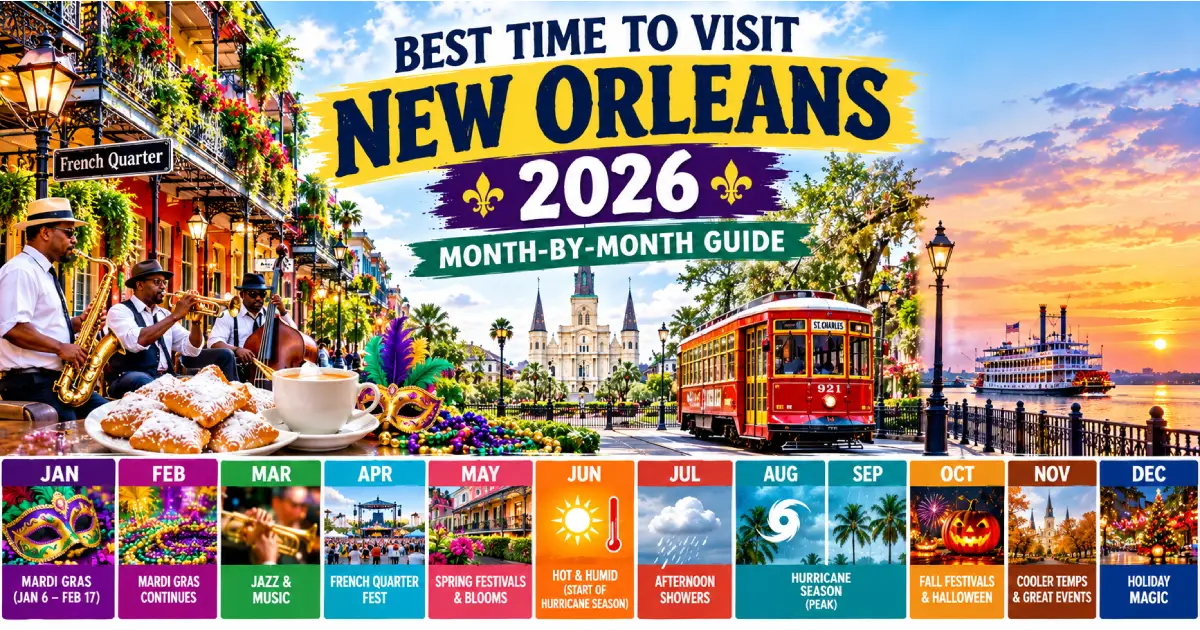
New Orleans has no single universally “best” time to visit — it has the best time for Mardi Gras (February or early March, non-negotiable), the best time for Jazz Fest (late April through early May), the best time for the finest weather with the fewest crowds (October and November), the best time for the lowest hotel prices (August and early September, when the heat and hurricane season combine to suppress demand), and the times when the specific New Orleans experience is most concentrated and most specifically itself (the fall and spring shoulder seasons, when the city is neither at its festive peak nor at its summer extreme). Understanding when to visit New Orleans requires understanding these specific seasonal characters rather than applying a generic “best weather = best time” formula — a city whose most celebrated annual event (Mardi Gras) occurs in the least predictably pleasant weather window of the year, and whose finest weather window (October–November) is also the least festival-saturated.
New Orleans’ climate is subtropical — a classification that means genuinely hot and genuinely humid summers (July and August averaging 91°F/33°C with heat indices regularly reaching 105–110°F/40–43°C due to the specific humidity of a coastal city below sea level surrounded by water on multiple sides), genuinely mild winters (January averaging 53°F/12°C, measurable snowfall occurring only once every 5–10 years), and the specific two shoulder seasons (spring from February through April and fall from October through November) that provide the most reliably comfortable outdoor conditions. The fall shoulder season (October–November) is the most consistently recommended period by New Orleans residents who have experienced all seasons — the specific combination of comfortable temperatures, low humidity, reduced crowds, lower hotel prices, and the continuation of the city’s music and food culture (which operates at full intensity year-round) creating the most balanced single New Orleans visiting period available in the annual calendar.
For planning resources, see our New Orleans Travel Guide 2026, Things to Do in New Orleans 2026, Best Restaurants in New Orleans 2026, and Places to Visit in New Orleans 2026.
| Month | Temp (High/Low) | Humidity | Crowds | Hotel Prices | Best For |
|---|---|---|---|---|---|
| January | 62°F/44°F (17°C/7°C) | Low-Medium | Low–Medium | Medium | Quiet visit, mild weather |
| February | 65°F/47°F (18°C/8°C) | Medium | Very High (Mardi Gras) | Very High | Mardi Gras only |
| March | 72°F/53°F (22°C/12°C) | Medium | Medium–High | Medium–High | Spring weather, post-Mardi Gras |
| April | 79°F/60°F (26°C/16°C) | Medium | High (Jazz Fest) | High | Jazz Fest, best spring weather |
| May | 85°F/67°F (29°C/19°C) | Medium–High | Medium–High | Medium–High | Jazz Fest, warming |
| June | 90°F/74°F (32°C/23°C) | High | Medium | Medium | Budget travel, heat manageable |
| July | 91°F/76°F (33°C/24°C) | Very High | Low–Medium | Low–Medium | Avoid if heat-sensitive |
| August | 91°F/76°F (33°C/24°C) | Very High | Low | Lowest | Budget only; hurricane season |
| September | 87°F/72°F (31°C/22°C) | High | Low | Low | Budget; improving late month |
| October | 79°F/60°F (26°C/16°C) | Low–Medium | Medium | Medium | Best overall month |
| November | 70°F/51°F (21°C/11°C) | Low | Low–Medium | Low–Medium | Excellent weather, fewer crowds |
| December | 63°F/46°F (17°C/8°C) | Low | Low–Medium | Medium (holidays) | Holiday atmosphere, cool |
October is the month that New Orleans residents most consistently recommend to visiting friends — the specific combination of the falling humidity (from the summer’s oppressive levels to a genuinely comfortable low-to-medium range), the comfortable temperatures (highs of 75–82°F/24–28°C, lows in the 58–65°F/14–18°C range — the most specifically “walk the French Quarter without suffering” weather of the year), the reduced crowds (the summer domestic visitor peak has ended and the Mardi Gras bookings haven’t yet driven up demand), and the specific October festival calendar (the New Orleans Film Festival in mid-October, the Voodoo Fest music festival at the end of October, and the general Halloween culture that New Orleans celebrates with specific and elaborate local involvement). Hotel rates in October are typically 20–35% below the February and April peak — the combination of better weather, fewer tourists, and lower prices making October the single most objectively rewarding single month to visit New Orleans.
If the specific festival experience is the primary travel purpose — and for many visitors it genuinely is, the Mardi Gras or Jazz Fest experience being specifically what they’ve come for — then the obvious planning is to time the visit for these windows regardless of the weather trade-offs that February’s unpredictability and May’s building humidity create. Both are genuinely extraordinary experiences that justify the compromises.
August and September provide New Orleans’ lowest hotel prices and fewest tourists — the combination of the summer heat, the humidity, and the hurricane season’s psychological effect suppressing demand for rooms that the city’s supply keeps available. For heat-tolerant visitors who prioritize cost over comfort, this window provides the most affordable version of a New Orleans visit: the same music, the same food, the same French Quarter and Garden District, at 30–50% lower hotel rates.
The two shoulder seasons provide the most reliably comfortable outdoor conditions — March through April (the post-Mardi Gras spring warming) and October through November (the post-summer cooling) both offering the temperatures and humidity levels most compatible with the walking-heavy French Quarter and neighborhood exploration that New Orleans most rewards.
Average high: 62°F (17°C) | Average low: 44°F (7°C) | Rain: 5 inches | Crowds: Low to medium | Hotel rates: Medium
January in New Orleans is the city’s most specifically “local” month — the holiday season concluded, the Mardi Gras season not yet in full swing (though the Mardi Gras preparations are underway in the krewe workshops and costume shops), and the tourist presence at its annual minimum. The weather is genuinely mild by Northern standards (the 62°F average high requiring a light jacket rather than the heavy coat that January demands in New York, Chicago, or Boston) but unpredictable in the specific New Orleans way — the subtropical climate’s winter produces a specific mix of cold fronts (the “northers” that blow in from the continental interior, dropping temperatures to the low 40s°F/5°C range for several days at a time) alternating with warm spells (the temperature rising to 70°F/21°C in the intervals between cold fronts).
January events:
Who should visit in January: Visitors who want the lowest crowds, the most specifically local New Orleans atmosphere, and the comfort of mild weather without the summer heat — particularly appropriate for first-time visitors who want the French Quarter and the museum experiences without the festival-season noise and price premiums.
What to avoid in January: Expecting warm weather for outdoor dining and extended outdoor activity — the cold fronts can make outdoor table service genuinely uncomfortable for several days, the specific New Orleans winter requiring the flexibility to move inside when the temperature drops.
Average high: 65°F (18°C) | Average low: 47°F (8°C) | Rain: 5.4 inches | Crowds: Extreme (during Mardi Gras) | Hotel rates: Very High (3–5x normal during Mardi Gras week)
February is New Orleans’ most specifically famous month and its most specifically challenging to visit without specific planning — the Mardi Gras season (technically beginning January 6, Twelfth Night, but building to the full crescendo in the two weekends before Fat Tuesday) creating the most intensely festive and most specifically logistically demanding visitor environment of the year. Fat Tuesday falls between February 3 and March 9 depending on the Easter calendar — in 2026, check mardigrasneworleans.com for the specific 2026 Fat Tuesday date.
The Mardi Gras experience:
Practical February/Mardi Gras planning:
Who should visit in February: Visitors whose specific purpose is Mardi Gras — the experience is genuinely extraordinary and specifically New Orleans in a way that no other American festival matches, but it requires specific planning, significant budget, and tolerance for crowds at levels that the non-Mardi Gras city doesn’t approach.
Average high: 72°F (22°C) | Average low: 53°F (12°C) | Rain: 5.1 inches | Crowds: Medium to High (early); Medium (post-Mardi Gras) | Hotel rates: Medium to High
March in New Orleans varies dramatically based on its relationship to Mardi Gras — when Mardi Gras falls in early March (as it does in late-Easter years), the first weeks of March maintain the Mardi Gras energy and pricing; when Mardi Gras falls in February (early-Easter years), March begins as the post-Mardi Gras shoulder season, the most specifically relaxed and most comfortable spring window.
Post-Mardi Gras March (when Fat Tuesday falls in February): The most specifically underrated New Orleans visiting period — the city’s spring flowering (the azaleas, the camellias, and the wisteria that cover the Garden District’s mansion gardens blooming in the warming March temperatures), the comfortable weather (the 72°F average high and the low humidity creating genuinely pleasant outdoor conditions), and the post-Mardi Gras crowd reduction (the festival visitors departed, the city returned to its residents, and the hotel rates significantly reduced from the Mardi Gras peak) creating the most specifically “New Orleans as it actually is” experience available in the spring season.
The New Orleans St. Patrick’s Day Parade (March 17): New Orleans’ Irish-heritage community celebrates St. Patrick’s Day with a parade that, while not approaching Mardi Gras in scale, maintains the specific New Orleans parade tradition (the throws, the marching bands, the krewe organization) in a specifically spring-weather context. The Magazine Street parade (the route through the Irish Channel neighborhood) is the most specifically local celebration.
Who should visit in March: Visitors who want the best of the spring weather without the Jazz Fest pricing and crowds of April — particularly appropriate for visitors who appreciate the Garden District’s azalea season and want comfortable walking temperatures.
Average high: 79°F (26°C) | Average low: 60°F (16°C) | Rain: 4.5 inches | Crowds: Very High (Jazz Fest weekends) | Hotel rates: High
April provides New Orleans’ finest weather alongside its second-largest annual festival — the combination creating the most specifically rewarding single month for visitors who want both comfortable conditions and major event programming. The temperatures (79°F/26°C average high, 60°F/16°C average low — the most specifically comfortable outdoor temperature range of the year, the low humidity distinguishing April from the summer months at equivalent temperature levels) and the New Orleans Jazz and Heritage Festival (the last weekend of April and the first weekend of May — check nojazzfest.com for exact 2026 dates) together create the most complete available New Orleans spring experience.
Jazz Fest specifics: The New Orleans Jazz and Heritage Festival occupies the Fair Grounds Race Course for two consecutive weekends (10 days total, with a gap week between the weekends) — the 12 simultaneous stages covering the full spectrum of American music (jazz, blues, gospel, Cajun, zydeco, R&B, funk, brass band, rock, and the New Orleans hybrid forms), the food vendors (the most specifically New Orleans-focused food market of any American music festival — the crawfish étouffée, the cochon de lait po’boy, the Crawfish Monica pasta, and the various other preparations that Jazz Fest food vendors have maintained as festival-exclusive offerings), and the Heritage area (the Louisiana crafts and food culture exhibits) together creating a festival whose cultural comprehensiveness exceeds any comparable American annual event.
Practical Jazz Fest planning:
Who should visit in April: Jazz Fest attendees (the festival is the primary reason) and visitors who want the most comfortable walking weather in the most culturally active single month — the combination of Jazz Fest programming, the spring flowers in the Garden District, and the April temperatures creates the single most rewarding New Orleans month for the culturally-focused visitor.
Average high: 85°F (29°C) | Average low: 67°F (19°C) | Rain: 5.1 inches | Crowds: High (Jazz Fest second weekend); Medium (after Jazz Fest) | Hotel rates: High (Jazz Fest); Medium (after)
May begins with the Jazz Fest’s second weekend (typically the first weekend of May — check nojazzfest.com for exact 2026 dates) before transitioning to the post-festival quieter period that represents New Orleans before summer’s full establishment. The temperatures (85°F/29°C average high) are warm but manageable with the morning and evening visiting strategy, the humidity is building but not yet at the summer’s extreme levels, and the city’s post-Jazz Fest character (the festival energy dissipated, the local culture reasserting itself, and the tourist volumes reduced from the Jazz Fest peak) provides the most specifically transitional New Orleans visiting experience.
The Essence Festival connection: The Essence Festival (the annual African American music and culture festival typically held over the Fourth of July weekend — check essence.com for 2026 dates) occasionally creates a late May preparatory energy as the largest hotels begin filling for advance bookings, but May itself remains one of New Orleans’ most accessible spring months for last-minute planning.
Who should visit in May: Jazz Fest second-weekend attendees and visitors who want the spring conditions without the April premium pricing — the post-Jazz-Fest May provides good weather and reduced crowds at meaningfully lower hotel rates than the festival weekends.
Average high: 90°F (32°C) | Average low: 74°F (23°C) | Rain: 6.7 inches | Crowds: Medium | Hotel rates: Medium
June marks the beginning of New Orleans’ summer season — the temperatures climbing to the 90°F/32°C range and the humidity building toward the summer peak, the combination creating a heat index (the “feels like” temperature that accounts for humidity’s effect on the body’s ability to sweat-cool) that regularly reaches 100–105°F/38–40°C by midday. June is genuinely hot but not the most extreme summer month — the afternoon thunderstorm pattern (the daily afternoon convective storms that the Gulf’s moisture feeds, typically occurring between 2–5 PM and providing temporary relief from the heat) and the morning hours (genuinely comfortable before 10 AM) create a specific summer visiting rhythm.
The June summer strategy: The most effective New Orleans summer approach — morning outdoor activities (the French Quarter walk, the Garden District exploration, the outdoor market visits all scheduled before 11 AM), midday indoor respite (the National WWII Museum, the air-conditioned restaurants, the hotel pool), and afternoon/evening outdoor return (after 6 PM when the day’s heat peak has passed and the Frenchmen Street music begins). New Orleans in summer is not comfortable by Northern standards but is entirely functional for heat-acclimated visitors who respect the rhythm.
Who should visit in June: Budget-conscious visitors who want reduced hotel rates (typically 20–30% below the April peak) with the understanding that outdoor activity requires specific heat management. June is not the best time for the casual visitor but is entirely workable for the heat-tolerant budget traveler.
Average high: 91°F (33°C) | Average low: 76°F (24°C) | Rain: 6.3 inches | Crowds: Low to Medium | Hotel rates: Low to Medium
July is New Orleans at its hottest and most specifically challenging for outdoor-focused visitors — the 91°F/33°C average high combined with the July humidity creating the most extreme heat-index conditions of the year (100–110°F/38–43°C regularly during midday hours). The Essence Festival (typically the July 4th weekend — check essence.com for 2026 dates) creates a specific July event concentration that partially offsets the summer’s crowd suppression.
The Essence Festival: The annual African American music and culture festival at the Caesars Superdome (100,000+ attendees over the long weekend, the music programming featuring the most commercially successful Black American artists alongside the specific New Orleans music tradition) is New Orleans’ largest single annual event by attendee count — larger than Jazz Fest, considerably more commercially mainstream in its programming. For visitors specifically interested in the Essence Festival’s music programming, the July 4th weekend provides one of New Orleans’ most energetic single event weekends.
Who should visit in July: Essence Festival attendees and visitors with the most extreme budget constraints — the hotel rates reach their seasonal low in late July (excluding the Essence Festival weekend) and the city’s music and food culture operates at full intensity regardless of the temperature. Not recommended for visitors with children, elderly travelers, or anyone with heat sensitivity.
Average high: 91°F (33°C) | Average low: 76°F (24°C) | Rain: 6.3 inches | Crowds: Lowest | Hotel rates: Lowest | Hurricane risk: Highest
August is the peak month of the Atlantic hurricane season (June 1–November 30, with peak activity statistically concentrated in mid-August through mid-October) and New Orleans’ most specifically risk-associated visiting month — the city’s specific vulnerability to hurricane impacts (the 2005 Hurricane Katrina event remaining the defining reference point for New Orleans hurricane risk, though the post-Katrina levee improvements have significantly reduced the specific flood risk that Katrina produced) creating a psychological barrier to August travel that drives the year’s lowest hotel prices.
The practical August reality: The hurricane risk is genuine but statistical — the probability that any specific August visit will coincide with a hurricane directly affecting New Orleans is low (New Orleans receives direct hurricane impacts in approximately 1 in 15–20 years statistically), but the psychological uncertainty (the monitoring of developing Gulf storms, the potential for last-minute evacuation orders, and the specific disruption that a hurricane watch creates even when the storm doesn’t directly impact the city) makes August the month most specifically recommended against for first-time visitors or those without travel insurance and flexible return arrangements.
Travel insurance is non-negotiable for August visits: The specific hurricane cancellation coverage (a policy that specifically covers trip cancellation due to named hurricane warnings — not all travel insurance policies include this, requiring specific “cancel for any reason” or “hurricane cancellation” coverage) is the essential planning document for any August New Orleans visit.
Who should visit in August: Visitors with maximum budget flexibility (the hotel rates are genuinely attractive), genuine heat tolerance, travel insurance with hurricane cancellation coverage, and the psychological comfort to monitor weather forecasts without excessive anxiety. Not recommended for first-time visitors or anyone with rigid return travel schedules.
Average high: 87°F (31°C) | Average low: 72°F (22°C) | Rain: 5.9 inches | Crowds: Low | Hotel rates: Low | Hurricane risk: Still elevated through mid-October
September represents New Orleans’ most specifically transitional month — the summer heat beginning to moderate (the average high dropping from August’s 91°F/33°C to September’s 87°F/31°C, a reduction that remains academic until the late-September cold fronts begin arriving from the north), the hurricane season remaining statistically active through mid-October, and the fall festival season’s approach creating anticipation without yet delivering the October comfort.
Late September specifically: The last week of September and the first weeks of October mark the most dramatic single weather improvement of the New Orleans annual calendar — the specific moment when the Gulf humidity’s summer grip releases and the first Canadian air masses reach Louisiana, dropping temperatures and humidity to the comfortable fall range. The last week of September can feel dramatically different from the first — the specific fall-arrival phenomenon that New Orleans residents celebrate as the most specifically welcome single weather event of the year.
Who should visit in September: Budget travelers willing to accept late-summer conditions for significantly reduced costs, and visitors whose specific New Orleans plans concentrate on indoor activities (the museums, the restaurants, and the indoor music venues that are the primary reasons to visit regardless of season) rather than extended outdoor exploration.
Average high: 79°F (26°C) | Average low: 60°F (16°C) | Rain: 3.9 inches | Crowds: Medium | Hotel rates: Medium | Overall rating: ⭐⭐⭐⭐⭐
October is the month that residents and experienced visitors most consistently identify as New Orleans at its finest — the specific combination of the comfortable temperatures (79°F/26°C high, 60°F/16°C low — the most specifically walkable outdoor conditions of the year), the dramatically reduced humidity (the fall dry-out producing the lowest relative humidity levels since the spring), the moderate crowd levels (below the Mardi Gras and Jazz Fest peaks, above the summer minimum — the most balanced visitor volume of the year), and the specific October festival calendar creating the most rewarding single month available.
October events:
New Orleans Film Festival (mid-October): One of the most significant regional film festivals in the American South — the programming (independent films, international cinema, and Louisiana-specific productions) distributed across multiple venues throughout the French Quarter and CBD, the festival creating a specifically cinematic energy in the city that complements the year-round music culture.
Voodoo Fest (late October): The annual music festival at City Park (typically the last weekend of October — check voodoomusicfest.com for 2026 dates) programming the most commercially diverse single New Orleans music event — the rock, hip-hop, and electronic programming alongside the New Orleans brass and jazz tradition creating the year’s most eclectic single music weekend. The City Park setting (the live oaks, the lagoons, and the specific City Park landscape in the October light) provides the most beautiful single outdoor festival environment in New Orleans.
Halloween in New Orleans: New Orleans takes Halloween with the specific seriousness that a city with a visible voodoo tradition, a significant cemetery culture, and a year-round costume sensibility naturally would — the French Quarter Halloween (the Krewe of Boo parade in the days before Halloween, the costume culture at its most elaborately assembled peak on October 31, and the specific New Orleans Gothic character [the above-ground cemeteries, the haunted history, and the voodoo tradition] providing authentic Halloween atmosphere that more commercially manufactured destinations can’t replicate).
Who should visit in October: Virtually everyone who doesn’t have a specific festival purpose requiring a different month — the best weather, the best balance of crowds and activity, and the most specifically varied festival calendar make October the single most objectively rewarding New Orleans month for the first-time and returning visitor alike.
Average high: 70°F (21°C) | Average low: 51°F (11°C) | Rain: 4.1 inches | Crowds: Low to Medium | Hotel rates: Low to Medium
November provides New Orleans’ second-finest month by most objective measures — the temperatures cooling to the most specifically comfortable range of the year (70°F/21°C high, 51°F/11°C low — the specific condition that makes extended outdoor walking not just possible but genuinely pleasurable), the crowds lower than October’s moderate levels, the hotel rates among the year’s most accessible outside of August and September, and the specific New Orleans fall atmosphere (the live oaks’ Spanish moss catching the low November sun, the cooling temperatures encouraging the outdoor café culture to extend its seasons, and the general New Orleans character asserting itself most specifically when the tourist-season energy subsides).
November events:
Tremé Creole Gumbo Festival (November): The free music and food festival in Armstrong Park celebrating the Tremé neighborhood’s specific food and music traditions — the most specifically local of New Orleans’ annual festivals, the event drawing the Tremé community itself alongside visitors in a genuinely neighborhood-centered celebration. The gumbo competition (local restaurants and home cooks competing in various categories) provides the most concentrated single-location gumbo tasting available anywhere in New Orleans.
French Quarter Festival (April — sometimes partially extends into adjacent months): While the primary FQF is in April, the general festival-friendly atmosphere of New Orleans’ music culture maintains specific programming through November in the French Quarter’s venues.
Thanksgiving in New Orleans: The specific New Orleans Thanksgiving (the city’s restaurant culture at its most festive — Commander’s Palace’s Thanksgiving dinner, the various New Orleans restaurants offering specifically Creole Thanksgiving preparations, and the general celebratory character that the city brings to the American food holiday) makes New Orleans one of the most rewarding single American cities for the Thanksgiving travel window.
Who should visit in November: Visitors who want the most comfortable weather at the most accessible prices — November provides essentially October’s conditions (slightly cooler, slightly less festive) at meaningfully lower hotel rates, making it the most specifically value-optimized fall New Orleans month.
Average high: 63°F (17°C) | Average low: 46°F (8°C) | Rain: 5.3 inches | Crowds: Low (early); Medium–High (holidays) | Hotel rates: Medium (early); High (Christmas/New Year)
December in New Orleans provides the city’s most specifically festive non-Mardi Gras atmosphere — the holiday decorations in the French Quarter (the wrought-iron balconies with their magnolia and live oak garland, the Cathedral illuminated, and the Jackson Square Christmas market creating the most specifically New Orleans holiday composition), the Reveillon dinners (the Louisiana Creole Christmas Eve dinner tradition — the historically French Louisiana celebration of Christmas Eve with an elaborate late-night feast, now adopted by New Orleans restaurants as a December prix-fixe dinner series offering multi-course Creole menus at reduced prices), and the specific New Orleans New Year’s Eve (the French Quarter’s celebration being among the most specifically atmospheric New Year’s events in the United States — the midnight countdown from the fleur-de-lis dropped from the Jax Brewery building visible throughout the riverfront area).
The Reveillon Dinner tradition: The most specifically New Orleans December dining experience — the participating restaurants (Commander’s Palace, Galatoire’s, Arnaud’s, and dozens of others offer specific Reveillon menus from approximately December 1–25) serving multi-course prix-fixe dinners at $45–$85/person (significantly below the à la carte equivalent cost), the specific Creole Christmas preparations (the oyster soup, the duck confit, and the various other dishes that the Louisiana winter season traditionally inspires) making the Reveillon series the most cost-effective way to experience multiple grand Creole restaurant kitchens in a single visit.
Who should visit in December: Visitors who want the holiday atmosphere without the Mardi Gras crowds and pricing — the specific New Orleans holiday character (the wrought-iron balconies decorated, the Reveillon dinners, and the New Year’s Eve French Quarter celebration) creates a December visit of specific charm. Avoid the Christmas and New Year’s windows if budget is a concern — the holiday premium pricing mirrors the Mardi Gras pattern on a smaller scale.
What to expect: Variable — cool mornings warming to pleasant afternoons, with the occasional cold front bringing temperatures to the 50s°F/10–15°C for a day or two
Pack:
What to expect: Genuinely hot and humid — the heat index regularly exceeding 100°F/38°C during midday hours
Pack:
What to expect: The most comfortable single season — daytime highs in the 70–79°F/21–26°C range, low humidity, clear skies
Pack:
What to expect: Mild by Northern standards but variable — cold fronts (“northers”) can drop temperatures to the 40s°F/4–8°C range for several consecutive days
Pack:
| Event | Month | Type | Cost |
|---|---|---|---|
| Sugar Bowl | January 1 | Sports | $100–$500 (tickets) |
| Krewe du Vieux | Late January | Mardi Gras parade | Free |
| Mardi Gras | Feb/March | Festival | Free (parades) |
| St. Patrick’s Day Parade | March 17 | Parade | Free |
| Tennessee Williams Festival | March | Literary | $15–$45 |
| French Quarter Festival | April | Music | Free |
| Jazz Fest | Late April–Early May | Music | $90–$110/day |
| Essence Festival | July 4th weekend | Music | $75–$200 |
| White Linen Night | August | Arts | Free |
| Voodoo Fest | Late October | Music | $75–$150 |
| New Orleans Film Festival | Mid-October | Film | $12–$35 |
| Tremé Creole Gumbo Festival | November | Food/Music | Free |
| Reveillon Dinners | December | Dining | $45–$85/person |
| New Year’s Eve | December 31 | Celebration | Free (public) |
About Travel Tourister Travel Tourister’s destination specialists have visited New Orleans in every season — from February Mardi Gras Zulu parade front-row positions and April Jazz Fest Gospel Tent experiences through July Essence Festival Superdome evenings and August heat-management strategy testing to October Voodoo Fest City Park evenings, November Tremé Gumbo Festival free-entry gumbo competitions, and December Reveillon Commander’s Palace multi-course dinners — to deliver the most practically honest and most comprehensively tested New Orleans seasonal guide for every type of 2026 visitor.
Posted By : Vinay
Latest Article
2nd Floor, 39, Above Kirti Club, DLF Industrial Area, Kirti Nagar, New Delhi, Delhi 110015



Travel Tourister is a leading Travel portal where we introduce travellers to trusted travel agents to make their journey hasselfree, memorable And happy. Travel Tourister is a platform where travellers get Tour packages ,Hotel packages deals through trusted travel companies And hoteliers who are working with us across the world. We always try to find new and more travel agents and hoteliers from every nook and corners across the world so that you could compare the deals with different travel agents and hoteliers and book your tour or hotel with the one you have chosen according to your taste and budget.
Copyright © Travel Tourister, India. All Rights Reserved

 Call
 Enquiry