Published on : 16 Sep 2026
By Travel Tourister | Updated Sep 2026
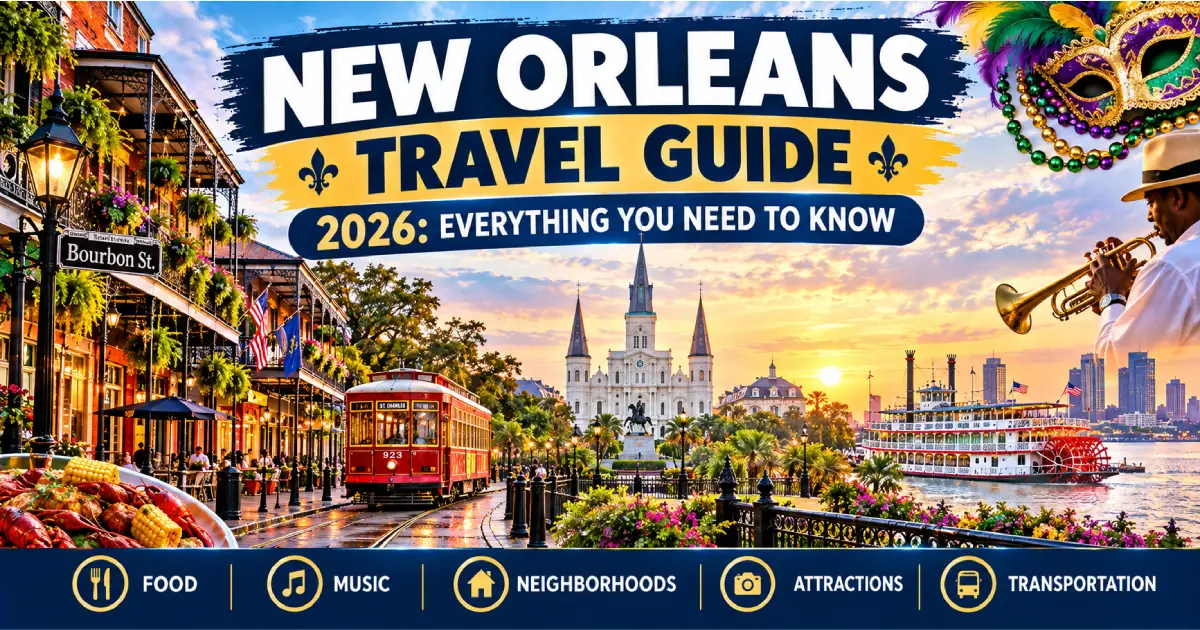
New Orleans is the American city that most consistently exceeds visitor expectations — a place whose reputation (for Mardi Gras excess, Bourbon Street noise, and festival-season crowds) is accurate but radically incomplete, failing to communicate the quieter and more profound pleasures that the city provides when the festival season ends and the city returns to being itself: the early morning French Quarter when the only sounds are the Cathedral bells and the distant river, the Garden District live oaks creating a cathedral of Spanish moss above the St. Charles Avenue Streetcar route, the Frenchmen Street clubs where New Orleans musicians play for each other as much as for the audience, and the specific quality of the food — the most sophisticated regional American cuisine, the most specific culinary identity, and the most direct lineage from 18th-century French colonial cooking of any American city’s food culture.
Planning a New Orleans visit in 2026 requires understanding several things that the standard travel-advice resources frequently underemphasize: the city’s specific neighborhood geography (the French Quarter is the tourist heart but not the residential soul — the Garden District, the Tremé, the Marigny, the Bywater, and the Mid-City neighborhoods each providing more authentic New Orleans character than the Bourbon Street entertainment district), the transportation reality (New Orleans is a walkable and streetcar-accessible city for most attractions, but the specific geography [the Mississippi River’s curve creating the specific “upriver/downriver” directional system that replaces the conventional “north/south” in local usage] requires orientation before navigation feels natural), the dining culture (the reservation reality at Commander’s Palace and the walk-in culture at Café Du Monde exist simultaneously, the formal and informal dining traditions operating in specific contexts that require understanding), and the seasonal considerations (the hurricane season’s August–October peak, the Mardi Gras hotel-booking requirements, and the October–November sweet spot that most visitors don’t know about).
This complete New Orleans Travel Guide for 2026 covers everything from getting there and getting around through neighborhood-by-neighborhood orientation, budget planning, safety, and the specific insider knowledge that makes the difference between a good New Orleans visit and a genuinely transformative one.
For specific activity and dining guidance, see our Things to Do in New Orleans 2026, Best Restaurants in New Orleans 2026, Places to Visit in New Orleans 2026, and Best Time to Visit New Orleans 2026.
| Category | Details |
|---|---|
| Location | Southeast Louisiana, Mississippi River delta, Gulf Coast |
| Population | Approximately 383,000 (city); 1.3 million (metro) |
| Nickname | The Crescent City; The Big Easy; NOLA |
| Founded | 1718 by French colonial governor Jean-Baptiste Le Moyne de Bienville |
| Language | English (primary); French (traditional, limited current use); Spanish (growing) |
| Currency | US Dollar (USD) |
| Time Zone | Central Time (CT) — UTC-6 (standard); UTC-5 (daylight saving) |
| Airport | Louis Armstrong New Orleans International Airport (MSY) |
| Airport Distance | 13 miles west of downtown |
| Best Neighborhoods | French Quarter, Garden District, Tremé, Marigny, Bywater, Uptown |
| Best Season | October–November; February (Mardi Gras); April–May (Jazz Fest) |
| Average Hotel Cost | $120–$280/night (mid-range); $80–$120 (budget); $300–$600+ (luxury) |
| Typical Daily Budget | $150–$300/person (mid-range) |
| Hurricane Season | June 1–November 30 (peak August–October) |
| Primary Transport | Walking, streetcar, rideshare (Uber/Lyft), taxi |
Airport code: MSY | Distance from downtown: 13 miles west | Drive time: 25–40 minutes (traffic-dependent) | Website: flymsy.com
Louis Armstrong New Orleans International Airport (MSY) serves as the primary gateway for the majority of New Orleans visitors — the airport handling approximately 13 million annual passengers with direct flights from most major US hubs and international service from a growing number of European and Latin American cities.
Airlines serving MSY: American, Delta, Southwest, United, Spirit, Frontier, and various international carriers (British Airways from London Heathrow, Lufthansa connections through Houston, and various Caribbean airlines provide the primary international access).
Airport to downtown transportation:
Airport Shuttle/Bus (RTA Express): The Regional Transit Authority operates an express bus service (the $3 airport bus connecting MSY with the downtown CBD) — the most economical surface transportation option, approximately 45–60 minutes to downtown. Check norta.com for the current 2026 schedule.
Taxi: The fixed-rate taxi from MSY to the French Quarter and downtown hotels (currently $36 for 1–2 passengers; $15/person for 3+ — confirm current 2026 rates at the taxi dispatch desk) provides the most straightforward airport-to-hotel transfer without surge-pricing variability.
Rideshare (Uber/Lyft): Available from the designated rideshare pickup area at MSY — typically $30–$50 to the French Quarter, with surge pricing adding significantly during peak arrival periods (the Sunday evening after a Jazz Fest weekend being the most specific surge-pricing scenario).
Rental car: Available at the consolidated rental facility adjacent to the terminal — only recommended for visitors planning specific out-of-city excursions (the Oak Alley Plantation, the swamp tours in areas without organized pickup, and the Cajun Country day trips to Lafayette) since New Orleans’ city attractions are accessible without a car and parking in the French Quarter is expensive and scarce.
Station: New Orleans Union Passenger Terminal, 1001 Loyola Avenue, CBD | Amtrak routes: City of New Orleans (Chicago–New Orleans), Sunset Limited (Los Angeles–New Orleans), Crescent (New York–New Orleans)
Amtrak’s three New Orleans routes provide rail access from three different American regions — the City of New Orleans (the most historically celebrated, the route that Arlo Guthrie’s “City of New Orleans” song immortalized, connecting Chicago with New Orleans via Memphis in approximately 19 hours), the Sunset Limited (the southern transcontinental route connecting Los Angeles with New Orleans in approximately 48 hours), and the Crescent (the northeastern route connecting New York with New Orleans via Washington DC, Charlotte, and Atlanta in approximately 30 hours).
The Amtrak option is most practical for visitors traveling from Chicago (the 19-hour overnight City of New Orleans providing an economical and specifically atmospheric alternative to flying) and from the Northeast (the Crescent’s 30-hour journey less competitive with flying on time but providing the specific train-travel experience through the American South).
From Houston: I-10 East, approximately 5.5 hours (350 miles) From Atlanta: I-59 West to I-10, approximately 7 hours (470 miles) From Memphis: I-55 South, approximately 6 hours (390 miles) From Nashville: I-65 South to I-59, approximately 8 hours (530 miles) From Miami: I-10 West, approximately 12 hours (835 miles)
New Orleans’ Interstate access is straightforward from all directions — the I-10 (the major east-west highway that bisects the city east to west, crossing the Lake Pontchartrain Causeway approach from the north and connecting with Baton Rouge and Houston to the west), I-610 (the inner loop providing access from the northeast), and the Lake Pontchartrain Causeway (the 24-mile crossing connecting the north shore suburbs with Metairie on New Orleans’ western edge) all providing efficient access.
Parking in New Orleans: The French Quarter parking reality — garages exist (the Canal Place Garage, the Bienville Street Garage, and various others within or adjacent to the Quarter), but daily rates ($25–$45) and the high demand during festival seasons make daily parking an expensive and unreliable choice. Visitors staying in the French Quarter should specifically seek hotels with included parking (rare and premium-priced) or accept the daily parking cost as a budget item. For the Garden District and Uptown, street parking is more available.
New Orleans is fundamentally a walking city — the French Quarter’s 13 x 6 block footprint, the Garden District’s mansion streets, the Frenchmen Street music scene, and the riverfront are all most specifically rewarding on foot. The specific New Orleans walking culture (the “neutral ground” [the median strip between opposing traffic lanes] used as gathering space, the covered sidewalk arcades [the Galleria and various Quarter arcades providing weather protection during summer rain], and the specific pace of New Orleans street life [slower than New York or Chicago, the specific “laissez les bons temps rouler” [let the good times roll] ethos expressing itself in the pedestrian environment]) creates a walking experience of specific character.
The New Orleans navigation system: New Orleans uses a location system based on the Mississippi River rather than cardinal directions — “upriver” (toward Baton Rouge) and “downriver” (toward the Gulf) replace north and south, while “lakeside” (toward Lake Pontchartrain) and “riverside” (toward the Mississippi) replace east and west. The specific New Orleans directional vocabulary (asking for directions and being told “two blocks upriver and one block lakeside”) requires initial orientation but becomes intuitive within a day.
Routes relevant to visitors:
St. Charles Avenue Streetcar (Line 12): The most historically significant and most practically useful streetcar for visitors — the olive-green car operating since 1835 (the oldest continuously operating street railway in the world, National Historic Landmark) connects the CBD with the Garden District, Uptown, and the Carrollton neighborhood along the 13-mile St. Charles Avenue route. Cost: $1.25 (exact change required; day passes available at the Walgreens at Canal and Bourbon Streets)
Canal Street Streetcar (Line 47/48): The Canal Street route connecting the CBD with the City Park and Mid-City areas — less scenic than the St. Charles but more practically useful for reaching NOMA and City Park. Cost: $1.25
Rampart-Loyola Streetcar (Line 49): The route connecting the Union Passenger Terminal (Amtrak) with the French Quarter edge on N. Rampart Street — the most practically useful connection between the Tremé neighborhood and the downtown transit hub.
Practical streetcar tips: The streetcars accept exact change only ($1.25 coins or bills — no change provided), run every 10–20 minutes during peak hours and every 20–40 minutes during off-peak, and operate 24 hours (with reduced overnight frequency). The Canal Street Streetcar’s RTA Day Pass (available at RTA outlets) provides unlimited rides for $3 — worthwhile for a day with multiple streetcar trips.
Uber and Lyft operate throughout New Orleans with generally good availability — the primary practical transport for reaching destinations beyond streetcar range (the National WWII Museum is walkable; the Audubon Zoo is 3 minutes by rideshare from the streetcar), late-night returns from Frenchmen Street, and airport transfers. The New Orleans rideshare rate is generally moderate compared to other major American cities ($10–$20 for most within-city trips in off-peak conditions; $25–$45 during festival-season surge pricing).
Festival-season rideshare reality: During Mardi Gras, Jazz Fest, the Essence Festival, and various other peak-period events, rideshare surge pricing can reach 3–5x normal rates — the specific supply-demand imbalance of hundreds of thousands of visitors competing for the same finite driver pool during event-end periods creating surge prices that make the streetcar or walking the more cost-effective choice for the patient visitor.
Traditional taxis operate from the taxi stands at the French Quarter hotels, the airport (fixed rates), and are hailable on the street. The New Orleans taxi rate (a metered fare starting at $3.50 plus $2/mile) makes short Quarter-to-Quarter trips approximately equivalent to rideshare at non-surge pricing. The specific advantage of taxis over rideshare during high-demand periods is the fixed-rate airport service and the availability at hotel taxi stands without app-surge pricing.
New Orleans’ Blue Bikes (the city’s bikeshare system — docking stations throughout the French Quarter, the CBD, the Garden District, Uptown, and the Marigny) provides the most specifically independent mobility option: the 30-minute ride between the Marigny and the Garden District (approximately 30 minutes of comfortable cycling), the Crescent Park riverfront path (the most specifically cycling-appropriate surface in the city, the dedicated path running the length of the Marigny/Bywater riverfront), and the City Park interior (the flat, car-minimal roads of City Park providing the most relaxed cycling environment in New Orleans).
Cost: $10/day pass (unlimited 60-minute rides); available at bikeshare stations via the Blue Bikes app.
Cycling caveat: New Orleans’ streets (the specific combination of streetcar tracks [the most hazardous single cycling hazard — the parallel tracks catching bicycle tires at specific angles and causing falls], the uneven brick pavements of the French Quarter [impassable by narrow-tire road bikes], and the surface condition of some secondary streets [the poor drainage in a below-sea-level city creating specific road surface deterioration]) require specific cycling attention. Wider-tire bikes (the Blue Bikes’ specific hybrid tire width is appropriate) and streetcar-track crossing technique (crossing tracks at right angles rather than parallel) are the primary cycling skills required.
Character: Historic, tourist-concentrated, architecturally extraordinary, 24-hour entertainment | Best for: First-time visitors, history, architecture, music, nightlife | Stay here if: You want to be central to everything and within walking distance of the major attractions
The French Quarter is the starting point for every New Orleans visit — the 13 x 6 block grid of Creole townhouse architecture, the Jackson Square civic heart, and the full spectrum from Preservation Hall’s traditional jazz to Bourbon Street’s entertainment district coexisting in the most compact historic neighborhood footprint in the United States. The Quarter’s hotels are the most centrally located and the most specifically atmospheric (many occupying historic Creole townhouses with the courtyard gardens), but they are also the most expensive and the most noise-affected (Bourbon Street’s nightlife creates noise levels that penetrate most Quarter hotel rooms below the top floors).
Where to stay in the French Quarter: The quieter blocks (Royal Street, Chartres Street, and the residential streets below the entertainment district) provide better sleeping conditions than the Bourbon Street corridor. The Olivier House, the Hotel Monteleone (the classic literary bar hotel where Truman Capote, William Faulkner, and Ernest Hemingway all drank at the Carousel Bar), and the Dauphine Orleans Hotel all provide specifically French Quarter atmospheric character.
Character: Residential, mansions, live oaks, Commander’s Palace, Lafayette Cemetery | Best for: Architecture, upscale dining, Magazine Street shopping | Stay here if: You want a quieter base with the streetcar to the French Quarter
The Garden District provides the most specifically elegant New Orleans residential character — the Greek Revival mansions, the live oak canopy, and the general quietness of a functioning upscale residential neighborhood providing a specific alternative to the French Quarter’s 24-hour energy. The Magazine Street corridor (the six-mile commercial street running through the Lower Garden District and Uptown parallel to St. Charles Avenue) provides the most locally-oriented shopping, café, and dining experience outside the Quarter.
Where to stay in the Garden District: The Pontchartrain Hotel (the historic St. Charles Avenue grand hotel, fully restored and reopened as a boutique property), the Henry Howard Hotel (a renovated mansion hotel on Prytania Street), and various vacation rental properties in historic Garden District houses provide the most specifically Garden District atmospheric accommodation.
Character: Music-focused, LGBTQ+ community, artist-populated, the most specifically local feel adjacent to the Quarter | Best for: Music-first visitors, Frenchmen Street nightlife | Stay here if: Frenchmen Street is your primary evening destination
The Marigny (the neighborhood immediately downriver from the French Quarter, accessible across Esplanade Avenue) is the most specifically music-focused residential New Orleans neighborhood — the Frenchmen Street music district at its heart, the various small clubs and bars providing the most concentrated live-music alternative to the tourist-facing Bourbon Street experience. The Marigny’s accommodation options (vacation rentals in shotgun houses, the Frenchmen Hotel, and various small inns) are generally less expensive than equivalent French Quarter options.
Character: Arts, restaurants, street murals, the most specifically creative neighborhood | Best for: Food explorers, art enthusiasts, local culture | Stay here if: You prioritize neighborhood character over proximity to the Quarter
The Bywater (downriver from the Marigny — the most specifically contemporary creative New Orleans neighborhood, the converted shotgun houses, Bacchanal Wine, and the Crescent Park riverfront providing the most non-touristy single New Orleans neighborhood experience) has become the destination of choice for the most specifically discerning New Orleans visitors who prioritize local character over tourist convenience.
Character: African American history, jazz origins, Congo Square, the most historically significant neighborhood | Best for: Music history enthusiasts, cultural tourism | Stay here if: The specific historical and musical heritage is the primary interest
The Tremé (America’s oldest African American neighborhood, directly north of the French Quarter across Rampart Street) is the most historically significant neighborhood in American music history — the birthplace of jazz, the home of the second-line parade tradition, and the community whose specific cultural identity the Backstreet Cultural Museum documents. The Tremé’s accommodation options are limited (the neighborhood’s residential character providing fewer hotel options than the Quarter or Garden District), making it more typically a walking destination than an overnight base.
| Type | Cost Per Night | Notes |
|---|---|---|
| Budget hostel (dorm) | $35–$55 | Several French Quarter and Marigny options |
| Budget hotel/motel | $80–$120 | Mid-City and airport corridor; requires transport |
| Mid-range hotel | $140–$250 | Garden District, French Quarter; good quality |
| Boutique hotel | $200–$350 | Historic buildings, courtyard character |
| Luxury hotel | $300–$600+ | Hotel Monteleone, Roosevelt, Windsor Court |
| Vacation rental | $120–$400 | Best value for groups; specific neighborhood character |
| Mardi Gras/Jazz Fest premium | 3–5x normal | Book 6–12 months ahead |
| Category | Cost Per Person | Examples |
|---|---|---|
| Street food / market | $5–$15 | Café Du Monde beignets, French Market snacks |
| Plate lunch counter | $12–$18 | Café Reconcile, local diners |
| Po’boy shop | $12–$20 | Domilise’s, Parkway Bakery |
| Casual restaurant | $20–$40 | Bacchanal Wine, neighborhood spots |
| Mid-range restaurant | $40–$70 | Cochon, Herbsaint, Compère Lapin |
| Fine dining | $70–$150 | Commander’s Palace, Galatoire’s, GW Fins |
| Daily food budget (mid-range) | $60–$100 | Mix of casual and one sit-down meal |
| Activity | Cost |
|---|---|
| Preservation Hall jazz show | $20–$35 |
| National WWII Museum | $31 |
| New Orleans Museum of Art (NOMA) | $15 |
| Sculpture Garden (NOMA) | Free |
| French Quarter walk | Free |
| Garden District walk | Free |
| St. Charles Streetcar | $1.25 |
| Swamp tour | $35–$55 |
| Steamboat Natchez | $42–$55 |
| Mardi Gras parades | Free |
| Jazz Fest | $90–$110/day |
| St. Louis Cemetery No. 1 tour | $20 |
| Lafayette Cemetery No. 1 | Free |
| Congo Square / Armstrong Park | Free |
| Frenchmen Street clubs | Free–$15 cover |
Budget traveler ($100–$130/day):
Mid-range traveler ($180–$280/day):
Luxury traveler ($350–$600+/day):
The Roosevelt New Orleans (130 Roosevelt Way): The grande dame of New Orleans hotels — the 1893 grand hotel in the CBD, the Sazerac Bar (the most historically significant single cocktail bar in New Orleans — the Sazerac cocktail was invented in New Orleans, and the Roosevelt’s Sazerac Bar maintains the most specifically atmospheric single bar environment in the city), and the Blue Room entertainment venue providing the most complete historic grand hotel experience.
Hotel Monteleone (214 Royal Street, French Quarter): The French Quarter’s oldest grand hotel (1886) — the Carousel Bar (the rotating bar on the hotel’s ground floor, the bar top revolving slowly while the bar stools remain stationary, the specific gimmick that every New Orleans visitor should experience at least once) and the literary connection (Truman Capote was born in the hotel; William Faulkner, Ernest Hemingway, and various other American literary figures drank at the Carousel Bar) create the most specifically literary-atmospheric hotel experience in New Orleans.
The Windsor Court Hotel (300 Gravier Street, CBD): The most specifically elegant New Orleans hotel by pure luxury standard — the art collection (genuine Gainsborough, Renoir, and other European Old Masters displayed throughout the public spaces), the afternoon tea service, and the specific British-influenced formal hotel tradition creating the most dramatically non-New-Orleans single hotel experience in a city that typically celebrates its local character.
Pontchartrain Hotel (2031 St. Charles Avenue, Garden District): The fully restored historic Garden District grand hotel — the rooftop bar (the most specifically atmospheric rooftop drinking position in New Orleans, the Garden District live oak canopy visible below and the downtown skyline in the distance), the Bayou Bar (the most specifically Garden District single hotel bar), and the specific renovation quality creating the best single boutique hotel experience outside the French Quarter.
Henry Howard Hotel (2041 Prytania Street, Garden District): A converted Garden District mansion — the 18 rooms in the renovated Italianate mansion, the courtyard garden, and the specific residential-neighborhood character providing the most authentic Garden District accommodation experience.
Maison de Macarty (3820 Burgundy Street, Bywater): The most specifically local-character boutique property in the Bywater — the converted double-shotgun house, the courtyard pool, and the Bywater neighborhood character (Bacchanal Wine one block away, the Crescent Park riverfront 5 minutes) creating the most specifically New Orleans residential accommodation experience.
Olivier House Hotel (828 Toulouse Street, French Quarter): The most specifically atmospheric mid-range French Quarter property — the historic Creole townhouse, the courtyard with the banana trees and the fountain, and the resident cat (a longstanding New Orleans hotel tradition) creating the most specifically Old New Orleans hotel character at mid-range pricing.
Hotel Provincial (1024 Chartres Street, French Quarter): A complex of five historic French Quarter buildings — the largest courtyard of any French Quarter hotel, the pool (rare at this price point in the Quarter), and the specific historic character creating exceptional value at mid-range pricing.
New Orleans has a higher-than-average crime rate for a US city of its size — the specific honest guidance that the city’s tourism marketing doesn’t emphasize but that every visitor should understand before arriving.
New Orleans’ violent crime (the city’s homicide rate, specifically) is concentrated in specific neighborhoods and contexts (domestic disputes, drug-related conflicts, and gang-related violence in the residential areas of New Orleans East, Central City, and the 7th Ward) that do not typically involve tourists in the French Quarter, the Garden District, or the Marigny. The tourist areas of New Orleans are generally safe for visitors exercising normal urban awareness — the same precautions appropriate in any major American city.
In the French Quarter:
General precautions:
The specific New Orleans safety myth: The common assumption that Mardi Gras and festival-season New Orleans is more dangerous than the off-season city is not well-supported by crime statistics — the increased police presence during major events and the high visibility of the French Quarter during festival periods actually suppresses crime relative to the tourist volume. The post-festival Sunday mornings (when the crowds thin rapidly) and the quiet weekday nights in the residential neighborhoods adjacent to the Quarter are specifically where the awareness-to-safety equation most benefits from attention.
New Orleans’ service industry tipping culture follows the American standard — the specific guidance that first-time US visitors need most:
New Orleans is famously one of the few American cities that allows alcoholic beverages in open containers on public streets — the specific “go cup” culture (bars providing plastic cups for departing customers to take their drink to go) being one of the most specifically New Orleans social institutions. The specific rule: glass containers are not permitted on the public street, but plastic cups are explicitly allowed. The French Quarter and the Marigny entertainment area are the primary open-container zones — the Garden District residential areas maintain more conventional public-drinking restrictions.
For visitors traveling during hurricane season (June 1–November 30, peak August–October):
| Term | Meaning |
|---|---|
| Neutral ground | The median strip between opposing traffic lanes (elsewhere called “median”) |
| Banquette | The sidewalk |
| Lagniappe | A little something extra; a bonus (from the Louisiana French tradition of giving extra measure) |
| Making groceries | Grocery shopping |
| Where y’at? | The New Orleans greeting (“where are you at?” — meaning “how are you?”) |
| Ya’at | A native New Orleanian (derived from “Where y’at”) |
| Second line | The informal parade followers behind the official parade; also the style of jazz parade |
| Jazz funeral | The New Orleans funeral tradition — solemn music to the cemetery, celebratory music returning |
| Dressed | A po’boy with lettuce, tomato, pickle, and mayo |
| Debris | The drippings and fragments from a roast used in the debris po’boy |
| NOLA | Common abbreviation for New Orleans, Louisiana |
| The Big Easy | New Orleans’ most internationally recognized nickname |
Day 1 — The French Quarter and the River:
Day 2 — The Garden District and Culture:
Add to the 2-day itinerary:
Day 3 — Tremé, Congo Square, and Local Neighborhoods:
Day 4 — Day Trip or Festival Experience:
About Travel Tourister Travel Tourister’s destination specialists have visited New Orleans across multiple seasons and trip types — navigating the MSY-to-French-Quarter taxi fixed-rate system, riding every streetcar route, staying in French Quarter courtyard hotels and Garden District mansion boutiques, eating at Commander’s Palace and Café Reconcile on the same visit, walking the Tremé at dawn and Frenchmen Street at midnight, surviving August humidity and February cold-front Mardi Gras, and building the specific orientation and practical knowledge that makes each New Orleans visit more rewarding than the last — to deliver the most practically useful and most honestly calibrated New Orleans travel guide for 2026 visitors of every type.
Posted By : Vinay
Latest Article
2nd Floor, 39, Above Kirti Club, DLF Industrial Area, Kirti Nagar, New Delhi, Delhi 110015



Travel Tourister is a leading Travel portal where we introduce travellers to trusted travel agents to make their journey hasselfree, memorable And happy. Travel Tourister is a platform where travellers get Tour packages ,Hotel packages deals through trusted travel companies And hoteliers who are working with us across the world. We always try to find new and more travel agents and hoteliers from every nook and corners across the world so that you could compare the deals with different travel agents and hoteliers and book your tour or hotel with the one you have chosen according to your taste and budget.
Copyright © Travel Tourister, India. All Rights Reserved

 Call
 Enquiry