Published on : 29 Sep 2026
By Travel Tourister | Updated Sep 2026
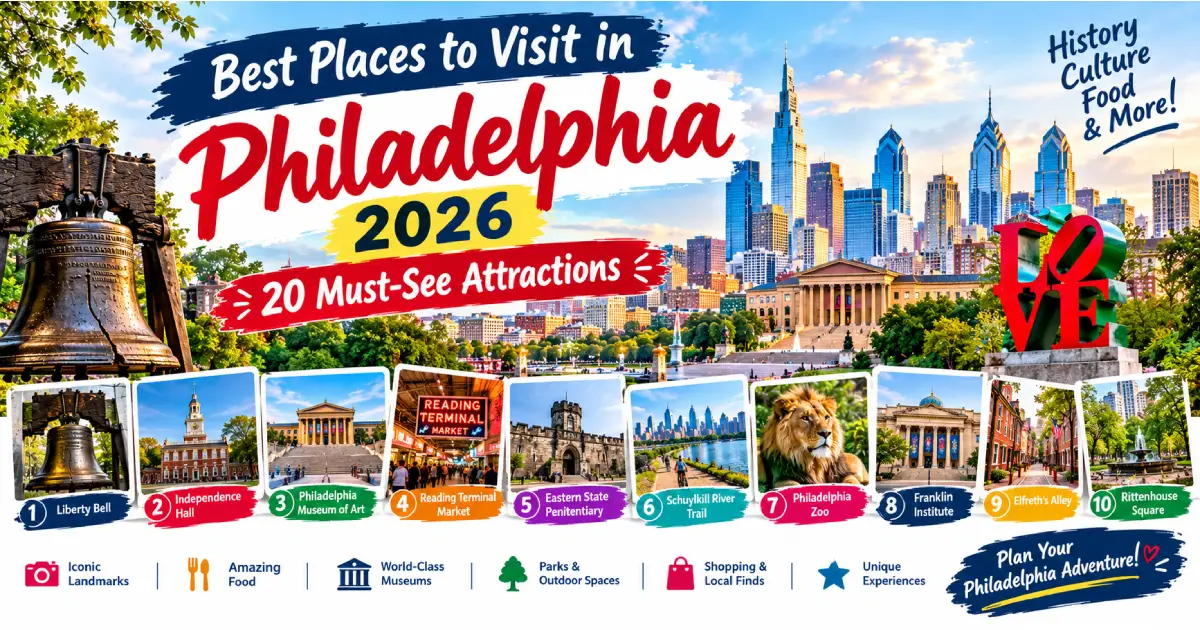
Philadelphia rewards the visitor who understands that its most specifically rewarding places exist on two entirely different scales simultaneously — the world-historical (the Assembly Room of Independence Hall where the Declaration of Independence and the Constitution were both created, the single most consequential interior space in American democratic history) and the genuinely local (the 9th Street Italian Market’s sidewalk produce stalls, Elfreth’s Alley’s cobblestones worn smooth by 320 years of foot traffic, and the specific Fishtown bar whose tap list represents the most specifically Philadelphia craft beer culture without a single concession to tourist-facing simplicity). Understanding which scale you’re visiting at any given moment, and allowing both to coexist within the same Philadelphia day, is the specific skill that distinguishes a genuinely rewarding Philadelphia visit from one that merely covers the landmarks.
The best places to visit in Philadelphia in 2026 are organized around the city’s specific geographic logic — the Old City historic core (the Independence National Historical Park district from Market Street to Walnut, from the Delaware waterfront to 6th Street), the Benjamin Franklin Parkway cultural corridor (the diagonal boulevard from City Hall to the Philadelphia Museum of Art, the most deliberately planned single American cultural boulevard, lined with the Barnes Foundation, the Franklin Institute, the Rodin Museum, and the PMA itself), the South Philadelphia food and neighborhood corridor (the Italian Market, Pat’s and Geno’s, the Magic Gardens, and the specific South Philly character that the tourist infrastructure has barely touched), and the emerging neighborhood character of Fishtown, Northern Liberties, and East Passyunk (the most actively evolving single Philadelphia neighborhood cluster, the most restaurant- and bar-dense concentration outside of Center City). Together these four geographic zones provide the most complete single Philadelphia visitor experience available in a 3–5 day visit.
For related guides, see our Things to Do in Philadelphia 2026, Best Cities to Visit in USA 2026.
| Place | Type | Cost | Best For | Duration |
|---|---|---|---|---|
| Independence Hall | Historic Site | Free (timed ticket) | America’s most important building | 1 hr |
| Liberty Bell Center | Historic Site | Free | Iconic American symbol | 45 min |
| Philadelphia Museum of Art | Museum | $30 | World-class art + Rocky Steps | 2–3 hrs |
| Reading Terminal Market | Market | Free entry | Best indoor market in America | 1.5–2 hrs |
| Barnes Foundation | Museum | $30 | Most extraordinary private collection | 2 hrs |
| Eastern State Penitentiary | Historic Site | $22 | Gothic architecture, history | 1.5–2 hrs |
| Old City Neighborhood | Historic District | Free | Colonial streetscape, galleries | 1.5–2 hrs |
| Elfreth’s Alley | Historic Street | Free ($5 museum) | Oldest US residential street | 45 min |
| Italian Market (9th Street) | Outdoor Market | Free | America’s oldest outdoor market | 1.5 hrs |
| Philadelphia’s Magic Gardens | Art Installation | $15 | Isaiah Zagar mosaic environment | 1 hr |
| Rittenhouse Square | Park | Free | Most European American square | 1 hr |
| Benjamin Franklin Parkway | Boulevard | Free | Cultural corridor, museum mile | 1–2 hrs |
| Fishtown Neighborhood | Neighborhood | Free | Most dynamic current Philadelphia | 1.5 hrs |
| East Passyunk Avenue | Neighborhood | Free | Best restaurant corridor | Evening |
| Fairmount Park / Kelly Drive | Park | Free | Boathouse Row, scenic river drive | 1–2 hrs |
| South Street | Neighborhood | Free | Eclectic culture, Magic Gardens | 1.5 hrs |
| Mütter Museum | Museum | $25 | Most unusual American museum | 1.5 hrs |
| Penn Museum (U Penn) | Museum | $20 | World archaeology, Egypt, Mesopotamia | 2 hrs |
| Christ Church | Historic Site | Free ($5 suggested) | Founding Fathers’ church | 45 min |
| Wissahickon Valley Park | Park | Free | Most surprisingly wild urban park | 2–3 hrs |
Cost: Free (timed-entry ticket required) | Location: 520 Chestnut St, Old City | Hours: Daily 9 AM–5 PM | Tickets: recreation.gov — book 2–4 weeks ahead in summer | Duration: 1 hour | NPS Ranger tours: Included with timed entry
Independence Hall (the 1732 Pennsylvania State House — the most historically consequential single building in American history, the specific Assembly Room where the Declaration of Independence was adopted on August 2, 1776 and where the United States Constitution was drafted and signed on September 17, 1787) is the non-negotiable first Philadelphia place for every visitor regardless of prior historical knowledge or interest: the specific Assembly Room (the 40-by-40-foot room whose specific physical scale [surprisingly intimate — this is not a grand ceremonial hall but a working meeting room whose dimensions reflect the specific working political debate rather than the theatrical ambition of later government architecture] and the specific original furnishings [the Windsor chair from which Washington presided over the Constitutional Convention as its president, the silver inkstand used to sign both documents, and the specific period furniture arrangement that the NPS maintains with documentary precision] create the most immediately humanizing single encounter with American founding history).
The Assembly Room’s specific power: The specific Independence Hall Assembly Room experience that distinguishes it from every other American historic site is the specific human scale — the room in which 56 men voted for independence and 55 men signed the Constitution is small enough that the visitor can stand in the precise spot where any named founder stood, look at the door through which they entered, and understand the room’s specific acoustic character (the room in which these specific debates occurred is audible in its entirety from any position, the founding-era debate was genuinely intimate). The NPS rangers’ specific knowledge (the best-informed single American building guides, the specific rangers who conduct Independence Hall tours routinely knowing the specific seating arrangements, the specific debates of individual sessions, and the specific personal relationships between the founders present on specific days) elevates the Independence Hall tour above every other NPS site tour for sheer historical content.
The practical booking reality: Timed-entry tickets (free, at recreation.gov) are required and sell out weeks ahead during summer and on holiday weekends. The first available morning tour (9 AM) provides the most uncrowded single tour; the walk-up ticket availability at the ticket center (on Chestnut Street across from Independence Hall, opening at 8:30 AM) can provide same-day tickets when advance allocation hasn’t sold out — the most reliable same-day strategy is arriving at the ticket center by 8:15 AM.
Cost: Free | Location: 526 Market St, Old City | Hours: Daily 9 AM–5 PM | Duration: 45 minutes | No advance tickets required
The Liberty Bell Center (the purpose-built 2003 pavilion housing the Liberty Bell at the northern end of Independence Mall — the most visited single free attraction in Philadelphia and the most immediately recognizable single American historical object) provides the most specifically symbolic single American historic site encounter: the approach through the center’s chronological exhibition (the bell’s history from its 1751 commission through its 1839 adoption as the abolitionist movement’s freedom symbol — the specific detail that the “Liberty Bell” name derives not from the American Revolution but from the abolitionist movement’s 1837 use of the bell’s image is the most consistently surprising single Liberty Bell historical fact for most visitors), and the bell itself.
The bell’s specific details: The specific Liberty Bell (the 2,080-pound cast bronze bell, 12 feet in circumference at the lip, the specific crack [extending approximately 24 inches from the lip to the crown, approximately 0.5 inches wide at its widest point] visible in extraordinary detail in the Liberty Bell Center’s intimate display environment — the bell displayed at eye level rather than on an elevated pedestal, the most directly accessible single close-range encounter with a major American historical object) and the specific inscription (“PROCLAIM LIBERTY THROUGHOUT ALL THE LAND UNTO ALL THE INHABITANTS THEREOF” — the Leviticus 25:10 verse whose specific Biblical resonance the abolitionists and subsequently every American freedom movement has specifically appropriated creating the most multiply-claimed single American historical inscription).
The Liberty Bell Center view: The most specifically Philadelphia single composed photograph — the Liberty Bell visible in the foreground through the Center’s southern glass wall with Independence Hall’s tower visible in the middle distance behind it, the specific alignment creating the most frequently photographed single Philadelphia compositional image available from inside a building.
Cost: Free (alley); $5 (museum house at #126) | Location: Between 2nd and Front Streets, north of Arch St, Old City | Hours: Always open (alley); Museum Tuesday–Sunday noon–5 PM | Duration: 45 minutes
Elfreth’s Alley (the 1702 cobblestone alley — the oldest continuously inhabited residential street in the United States, the 32 houses [each individually listed on the National Register of Historic Places] dating from 1728 to 1836 and creating the most specifically intact single American Colonial and Federal-era residential streetscape) is the most specifically atmospheric and most specifically non-monumental single Philadelphia historic place: the specific alley scale (the 9-foot-wide cobblestone passage between the two rows of 2- and 3-story Georgian and Federal brick houses — the most specifically intimate single Philadelphia historic environment, the alley’s width reflecting the pre-automobile urban scale that this specific block has maintained while every surrounding block has been demolished and rebuilt to accommodate wider streets and larger buildings), the specific residents (people actually live in these houses, the most continuously inhabited single block of buildings in America, the specific Elfreth’s Alley Association managing the tension between historic preservation and ongoing habitation with the most carefully calibrated single American residential historic district management philosophy), and the specific morning light (the specific Elfreth’s Alley at 7–9 AM when the eastern light illuminates the cobblestones and the brick facades without the midday tourist density — the most specifically beautiful single Elfreth’s Alley moment).
Cost: Free (self-guided); $5 (suggested donation) | Location: 20 N. American St, Old City | Hours: Monday–Saturday 9 AM–5 PM; Sunday 1–5 PM | Duration: 45 minutes | Significance: The church where Washington, Franklin, Adams, and Jefferson worshipped
Christ Church (the 1744 Anglican church — the most specifically Founding-Father-connected single Philadelphia religious building, the specific Christ Church congregation [the most specifically American Revolutionary-era elite Anglican community, the specific pews [Washington’s rented pew [#58], Franklin’s pew [#70], and the various other specifically designated and specifically historically documented Founding Father pews maintained with their original brass identification plates] providing the most specifically humanizing single Founding Father physical encounter — the specific pew where Washington sat is a specific chair that can be stood beside, the most specifically physical single connection to a Founding Father available at any American site outside of Mount Vernon) provides the most specifically personal Founding Father encounter in Philadelphia.
The Christ Church burial ground: The most specifically historically-dense single Philadelphia outdoor space — the 1719 burial ground at 5th and Arch Streets (2 blocks from the church, accessible during the same visit) contains the graves of Benjamin Franklin and Deborah Franklin alongside 4 other Signers of the Declaration of Independence and various other colonial Philadelphia luminaries. The Franklin grave (the most visited single grave in Philadelphia, the specific tradition of tossing pennies onto Franklin’s gravestone [the “heads up” penny toss as a specific tribute to Franklin’s “a penny saved is a penny earned” attributed aphorism] visible in the accumulated coins on the grave marker creating the most specifically visitor-participatory single Philadelphia historic grave).
Cost: $30 (adults); $27 (seniors/students) | Location: 2600 Benjamin Franklin Pkwy, Fairmount | Hours: Wednesday–Monday 10 AM–5 PM (Friday until 8:45 PM) | Duration: 2–3 hours
The Philadelphia Museum of Art (the 1928 Beaux-Arts temple on Fairmount Hill — the most dramatically positioned single American museum building, the 300-step approach from the Benjamin Franklin Parkway providing the most grand single American museum arrival experience, and the collection [240,000 objects spanning 2,000 years of global art history] representing the most encyclopedic single American art collection outside of New York and Chicago) is the single most comprehensive cultural institution in Philadelphia and the building most immediately associated with Philadelphia by the widest possible global audience (the Rocky Steps — the 72 granite steps at the museum’s main entrance made famous by the 1976 film — being the most specifically cinematic single American museum approach and the most frequently ascended non-workout single outdoor staircase in any American city).
The collection highlights:
American decorative arts: The most comprehensively documented American furniture, silver, ceramics, and textiles collection between New York and Boston — the specific period rooms (the complete American domestic interiors from the Colonial period through the Federal period, reconstructed and installed in the PMA’s American art galleries with the most archaeologically precise single American period room installation outside of the Metropolitan Museum) providing the most specifically American material culture single museum encounter.
The Duchamp collection: The most surprising single PMA collection element for most first-time visitors — the most comprehensive single Marcel Duchamp collection in any museum, the specific Large Glass (The Bride Stripped Bare by Her Bachelors, Even — the 1915–1923 oil, lead wire, and foil on glass panels that Duchamp considered his masterwork) and the specific posthumous installation (Étant donnés — the single most specifically secretive work in any American museum, the peep-show installation in a former storage room that Duchamp worked on secretly for 20 years before his death, accessed through a pair of holes in a wooden door, viewable by one person at a time) together constituting the most specifically conceptually complex single artist collection in any American art museum.
The Rocky Steps experience: The specific Rocky Steps ritual (the ascent of the 72 granite steps to the PMA’s main entrance terrace — the specific run that Rocky Balboa performs in the 1976 training montage, the specific music [“Gonna Fly Now” by Bill Conti] psychologically audible to most visitors regardless of whether they’re actually playing it as they ascend, the specific moment at the top [turning to face the Benjamin Franklin Parkway, the city visible down the Parkway to City Hall, the Rocky fist-pump position adopted by an overwhelming majority of the approximately 1,000 daily step-ascenders creating the most specifically joyful single American museum arrival experience]).
Cost: $30 (adults) | Location: 2025 Benjamin Franklin Pkwy, Logan Square | Hours: Wednesday–Monday 11 AM–5 PM | Book: barnesfoundation.org | Duration: 2 hours
The Barnes Foundation (the most idiosyncratic and most specifically extraordinary single American art collection — the 181 Renoirs, 69 Cézannes, 59 Matisses, and the specific Barnes ensemble arrangements [the compositional groupings of paintings with Pennsylvania-German ironwork, Native American objects, and various decorative arts that Dr. Albert C. Barnes designed as a pedagogical system rather than a conventional art display]) challenges every museum convention while housing one of the greatest private art collections ever assembled. The specific Barnes character (the paintings displayed without labels, hung floor-to-ceiling in the specific ensemble arrangements Barnes designed, the specific instruction from the Barnes Foundation that the arrangements must be maintained exactly as Barnes left them [the same compositional relationships between paintings that were established in the 1920s and 1930s maintained in the 2012 purpose-built Parkway building]) creates the most specifically unconventional single world-class art collection encounter.
The Barnes arrangement philosophy: The most specifically educational single Philadelphia museum visit for visitors who engage with it — Barnes’ specific pedagogy (the ensemble arrangements designed to teach visual principles of color, line, light, and space by juxtaposing works that demonstrate these principles rather than by organizing chronologically or geographically) produces a genuinely different encounter with paintings the visitor may know well from other museums. The specific Renoir portrait seen in isolation at the Metropolitan Museum of Art is experienced entirely differently when hung alongside a Cézanne still life and a piece of Pennsylvania-German ironwork in a specific Barnes compositional relationship.
Cost: $10 (suggested donation) | Location: 2151 Benjamin Franklin Pkwy | Hours: Wednesday–Monday 10 AM–5 PM | Duration: 1 hour | Highlight: The Thinker; The Gates of Hell — the finest Rodin collection outside Paris
The Rodin Museum (the 1929 Parkway museum housing the largest single Rodin collection outside of Paris — the 124 sculptures including The Thinker [the most famous single sculpture in any Philadelphia collection, positioned at the museum’s garden gate where it has stood since 1929, the specific Thinker at this specific location being the most photographed single outdoor sculpture in Philadelphia], The Gates of Hell [the massive bronze portal that Rodin worked on for 37 years and never considered finished, the specific Gates at the Rodin Museum being one of the 7 bronze casts made after Rodin’s death, the most specifically dramatically-scaled single outdoor sculpture in Philadelphia], and the various other Rodin works throughout the garden and the building) provides the most specifically sculpture-dedicated single Parkway museum experience at the most accessible single Parkway museum price point.
The Thinker in context: The specific Rodin Museum Thinker (the full-size bronze cast — one of 28 full-size authorized casts, the Rodin Museum cast being the most specifically Philadelphia-identity single public sculpture) positioned at the museum’s garden entrance provides the most specifically accessible single encounter with the most recognized individual sculpture in the Western artistic canon: the specific Rodin Museum context (the garden gate framing, the Benjamin Franklin Parkway visible behind the visitor, and the museum building visible beyond the statue creating the most comprehensively contextualized single American Rodin viewing position).
Cost: $22 (adults); $18 (children 3–11) | Location: 222 N. 20th St, Logan Square | Hours: Daily 9:30 AM–5 PM | Duration: 2 hours | Best for: Families, science enthusiasts | Highlight: The walk-through heart; the Benjamin Franklin Memorial
The Franklin Institute (the 1934 science museum — the most comprehensively interactive single Philadelphia museum, the specific Franklin Institute character [the walk-through human heart [the most specifically beloved single Franklin Institute exhibit, the two-story heart model that visitors walk through following the path of blood through the heart’s chambers — the most dramatically scale-shifted single human anatomy educational exhibit in any American science museum], the Benjamin Franklin Memorial [the 30-foot Benjamin Franklin marble statue in the institute’s central rotunda — the most dramatically scaled single Benjamin Franklin figure in Philadelphia, the 30-foot marble Georgi Luring sculpture providing the most imposing single Franklin monument in any American institution]) provides the most family-accessible single Benjamin Franklin Parkway museum.
Cost: Free entry | Location: 12th and Arch Streets, Center City | Hours: Monday–Saturday 8 AM–6 PM; Sunday 9 AM–5 PM | Duration: 1.5–2 hours | Est.: 1893 | Character: The most vibrant single American indoor food market; operating continuously since 1893
Reading Terminal Market (the 1893 Reading Railroad train shed converted to the most comprehensively stocked and most vibrant single American indoor food market — the 80+ vendors under a single Victorian iron-and-glass roof creating the most specifically diverse single indoor food experience in any American city) is the most essential single Philadelphia food place and the single American market most consistently cited by international food media as the country’s finest indoor food market. The specific Reading Terminal combination (the Amish vendors from Lancaster County [the most specifically unusual element — the actual Amish community’s twice-weekly [Wednesday through Saturday] presence at the most modern American city’s most historic market, the specific cultural juxtaposition of bonneted Amish women selling shoo-fly pie and hand-rolled soft pretzels 90 miles from their Lancaster County farms in the heart of Philadelphia’s downtown] alongside the DiNic’s Roast Pork [the Tommy DiNic’s roast pork sandwich — slow-roasted Italian pork with sharp provolone and broccoli rabe on a long roll, named the best sandwich in America by Food Network and various national food publications, the specific DiNic’s preparation arguably superior to the cheesesteak as Philadelphia’s most specifically excellent single food], the Beiler’s Donuts, the Metropolitan Bakery, and the various other Reading Terminal vendors) creates the single most food-diverse and most food-quality-consistent single American market experience.
The Reading Terminal Market navigation: The most rewarding single Reading Terminal approach — entering from the 12th Street entrance (the most comprehensively market-visible single entrance, the entire Reading Terminal floor plan visible from the 12th Street entry corridor), moving clockwise through the Amish section (the most distinctively Reading Terminal section, concentrated in the market’s western portion), the prepared food section (the most densely-vendor single Reading Terminal zone), and the specialty food section (the cheeses, the charcuterie, and the specialty grocery vendors) before arriving at DiNic’s for the specific roast pork lunch.
Cost: Free | Location: 9th Street between Christian and Washington Ave, South Philadelphia | Hours: Tuesday–Sunday, approximately 8 AM–5 PM (outdoor vendors); daily (shops) | Duration: 1.5 hours | Est.: 1884 | Character: America’s oldest continuously operating outdoor market
The Italian Market (the 9th Street outdoor market — the oldest continuously operating outdoor market in the United States, the specific South Philadelphia Italian immigrant community establishment whose specific vendors [the sidewalk produce stalls, the Italian-American butcher shops, the cheese shops, and the specific 9th Street food businesses that have operated across multiple generations of Italian-American families in the same specific storefronts]) provides the most specifically un-touristy and most specifically working-class-community single Philadelphia market experience: the specific Italian Market outdoor vendors (the vegetable and fruit stalls whose specific canopy coverage creates the most continuously shaded single outdoor market corridor in any American city, the awnings extending from the storefronts over the sidewalk produce stalls in an unbroken covered walkway stretching 6 city blocks), Di Bruno Bros. (the most specifically celebrated single Italian Market institution — the 1939 Italian specialty food shop whose specific cheese program [the most comprehensively curated single Philadelphia artisan cheese selection] and the specific prepared food [the house-made fresh pasta, the marinated olives, and the specific Italian antipasti that Di Bruno’s has been preparing since 1939] makes it the most specifically quality-exceptional single Italian Market shopping destination), and Sarcone’s Bakery (the 1918 bakery whose specific seeded Italian bread [the sesame-seed-crusted loaf that is the most specifically authentic single Italian-American bread in Philadelphia] is the most consistently sought-after single Italian Market baked good).
Cost: Free | Location: Delaware River to 6th Street, Market to Walnut Street | Duration: 1.5–2 hours | Best time: Evening (First Friday); Morning (historic sites least crowded) | Character: The most historically layered single Philadelphia neighborhood
Old City (the neighborhood encompassing the Independence National Historical Park and the surrounding Colonial and Federal-era commercial and residential buildings — the most specifically historically layered single Philadelphia neighborhood, the specific Old City character [the surviving 18th and early 19th-century commercial buildings on Chestnut and Walnut Streets, the converted warehouse galleries of the First Friday art scene, the specific contemporary restaurants in buildings whose facades date from the 1790s, and the general Old City atmosphere of the most specifically American-founding-heritage single active urban neighborhood] creates the most historically complex single pedestrian environment in any American city: standing on the corner of 3rd and Chestnut Streets in Old City, the visitor is simultaneously in the neighborhood where Benjamin Franklin walked daily, in the neighborhood where the Declaration of Independence was printed (the Benjamin Franklin’s print shop is reconstructed 2 blocks north), and in a functioning contemporary neighborhood whose current residents chose specifically to live in the most historically dense single American urban environment.
The Old City First Friday: The most specifically attended single Old City recurring event (the first Friday of every month, the 40+ Old City galleries opening simultaneously for receptions from 5–9 PM — the most comprehensively gallery-concentrated single American monthly art event accessible on foot) transforms the historic neighborhood into the most vibrant single Philadelphia evening destination: the galleries concentrated on 2nd, 3rd, and 4th Streets between Market and South Streets, the outdoor pop-up art vendors in the spaces between galleries, and the specific First Friday crowd (the most specifically arts-community-engaged single Philadelphia monthly gathering, the First Friday demographics [the art students from the Pennsylvania Academy of the Fine Arts, the local collectors, and the neighborhood residents together creating the most genuinely mixed single Philadelphia gallery crowd]) together producing the most rewarding single monthly Old City evening.
Cost: Free | Location: 18th to 20th Streets between Walnut and Locust, Center City | Duration: 1 hour | Best time: Weekend morning (farmers market); afternoon (social culture) | Character: The most specifically European-feeling single Philadelphia public square
Rittenhouse Square (the 1820 formal park — the most specifically European-character single Philadelphia outdoor space, the specific Rittenhouse Square atmosphere [the formal central fountain, the bronze lion sculptures, the surrounding high-rise residential and hotel buildings, and the specific square social culture that the most specific Philadelphia social community maintains: the dog walkers, the nannies, the office workers eating lunch on the stone benches, and the weekend afternoon social culture where the square functions as the most specifically neighborhood-living-room single Philadelphia public space]) and the surrounding streets (the Walnut Street restaurant corridor immediately south of the square, the Rittenhouse Square boutique shopping on 18th Street, and the specific residential character of the surrounding blocks) together constitute the most specifically wealthy-residential-Philadelphia single neighborhood experience.
The Rittenhouse Farmers Market: The Saturday morning farmers market (10 AM–2 PM, the specific Rittenhouse Square farmers market that is one of the most beloved single Philadelphia weekend institutions — the local Pennsylvania farm vendors, the artisan food producers, and the specific Philadelphia food community whose Saturday morning Rittenhouse market ritual creates the most specifically pleasurable single Philadelphia weekend morning) provides the most specifically community-engaged single Rittenhouse Square experience.
Cost: Free | Location: North of Old City, centered on Frankford Ave between Girard and Norris | Duration: 1.5–2 hours | Best time: Evening (restaurants and bars); Weekend afternoon (coffee shops, boutiques) | Character: Philadelphia’s most dynamic current neighborhood
Fishtown (the former working-class fishing and manufacturing neighborhood north of Old City — the most specifically Brooklyn-analogous single Philadelphia neighborhood, the specific Fishtown transformation [the specific trajectory from the most specifically working-class single North Philadelphia neighborhood through the 2000s-era artist colonization to the current most-restaurant-dense single Philadelphia neighborhood outside Center City] producing the most specifically contemporary-Philadelphia single neighborhood experience: the Frankford Avenue corridor (the most restaurant- and bar-dense single Fishtown street — the specific Frankford Ave from Girard to Norris containing more restaurant openings per city block than any other single Philadelphia street in the past decade), the specific Fishtown venues (Suraya [the Lebanese restaurant whose specific garden dining room is the most dramatically designed single Fishtown restaurant interior], Laser Wolf [Michael Solomonov’s rooftop Israeli-inspired grilling restaurant — the most specifically outdoor-dining and most specifically festive single Fishtown dining experience], the Fillmore Philadelphia [the mid-size concert venue whose specific booking [the most eclectic single Philadelphia mid-size concert programming] makes it the most consistently attended single Philadelphia music venue outside of the Wells Fargo Center], and the craft cocktail bars [the Wm. Mulherin’s Sons, the Johnny Brenda’s, and the various other Fishtown bars whose specific craft beverage programs represent the most specifically ambitious single Philadelphia cocktail and craft beer neighborhood culture]).
Cost: Free (to walk); restaurant costs vary | Location: East Passyunk Ave in South Philadelphia, roughly between Broad and 12th Streets | Duration: Evening | Character: Philadelphia’s most specifically restaurant-destination single street; the best single evening food walk in the city
East Passyunk Avenue (the diagonal South Philadelphia commercial street — the most specifically restaurant-destination single Philadelphia street, the specific East Passyunk transformation [the South Philadelphia Italian-American neighborhood’s commercial main street that has evolved from the butcher shops and produce stands of the Italian immigrant community into the most comprehensively restaurant-dense single Philadelphia outside-of-Center-City street, while maintaining specific Italian-American commercial character in the specific merchants who have not been replaced by restaurants]) is the single most rewarding Philadelphia evening walk for food-motivated visitors: the specific East Passyunk restaurants (Laurel [the most specifically acclaimed single East Passyunk fine dining restaurant, the intimate tasting menu in the former barbershop space], Palizzi Social Club [the most specifically Italian-American-heritage single East Passyunk restaurant — the members-only Italian social club that has been open to the public since 2017, the specific old-school Italian-American cooking [the red gravy, the veal, and the specific 1960s Italian-American restaurant tradition maintained in the most authentically time-capsule single Philadelphia restaurant setting] making it the most specifically evocative single East Passyunk restaurant], and the various other East Passyunk restaurants and bars creating the most consistently recommended single Philadelphia evening restaurant walk).
Cost: Free | Location: South Street from Front to 10th Street | Duration: 1.5 hours | Character: Philadelphia’s most specifically eclectic commercial street
South Street (the former boundary between the original 1682 Penn city plan and the southern additions — the most specifically eclectic single Philadelphia commercial street, the specific South Street character [the vintage clothing shops, the tattoo studios, the music shops, the independent bookstores, and the restaurants that have occupied South Street since the 1970s when it became Philadelphia’s specific counter-cultural commercial corridor — the specific Jim Morrison and Jimi Hendrix murals, the Philadelphia’s Magic Gardens at 1020 South Street, and the specific South Street night-culture making it the most specifically alternative-character single South Philadelphia commercial street]) and Philadelphia’s Magic Gardens (the Isaiah Zagar mosaic environment at 1020 South Street — the most specifically visually overwhelming single South Street attraction, the three connected lots covered floor-to-ceiling in the mosaic of recycled materials creating the most immersive single South Street art experience) together make South Street the most specifically visually stimulating single Philadelphia daytime or evening walk.
Cost: $22 (adults) | Location: 2027 Fairmount Ave, Fairmount | Hours: Daily 10 AM–5 PM | Duration: 1.5–2 hours
Eastern State Penitentiary (the 1829 Gothic Revival fortress prison — the most architecturally imposing and most specifically haunting single Philadelphia building, the 30-foot stone walls, the seven radiating cellblocks, and the specific decaying interior [the cellblocks in varying states of preserved decay, the plaster falling from the walls, the vegetation growing through the skylights, and the specific atmospheric evidence of institutional abandonment creating the most genuinely Gothic single American building interior]) provides the most dramatically atmospheric single Philadelphia historic site experience: the specific Eastern State philosophy (the “Pennsylvania System” of solitary confinement [the 1829 penal philosophy that isolation from other prisoners, combined with labor and reflection, would produce moral rehabilitation — the specific individual exercise yards attached to each cell, the hoods placed over prisoner faces during transport to prevent any human contact, and the specific “Eye of God” skylights creating the most comprehensively solitary single incarceration environment in American penal history]).
The Great Depression-era cellblocks: The most specifically photogenic single Eastern State Penitentiary interior — the cellblocks 7 and 11 (the cellblocks in the most dramatically decayed condition, the specific peeling paint, the collapsing ceilings, and the vegetation growing through the skylights creating the most specifically atmospheric single American ruin photography location) are the most visited and most specifically memorable single Eastern State Penitentiary interior spaces.
Cost: $15 (adults); $10 (students/seniors) | Location: 1020 South St, South Philadelphia | Hours: Wednesday–Monday 11 AM–6 PM | Duration: 1 hour | Artist: Isaiah Zagar (b. 1939) | Book: phillymagicgardens.org for weekend visits
Philadelphia’s Magic Gardens (the Isaiah Zagar-created mosaic environment — the most specifically individual-vision-driven single Philadelphia art place, the three interconnected lots whose every surface [the floors, the walls, the ceilings, and the specific tunnel passages] is covered in the Zagar mosaic vocabulary [the bicycle wheels, the bottles, the mirrors, the hand-painted tiles, the found objects, and the specific figure drawings whose specific Zagar figures [the elongated, stylized human forms derived from Mexican folk art and the Philadelphia South Street community that Zagar has observed for 50+ years] appear throughout the installation] creating the most immersive and most specifically personal single American folk art environment) provides the most specifically visually overwhelming single Philadelphia cultural place.
The Isaiah Zagar South Street context: The most specifically rewarding single context for the Magic Gardens visit — the understanding that Philadelphia’s Magic Gardens represents the most intensively developed single site within a 50-year, 30-building single-artist mosaic program covering buildings and alleyways throughout the South Street corridor. The adjacent buildings (visible on the surrounding South Street blocks) covered in Zagar’s mosaic show the spatial context: the Magic Gardens site is the most concentrated single expression of a mosaic program that has been covering South Philadelphia’s built environment since 1968.
Cost: Free | Location: Kelly Drive along the Schuylkill River’s east bank, from Boathouse Row north | Duration: 1–2 hours | Season: Year-round | Best activities: Cycling, rowing, the Boathouse Row view
Fairmount Park (the 9,200-acre park system — the largest single urban park system of any American city, the specific park whose specific character [the Schuylkill River as the park’s central organizing element, the Kelly Drive as the most specifically scenic single Philadelphia riverside drive, and the Boathouse Row as the most specifically Philadelphia single architectural ensemble] provides the most specifically scenic and most specifically athletically active single Philadelphia outdoor experience): Kelly Drive (the riverside road from Boathouse Row northward along the Schuylkill’s east bank — the most scenic single Philadelphia drive and the most competitive single American collegiate rowing course) and Boathouse Row (the 11 Victorian boathouses along the Schuylkill’s east bank whose specific night illumination [each boathouse’s Victorian silhouette outlined in white and colored lights visible most dramatically from the West River Drive across the river — the most specifically Philadelphia single illuminated architectural view, the specific Boathouse Row evening image being the most recognizable single nighttime Philadelphia photograph] creates the most atmospheric single Philadelphia evening outdoor experience).
Cost: Free | Location: Northwest Philadelphia (access via Chestnut Hill or Roxborough) | Duration: 2–3 hours | Season: Year-round | Character: The most surprisingly wild single park within any major American city
Wissahickon Valley Park (the 1,800-acre Fairmount Park unit — the most specifically wild and most specifically unexpected single Philadelphia outdoor place, the specific Wissahickon gorge [the 57-mile trail network through a hemlock-and-oak forest gorge whose specific ecology [the historic covered bridges, the gorge walls rising 50–100 feet above Wissahickon Creek, and the specific creek-corridor wildlife including the great blue herons visible at the creek’s edge] creating the most authentically wilderness-feeling single landscape within 10 miles of any major American city’s downtown]) provides the single most specifically surprising Philadelphia natural experience for visitors who don’t expect to find this landscape within the city limits.
The Forbidden Drive: The most specifically beloved single Wissahickon trail — the historic carriage road along Wissahickon Creek (the “Forbidden Drive” [forbidden to motorized vehicles since 1924 — the most consistently car-free single Philadelphia trail, the specific Forbidden Drive character [the packed gravel surface, the creek visible throughout the walk, and the specific dappled-light-through-hemlock-canopy atmosphere creating the most specifically meditative single Philadelphia outdoor walking environment]) providing the most complete single Wissahickon experience: the Valley Green Inn at the trail’s midpoint (the 1850 inn-turned-restaurant whose specific position [the building at the creek’s edge, the porch overlooking the water, and the specific old-stone building character creating the most specifically 19th-century-feeling single Philadelphia restaurant setting] provides the most naturally timed single Wissahickon lunch stop).
Cost: $20 (adults); $15 (seniors/students) | Location: 3260 South St, University City | Hours: Tuesday–Sunday 10 AM–5 PM | Duration: 2 hours | Highlight: The 13-ton granite sphinx; the Ur collections
The Penn Museum (the University of Pennsylvania Museum of Archaeology and Anthropology — the most globally comprehensive single Philadelphia museum, the specific Penn Museum collections spanning Egypt, Mesopotamia, the Classical Mediterranean, the Near East, Asia, Africa, and the Americas [the most geographically comprehensive single Philadelphia museum collection] through the specific lens of the University of Pennsylvania’s own archaeological expeditions [the Penn Museum was among the most active single American university archaeological expedition sponsors of the late 19th and early 20th centuries, the specific Ur excavations [Gordon’s excavations of the Royal Cemetery at Ur in modern Iraq] producing the most dramatically extraordinary single ancient world objects in any American university collection]) provides the most comprehensively world-archaeology single Philadelphia place.
The Egyptian Sphinx: The most immediately awe-inspiring single Penn Museum object — the 13-ton red granite sphinx (one of the largest sphinx sculptures outside of Egypt, the specific sphinx’s scale visible from the museum’s entrance hall and requiring the visitor to stand back approximately 20 feet to see it in its entirety) discovered at Memphis, Egypt in 1913 and transported to Philadelphia across multiple ships provides the most dramatic single scale-encounter with the ancient world available at any Philadelphia museum.
About Travel Tourister Travel Tourister’s destination specialists have explored every Philadelphia neighborhood and attraction in this guide across multiple visits — from Independence Hall Assembly Room 9 AM first-tour ranger-led sessions where the specific Windsor chair Washington used remains visible at its period-documented position, Liberty Bell Center 9:05 AM pre-crowd Liberty Bell close-range crack examination sessions, Philadelphia Museum of Art Rocky Steps 7 AM empty pre-crowd ascent experiences and Friday evening cocktail-in-the-gallery extended-hours visits, Reading Terminal Market 9 AM Amish vendor opening sessions for the freshest soft pretzel and the DiNic’s 11:30 AM pre-queue roast pork positioning, Barnes Foundation ensemble-arrangement confusion-to-revelation gallery navigation afternoons, Elfreth’s Alley 6:30 AM morning light photography when the cobblestones glow in the eastern sun without a single tourist visible, Eastern State Penitentiary Terror Behind the Walls October evening queue experiences, Fishtown Frankford Avenue late-evening Saturday bar circuit walks, East Passyunk Palizzi Social Club members-welcome evening Italian-American dining sessions, and Wissahickon Valley Park Forbidden Drive early-morning heron-watching walks — to deliver the most comprehensively experienced and most honestly described Philadelphia places guide for 2026 visitors.
Posted By : Vinay
Latest Article
2nd Floor, 39, Above Kirti Club, DLF Industrial Area, Kirti Nagar, New Delhi, Delhi 110015



Travel Tourister is a leading Travel portal where we introduce travellers to trusted travel agents to make their journey hasselfree, memorable And happy. Travel Tourister is a platform where travellers get Tour packages ,Hotel packages deals through trusted travel companies And hoteliers who are working with us across the world. We always try to find new and more travel agents and hoteliers from every nook and corners across the world so that you could compare the deals with different travel agents and hoteliers and book your tour or hotel with the one you have chosen according to your taste and budget.
Copyright © Travel Tourister, India. All Rights Reserved

 Call
Call Enquiry