Published on : 05 Oct 2026
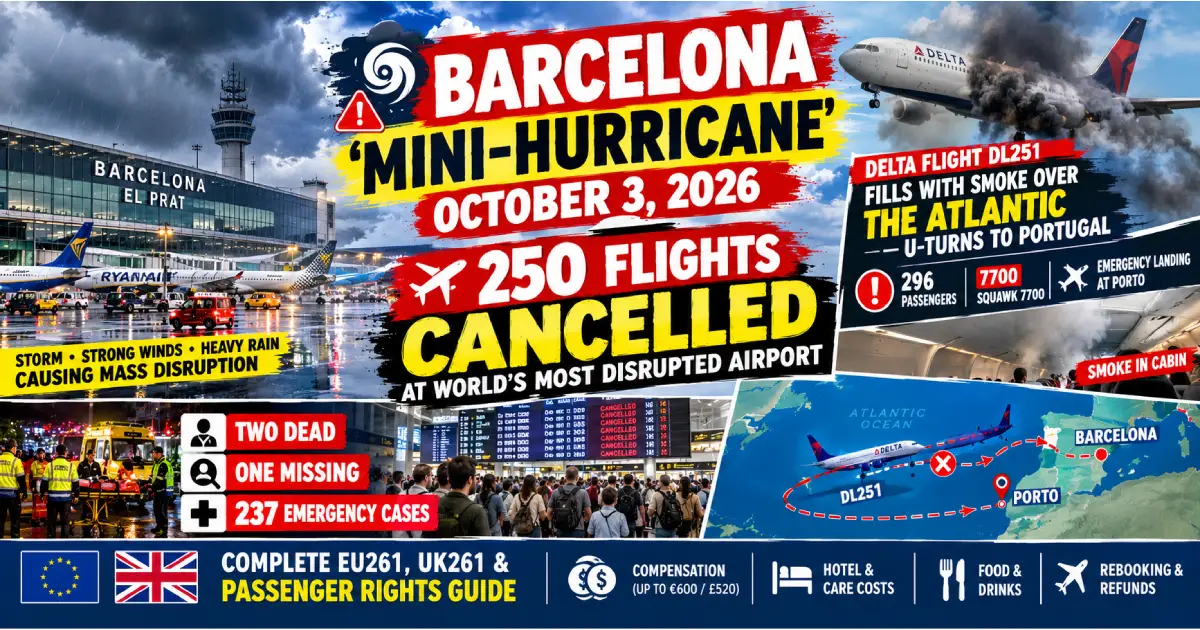
Two separate aviation catastrophes struck in 48 hours on the Barcelona–Boston corridor. First, on Saturday October 3, a Mediterranean ‘mini-hurricane’ buried Barcelona under 192 millimetres of rain — its wettest single day in 20 years — killing two people, leaving a third missing, generating more than 237 medical cases, sending floodwater chest-high through Barcelona neighbourhoods, and producing so many flight cancellations at Barcelona El Prat Airport that by 9pm on Saturday the airport had become the most disrupted aviation hub on earth. Then, on Sunday September 28, a Delta Air Lines Airbus A330 carrying 296 passengers from Barcelona to Boston began filling with smoke over the mid-Atlantic, broadcast Squawk 7700 — the international emergency transponder code — to air traffic control across the ocean, turned around, and made an emergency landing at Porto Airport in Portugal with 60 firefighters and emergency crews waiting on the runway. Eight passengers were treated on the tarmac. Four were taken to hospital. The flight never made it to Boston. This is the complete story of both events — and everything 296 Delta passengers, every UK holidaymaker stranded at Barcelona, and every traveller booked through either airport in the days that followed needs to know about their rights and compensation.
Storm crisis dates: October 3–4, 2026 Delta emergency landing date: Sunday September 28, 2026 (immediately preceding the storm — same Barcelona–Boston route, 5 days apart) Data sources: Reuters, NBC News, CBS News, The Hill, Euro Weekly News, The Olive Press, InSpain, Aviation A2Z, Airline Geeks, Hoodline, Flightradar24 Deaths from storm: 2 confirmed — Tordera (wall collapse) and Montornès del Vallès Missing: 1 person Medical cases treated: 237 people affected by the Catalonia storm Barcelona El Prat cancellations October 3: Nearly 250 flights (Flightradar24) — highest disruption of any airport in the world by 9pm Barcelona El Prat cancellations October 4 (Sunday): 138 flights cancelled, 53 delayed by late morning Flight delay maximum: Up to 4 hours for departing passengers Delta DL251 passengers: 283 passengers + 13 crew = 296 total onboard Delta DL251 diversion airport: Francisco Sá Carneiro Airport, Porto (OPO) Delta DL251 departure time: 15:15 local Barcelona time, September 27, 2026 Delta DL251 landing Porto: 17:45 local Porto time — approximately 2 hours 30 minutes after departure Emergency transponder: Squawk 7700 broadcast over the Atlantic Passengers treated on tarmac: 8 Passengers hospitalised: 4 (3 confirmed by Portuguese authorities / 4 per CBS/civil protection reports) Passengers needing oxygen mid-flight: 12 (Portuguese media) Delta statement: “Mechanical issue” — Portuguese civil protection: “Smoke in the cabin” Cancelled follow-on Delta flights: DL276 and DL277 Barcelona airport operator: Aena Red weather alert: AEMET — Reds alerts across Barcelona, Girona and Tarragona EU261 compensation ceiling: Up to €600 per passenger departing EU airports UK261 compensation ceiling: Up to £520 per passenger departing UK airports Extraordinary circumstances (storm): Yes — weather = extraordinary circumstances Extraordinary circumstances (Delta smoke): No — mechanical failure = within airline’s control = full EU261 compensation payable
The Mediterranean’s autumn storm season — known in Spanish meteorology as DANA (Depresión Aislada en Niveles Altos) — had already struck southern Catalonia in the days before the main event. The city of Tortosa, approximately halfway between Barcelona and Valencia, experienced severe flooding with around 147mm of rain recorded within just 24 hours from Thursday to Friday, as local ravines overflowed and streets submerged.
By Saturday morning, the warning was escalating. Catalan leader Salvador Illa wrote on social media: “Maximum caution is urged in light of the weather forecasts: a Mediterranean mini-hurricane could form in Catalonia.” He added, with unusual directness: “This is no joke.”
Sarai Sarroca, director of regional weather service Meteocat, confirmed on Saturday that the core of an exceptional weather system was over the Mediterranean and that a “mini-hurricane” could move over land in Catalonia. The State Meteorological Agency (Aemet) issued red alerts for torrential rains in parts of Barcelona, Girona and Tarragona where rainfall could exceed 90 litres per square metre in one hour and 200 litres in less than six hours.
Prime Minister Pedro Sanchez described the situation on Sunday morning as “very complex,” particularly in the province of Barcelona. “My solidarity and affection go to their families and friends,” he wrote on social media after the two deaths were confirmed.
In central Barcelona, the city’s Raval observatory recorded 192mm of rainfall — making Saturday its wettest day in 20 years. Records were also broken at outposts in Badalona, Sabadell and Zona Universitaria.
The numbers are staggering in context. Barcelona’s average total rainfall for October is approximately 90mm. The storm deposited more than double October’s average rainfall in a single day. Some areas received more than 200 litres per square metre. The extreme weather inundated homes and hospitals, cut power to thousands, and brought parts of the transport network to a complete standstill.
Homes were flooded and cars left submerged in Bellvitge and Cornella near Barcelona after the torrential rain on Saturday. Ducks swam in huge puddles that formed on motorways in Barcelona. Images shared on social media showed sections of Barcelona’s Ronda de Dalt covered by water, while several roads in L’Hospitalet de Llobregat were also affected.
Emergency medical teams treated 237 people affected by the storm, although no serious cases were reported among those patients specifically — the deaths came from separate structural and flood incidents.
One victim died at the Caravaning Internacional Costa Brava site in Tordera after a wall collapsed. A second person died in Montornès del Vallès, according to Catalonia’s fire service. A third person remained missing as of Sunday morning.
The Red Cross assisted around 3,000 people at Sants and Camp de Tarragona train stations, as well as another 800 at Barcelona El-Prat airport directly.
The storm’s impact on aviation was immediate and total. Barcelona-El Prat Airport was among the worst affected, with nearly 250 flights cancelled on Saturday, according to flight-tracking service Flightradar24. By 9pm, aviation monitoring account Trànsit Aeri de Catalunya said Barcelona-El Prat had the most flight disruption of any airport in the world, although flights were still ‘technically’ operating. Some passengers faced delays of more than four hours as heavy rain swept across the region.
The Spanish news agency EFE described a “very complicated” day at Barcelona’s Josep Tarradellas El Prat Airport on October 3, with several flights cancelled and others departing with delays of up to four hours because air traffic controllers were forced to reduce the number of operations due to thunderstorms in Catalonia and offshore.
Heavy rain even caused leaks in the air traffic control tower. This detail — water forcing its way into the ATC tower that coordinates every aircraft arriving at and departing from one of Europe’s busiest airports — encapsulates the severity of the event. ATC towers are purpose-built to withstand extreme weather. When water is entering through the roof, the storm is genuinely exceptional.
Hundreds of passengers found themselves stranded inside the terminal as departure boards filled with red. The airport’s road connections were also compromised — several roads remained closed because of flooding or landslides, while travellers using Barcelona-El Prat Airport were urged to check the status of their flights before setting out.
Several regional services were cancelled, including at least two services between Asturias and Barcelona on Saturday evening.
At Barcelona-El Prat airport, 138 flights had been cancelled and another 53 delayed by late Sunday morning as the severe weather disrupted travel across Catalonia.
The cumulative two-day disruption total — approximately 388 cancellations and well over 200 delays across Saturday and Sunday — makes the October 3–4 2026 Catalonia DANA one of the most severe aviation disruption events at a single airport in Europe’s autumn 2026 travel calendar.
By Sunday, the worst of the storm was shifting towards Girona as the DANA moved north. The province of Girona received its own red alert as the system tracked northeast, extending the disruption window for passengers flying through northern Catalonia’s regional airports.
The disruption was not limited to the airport. Heavy rainfall caused major problems on the road network, with traffic moving slowly and some roads flooded. The Catalan rail network — Rodalies — suspended multiple lines. High-speed AVE services between Tarragona and the French border were cancelled with no resumption expected before midday on Sunday. Barcelona’s metro experienced disruption. Coach services from Barcelona to other Catalan cities were suspended or significantly delayed.
For international travellers caught in Barcelona on October 3 who were trying to reach the airport: the normal 20-minute journey from central Barcelona to El Prat was effectively impossible for long stretches of Saturday evening. Passengers arriving at the terminal reported that the roads surrounding the airport were flooded, taxis were unavailable, the Aerobus was suspended, and the train connection was affected. Being inside the airport with a cancelled flight was manageable. Trying to reach the airport from central Barcelona on Saturday night was not.
Five days before the storm — on Sunday September 27, 2026 — another flight on the exact same Barcelona–Boston corridor had already become the most terrifying journey of hundreds of passengers’ lives.
A Delta Air Lines flight bound for Boston from Barcelona turned around over the Atlantic Ocean on Sunday and made an emergency landing in Porto, Portugal, after smoke filled the cabin mid-flight.
Flight DL251 departed Barcelona at 3:15 p.m. local time on the afternoon of September 27. The Airbus A330, an 11-year-old widebody aircraft, was carrying 283 passengers and 13 crew members — 296 people in total — on a transatlantic route that crosses approximately 5,700 kilometres of open ocean before reaching Boston Logan International Airport.
The flight was, by all measures, a routine transatlantic departure. The weather was clear. The aircraft was airworthy. The crew was experienced. Nothing in the departure from Barcelona El Prat suggested the next two and a half hours would end with emergency services lining a runway in Porto, Portugal.
The smoke began filling the cabin while the Airbus was over the Atlantic, approximately two hours after departure. The moment smoke appears in the cabin of a commercial aircraft over open ocean, the crew faces one of the most acute operational challenges in aviation: identify the source, assess the severity, and decide whether to continue towards the destination or divert to the nearest suitable airport — all while managing the psychological and physical impact on several hundred passengers.
The crew of DL251 made the decision rapidly. They followed emergency protocols, descending and diverting towards Francisco Sá Carneiro Airport in Porto. As they did so, flight crew broadcast the emergency transponder code Squawk 7700 — the international emergency signal that immediately alerts air traffic controllers across the Atlantic that an aircraft requires priority handling. Squawk 7700 was broadcast to international air traffic control before landing safely on Runway 35 at Francisco Sá Carneiro Airport in Porto.
According to Portuguese media, 12 people required oxygen during the flight. The combination of smoke in the cabin, oxygen masks deployed, and an emergency transponder active over the mid-Atlantic is the aviation scenario that every pilot trains for and every passenger fears.
The aircraft landed safely in Porto at 5:45 p.m. local time. Emergency fire and medical services — more than 60 firefighters and other emergency personnel — were positioned along the runway ahead of the aircraft’s arrival. Air traffic was briefly suspended at Porto Airport to clear the approach corridor for the diverted aircraft. The aircraft landed on Runway 35 without a reported fire.
Eight passengers were treated on the tarmac, with three others hospitalized for treatment, Portuguese emergency officials told Reuters. The flight had 283 passengers and 13 crew members. CBS News and Portugal’s civil protection service cited four hospitalisations. Two male passengers were admitted to the emergency department at São João Hospital in Porto after experiencing smoke inhalation.
Delta described the diversion as resulting from a reported mechanical issue. Portuguese authorities were more specific: a spokesperson for Portugal’s emergency and civil protection authority told Reuters that the forced landing was due to smoke in the cabin.
Delta issued a statement: “The flight landed safely, and we apologize to our customers for the delay in their travels as we work to get them to Boston as safely and quickly as possible.”
The disruption did not end when the aircraft stopped. Delta cancelled connected flights DL276 and DL277 as a consequence of the operational disruption. A Boston-bound flight scheduled to depart Porto at 1pm on Monday was reported cancelled. Delta planned another Boston service from Barcelona at 3:15pm on Monday. Passengers who had made onward connections from Boston were now facing a cascading rebooking nightmare across New England.
For 296 passengers who had boarded a routine transatlantic flight in Barcelona on a Sunday afternoon, the journey had become: two hours in the air, smoke filling the cabin, oxygen for 12 passengers, emergency landing in a city they hadn’t planned to visit, treatment on a tarmac in Portugal, and then a second night away from their destination before Delta could get them to Boston.
This incident did not happen in isolation. Delta recently had four emergency landings in a one-week span — two due to reports of cabin fumes and two due to apparent pressurization issues.
This pattern — four emergency landings in seven days, including DL251 — is not typical for any airline in a normal operating week. It does not necessarily indicate a systemic fleet safety problem; aircraft emergencies can cluster statistically without revealing a common technical cause. But it is a pattern that the Federal Aviation Administration (FAA) and the National Transportation Safety Board (NTSB) would be expected to monitor and examine.
The cause of the smoke on DL251 had not been publicly established at the time of initial reporting. The technical issue has not yet been formally identified in public statements as of this article’s publication. Delta described it as a mechanical issue; Portuguese authorities confirmed smoke in the cabin. The specific source — an electrical fire, an overheating component, contaminated bleed air — remains under investigation.
For passengers who have never experienced a smoke or fume event on an aircraft, the severity of the crew’s response — diverting across the Atlantic, broadcasting Squawk 7700, putting emergency services on the runway — may seem disproportionate. It is not.
Cabin smoke and fume events can prompt crews to divert to a suitable airport. In 2025, 93 lithium-battery incidents involving smoke, fire or heat were recorded in commercial aviation globally. But the most dangerous cabin smoke events are not battery fires — they are electrical fires within the aircraft’s systems, which can be invisible in their early stages and catastrophic if left unaddressed. The crew’s decision to divert DL251 immediately rather than continuing to Boston reflects both regulatory requirements and hard-won operational experience: unexplained smoke at altitude demands immediate diversion, every time.
Emergency diversions involving smoke receive an immediate response because crews must treat any unexplained smoke or burning smell as potentially serious until the source can be identified.
To understand the full scope of what happened on the Barcelona–Boston aviation corridor between September 27 and October 4, 2026:
| Date | Event | Impact |
|---|---|---|
| Sept 27 | Delta DL251 smoke emergency | 296 passengers diverted Porto, 4 hospitalised, DL276 & DL277 cancelled |
| Oct 3 | Barcelona DANA mini-hurricane | ~250 cancellations, world’s most disrupted airport, 2 dead, 237 medical cases |
| Oct 4 | Barcelona disruption continues | 138 cancellations, 53 delays, transport network still compromised |
For any UK, Australian, or US traveller who had flights touching Barcelona during this window, the combined effect was a six-day period during which the Barcelona–transatlantic corridor was hit by two separate crisis events — one a mechanical emergency over the ocean, one a natural disaster at the airport itself.
The Barcelona storm and the Delta DL251 emergency involve fundamentally different legal situations for passenger compensation. Understanding the difference is critical.
The Delta DL251 emergency landing at Porto was caused by a mechanical issue within Delta’s operational control. A technical failure on an aircraft — even one that produces a genuine emergency — does not qualify as an extraordinary circumstance under EU261. Airlines are responsible for the airworthy condition of their aircraft. A smoke event caused by a mechanical failure is the airline’s operational responsibility.
What this means for DL251 passengers: Every passenger on Delta flight DL251 departing Barcelona (an EU airport) has a strong EU261 compensation claim.
| Compensation | Route Distance | Amount |
|---|---|---|
| Barcelona → Boston (5,700+ km) | Over 3,500 km | €600 per passenger |
Additionally:
Delta’s likely defence: Delta described the incident as a “mechanical issue” and may argue that a genuine in-flight emergency constitutes extraordinary circumstances. Courts and aviation regulators have generally rejected this argument for mechanical failures — extraordinary circumstances apply to events outside the airline’s control (weather, ATC, security), not to the airline’s own equipment failures.
How to file your DL251 claim: Go to delta.com → My Trips → Refund/Compensation Request, or file directly via AirHelp (airhelp.com) or AirAdvisor (airadvisor.com) — both operate no-win-no-fee for EU261 claims. Time limit: 2 years (most EU member states), 6 years (England and Wales).
The October 3–4 storm cancellations at Barcelona El Prat are classified as extraordinary circumstances. A DANA Mediterranean storm system producing 192mm of rainfall in a single day is unambiguously a natural event outside any airline’s control.
What this means for storm-cancelled passengers:
✅ Full cash refund — every passenger on a cancelled Barcelona flight is entitled to a full refund to their original payment method within 7 days. The airline cannot substitute a travel voucher without your explicit consent.
✅ Or rebooking — at no additional cost on the next available flight to your destination.
✅ Duty of care — airlines must provide meals, refreshments, and hotel accommodation for overnight disruptions, even in extraordinary circumstances. This is not optional.
❌ No €250–€600 cash compensation lump sum — the storm qualifies as extraordinary circumstances, exempting airlines from the compensation payment (but not from the refund and duty of care obligations above).
The voucher trap: Multiple airlines at Barcelona on October 3–4 offered travel vouchers as a first response to stranded passengers. You are not obligated to accept a voucher. State clearly: “I am requesting a full cash refund under EU Regulation 261/2004 to my original payment method.” Put it in writing.
Duty of care you were entitled to at Barcelona on October 3:
Airlines at Barcelona October 3–4: Vueling (largest operator), Ryanair, easyJet, British Airways, Iberia, Lufthansa, Air France, KLM, Delta, United, American Airlines, Norwegian, Wizz Air and others all operated services affected by the disruption.
UK passengers departing from Heathrow, Gatwick, Manchester, Edinburgh, or Bristol on flights to Barcelona that were cancelled due to the storm are covered by UK Air Passenger Rights regulations — with identical entitlements to EU261 in sterling.
| Route | Extraordinary Circumstances | Compensation |
|---|---|---|
| UK to Barcelona (storm-cancelled) | Yes — weather | Refund only, no lump sum |
| DL251 Barcelona to Boston (mechanical) | No — mechanical | £520 per passenger |
File UK261 claims: Civil Aviation Authority — caa.co.uk → Passenger Rights No-win-no-fee services: airhelp.com or airadvisor.com Time limit: 6 years from date of disruption (England and Wales)
Australia does not have a statutory EU261-equivalent. However, under Australian Consumer Law and airline conditions of carriage:
For Australian passengers on DL251 (Barcelona departure): the EU261 framework applies to the Barcelona departure leg, meaning Australian passengers departing the EU airport are covered by EU261 — not Australian Consumer Law — for that specific cancelled/disrupted service.
Under Canada’s Air Passenger Protection Regulations for large airlines, disruptions within the airline’s control (such as the DL251 mechanical):
| Delay | Compensation |
|---|---|
| 3–6 hours | CAD $400 |
| 6–9 hours | CAD $700 |
| 9+ hours | CAD $1,000 |
Delta is classified as a large airline under APPR. File at otc-cta.gc.ca → Air Travel Complaints.
The storm that devastated Barcelona on October 3 is not a freak event without precedent. It is part of a recurring meteorological pattern that strikes Spain’s Mediterranean coast every autumn — and one that has been intensifying in severity as Mediterranean sea surface temperatures rise.
DANA (Depresión Aislada en Niveles Altos) — an isolated upper-level low-pressure system — forms when a cold air mass detaches from the main Atlantic jet stream and sinks over the warmer Mediterranean. The Mediterranean, whose surface temperatures have been running above historical averages throughout 2026, provides the latent heat energy that transforms these low-pressure cells into the kind of extreme convective system that hit Catalonia on October 3.
Forecasts suggested some areas could receive more than 200 litres of rain per square metre. That kind of rainfall intensity — achieved over Barcelona’s 101 square kilometre municipal area in a matter of hours — overwhelms every drainage and flood management system the city possesses. Barcelona’s drainage infrastructure, like most European city drainage systems, was designed to handle severe rainfall events. It was not designed to handle the rainfall equivalent of two months compressed into a single afternoon.
The October 3 event follows the catastrophic Valencia flooding of November 2024, which killed over 200 people. Spain’s Mediterranean coast is now statistically the most flood-affected region in Western Europe by frequency and severity of autumn rainfall events. Catalonia and Valencia are both in the primary DANA strike zone.
For UK and Australian travellers: Spain remains one of the world’s greatest travel destinations and October is one of the most beautiful months to visit. But October travel to Catalonia and Valencia now carries a materially higher weather disruption risk than it did a decade ago. Booking refundable accommodation and maintaining flight flexibility into October is not excessive caution — it is rational risk management given the documented frequency of autumn DANA events.
Yes — Barcelona-El Prat Airport is fully operational as of Monday October 5. The DANA system has moved north and east. Normal operations have resumed.
The disruption window was acute but finite: Saturday October 3 and Sunday October 4 were the primary impact days. By Sunday evening, operations were recovering, and Monday’s schedule at Barcelona is running normally.
For passengers with upcoming Barcelona flights in October: the specific DANA that caused the October 3 crisis has passed. However, the underlying atmospheric conditions that produce DANAs — warm Mediterranean waters, cooling upper-level air — are still present throughout October and into November. The probability of a second significant weather event before the end of autumn cannot be excluded.
Practical advice for October Barcelona travellers:
Action 1 — DL251 passengers: file your EU261 claim immediately. You are entitled to €600 per passenger. The cause is a mechanical failure — not extraordinary circumstances. Go to delta.com → Refund Request, or file via airhelp.com (no win, no fee). Do this today — do not wait.
Action 2 — Barcelona storm-cancelled passengers: request your cash refund. Do not accept a travel voucher. State in writing to your airline: “I am requesting a full cash refund under EU Regulation 261/2004 to my original payment method.”
Action 3 — If you paid for a hotel in Barcelona on October 3 or 4 because your return flight was cancelled: Keep all receipts. Your airline is obligated to reimburse reasonable accommodation under EU261 duty of care provisions, even for weather cancellations.
Action 4 — If you have a future Barcelona booking in October: Check aena.es for live flight status on your travel day. Monitor AEMET (aemet.es) for active weather alerts. If a red alert is issued for your travel window, check your airline’s waiver page before going to the airport.
Action 5 — Do not accept a voucher in place of cash. This applies to both storm and mechanical cancellations. Airlines routinely offer vouchers as a first response. You are legally entitled to cash.
Action 6 — DL276 and DL277 passengers: If your flight was cancelled as a downstream consequence of DL251’s diversion, you are also entitled to EU261 refunds and potential compensation — the mechanical failure that caused DL251 to divert was within Delta’s operational control, and the follow-on cancellations flowed from that same controllable cause.
Action 7 — File a Property Irregularity Report if your baggage didn’t follow you. If you were rerouted from Barcelona or Porto and your bags didn’t follow your new routing, file a PIR at the airport baggage desk immediately before leaving the terminal. The Montreal Convention provides up to approximately €1,600 per passenger for provable losses from delayed checked luggage.
Action 8 — Save screenshots of every notification. Every cancellation alert, gate change, delay notification, and rebooking message from your airline is evidence for your compensation claim. Screenshot immediately and date-stamp.
Action 9 — UK passengers: check your travel insurance volcanic ash / extreme weather exclusion. Some standard policies exclude DANA or Mediterranean storm events. If you have future Barcelona or Spanish Mediterranean bookings in October, check your policy now.
Action 10 — Save these emergency contacts.
| Contact | Details |
|---|---|
| Delta DL251 claim | delta.com → My Trips → Compensation Request |
| Delta US | 1-800-221-1212 |
| EU261 no-win-no-fee | airhelp.com or airadvisor.com |
| UK CAA passenger rights | caa.co.uk/passengers |
| Australia Airline Advocate | airlinecustomeradvocate.com.au |
| Canada APPR claims | otc-cta.gc.ca |
| Barcelona airport live status | aena.es → Flights |
| AEMET live weather alerts | aemet.es → Early Warning |
| Vueling rebooking | vueling.com → My Booking |
| Ryanair rebooking | ryanair.com → My Trips |
| easyJet rebooking | easyjet.com → Manage Bookings |
| British Airways rebooking | ba.com → Manage My Booking |
Related Articles:
Posted By : Vinay
This article is provided for general informational purposes only and is based on information available at the time of publication. Travel advisories, airline schedules, airport operations, visa requirements, government regulations, and other travel-related information are subject to change without prior notice. While Travel Tourister makes reasonable efforts to verify information using official announcements, government publications, airline and airport communications, and other reliable sources, we cannot guarantee that all information remains complete, accurate, or up to date at all times. Readers should independently verify any information that may affect their travel plans with the relevant airline, airport authority, government agency, embassy, or other official source before making travel, financial, or other decisions. Travel Tourister shall not be liable for any direct or indirect loss, inconvenience, or damages arising from the use of or reliance on the information contained in this article. Nothing in this publication constitutes legal, immigration, financial, or professional travel advice. If you believe any information in this article is inaccurate or outdated, please contact our editorial team. We review all credible correction requests promptly and update our content whenever appropriate.
Lastest News
2nd Floor, 39, Above Kirti Club, DLF Industrial Area, Kirti Nagar, New Delhi, Delhi 110015



Travel Tourister is a leading Travel portal where we introduce travellers to trusted travel agents to make their journey hasselfree, memorable And happy. Travel Tourister is a platform where travellers get Tour packages ,Hotel packages deals through trusted travel companies And hoteliers who are working with us across the world. We always try to find new and more travel agents and hoteliers from every nook and corners across the world so that you could compare the deals with different travel agents and hoteliers and book your tour or hotel with the one you have chosen according to your taste and budget.
Copyright © Travel Tourister, India. All Rights Reserved

 Call
Call Enquiry