Published on : 05 Oct 2026
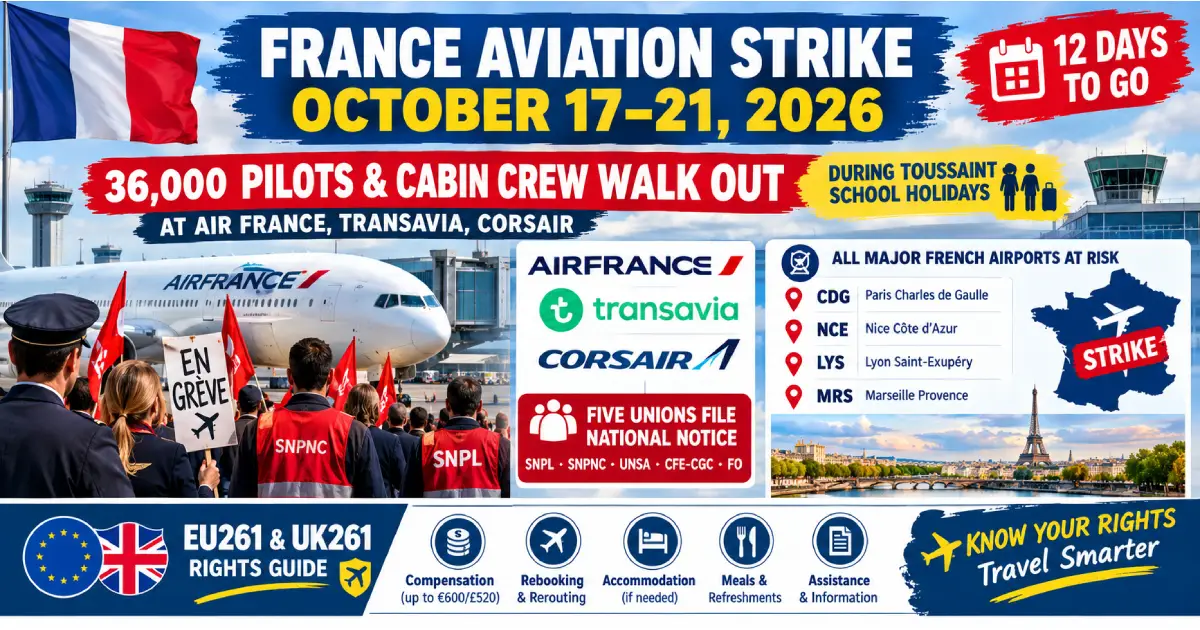
France’s aviation sector is heading toward its most significant disruption since the June 18 Paris CDG strike. Five pilot and cabin crew unions representing 36,000 members have called a nationwide five-day walkout from October 17 to 21 — the exact moment France’s autumn school holidays begin and flights are at their most packed. Air France, Transavia France, Corsair, and every airline employing flight crew under French labour law faces potential disruption. Here is everything you need to know — 12 days before it starts.
French pilots and cabin crew have called a nationwide five-day aviation strike from October 17–21, 2026, coinciding with the Toussaint school holidays. The strike notice runs from 00:01 on Saturday, October 17 until 23:59 on Wednesday, October 21, covering flights operated by aviation companies whose crews fall under French employment law.
The action has been called by an inter-union group including five major bodies — SNPL, UNSA-PNC, SNPNC-FO, SNGAF, and UNAC — representing 36,000 cockpit and crew members. The unions have called for pilots and cabin crew to “completely cease work” during the five-day period but said they remain ready to resume talks with the government.
No airline has yet published a detailed cancellation schedule for October 17–21. The eventual disruption scale will depend on participation levels and operational measures taken by individual carriers. But with 12 days to go and no resolution in sight, every passenger booked on a French airline or departing from a French airport in that window should act now.
Published: October 5, 2026 Strike dates: October 17–21, 2026 (5 days) Strike window: 00:01 Saturday October 17 → 23:59 Wednesday October 21 (Paris time) Unions: SNPL · UNSA-PNC · SNPNC-FO · SNGAF · UNAC Crew represented: 36,000 pilots and cabin crew Airlines directly covered: Air France · Transavia France · Corsair · all carriers with French-law crew Airlines potentially affected (French-law crew): easyJet France (partial) · Vueling France (partial) · all carriers employing pilots or cabin crew under French labour contracts School holiday timing: Toussaint holidays October 16 – November 2 — strike covers first week of peak season Dispute cause: Cumul-Emploi-Retraite (CER) pension reform — due January 1, 2027 Cancellations announced: None yet — expect airline communications 48–72 hours before October 17 UK261: ✅ Applies to UK-carrier departures from French airports (easyJet, Jet2, Ryanair, BA) EU261: ✅ Applies to Air France/Transavia departures worldwide + all departures from French airports Confirmed by: Loyalty Lobby · The Local France · Travel Trade Journal · Rust Tourism News · Strike Tracker · Aviation Today · TBO Academy · Travel Himalaya Nepal · Strike Tracker France
This is not a pay dispute. This is not a dispute about working conditions on aircraft. The strike is about French pension law — and that distinction matters enormously for your EU261 compensation rights.
France’s pension system includes a mechanism called Cumul-Emploi-Retraite (CER), which allows people to continue working while simultaneously drawing their state pension. For aviation workers — who face mandatory medical fitness requirements and early career retirement provisions — this system has specific importance. Pilots and cabin crew who reach standard retirement ages often continue to work in part-time or advisory capacities while drawing their pension.
The French government’s proposed reform of the CER system, due to take effect on January 1, 2027, would change the rules for simultaneous work-and-pension arrangements. The unions argue the reform doesn’t adequately account for the specific working conditions, medical requirements, and retirement provisions governing flight crew. They also raise concerns about risks to the autonomy of CRPN — France’s dedicated aviation worker pension fund — which manages pension assets separately from the general state pension system.
The unions have called for pilots and cabin crew to “completely cease work” during the five-day period but remain ready to resume talks with the government.
Why the dispute’s nature matters for passengers: Because the strike is against a government pension reform rather than against individual airlines, the extraordinary circumstances classification is genuinely contested. See the complete rights analysis below.
The strike is called by an alliance of five unions, representing different segments of France’s aviation workforce:
| Union | Members represented |
|---|---|
| SNPL (Syndicat National des Pilotes de Ligne) | France’s largest pilots’ union — Air France, Transavia, smaller carriers |
| UNSA-PNC | Cabin crew — Air France and affiliated carriers |
| SNPNC-FO | Cabin crew — independent federation, Air France |
| SNGAF | Air France navigating personnel — mixed crew/pilot |
| UNAC | Cabin crew across French carriers |
Together, these five unions represent approximately 36,000 cockpit and crew members. That figure covers the majority of France’s licensed pilots and cabin crew working under French employment law.
Critical scope note: The strike notice applies to pilots and cabin crew working for air transport and aviation companies covered by French labour law. This means the impact will not necessarily be limited to French airlines. Any carrier — including non-French airlines operating in France — whose pilots or cabin crew are employed under French labour law may have some staff joining the strike.
Air France is the airline most directly affected. All Air France pilots and cabin crew are employed under French labour law and are covered by the unions filing this notice. Air France operations at Paris Charles de Gaulle (CDG), Paris Orly (ORY), Nice Côte d’Azur (NCE), Marseille Provence (MRS), Lyon Saint-Exupéry (LYS), and all other French airports could face significant cancellations.
Air France typically operates approximately 450–500 daily scheduled departures. A five-day strike with strong participation could cancel a significant proportion of these — as the June 18, 2026 CDG ground staff strike demonstrated, when hundreds of flights were cancelled at CDG alone.
Air France’s most important routes from a UK/Australian/Canadian perspective:
Transavia France, Air France Group’s low-cost subsidiary, is also covered by the strike notice. Transavia operates heavily from Paris Orly and Lyon to leisure destinations across the Mediterranean — particularly southern Spain, Morocco, Portugal, Greece, and Tunisia. UK passengers rarely fly Transavia directly but frequently connect through Paris on Air France-Transavia codeshares.
Transavia’s cancellation during school holiday week would devastate French family holiday travel — these are the flights carrying French families to Marrakech, Malaga, Crete, and Faro during the exact week the Toussaint school holidays begin.
Corsair, France’s long-haul carrier specialising in routes to the French overseas territories (Martinique, Guadeloupe, Réunion, French Guiana) and West Africa, is also covered. Corsair passengers travelling to the French Caribbean during half-term should monitor this strike closely — disruption on long-haul island routes can strand passengers for days.
The strike notice covers all flight crew employed under French labour law — not just French airlines. This means that non-French airlines that base crew in France and employ them under French labour contracts may have some pilots or cabin crew joining the strike. The practical implication: carriers including easyJet (which has a French subsidiary, easyJet Société par Actions Simplifiée), Vueling, and other airlines with French bases and French-contract crew could face some disruption.
The most visible previous example: the September 2026 easyJet France pilot strike (your September 2 article) affected easyJet routes from CDG, Orly, Lyon, Nice, Nantes, and Bordeaux, because easyJet’s French-based pilots fall under French labour law.
The strike coincides with France’s autumn school holidays, called Toussaint, which fall from October 16th to November 2nd — so if you have a flight between October 17th and 21st, check directly with your airline before travelling.
The Toussaint holidays are the peak autumn travel period in France and one of the busiest weeks of the year for all European aviation. French families travelling abroad for half-term fill aircraft operating from CDG, Orly, Nice, Lyon, Marseille, and Bordeaux. British, American, Canadian, and Australian tourists who have planned autumn Paris breaks for the same week are competing for the same seats.
The practical consequence of a strike during Toussaint:
The unions have timed the strike deliberately — Toussaint is exactly when a walkout creates maximum pressure on the government to resolve the pension reform dispute before the January 1, 2027 implementation date.
This strike creates one of the most legally nuanced EU261 situations of 2026. Two competing arguments apply simultaneously:
Air traffic control strikes and government-mandated extraordinary events are consistently classified as extraordinary circumstances, removing airline cash compensation liability. This strike is against a government pension reform, not against the airline. Airlines will argue:
If this argument prevails, airlines would not owe the fixed EU261 cash compensation of €250–€600.
European Court of Justice rulings, particularly Krüsemann v TUIfly (2018), established that spontaneous strikes by an airline’s own employees — even when motivated by external factors — can fall within the airline’s sphere of responsibility. The Krüsemann ruling distinguished between strikes inherent to the normal exercise of an airline’s activity (not extraordinary) and truly external events (extraordinary).
Pilots and cabin crew employed by Air France are Air France employees. Their walkout disrupts Air France operations. French courts and the DGAC have taken different positions on government-dispute aviation strikes in the past — and the final classification of this strike for EU261 purposes will not be clear until individual cases are decided.
The practical advice: File your EU261 compensation claim regardless. Airlines may attempt the extraordinary circumstances defence — challenge it. If your airline refuses compensation citing extraordinary circumstances, escalate to the DGAC or your national regulator. The final call is made by courts and regulators, not airlines.
Duty of care always applies — regardless of how the extraordinary circumstances question is resolved:
Airlines cannot refuse duty of care even when they claim extraordinary circumstances for cash compensation purposes.
| Situation | Your rights |
|---|---|
| Any flight departing from a French airport (CDG, ORY, NCE, MRS, LYS, etc.) on ANY carrier | EU261 applies |
| Air France or Transavia departing from ANY airport worldwide | EU261 applies |
| easyJet UK departing from UK airport to France | UK261 applies |
| British Airways departing from UK airport to France | UK261 applies |
| Ryanair, Jet2 departing from UK airport to France | UK261 applies |
| Non-French carrier departing from non-French airport | Airline T&Cs + national law |
| Distance | EU261 / UK261 |
|---|---|
| Under 1,500km | €250 / £220 per passenger |
| 1,500–3,500km | €400 / £350 per passenger |
| Over 3,500km | €600 / £520 per passenger |
Most UK–France routes: Under 1,500km → €250 / £220 per passenger
Paris CDG → New York: Over 3,500km → €600 per passenger (if compensation applies)
Paris CDG → Sydney or Melbourne: Over 3,500km → €600 per passenger
EU261 provides a way out of cash compensation when airlines give passengers more than 14 days’ notice of cancellation. October 17 is 12 days from today — meaning that cancellation notifications issued TODAY or later are within the 14-day window, potentially preserving your compensation rights even if the extraordinary circumstances defence fails.
Passengers notified of cancellations after October 3: Your compensation rights are maximally protected — less than 14 days’ notice, and the extraordinary circumstances defence is your airline’s only argument.
Step 1 — Check your booking:
If you have any flight involving France between October 17 and 21 — departing from France, arriving in France on Air France or Transavia, or connecting through CDG or Orly — visit your airline’s website or app now and sign up for flight status notifications.
Step 2 — Don’t rebook yourself yet:
The most common mistake passengers make when a strike is announced 12 days in advance is to proactively rebook onto an alternative flight — and then discover they cannot claim EU261 compensation because they cancelled the original booking rather than waiting for the airline to cancel it. Wait for your airline to cancel or issue a travel waiver before making changes.
Step 3 — Watch for airline waivers:
Expect Air France to issue travel waivers in the next 7–10 days as strike confirmation or resolution becomes clearer. A waiver allows you to change your flight dates without fee — which is genuinely valuable for Toussaint week travel when alternative date availability is limited.
Step 4 — Book alternatives now if you must travel:
If your October 17–21 trip is non-negotiable and you cannot risk a cancelled Air France flight:
Step 5 — Watch this article for updates:
This publication will update this article as cancellation schedules are released, as resolution talks develop, and as individual airlines issue waivers. Bookmark this page.
October 17–21 does not stand alone. France is heading into one of its most disruption-heavy months in years:
| Date | Event | Impact |
|---|---|---|
| Already ongoing | Paris CGT-RATP unlimited metro/bus strike from September 28 | Paris metro, RER, bus disrupted daily |
| October 10 | Charleroi nightly ATC strikes end (last night) | Charleroi normalises |
| October 14 | Belgium national strike — ALL Brussels + Charleroi flights cancelled | 70,000 passengers stranded |
| October 16 | France Toussaint school holidays begin | Travel demand peaks |
| October 17–21 | FRANCE AVIATION STRIKE | Air France, Transavia, Corsair at risk |
| October 30 | Italy CGIL/UIL national general strike | Rail + flights + major Italian disruption |
Three consecutive aviation disruption events — Belgium October 14, France October 17–21, Italy October 30 — make the final two weeks of October the most disrupted travel period in Europe since June 2026.
| Contact | Phone (UK) | Online |
|---|---|---|
| Air France | 0800 234 6005 | airfrance.com → Manage Booking |
| Transavia France | — | transavia.com → Manage My Booking |
| Corsair | — | corsair.fr → Manage Booking |
| British Airways | 0800 727 800 | ba.com → Manage My Booking |
| easyJet | 0330 365 5000 | easyjet.com → Manage Trips |
| Eurostar | 03432 186 186 | eurostar.com → Manage Booking |
| SNCF (France rail) | — | sncf-connect.com |
| AirHelp (EU261 claims) | — | airhelp.com |
| AirAdvisor (EU261/UK261) | — | airadvisor.com |
| Bottonline (UK261) | — | bottonline.co.uk |
| DGAC (France complaints) | — | dgac.fr/fr/contact |
| CAA PACT (UK261) | — | caa.co.uk/passengers |
| Metric | Detail |
|---|---|
| Strike dates | October 17–21, 2026 (5 days) |
| Strike window | 00:01 Oct 17 → 23:59 Oct 21 (Paris time) |
| Unions | SNPL · UNSA-PNC · SNPNC-FO · SNGAF · UNAC |
| Crew covered | 36,000 pilots and cabin crew |
| Airlines affected | Air France · Transavia France · Corsair · carriers with French-law crew |
| Dispute | CER pension reform — government reform due January 1, 2027 |
| School holidays | Toussaint Oct 16 – Nov 2 — peak family travel week |
| Cancellations so far | None announced — expect 48–72hr before Oct 17 |
| Days to go | 12 days |
| EU261 compensation | Contested — dispute against government, not airline. Challenge any refusal |
| Duty of care | ✅ ALWAYS applies — refund or rebooking + meals + hotel |
| Key advice | Wait for airline to cancel before rebooking yourself |
| Alternative | Eurostar London–Paris unaffected · BA not covered by French labour law |
| Next update | When airlines issue waivers or cancellation schedules (expect Oct 10–14) |
Related Articles:
Posted By : Vinay
This article is provided for general informational purposes only and is based on information available at the time of publication. Travel advisories, airline schedules, airport operations, visa requirements, government regulations, and other travel-related information are subject to change without prior notice. While Travel Tourister makes reasonable efforts to verify information using official announcements, government publications, airline and airport communications, and other reliable sources, we cannot guarantee that all information remains complete, accurate, or up to date at all times. Readers should independently verify any information that may affect their travel plans with the relevant airline, airport authority, government agency, embassy, or other official source before making travel, financial, or other decisions. Travel Tourister shall not be liable for any direct or indirect loss, inconvenience, or damages arising from the use of or reliance on the information contained in this article. Nothing in this publication constitutes legal, immigration, financial, or professional travel advice. If you believe any information in this article is inaccurate or outdated, please contact our editorial team. We review all credible correction requests promptly and update our content whenever appropriate.
Lastest News
2nd Floor, 39, Above Kirti Club, DLF Industrial Area, Kirti Nagar, New Delhi, Delhi 110015



Travel Tourister is a leading Travel portal where we introduce travellers to trusted travel agents to make their journey hasselfree, memorable And happy. Travel Tourister is a platform where travellers get Tour packages ,Hotel packages deals through trusted travel companies And hoteliers who are working with us across the world. We always try to find new and more travel agents and hoteliers from every nook and corners across the world so that you could compare the deals with different travel agents and hoteliers and book your tour or hotel with the one you have chosen according to your taste and budget.
Copyright © Travel Tourister, India. All Rights Reserved

 Call
Call Enquiry