Published on : 07 Oct 2026
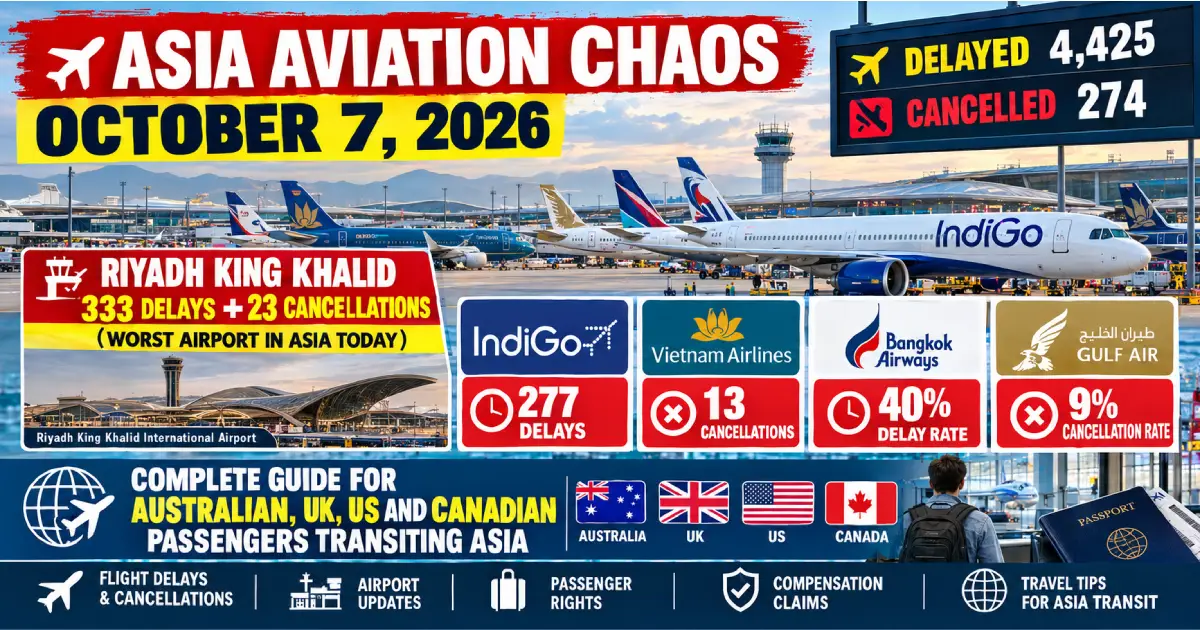
Asia’s aviation network recorded 4,425 flight delays and 274 cancellations on Wednesday October 7, 2026, in a widespread disruption event spanning Saudi Arabia, the UAE, India, Vietnam, Indonesia, Thailand, Singapore and beyond. Riyadh’s King Khalid International Airport is today’s single worst hub in Asia — 333 delays and 23 cancellations driven by ongoing Middle East security airspace constraints and regional rerouting pressure. IndiGo absorbed 277 delays, the highest individual airline delay count in Asia today. Bangkok Airways posted a 40% delay rate — the most alarming operational rate of any carrier tracked today. Vietnam Airlines recorded 13 cancellations and a 3% cancellation rate. Gulf Air posted a 9% cancellation rate. If you are transiting through any Asian or Gulf hub today on your way to or from Australia, the UK, the US or Canada — this is everything you need to know before you reach your connecting gate.
Data published October 7, 2026 at 01:52 GMT+5:30 by Travel and Tour World, sourced from FlightAware real-time tracking.
| Metric | October 7, 2026 |
|---|---|
| Total Asia delays | 4,425 |
| Total Asia cancellations | 274 |
| Worst airport — delays | Riyadh King Khalid (RUH) — 333 delays |
| Worst airport — cancellations | Riyadh King Khalid (RUH) — 23 cancellations |
| Highest airline delays | IndiGo — 277 delays (12% delay rate) |
| Highest cancellation rate | Gulf Air — 9% cancellation rate |
| Most alarming delay rate | Bangkok Airways — 40% delay rate |
| Vietnam Airlines | 13 cancellations (3% rate) + 52 delays (14% rate) |
| Garuda Indonesia | 2 cancellations + 54 delays (21% delay rate) |
| flynas | 3 cancellations + 89 delays (34% delay rate) |
| Primary causes | Middle East security airspace, monsoon transition, peak Golden Week traffic |
Riyadh’s King Khalid International Airport is today’s single most disrupted aviation hub in the entire Asia-Pacific and Middle East region. Its 333 delays and 23 cancellations place it well above every other airport in today’s data.
The Riyadh disruption is driven by the same structural pressures that have dominated Middle East aviation since the 2026 Iran conflict began: active airspace closures over Iran and Iraq forcing civilian traffic into narrow alternative corridors over Saudi Arabia, the UAE and Oman; Houthi missile threats against Saudi aviation infrastructure; and Saudia’s network-wide operational pressure from the strain of carrying diverted traffic that would normally transit Iranian airspace.
King Khalid International in Riyadh posted 222 delays and 11 cancellations in a comparable disruption event last week, making today’s 333 delays and 23 cancellations a significant escalation in Saudi Arabia’s aviation pressure.
Why it matters for your readers: Riyadh is a critical connecting point for Australian and NZ passengers on Saudia-marketed itineraries, and for UK and US passengers on Middle Eastern connection routes through the Arabian Peninsula.
Abu Dhabi International Airport is showing active disruption today with 0% cancellation rates at origin and destination — meaning cancellations are low but delays are building. Etihad Airways operates AUH as its hub — the airport serves as one of the primary gateways for Australian passengers on Etihad’s Sydney, Melbourne and Brisbane services to London and Europe.
Singapore Changi Airport is showing active delays with 0% cancellation rates today. Singapore is Australia’s most-used transit hub for Southeast Asia, and a primary connection point for UK, US and Canadian passengers routing through Asia. Delays at Changi cascade into onward connections across Australia, New Zealand, India and Southeast Asia within 2–3 hours.
Bangkok is absorbing significant pressure today. Bangkok Airways has recorded two cancellations, or 1%, and 49 delays, representing a 40% delay rate — the most alarming single-airline operational rate in today’s Asia data. A 40% delay rate means four in every ten Bangkok Airways flights are running late. Bangkok Airways operates regional Southeast Asian routes from BKK connecting to island and resort destinations including Koh Samui, Chiang Mai, Luang Prabang and Phnom Penh — popular with Australian, UK and US leisure travellers.
Bangkok has been under compound operational pressure throughout Q4 2026 — post-flooding recovery, peak pre-Golden Week traffic from China, and the broader monsoon transition creating convective weather cells over the Gulf of Thailand.
Vietnam Airlines has recorded 13 cancellations, or 3%, and 52 delays, or 14% today. A 3% cancellation rate across a major national carrier’s entire network is significant — it translates to dozens of passengers stranded at Vietnamese airports. Vietnam Airlines operates Sydney–Ho Chi Minh City, Melbourne–Hanoi and routes to the UK and Europe through its Gulf and Asian codeshare partners.
India’s aviation network is under significant pressure today. IndiGo has only eight cancellations, shown as 0%, but 277 delays representing 12% of its tracked operations — the highest individual airline delay count in Asia today. IndiGo is India’s largest domestic carrier and the primary feeder airline for international connections at Delhi, Mumbai, Bengaluru and Chennai. A 12% network delay rate means roughly one in eight IndiGo flights is running late, cascading into international connections at India’s major hub airports.
Delhi’s disruption reflects the October monsoon transition — the period when the southwest monsoon retreats from northern India, creating sudden atmospheric instability over the Indo-Gangetic Plain that produces holding patterns and reduced approach rates at Indira Gandhi International.
Gulf Air also has 13 cancellations, representing 9%, and 15 delays, representing 10% today. Gulf Air’s 9% cancellation rate is the highest cancellation rate of any carrier in today’s data and reflects Bahrain’s position on the front line of Middle East aviation pressure. Gulf Air operates routes to London Heathrow, Manchester, Birmingham, Frankfurt, Paris, Athens, and multiple Asian destinations.
Garuda Indonesia has two cancellations shown as 0% and 54 delays representing 21% of its operations today. A 21% delay rate at Garuda — Indonesia’s flag carrier — reflects Jakarta’s chronic congestion issues compounded by aircraft rotation pressure from the Indonesian school holiday season. Jakarta is a key Australian transit point for Bali, Lombok and eastern Indonesian connections.
| Airport | Code | Key Disruptions |
|---|---|---|
| Hanoi Noi Bai | HAN | Vietnam Airlines 13 cancellations originating here |
| Ho Chi Minh Tan Son Nhat | SGN | Vietnam Airlines network disruption |
| Jeddah King Abdulaziz | JED | Saudi Arabia airspace pressure, Saudia delays |
| Dubai International | DXB | Emirates and flydubai — see today’s UAE article |
| Islamabad | ISB | airblue 4 cancellations (10% rate) + 8 delays (20%) |
| Singapore Changi | SIN | Delays building — 0% cancellation rate |
| Airline | Delays | Cancellations | Rate | Key Stat |
|---|---|---|---|---|
| IndiGo | 277 | 8 | 12% delay | Highest delay count in Asia today |
| flynas | 89 | 3 | 34% delay | Saudi LCC under airspace pressure |
| Garuda Indonesia | 54 | 2 | 21% delay | Jakarta congestion, school holidays |
| Bangkok Airways | 49 | 2 | 40% delay | Most alarming delay rate in Asia |
| Vietnam Airlines | 52 | 13 | 3% cancel | Highest cancellations by count |
| Gulf Air | 15 | 13 | 9% cancel | Highest cancellation rate in Asia |
| Royal Jordanian | 16 | 2 | 1% cancel | Amman connecting routes |
| US-Bangla Airlines | 18 | 2 | 2% cancel | Bangladesh domestic/regional |
| airblue | 8 | 4 | 10% cancel | Pakistan — Islamabad hub |
| Drukair Royal Bhutan | 2 | 5 | 26% cancel | Highest cancellation rate proportionally |
IndiGo absorbs 277 delays today — the single highest airline delay count across the entire Asia-Pacific region. As India’s largest domestic carrier with over 50% domestic market share, IndiGo’s disruption is not isolated — it cascades into every international connection at Delhi, Mumbai, Bengaluru, Chennai, Hyderabad and Kolkata. Passengers flying into India on international services from the UK, Australia, US or Canada and connecting domestically on IndiGo are directly exposed today.
Bangkok Airways’ 40% delay rate is this article’s most important number for Australian, UK and US leisure travellers. Bangkok Airways operates the only direct air services to Koh Samui (USM) — the island airport is exclusively served by Bangkok Airways. If you are connecting at Bangkok today to Koh Samui, Luang Prabang, Phnom Penh or any other Bangkok Airways regional destination, a 40% delay rate means you have a roughly 4-in-10 chance of a delayed departure.
Gulf Air’s 9% cancellation rate is significant because it directly affects routes to London Heathrow, Manchester and Birmingham — three of TravelTourister’s highest-traffic UK reader airports. Gulf Air flights GF005 and GF006 (Bahrain–London Heathrow) are among the routes exposed to today’s disruption.
Three converging forces are driving today’s disruption:
1. Middle East airspace constraints — ongoing since February 2026 The 2026 Iran conflict has progressively narrowed the available civilian air corridors over the Middle East. Routes that previously transited Iranian airspace — including major east-west connections between Europe, India and East Asia — are now forced through congested alternative corridors over Saudi Arabia, the UAE and Oman. This structural rerouting pressure has no short-term resolution and will continue to drive above-normal disruption across all Gulf and South Asian hubs through the rest of 2026.
2. October Golden Week traffic surge — China China’s Golden Week holiday (October 1–7) generates the single largest surge in Chinese domestic aviation demand of the year. Golden Week creates massive increases in scheduled departures from Chinese hub airports — and even marginal weather disruptions during this peak window produce cascade effects that persist for days. The Golden Week surge is ending today, October 7, but recovery from the week’s rotational pressure will carry into Thursday and Friday.
3. October monsoon transition — India and Southeast Asia The simultaneous retreat of the southwest monsoon from India, Bangladesh and Myanmar in early October creates sudden atmospheric instability over the Indo-Gangetic Plain and the Bay of Bengal. This drives holding patterns above Mumbai, Delhi and Chennai, and convective weather cells over Bangkok and the Gulf of Thailand — compressing approach rates and cascading departure delays across South and Southeast Asia.
Australia and NZ passengers are most directly exposed through their primary Asian transit hubs:
If you are transiting through any of these airports today on a single ticket, your airline is legally obligated to rebook you at no extra cost if you miss a connection because of a delay on the inbound sector. Under Australian Consumer Law as applied to international aviation, you are entitled to care (meals, accommodation) during a significant delay regardless of cause.
Qantas specifically: Monitor the Qantas app before your first departure today. Qantas Conditions of Carriage entitle you to rebooking at no additional cost when disruption is caused by circumstances beyond the airline’s control.
UK passengers most exposed today:
UK261 rights apply to your UK-departing outbound flight. On return legs departing from Asian airports, local regulations or airline Conditions of Carriage govern your rights — which for most Asian countries means the airline’s own rebooking obligations rather than a mandatory compensation scheme equivalent to UK261.
US passengers flying to South Asia, Southeast Asia or Australia and transiting through Bahrain (Gulf Air), Bangkok (Bangkok Airways), or Delhi (IndiGo connections) are directly exposed today. Under US DOT rules, protections apply to US-departing and US-arriving flights. For purely international connections outside the US, your rights are governed by the airline’s Conditions of Carriage and the local regulatory framework.
Canadian passengers connecting through Asian Gulf hubs on Air Canada or WestJet codeshare arrangements should monitor today’s disruption. Riyadh and Abu Dhabi are the highest-risk points for any Middle Eastern connection today. APPR entitles you to rebooking at no extra cost — compensation depends on whether the disruption is within airline control.
| Hub Country | Your Rights if Cancelled |
|---|---|
| Saudi Arabia (GACA) | Rebooking + refund; meals after 2hrs; hotel if overnight |
| UAE (GCAA) | Rebooking + refund; meals; hotel if overnight |
| India (DGCA) | Refund or rebooking; meals after 2hrs; hotel overnight |
| Thailand (DCA) | Rebooking; meals after 2hrs; hotel if overnight |
| Vietnam (CAAV) | Rebooking; meals; hotel overnight |
| Indonesia (DGCA) | Refund or rebooking; meals; hotel overnight |
| Bahrain (CAAB) | Rebooking + refund; care rights |
| Singapore (CAAS) | Rebooking; airline Conditions of Carriage govern compensation |
| UK outbound | UK261 — full refund or rebooking + compensation if applicable |
| Australian outbound | Australian Consumer Law — rebooking at no cost |
The key rule at every Asian hub: If your onward connection is on the same ticket as your delayed inbound flight, the operating carrier of the delayed flight is responsible for getting you to your final destination. Go directly to the airline’s transfer or customer service desk — do not rebook independently without first confirming the airline will not cover your costs.
Posted By : Vinay
This article is provided for general informational purposes only and is based on information available at the time of publication. Travel advisories, airline schedules, airport operations, visa requirements, government regulations, and other travel-related information are subject to change without prior notice. While Travel Tourister makes reasonable efforts to verify information using official announcements, government publications, airline and airport communications, and other reliable sources, we cannot guarantee that all information remains complete, accurate, or up to date at all times. Readers should independently verify any information that may affect their travel plans with the relevant airline, airport authority, government agency, embassy, or other official source before making travel, financial, or other decisions. Travel Tourister shall not be liable for any direct or indirect loss, inconvenience, or damages arising from the use of or reliance on the information contained in this article. Nothing in this publication constitutes legal, immigration, financial, or professional travel advice. If you believe any information in this article is inaccurate or outdated, please contact our editorial team. We review all credible correction requests promptly and update our content whenever appropriate.
Lastest News
2nd Floor, 39, Above Kirti Club, DLF Industrial Area, Kirti Nagar, New Delhi, Delhi 110015



Travel Tourister is a leading Travel portal where we introduce travellers to trusted travel agents to make their journey hasselfree, memorable And happy. Travel Tourister is a platform where travellers get Tour packages ,Hotel packages deals through trusted travel companies And hoteliers who are working with us across the world. We always try to find new and more travel agents and hoteliers from every nook and corners across the world so that you could compare the deals with different travel agents and hoteliers and book your tour or hotel with the one you have chosen according to your taste and budget.
Copyright © Travel Tourister, India. All Rights Reserved

 Call
Call Enquiry