Published on : 10 Oct 2026
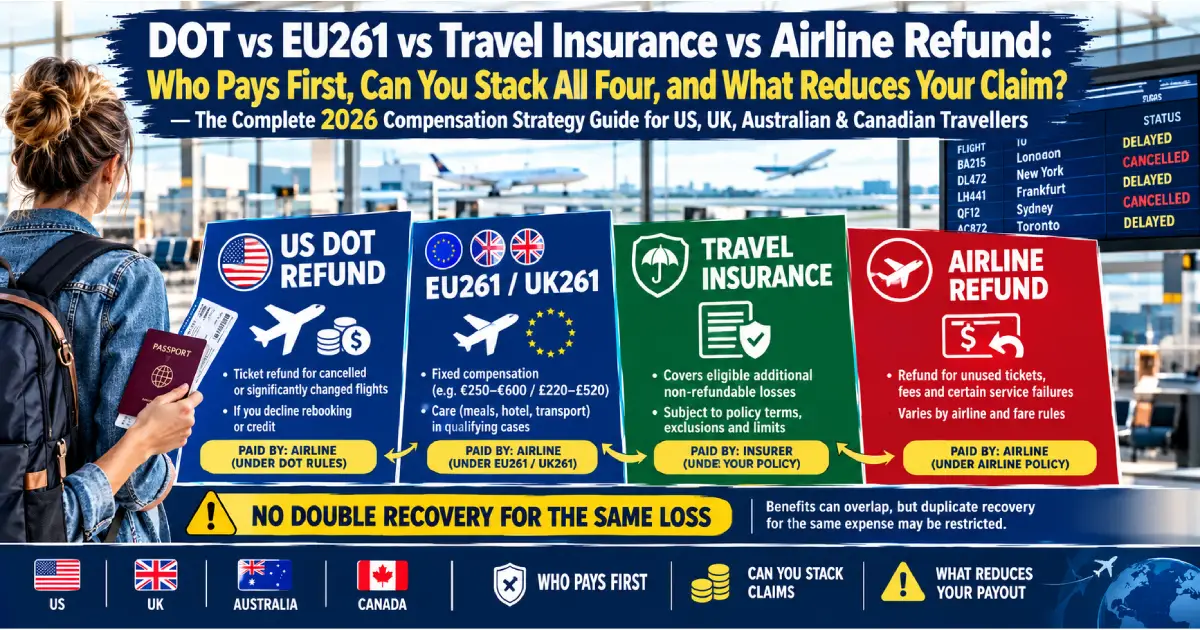
Your Paris–New York Air France flight was cancelled. Your ticket cost $1,200. You have travel insurance. You paid with a Chase Sapphire Reserve. The flight departed from Charles de Gaulle — an EU airport. You’re American. Which of the four compensation sources do you activate? In what order? Can you take money from all of them? Will the airline refund reduce what the insurance pays? The answers are more in your favour than you think — and more complex than any single guide has mapped until now.
This article does four things no other compensation guide does: it ranks the four compensation sources in priority order, maps the exact payment timelines, explains whether claiming one source reduces another, and runs a real $1,200 scenario through all four simultaneously.
| Source | What it is | Max payout |
|---|---|---|
| Airline refund (DOT / EU261 / UK261 / APPR) | Your legal right to your ticket price back | 100% of ticket + ancillary fees |
| EU261 / UK261 / APPR cash compensation | Fixed payment for the inconvenience | €250–€600 / £220–£520 / CAD $400–$1,000 |
| Travel insurance | Policy covering trip costs beyond the ticket | Up to 100% of total trip costs |
| Credit card trip protection | Built-in card benefit | Meals, hotels, incidentals (typically $500–$10,000) |
The critical insight: these four sources compensate for different things. They are not four ways to recover the same $1,200. They are four separate financial mechanisms covering different portions of your total loss — and in most scenarios, you are entitled to all four simultaneously.
Priority order matters because some sources are “secondary” — they only pay what primary sources haven’t already covered. Getting the order wrong leaves money on the table.
1st — Airline refund (always claim this first)
The airline refund is your legal right and costs you nothing to claim. It is primary to everything else. Insurance companies specifically require you to claim your airline refund before they will pay, because insurance is designed to fill gaps, not replace rights you already have.
If your airline cancels your flight or makes a significant change and you decide not to travel, they owe you a full refund to your original payment method — automatically, in cash, no vouchers or hoops.
Start here. Always.
2nd — EU261 / UK261 / APPR cash compensation (if applicable)
This is additional money on top of the refund — not instead of it. It compensates for inconvenience, not for the ticket cost. Claim it simultaneously with the refund if both apply.
3rd — Credit card trip protection (file within 60 days)
For expenses not covered by the airline’s duty of care (meals, hotels, incidentals). This is secondary to what the airline owes under duty of care — but covers the gap when duty of care doesn’t apply (weather) or doesn’t cover everything.
4th — Travel insurance (file after airline and card)
Travel insurance is designed to cover what nothing else does: non-refundable hotel costs, missed tours, business losses, consequential expenses. It is explicitly secondary to airline refunds and will ask what the airline has already paid before settling your claim.
This is the dimension that no other compensation article has charted — and it matters enormously for cash flow when you’ve just lost a $1,200 ticket and have $800 in hotel costs outstanding.
| Source | Filing deadline | Payment timeline | Statute of limitations |
|---|---|---|---|
| DOT refund (credit card) | Day of cancellation | 7 business days | 2 years |
| DOT refund (cash/debit) | Day of cancellation | 20 calendar days | 2 years |
| EU261 cash compensation | After flight | 30–60 days (varies by airline) | 6 yrs UK / 5 yrs France / 3 yrs Germany / 2 yrs Spain |
| UK261 cash compensation | After flight | 28 days (CAA guidance) | 6 years (UK) |
| APPR (Canada) | Within specified window | 30 days | Varies by province |
| Credit card trip delay | Within 60 days of incident | 30–45 days after claim filed | 60 days from incident |
| Travel insurance | Per policy (typically 90 days) | 14–21 days after docs submitted | Per policy (typically 1 year) |
The practical consequence of the timeline comparison:
If you paid for your Air France ticket with a credit card and the flight is cancelled, your DOT or EU261 refund should hit your card within 7 business days — about 10 calendar days. Your travel insurance claim for the non-refundable Paris hotel (not covered by the airline) takes 14–21 days from submission. Your EU261 cash compensation for the inconvenience takes 30–60 days from the airline.
So the order in which money actually arrives is: (1) card refund in 10 days, (2) travel insurance in 21 days, (3) EU261 compensation in 45–60 days. Understanding this sequencing prevents cash-flow problems while you wait for the slower-paying sources.
Yes. Absolutely. Here’s exactly how.
“Double-dipping” in compensation law refers to claiming the same loss from two sources simultaneously. That IS prohibited. But DOT and EU261 do not compensate for the same loss — they compensate for different things:
| Compensation | What it covers | Can you stack? |
|---|---|---|
| DOT refund | Your ticket cost | ✅ Yes — with anything |
| EU261 cash compensation | The inconvenience of the disruption | ✅ Yes — with DOT refund and insurance |
| EU261 duty of care | Meals, hotel during wait | ✅ Yes — with DOT and insurance |
| Travel insurance | Trip costs beyond the ticket | ✅ Yes — reduced by what airline already paid |
| Credit card trip delay | Incidentals during delay | ✅ Yes — reduced by what card already covered |
The scenario where both DOT and EU261 apply:
You book a flight with Air France from New York JFK to Paris CDG, returning CDG to JFK. Your outbound JFK departure is on Air France (a French/EU carrier). It’s cancelled with less than 14 days notice for a controllable reason.
You claim both. The DOT refund covers your ticket. The EU261 compensation is an additional €600 ($650 approximately) for the inconvenience. These are legally distinct claims covering distinct losses. No double-dipping occurs.
Important: The EU261 cash compensation is NOT reduced by the airline refund. You receive both. This is frequently misunderstood — passengers who accept a refund sometimes believe they’ve waived their compensation claim. They have not.
No. The airline refund and EU261 cash compensation are entirely separate legal entitlements.
Under EU261, you can receive compensation for the inconvenience AND a refund of your ticket if you choose not to travel.
The refund covers the money you paid for the ticket. The EU261 fixed compensation covers the disruption to your plans — time lost, inconvenience suffered, alternative arrangements needed. These are legally distinct losses under EU Regulation 261/2004, and one does not satisfy the other.
The only scenario where accepting the airline’s offer might affect your EU261 claim: if the airline offers you a voucher or settlement payment and you sign a document explicitly waiving your EU261 rights. Never sign such a document without reading it. The EU261 claim is worth €250–€600 per passenger — a family of four can be waiving up to €2,400.
Yes — this one does reduce your insurance payout, and this is where passengers most often get it wrong.
Travel insurance is “excess” or “secondary” insurance — it pays what other sources have not already covered. When you file a travel insurance claim, the insurer will ask:
“What has the airline already refunded or paid you?”
Whatever the airline has already paid is deducted from the insurance calculation. The insurance covers the gap.
Example — $1,200 Air France ticket cancelled:
| Step | Action | Amount |
|---|---|---|
| Airline refund | Air France refunds ticket | $1,200 recovered |
| Insurance claim for hotel | Non-refundable Paris hotel | $600 (hotel was not refunded by airline) |
| Insurance pays | $600 (airline already covered the ticket) | Net insurance payout: $600 |
If you had NOT claimed the airline refund first and just filed with insurance, the insurer would have paid $1,800 — but would then subrogate against Air France to recover the $1,200 ticket portion themselves. The outcome is the same for you, but insurers strongly prefer you claim the airline refund first.
The key principle: Insurance covers what the airline doesn’t. Always take what the airline owes first.
Generally no — because EU261 cash compensation covers inconvenience, not trip costs.
EU261 cash compensation (€250–€600) is classified as general damages for inconvenience. Travel insurance trip cancellation coverage reimburses specific financial losses (hotel, tours, car hire). These compensate for different economic losses, so they don’t offset each other.
However, some travel insurance policies have language that reduces payouts by any “compensation or payments received from the airline.” If your policy includes this language, the EU261 payment may reduce what insurance pays. Read your policy’s offset clause carefully.
The safe approach: Claim EU261 compensation from the airline AND claim trip costs from insurance. If your insurer later argues offset, point to the different nature of the losses. Most insurers accept this.
No — for the same reason EU261 doesn’t reduce insurance.
Credit card trip delay protection covers expenses incurred during a delay — meals, hotels, incidentals. EU261 cash compensation covers the inconvenience of the delay itself. Different losses, different claims, no offset.
However: if you received EU261 duty of care (airline-provided meals, hotel, transport), the credit card trip protection will typically not pay for the same items. Only claim the card benefit for expenses the airline’s duty of care did not cover.
Let’s run a complete scenario. You are a UK citizen flying Air France JFK → Paris CDG. Ticket cost: $1,200 (£950). Paid with a Barclaycard Avios Plus. You have comprehensive travel insurance. Flight cancelled at the gate — controllable cause, 0 days notice.
What you claim and from whom:
| Claim | Source | Amount | Timeline |
|---|---|---|---|
| Full ticket refund | Air France (EU261 refund right) | £950 | 7 business days (credit card) |
| EU261 cash compensation | Air France (EU261, route >3,500km) | €600 (~£500) | 30–60 days |
| Non-refundable Paris hotel | Travel insurance (trip interruption) | £400 | 14–21 days |
| Replacement flight (higher fare) | Travel insurance (trip interruption) | £200 | 14–21 days |
| Meals at JFK during 12-hr wait | Barclaycard Avios Plus trip delay | £80 | 30–45 days |
| Total recovered | All four sources | ~£2,130 | — |
| Original ticket price | — | £950 | — |
| Recovery ratio | — | 2.24× ticket price | — |
The $1,200 (£950) ticket generates £2,130 in total recoveries across four sources — because each source is compensating for a different component of the total loss.
Without knowing all four sources: Most passengers claim only the airline refund. They recover £950 — their ticket. They leave £1,180 on the table.
| Claim A | Claim B | Allowed? | Reason |
|---|---|---|---|
| DOT refund | EU261 cash compensation | ✅ Yes | Different losses |
| DOT refund | Travel insurance (trip costs) | ✅ Yes (insurance pays gap) | Insurance is secondary |
| DOT refund | Credit card trip delay | ✅ Yes | Different costs |
| EU261 cash comp | Travel insurance | ✅ Yes (usually) | Different loss types |
| EU261 cash comp | Credit card trip delay | ✅ Yes | Different costs |
| Travel insurance | Credit card trip delay | ✅ Yes (pays different expenses) | No overlap if claims differ |
| Airline duty of care (meals) | Credit card trip delay (same meals) | ❌ No | Same expense — not recoverable twice |
| Insurance trip cancel | Airline refund (same ticket) | ❌ No | Insurance deducts airline refund |
Follow this sequence after every disruption:
Within 24 hours:
Within 7 days:
Within 30 days:
If airline refuses:
| Your flight | Law | Cash comp available? | Refund right? |
|---|---|---|---|
| Departing any EU airport, any carrier | EU261 | ✅ €250–€600 (controllable) | ✅ Yes |
| EU carrier, any airport worldwide | EU261 | ✅ €250–€600 | ✅ Yes |
| Departing UK airport, any carrier | UK261 | ✅ £220–£520 | ✅ Yes |
| UK carrier, any airport | UK261 | ✅ £220–£520 | ✅ Yes |
| US domestic or US carrier, US departure | DOT only | ❌ No fixed comp | ✅ Yes (refund only) |
| Canadian carrier/airport | APPR | ✅ CAD $400–$1,000 | ✅ Yes |
| Australian domestic | ACL (case by case) | ❌ No fixed comp | Limited |
The most underused combination: A US passenger on a transatlantic Air France flight from JFK has both DOT refund rights (US departure) AND EU261 compensation rights (EU carrier). Most US passengers don’t know about EU261. This is often €600 per person left unclaimed.
If an airline refuses your EU261 claim, you have a limited window to escalate. The window varies dramatically by country:
| Country | Limitation period | Where to escalate |
|---|---|---|
| UK | 6 years | CAA PACT · CEDR · Aviation ADR |
| France | 5 years | DGAC / DGCCRF |
| Germany | 3 years | Luftfahrt-Bundesamt (LBA) |
| Spain | 2 years | AESA |
| Netherlands | 2 years | Inspectie Leefomgeving en Transport |
| Italy | 2 years | ENAC |
| Belgium | 1 year | DG Luchtvaart / Direction Générale Transport Aérien |
The UK’s 6-year window is the longest in Europe — meaning UK passengers who suffered disruptions as far back as 2020 may still have eligible claims they have not yet filed.
Posted By : Vinay
This article is provided for general informational purposes only and is based on information available at the time of publication. Travel advisories, airline schedules, airport operations, visa requirements, government regulations, and other travel-related information are subject to change without prior notice. While Travel Tourister makes reasonable efforts to verify information using official announcements, government publications, airline and airport communications, and other reliable sources, we cannot guarantee that all information remains complete, accurate, or up to date at all times. Readers should independently verify any information that may affect their travel plans with the relevant airline, airport authority, government agency, embassy, or other official source before making travel, financial, or other decisions. Travel Tourister shall not be liable for any direct or indirect loss, inconvenience, or damages arising from the use of or reliance on the information contained in this article. Nothing in this publication constitutes legal, immigration, financial, or professional travel advice. If you believe any information in this article is inaccurate or outdated, please contact our editorial team. We review all credible correction requests promptly and update our content whenever appropriate.
Lastest News
2nd Floor, 39, Above Kirti Club, DLF Industrial Area, Kirti Nagar, New Delhi, Delhi 110015



Travel Tourister is a leading Travel portal where we introduce travellers to trusted travel agents to make their journey hasselfree, memorable And happy. Travel Tourister is a platform where travellers get Tour packages ,Hotel packages deals through trusted travel companies And hoteliers who are working with us across the world. We always try to find new and more travel agents and hoteliers from every nook and corners across the world so that you could compare the deals with different travel agents and hoteliers and book your tour or hotel with the one you have chosen according to your taste and budget.
Copyright © Travel Tourister, India. All Rights Reserved

 Call
Call Enquiry