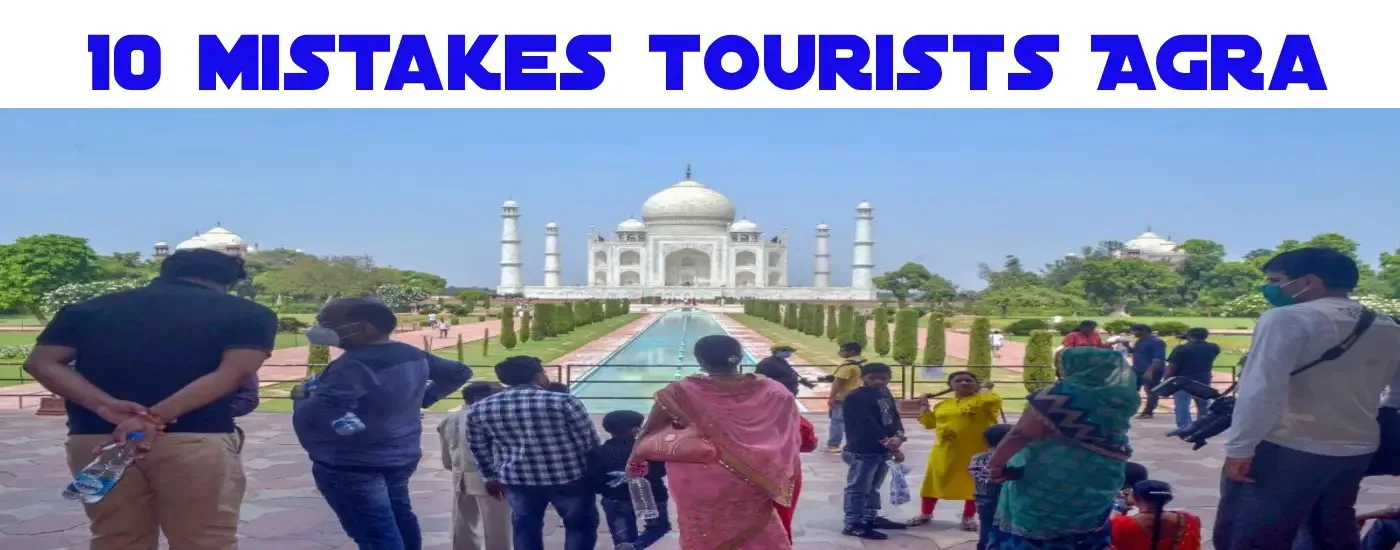
By Travel Tourister | Updated September 2025 | Verified by Local Agra Tour Experts
Over 7 million tourists visit Agra annually, yet countless visitors diminish their Taj Mahal experience through preventable mistakes that transform dream trips into frustrating ordeals! The 10 mistakes tourists make in Agra range from falling for scams to poor timing, inadequate planning to cultural missteps—each capable of seriously impacting your journey to the City of the Taj.
Having guided over 11,000 travelers through Agra’s complexities during 32 years of expertise, I’ve witnessed every possible error tourists make. Scammers in tourist-heavy Agra are becoming more sophisticated, often preying on unsuspecting visitors with fake guides, overcharging, and counterfeit goods. The mistakes tourists make Agra enthusiasts should avoid aren’t just about comfort—they affect safety, finances, health, and overall experience quality.
This comprehensive guide reveals the 10 Mistakes Tourists Make in Agra with practical solutions to ensure your journey focuses on Mughal magnificence rather than avoidable frustrations.
Agra presents specific challenges unlike typical tourist destinations—aggressive touts, monument restrictions, extreme weather, and sophisticated scams. Tourists visiting the Taj Mahal often encounter problems that can make the visit stressful if they are unprepared, from ticket confusion to weather issues, language barriers to transport delays.
Success requires preparation, scam awareness, realistic expectations, and cultural sensitivity about this historic city beyond just the Taj Mahal.
One of the most frequent scams involves unofficial tour guides—as soon as you arrive, you may be approached by people in uniform claiming to be government-certified.
Common Scams:
Financial Impact:
Smart Solutions:
Before Arrival:
At Agra:
Protection Checklist:
If you want to beat the crowd, visit the Taj Mahal as early as you can—the Taj is open to tourists at sunrise, so I would suggest reaching there by 8 AM.
Timing Problems:
Consequences:
Optimal Timing Strategy:
Best Times to Visit:
Seasonal Considerations:
Advanced Planning:
Agra’s summer temperatures regularly exceed 45°C (113°F), creating dangerous conditions for unprepared tourists who underestimate the extreme heat.
Heat-Related Problems:
Real Consequences:
Heat Management Solutions:
Visit in Cool Season:
Summer Survival Strategies:
Emergency Preparedness:
Tourists frequently arrive in revealing clothing or with prohibited items, causing entry denials and wasted time.
Dress Code Violations:
Prohibited Items (Taj Mahal):
Cultural Impact:
Proper Dress Code:
For Everyone:
What to Carry:
Last-minute visitors face long queues, sold-out slots, and inflated prices that proper planning easily prevents.
Planning Failures:
Consequences:
Advance Booking Strategy:
Essential Pre-Bookings:
| Item | Book When | Platform | Why Critical |
|---|---|---|---|
| Taj Mahal Tickets | 1-7 days ahead | asi.payumoney.com | Skip long queues |
| Gatimaan Express | 60-90 days ahead | IRCTC.co.in | Fastest train, sells out |
| Hotels (Peak Season) | 60-90 days ahead | Booking.com, hotel direct | Best rates, availability |
| Moonlight Viewing | 24 hours minimum | ASI website | Limited 400 slots |
Benefits of Advance Planning:
Tourists consistently underestimate distances, monument time requirements, and traffic, attempting to cram too much into limited hours.
Common Itinerary Failures:
Reality Check:
Minimum Time Requirements:
| Attraction | Time Needed | Notes |
|---|---|---|
| Taj Mahal | 2-3 hours | Including entry, photos, exploration |
| Agra Fort | 2-3 hours | Large complex, multiple palaces |
| Fatehpur Sikri | 2-3 hours + 2h drive | 40 km each way |
| Itmad-ud-Daulah | 1-1.5 hours | Smaller monument |
| Travel/Meals/Breaks | 3-4 hours | Traffic, rest, dining |
Realistic One-Day Plan:
Better Two-Day Plan:
Delhi belly ruins countless Agra trips through preventable food and water safety violations.
Common Problems:
Health Consequences:
Food Safety Protocol:
Water Guidelines:
Safe Food Choices:
Emergency Kit:
Tourists routinely overpay for souvenirs, fall for marble scams, and purchase poor-quality items through commission-based schemes.
Shopping Mistakes:
Financial Losses:
Smart Shopping Strategy:
Fair Price Guidelines:
| Item | Fair Price (INR) | Fair Price (USD) | Tourist Trap Price |
|---|---|---|---|
| Small marble coaster | ₹200-500 | $2.40-6 | ₹1,500-3,000 |
| Marble box (6″) | ₹500-1,500 | $6-18 | ₹3,000-8,000 |
| Leather mojaris | ₹300-800 | $3.60-9.60 | ₹1,500-3,000 |
| Pashmina shawl | ₹1,000-3,000 | $12-36 | ₹8,000-15,000 |
| Petha (1 kg) | ₹300-600 | $3.60-7.20 | ₹1,000-2,000 |
Shopping Best Practices:
Countless tourists skip insurance to save ₹300-600 ($3.60-7.20) daily, then face catastrophic costs when emergencies occur.
False Economy:
Common Agra Incidents:
Essential Coverage:
Recommended Insurers:
Tourists inadvertently offend locals through cultural ignorance, damaging interactions and missing authentic experiences.
Common Cultural Offenses:
Monument Etiquette:
Social Etiquette:
60-90 Days Before:
1-7 Days Before:
Day Before:
Morning:
Throughout Day:
Evening:
These 10 mistakes tourists make in Agra account for the vast majority of travel problems, financial losses, health issues, and disappointing experiences that diminish Taj Mahal visits. Every mistake is entirely preventable through proper preparation, scam awareness, realistic planning, and cultural sensitivity.
Understanding these pitfalls before arrival ensures your Agra adventure focuses on magnificent Mughal monuments, authentic cultural experiences, and creating memories rather than navigating frustrating problems and preventable disappointments.
For comprehensive Agra trip planning, explore our guides on best time to visit Agra, how to reach Agra, things to do in Agra, places to visit in Agra, Agra trip cost, and Agra travel checklist. Our curated tour packages include expert guidance, pre-booked accommodations, and scam protection for worry-free experiences.
Q: What’s the single biggest mistake tourists make in Agra? A: Falling for scams and fake guides causes the most financial loss and frustration. Scammers in Agra are becoming more sophisticated with fake guides, overcharging, and counterfeit goods. Pre-booking tickets online, using official guides only, and ignoring unsolicited approaches prevents 80-90% of scam-related problems. Always verify credentials and negotiate prices beforehand.
Q: How much money do tourists typically lose to scams in Agra? A: Based on traveler reports, tourists lose ₹2,000-10,000 ($24-120) to various scams during typical 1-2 day visits—fake guides, commission shops, overcharged transport, and inflated shopping. Advance research, pre-booking, and firm refusals prevent most losses. Using prepaid taxis, avoiding fake guides, and entering through right gate saves time and money.
Q: Is it really necessary to visit Taj Mahal at sunrise? A: Highly recommended but not mandatory. Visiting as early as you can, reaching by 8 AM, helps beat crowds and allows better experience. Sunrise (6-8 AM) offers magical golden light, 70% fewer crowds than midday, and cooler temperatures. Alternative: late afternoon (4-6 PM) provides warm lighting and fewer tourists, though not as dramatic as sunrise.
Q: Can I do a comfortable same-day trip from Delhi to Agra? A: Yes, but rushed. Gatimaan Express departing 8:10 AM (arrives 9:50 AM) and returning 5:50 PM (arrives 7:30 PM) allows 7-8 hours in Agra—sufficient for Taj Mahal and Agra Fort. However, overnight stay recommended for relaxed exploration including Fatehpur Sikri, sunset views at Mehtab Bagh, and quality dining experiences without constant time pressure.
Q: What should I do if I’m approached by fake guides? A: Firmly say “No, thank you” and keep walking without engagement. Don’t stop to listen to their pitch or enter conversation. Official ASI guides wear proper ID badges, charge fixed rates (₹500-1,500), and don’t approach aggressively. Pre-book guides through hotel or ASI website. If harassed, inform nearby police or security personnel.
Q: How can I tell if marble inlay work is authentic? A: Real marble inlay uses semi-precious stones (lapis lazuli, onyx, jasper) embedded into marble, visible as separate pieces under close inspection. Test with knife—real marble won’t scratch easily, resin/fake will. Shop at government emporiums (UP Handicrafts) for guaranteed authenticity. Authentic pieces start ₹1,000+ for small items, ₹10,000+ for quality work. Street vendor “marble” under ₹500 is almost certainly fake.
Q: What’s the biggest health risk in Agra and how do I prevent it? A: Heat exhaustion during summer (April-June with 40-45°C temperatures) hospitalizes hundreds of tourists annually. Visit October-March for comfortable weather. If visiting summer, limit outdoor activities to 6-9 AM only, carry 3-4 liters water, use electrolyte supplements, and know symptoms (dizziness, nausea, rapid pulse). Food poisoning is second concern—drink only bottled water, eat at busy establishments, and carry ORS packets and anti-diarrheal medication.

As an upcoming travel agent I got much support from travel tourister. We are getting very good leads from travel tourister and they mend our website which is also very commendable.... Excellent work Hope to do more business forward.... Thanks and regards CEO,Andaman Unlocked
Rating:
10/20/2018
As an upcoming travel agent I got much support from travel tourister. We are getting very good leads from travel tourister and they mend our website which is also very commendable.... Excellent work Hope to do more business forward.... Thanks and regards CEO,Andaman Unlocked
Rating:
10/20/2018
2nd Floor, 39, Above Kirti Club, DLF Industrial Area, Kirti Nagar, New Delhi, Delhi 110015



Travel Tourister is a leading Travel portal where we introduce travellers to trusted travel agents to make their journey hasselfree, memorable And happy. Travel Tourister is a platform where travellers get Tour packages ,Hotel packages deals through trusted travel companies And hoteliers who are working with us across the world. We always try to find new and more travel agents and hoteliers from every nook and corners across the world so that you could compare the deals with different travel agents and hoteliers and book your tour or hotel with the one you have chosen according to your taste and budget.
Copyright © Travel Tourister, India. All Rights Reserved








 Call
Call Enquiry