Published on : 16 Jan 2026
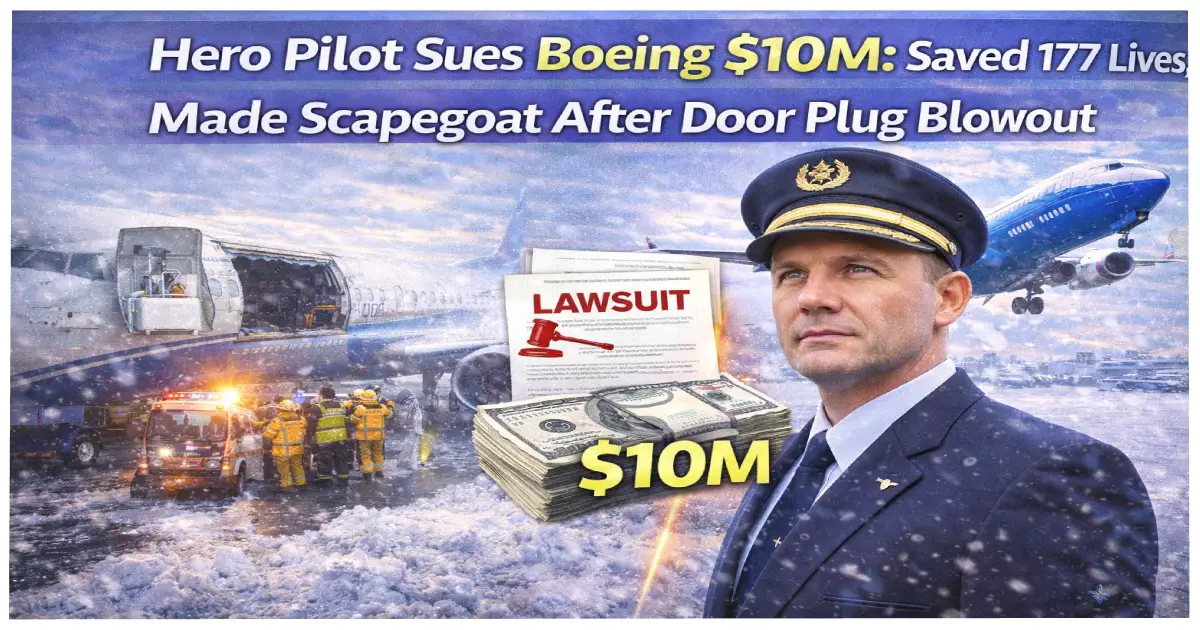
Breaking: Captain Brandon Fisher—the Alaska Airlines hero who saved 177 lives when a door plug exploded at 16,000 feet—is suing Boeing for $10 MILLION, claiming the aircraft giant tried to make him the scapegoat for their manufacturing disaster. Praised publicly as a hero, blamed privately in legal filings. FBI says he may be victim of “criminally negligent conduct” by Boeing. Here’s the explosive lawsuit that has aviation experts calling it “corporate betrayal.”
Published: January 16, 2026 Lawsuit Filed: December 30, 2025 (2-year anniversary week) Amount Sought: $10 million minimum Original Incident: January 5, 2024, Flight 1282 Lives Saved: 177 (171 passengers, 6 crew) NTSB Conclusion: Boeing’s fault—4 missing bolts from factory FBI Letter: Captain Fisher “may have been victim of criminally negligent conduct by Boeing”
Captain Brandon Fisher should be a household name celebrated like “Sully” Sullenberger. Instead, he’s fighting to clear his reputation from the very company whose planes he’s flown his entire Alaska Airlines career.
What Happened:
✈️ January 5, 2024: Door plug EXPLODES at 16,000 feet ✈️ 6 minutes after takeoff from Portland ✈️ 177 lives at stake in violent decompression ✈️ Perfect emergency landing — zero deaths ✈️ Public praise from NTSB, FAA, even Boeing executives ✈️ Private blame in Boeing legal filings suggesting pilot error ✈️ Passengers sued Fisher after Boeing suggested crew mistakes ✈️ FBI confirms Fisher may be victim of criminal negligence by Boeing ✈️ $10 million lawsuit filed December 30, 2025
“They should have been hailed as heroes. Instead, The Boeing Company attempted to shift blame, intentionally and falsely claiming that Captain Fisher and First Officer Wiprud made mistakes that contributed to the incident,” the lawsuit states.
Let’s rewind to the day that should have killed everyone on board.
Alaska Airlines Flight 1282—a Boeing 737 MAX 9—departed Portland International Airport at 5:07 PM PST, bound for Ontario, California. Captain Brandon Fisher and First Officer Emily Wiprud were at the controls with 171 passengers and 4 flight attendants in the cabin.
5:13 PM (6 minutes after takeoff):
BOOM.
A massive explosion rocked the aircraft at 16,000 feet. The left mid-exit door plug—a 2-foot-by-4-foot panel covering an unused emergency exit at Row 26—violently separated from the fuselage, creating a gaping hole in the aircraft.
What passengers experienced:
What the pilots faced in the cockpit:
Captain Fisher immediately declared an emergency:
“Emergency! We are depressurized. We do need to return back. We have 177 passengers. Our fuel is 18,900 pounds.”
Despite harrowing conditions—violent wind, system warnings, terrified passengers, and a gaping hole in the fuselage—Fisher and Wiprud executed a textbook emergency descent and landing.
5:27 PM: Flight 1282 landed safely at Portland International Airport.
14 minutes from explosion to safe landing.
177 lives saved.
8 minor injuries (7 passengers, 1 flight attendant)—mostly from turbulence during emergency descent.
Zero deaths.
In the immediate aftermath, Captain Fisher and First Officer Wiprud received universal acclaim:
National Transportation Safety Board (NTSB) Chair Jennifer Homendy:
Praised the flight crew’s “exemplary” actions and “remarkable” performance under extreme pressure.
Federal Aviation Administration (FAA) Officials:
Commended the crew for their skill and composure.
Boeing Executives:
Even Boeing’s own leadership initially praised the pilots for ensuring everyone survived.
Alaska Airlines:
“We remain grateful to our crew members for the bravery and quick-thinking that they displayed on Flight 1282 in ensuring the safety of all on board.”
Passengers:
Many publicly thanked the pilots on social media for saving their lives.
Aviation Experts:
John Cox, CEO of Safety Operating Systems aviation safety consulting firm: “The crew did a remarkable job considering what they were dealing with, and no one has faulted the crew.”
Captain Fisher was a hero. Everyone agreed.
Then Boeing’s lawyers got involved.
While publicly praising Fisher, Boeing’s legal team took a different approach in court filings defending against passenger lawsuits.
When passengers filed a class-action lawsuit in March 2024 seeking damages for the terror they experienced, Boeing filed a response denying liability.
Boeing’s March 2024 legal filing stated:
The aircraft was “improperly maintained or misused by persons and/or entities other than Boeing.”
This single sentence—buried in legal paperwork—changed everything for Captain Fisher.
Who maintains and operates Alaska Airlines aircraft?
Translation: Boeing’s lawyers were suggesting the incident resulted from mistakes by Alaska Airlines personnel—including potentially the flight crew.
The lawsuit alleges:
“Boeing knew this statement was false at the time it was made, but made it anyway as part of its often-used post-accident strategy to blame pilots for incidents caused solely by its own actions.”
“It was clear Boeing’s words were directed at Captain Fisher in attempt to paint him as the scapegoat for Boeing’s numerous failures.”
“Instead of praising Captain Fisher’s bravery, Boeing inexplicably impugned the reputations of the pilots who had prevented Boeing from having to explain to the families of all passengers and crew why its defective aircraft had resulted in the loss of their loved ones.”
For Captain Fisher, Boeing’s legal strategy wasn’t just professional—it was deeply personal.
From the lawsuit:
“Boeing’s lie infuriated Captain Fisher as well, as he was being castigated for his actions as opposed to being lauded. Because he had flown Boeing aircraft for the entirety of his employment with Alaska Airlines, Boeing’s attempts to blame him felt like a deep, personal betrayal by a company that claimed to hold pilots in the highest regard.”
Fisher is a Vancouver, Washington resident who has dedicated his entire Alaska Airlines career to flying Boeing aircraft. He trusted Boeing. He defended Boeing. He believed in Boeing’s commitment to safety and pilots.
Then Boeing threw him under the bus to protect itself from liability.
Boeing’s legal strategy had real-world consequences for Fisher.
The lawsuit states:
Following Boeing’s suggestion that crew errors contributed to the incident, two passengers sued Captain Fisher personally.
Think about that: A pilot saves 177 lives in a terrifying emergency caused by Boeing’s manufacturing defects, and passengers—encouraged by Boeing’s legal filings—turn around and sue the pilot who saved them.
Emotional toll:
“Boeing’s actions have had a dramatic and life-altering impact on Captain Fisher.”
“This accusation, despite its lacking any semblance of truth, only heightened the emotional impact and distress experienced by Captain Fisher.”
The lawsuit alleges Fisher has “endured profound physical and mental repercussions” since the incident.
Then came the bombshell.
March 27, 2025: Captain Fisher received a letter from the FBI.
The letter stated: Fisher “may have been the victim of criminally negligent conduct by Boeing.”
Let that sink in. The Federal Bureau of Investigation—after investigating the door plug blowout—informed the pilot that Boeing’s actions may have constituted criminal negligence.
This wasn’t just civil liability. The FBI was investigating potential criminal charges against Boeing.
For Fisher, the FBI letter validated everything he’d been saying: Boeing’s attempts to blame him were not just wrong—they may have been part of covering up criminal conduct.
The National Transportation Safety Board conducted an exhaustive investigation. Their findings—released in June 2025—were damning for Boeing.
NTSB Final Report (June 2025):
“The probable cause of the door plug separation was due to Boeing’s failure to provide adequate training, guidance, and oversight necessary to ensure that manufacturing personnel could consistently and correctly comply with its parts removal process, which was intended to document and ensure that the securing bolts and hardware that were removed to facilitate rework during the manufacturing process were properly reinstalled.”
Translation: Boeing screwed up. Period.
Investigators discovered the smoking gun:
Four critical bolts designed to prevent vertical movement of the door plug were MISSING when the aircraft left Boeing’s factory.
These weren’t bolts that fell out during flight. They were never installed during manufacturing.
How it happened:
Contributing Factor:
The NTSB also blamed the FAA for “ineffective compliance enforcement surveillance and audit planning activities, which failed to adequately identify and ensure that Boeing addressed the repetitive and systemic nonconformance issues associated with its parts removal process.”
The NTSB investigation found ZERO evidence of pilot error, maintenance error, or operational misuse.
The incident was 100% caused by Boeing’s manufacturing failures and the FAA’s inadequate oversight.
Captain Fisher and First Officer Wiprud performed flawlessly.
Fisher’s lawsuit, filed December 30, 2025, in Multnomah County Circuit Court (Oregon), names two defendants:
1. The Boeing Company 2. Spirit AeroSystems (subcontractor that supplied the fuselage)
The lawsuit includes multiple causes of action:
Against Boeing:
Against Spirit AeroSystems:
Minimum $10 million for:
Fisher is represented by:
Both are experienced aviation litigation attorneys.
Captain Fisher isn’t the only Flight 1282 crew member suing Boeing.
In August 2025, four flight attendants from Flight 1282 filed individual lawsuits against Boeing in Seattle’s King County Superior Court:
1. Adam Fisher (no relation to Captain Brandon Fisher) 2. Michelle Hughes 3. Steven Maller 4. Christine Vasconcellos
Each flight attendant alleges they suffered “personal, permanent, and pecuniary” injuries from the explosive decompression, including:
Michelle Hughes:
“This event has profoundly impaired my personal and professional life and created significant obstacles to returning to the career I once proudly made.”
Christine Vasconcellos:
“This is something that never should have happened. I’m seeking justice, accountability, and making the sky a safe place.”
Tracy Brammeier represents all four flight attendants:
“When the door plug blew off the aircraft on Flight 1282, each of the four flight attendants acted courageously, following their training and putting their passengers’ safety first while fearing for their lives. They deserve to be wholly compensated for this life-altering, traumatic experience caused by Boeing’s negligence in the 737 MAX production process.”
In addition to the flight crew, hundreds of passengers from Flight 1282 have filed lawsuits against Boeing and Alaska Airlines.
Claims include:
Many passengers settled with Alaska Airlines and Boeing in 2024-2025, but dozens of cases remain active.
Boeing’s official response to Fisher’s lawsuit has been minimal and non-committal.
Boeing Spokesperson Statement (to FOX Business):
“In the past two years, we’ve taken a disciplined look at every facet of our production operations. We developed a comprehensive plan to strengthen Boeing’s safety management, quality assurance and safety culture—and we are seeing the benefits of these actions.”
Notice what Boeing DIDN’T say:
Boeing’s statement is classic corporate PR: vague promises about “improvements” without admitting wrongdoing or addressing the specific harm to Fisher.
Boeing also stated:
“We do not comment on pending litigation.”
Translation: We’re fighting this in court, not the media.
Alaska Airlines has been careful to praise the crew publicly while staying neutral on the lawsuit.
Alaska Airlines Statement:
“We remain grateful to our crew members for the bravery and quick-thinking that they displayed on Flight 1282 in ensuring the safety of all on board.”
Alaska declined to comment further on the lawsuit, likely to avoid entanglement in legal proceedings between Fisher and Boeing.
Alaska Airlines is NOT a defendant in Fisher’s lawsuit—only Boeing and Spirit AeroSystems.
Captain Fisher’s lawsuit isn’t just about one pilot’s reputation. It raises fundamental questions about corporate accountability in aviation.
The Issue: Does Boeing have a pattern of blaming pilots for manufacturing defects?
Aviation experts and Fisher’s lawyers argue this is Boeing’s standard playbook:
Historical Precedent:
Critics point to Boeing’s initial response to the 737 MAX crashes (Ethiopian Airlines Flight 302, Lion Air Flight 610) where Boeing initially suggested pilot training deficiencies before investigations proved the crashes resulted from Boeing’s defective MCAS system.
The Issue: How far can companies go in defending themselves before it becomes character assassination?
Fisher’s lawsuit argues there’s a line between legitimate legal defense and unfairly destroying an individual’s reputation.
Boeing has the right to defend against lawsuits. But does that right include falsely suggesting a hero pilot made mistakes that contributed to a disaster Boeing caused?
The Issue: Will this lawsuit deter future corporate blame-shifting?
If Fisher wins a substantial judgment, it could discourage companies from using “blame the frontline worker” legal strategies.
If Fisher loses or settles quietly, corporations may continue the practice unchecked.
The Issue: How can pilots trust Boeing aircraft if Boeing throws pilots under the bus?
Fisher flew Boeing aircraft his entire Alaska Airlines career. He trusted Boeing. That trust is shattered.
How many other pilots are reconsidering their relationship with Boeing after watching the company betray Fisher?
Fisher’s lawsuit comes amid Boeing’s ongoing safety and quality crisis.
January 5, 2024: Flight 1282 door plug blowout
March 2024: Boeing suggests in legal filings that crew “misused” aircraft
June 2024: NTSB issues preliminary findings blaming Boeing
August 2024: New CEO Kelly Ortberg takes over, promises safety improvements
August 2025: Four flight attendants sue Boeing
October 2025: FAA fines Boeing $3.1 million for safety violations
October 2025: FAA allows Boeing to increase 737 MAX production to 42/month after safety improvements
December 30, 2025: Captain Fisher sues Boeing for $10 million
January 2026: Lawsuit gains national media attention
Boeing is a company in crisis—and Fisher’s lawsuit adds another damaging chapter.
Aviation law experts are divided on Fisher’s chances.
1. NTSB Findings: Clear evidence Boeing caused the incident, not the crew
2. FBI Letter: Federal investigators believe Boeing may have committed criminal negligence
3. Boeing’s Statement: “Improperly maintained or misused” can reasonably be interpreted as blaming crew
4. Emotional Distress: Documented harm to Fisher’s mental health and reputation
5. Passenger Lawsuits: Direct consequence of Boeing’s suggestion that crew contributed to incident
1. Standard Legal Defense: Companies routinely deny liability in legal filings
2. No Explicit Accusation: Boeing never specifically named Fisher or accused him of errors
3. Legal Privilege: Statements in legal proceedings may be protected from defamation claims
4. Burden of Proof: Fisher must prove Boeing’s statements were false AND made with knowledge of falsity
5. Causation Challenge: Proving Boeing’s statements directly caused his emotional distress and passenger lawsuits
John Cox (Aviation Safety Expert):
“I think the Boeing lawyers were kind of grasping at straws. The NTSB made clear this was caused by a manufacturing issue and the crew’s actions were exemplary.”
Legal Analysts:
Most predict Boeing will settle to avoid further negative publicity, likely for $2-5 million—less than the $10 million sought but enough to be considered a victory for Fisher.
A trial could expose damaging internal Boeing communications and create more negative headlines the company desperately wants to avoid.
January 2026: Boeing files response to lawsuit (due within 30 days)
Q1-Q2 2026: Discovery phase
Q3 2026: Settlement negotiations likely begin
Late 2026 or 2027: Trial (if no settlement)
2027+: Appeals (if necessary)
Most experts predict this settles within 12-18 months for an undisclosed sum.
The story has ignited outrage on social media:
Twitter/X:
“Boeing praising the pilot publicly while blaming him privately is the most corporate dystopia thing I’ve heard all week.” – @AviationWatcher, 15K likes
“Captain Fisher saved 177 lives and Boeing thanks him by making him a scapegoat. Disgusting.” – @FlyerRights, 12K retweets
“If I were a pilot I would refuse to fly Boeing aircraft after what they did to Captain Fisher. Trust destroyed.” – @PilotLife2024, 8K likes
Reddit (r/aviation):
Top comment with 25K upvotes: “Boeing’s legal strategy: 1) Make defective planes 2) Pilots save everyone 3) Blame the pilots 4) Profit???”
LinkedIn:
Aviation professionals posting support for Fisher, with many pilots sharing personal stories of Boeing deflecting blame.
Captain Brandon Fisher’s $10 million lawsuit against Boeing represents a David vs. Goliath battle that resonates far beyond aviation.
The Facts:
The Stakes:
The Outcome:
Most legal experts predict confidential settlement within 12-18 months for $2-5 million. Boeing wants this to disappear quietly.
But the damage is done. Fisher’s lawsuit has exposed Boeing’s willingness to sacrifice individual reputations to protect corporate interests—even when those individuals saved lives that Boeing’s negligence endangered.
For travelers: This lawsuit is another reminder that Boeing’s safety culture remains deeply broken. The company that built 346-death 737 MAX jets is now suing the hero pilot who saved 177 lives from Boeing’s next manufacturing disaster.
For pilots: If you fly Boeing aircraft, remember: They’ll praise you publicly and blame you privately if something goes wrong.
For Captain Brandon Fisher: Whether he wins $10 million, $5 million, $1 million, or nothing, he’s already won in the court of public opinion. Everyone knows he’s a hero. And everyone knows Boeing tried to make him a scapegoat.
Justice delayed is justice denied. But Fisher is fighting for justice—not just for himself, but for every pilot who risks being betrayed by the companies whose aircraft they trust with their lives.
For More Resources:
Related Articles:
Posted By : Vinay
This article is provided for general informational purposes only and is based on information available at the time of publication. Travel advisories, airline schedules, airport operations, visa requirements, government regulations, and other travel-related information are subject to change without prior notice. While Travel Tourister makes reasonable efforts to verify information using official announcements, government publications, airline and airport communications, and other reliable sources, we cannot guarantee that all information remains complete, accurate, or up to date at all times. Readers should independently verify any information that may affect their travel plans with the relevant airline, airport authority, government agency, embassy, or other official source before making travel, financial, or other decisions. Travel Tourister shall not be liable for any direct or indirect loss, inconvenience, or damages arising from the use of or reliance on the information contained in this article. Nothing in this publication constitutes legal, immigration, financial, or professional travel advice. If you believe any information in this article is inaccurate or outdated, please contact our editorial team. We review all credible correction requests promptly and update our content whenever appropriate.
Lastest News
2nd Floor, 39, Above Kirti Club, DLF Industrial Area, Kirti Nagar, New Delhi, Delhi 110015



Travel Tourister is a leading Travel portal where we introduce travellers to trusted travel agents to make their journey hasselfree, memorable And happy. Travel Tourister is a platform where travellers get Tour packages ,Hotel packages deals through trusted travel companies And hoteliers who are working with us across the world. We always try to find new and more travel agents and hoteliers from every nook and corners across the world so that you could compare the deals with different travel agents and hoteliers and book your tour or hotel with the one you have chosen according to your taste and budget.
Copyright © Travel Tourister, India. All Rights Reserved

 Call
Call Enquiry