Published on : 12 Feb 2026
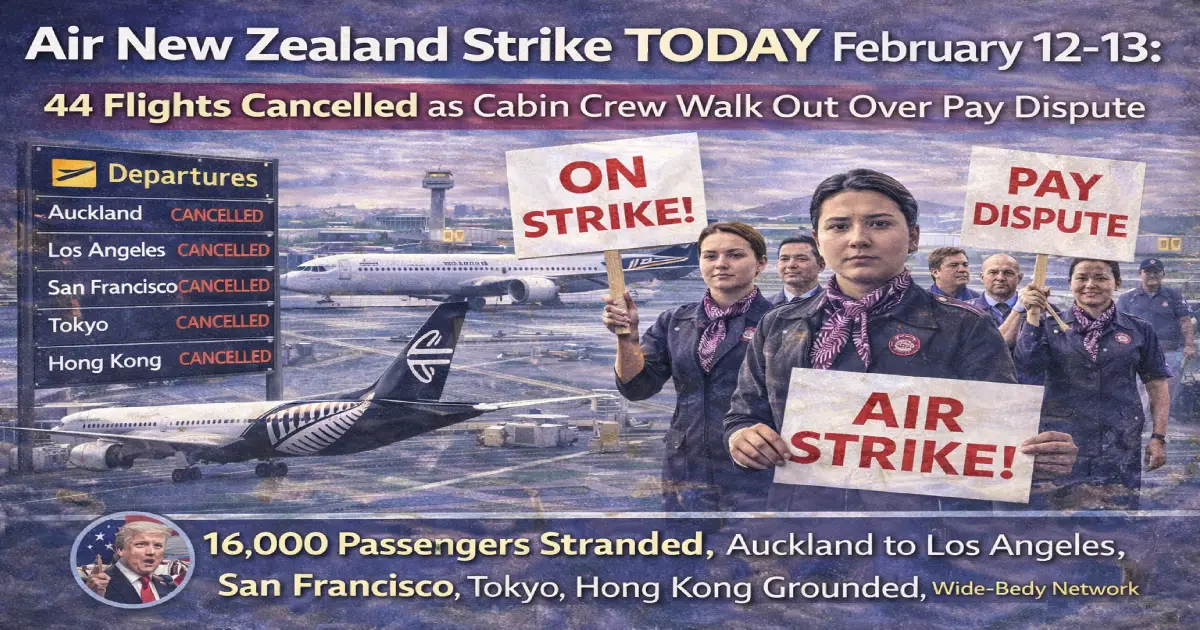
BREAKING DISRUPTION: Air New Zealand passengers are facing unprecedented chaos TODAY (February 12-13, 2026) as unionized international cabin crew execute a 48-hour strike grounding virtually ALL long-haul wide-body operations from Auckland—with 44 flights cancelled affecting approximately 16,000 passengers traveling to North America (Los Angeles, San Francisco), Asia (Tokyo, Hong Kong, Singapore), and beyond as the Flight Attendants’ Association of New Zealand (FAANZ) and E tū union escalate a months-long pay dispute after management offered salary increases of just 4.14%-6.41% that cabin crew say leaves them unable to afford Auckland rent on starting wages below New Zealand’s living wage. While short-haul Tasman (Australia) and Pacific Island routes operate normally using narrow-body aircraft, the strike decimates Air New Zealand’s international connectivity—forcing thousands to scramble for alternative bookings on Star Alliance partners or accept travel credits as the airline warns further industrial action could follow with just 14 days’ notice if facilitated bargaining through the Employment Relations Authority fails to resolve what has become New Zealand aviation’s most significant labor dispute in recent memory.
Published: February 12, 2026 Strike Dates: TODAY & TOMORROW – February 12-13, 2026 Duration: 48 hours (Thursday-Friday) Flights Cancelled: 44 (primarily long-haul) Passengers Affected: ~16,000 Routes Grounded: Auckland → Los Angeles, San Francisco, Tokyo, Hong Kong, Singapore, more Aircraft Type: Wide-body only (Boeing 777, 787 Dreamliner) NOT Affected: Tasman (Australia), Pacific Islands (narrow-body aircraft) Unions: Flight Attendants’ Association of NZ (FAANZ), E tū Core Dispute: Pay below living wage, working conditions Management Offer: 4.14%-6.41% first-year increases (REJECTED) Next Step: Employment Relations Authority facilitated bargaining
ALL DAY (48 hours):
Specific Routes GROUNDED:
North America (Hardest Hit):
Asia (Significant Disruption):
Other Long-Haul:
Routes OPERATING Normally:
Tasman (Australia):
Pacific Islands:
The core issue isn’t just percentages—it’s survival in one of the world’s most expensive cities:
Cabin crew starting salary:
Auckland cost of living (2026):
One source told Aviation A2Z:
“Air New Zealand Cabin Crew Strike as They Are Unable to Pay Rent”
Air New Zealand proposed:
Why unions rejected:
FAANZ President David Featherby:
“Our members love their jobs. They’re the safety ambassadors of Air New Zealand and they represent New Zealand to the world. We want passengers to continue to have that exceptional service on board. But we just have to get through the next couple of months with the negotiations that are currently taking place.”
Union demands (specifics not fully disclosed):
Negotiations status:
Who’s hit hardest:
1. US Travelers:
2. Asian Travelers:
3. Australians:
4. New Zealanders:
Air New Zealand’s rebooking policy:
Option 1: Rebook on Air New Zealand
Option 2: Star Alliance Partners
Option 3: Travel Credit
Option 4: Full Refund
Chief Customer Officer Jeremy O’Brien:
“We’ve actually provided re-accommodation options for all of the impacted customers on the flights two to three days either side of the strike days. For not every customer that’s going to be suitable, and for those customers, they’re entitled to and should request either a credit to fly later or a refund.”
US Routes:
Asian Routes:
Cost implications:
Wide-body aircraft (GROUNDED):
Narrow-body aircraft (OPERATING):
Why narrow-body flights continue:
This is strategic: Union knows wide-body routes = highest revenue, most critical to Air NZ. Targeting those maximizes pressure while minimizing collateral damage to domestic/regional travelers.
Generally harmonious:
Why this is significant:
Recent strikes:
Pattern: Global airline labor unrest post-pandemic as workers demand compensation after years of wage freezes and staff shortages.
Chief Customer & Digital Officer Jeremy O’Brien (Newstalk ZB interview):
“This is no different than other disruptions that we manage on an ongoing basis. It’s just part of business as usual. The key thing for us is when we know that we’ve got a disruption to the schedule that we go out and offer as many alternatives and options as possible to the customers and in this case, the whole business is rallying around and been able to do that.”
Describing strike as “controllable disruption”:
Chief People Officer Nikki Dines (interviewed TODAY):
Financial challenges cited:
Management argues:
New Zealand employment law:
What this means:
Next step:
Timeline:
Scenarios:
Immediate actions:
1. Check Email/SMS:
2. Rebook Online:
3. Call if Online Fails:
4. Request Refund if Rebooking Unsuitable:
Risk assessment:
Protection strategies:
US-bound:
Asia-bound:
Cost: More expensive, but greater reliability
Peak season:
Tourism New Zealand concerns:
Economic impact (estimated):
Kiwis traveling overseas:
Alternative: Fly from Australia (but requires traveling to Sydney/Melbourne first)
Q: Will my Air NZ flight be cancelled if it’s after February 13? A: Not automatically. The current strike is only February 12-13. However, if negotiations fail, future strikes are possible with 14 days’ advance notice.
Q: Can I get compensation for the strike delay? A: No. Strikes are considered “extraordinary circumstances” under passenger rights laws, exempting airlines from compensation. But you’re entitled to rebooking or refund.
Q: What if I’m connecting through Auckland from Australia to the US? A: If booked on single ticket, Air NZ must rebook you on alternative routing (e.g., direct Australia-US flight on partner airline). If separate tickets, you’re responsible for your own arrangements.
Q: Are domestic New Zealand flights affected? A: No. Domestic flights use narrow-body aircraft and different crew pool.
Q: Why aren’t Australia flights affected? A: Tasman routes (NZ-Australia) use narrow-body aircraft (Airbus A320/A321) which aren’t staffed by striking wide-body cabin crew.
Q: Should I avoid booking Air New Zealand? A: Union President David Featherby urges passengers NOT to avoid Air NZ: “Our members love their jobs… We want passengers to continue to have that exceptional service.” But be aware of potential future strikes if negotiations fail.
Q: What happens if strike is extended? A: Any extension requires 14 days’ advance notice, giving passengers time to adjust plans.
Air New Zealand’s 48-hour international cabin crew strike (February 12-13, 2026) represents an unprecedented disruption to New Zealand’s aviation connectivity as 44 flights cancelled affecting 16,000 passengers expose the financial strain on airline workers struggling to afford Auckland rent on starting salaries below the national living wage despite management’s 4.14%-6.41% pay increase offers. While short-haul Tasman and Pacific Island routes operate normally using narrow-body aircraft, the strike decimates critical long-haul links to North America (Los Angeles, San Francisco) and Asia (Tokyo, Hong Kong, Singapore)—forcing thousands to scramble for alternative bookings on Star Alliance partners or accept travel credits as the airline and Flight Attendants’ Association of New Zealand (FAANZ) head to government-mediated facilitated bargaining that will determine whether this becomes a one-time disruption or the beginning of prolonged industrial action requiring 14-day advance notice for any future strikes.
For travelers: Key takeaways:
For Air New Zealand:
For the union:
Whether this marks a turning point in New Zealand aviation labor relations or a brief disruption depends on what happens in the Employment Relations Authority facilitated bargaining room—but for 16,000 passengers stranded TODAY, the impact is immediate and undeniable.
For More Information:
Related Articles:
Posted By : Vinay
This article is provided for general informational purposes only and is based on information available at the time of publication. Travel advisories, airline schedules, airport operations, visa requirements, government regulations, and other travel-related information are subject to change without prior notice. While Travel Tourister makes reasonable efforts to verify information using official announcements, government publications, airline and airport communications, and other reliable sources, we cannot guarantee that all information remains complete, accurate, or up to date at all times. Readers should independently verify any information that may affect their travel plans with the relevant airline, airport authority, government agency, embassy, or other official source before making travel, financial, or other decisions. Travel Tourister shall not be liable for any direct or indirect loss, inconvenience, or damages arising from the use of or reliance on the information contained in this article. Nothing in this publication constitutes legal, immigration, financial, or professional travel advice. If you believe any information in this article is inaccurate or outdated, please contact our editorial team. We review all credible correction requests promptly and update our content whenever appropriate.
Lastest News
2nd Floor, 39, Above Kirti Club, DLF Industrial Area, Kirti Nagar, New Delhi, Delhi 110015



Travel Tourister is a leading Travel portal where we introduce travellers to trusted travel agents to make their journey hasselfree, memorable And happy. Travel Tourister is a platform where travellers get Tour packages ,Hotel packages deals through trusted travel companies And hoteliers who are working with us across the world. We always try to find new and more travel agents and hoteliers from every nook and corners across the world so that you could compare the deals with different travel agents and hoteliers and book your tour or hotel with the one you have chosen according to your taste and budget.
Copyright © Travel Tourister, India. All Rights Reserved

 Call
Call Enquiry