Published on : 12 Feb 2026
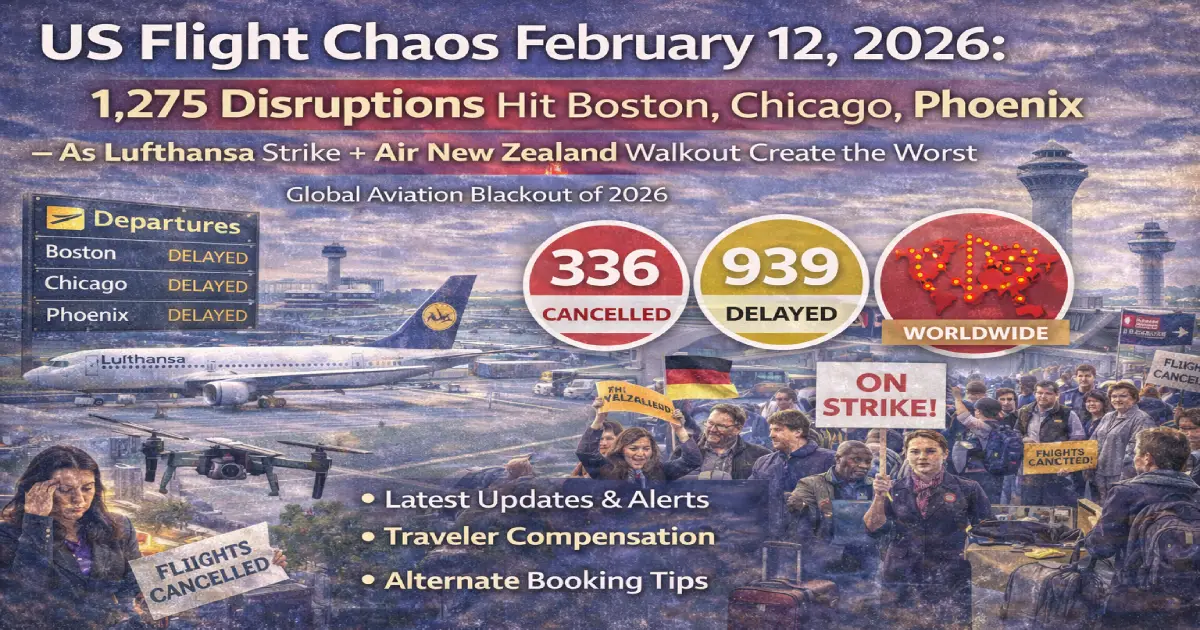
Breaking: February 12, 2026 has become the worst single day for global aviation in 2026 — a perfect storm of simultaneous crises across three continents grounding tens of thousands of passengers simultaneously: 1,275 flight disruptions (50 cancellations + 1,225 delays) cripple US airports from Boston to Chicago to Phoenix; a 24-hour coordinated Lufthansa pilot and cabin crew strike grounds 80–90% of Germany’s flag carrier, cancelling 800+ flights and stranding 120,000 passengers across Frankfurt and Munich; and Air New Zealand’s cabin crew walkout cancels 44 long-haul flights to Asia and North America affecting 16,000 passengers — all on the same day, all at once, three days before Presidents Day weekend. Here is your complete guide to what is happening and what you must do right now.
Published: February 12, 2026 US Disruptions Today: 1,275 total (50 cancellations + 1,225 delays) Worst US Airport: Boston Logan (80 delays, 8 cancellations) Lufthansa Strike: 800+ flights cancelled, 120,000 passengers stranded, 24-hour action Air New Zealand Strike: 44 long-haul flights cancelled, 16,000 passengers affected Global Total Today: Estimated 2,500+ flight disruptions across US, Europe, Pacific Carriers Hit: Delta, American, Southwest, JetBlue, Cape Air, Iberia (US) + Lufthansa mainline (Germany) + Air New Zealand (Pacific) Days to Presidents Day: 2 days Risk Level: 🔴 CRITICAL — worst global aviation day of 2026
Never in 2026 has a single calendar day produced simultaneous aviation crises across the United States, Europe, and the Pacific simultaneously. Today is that day. Let’s break down each crisis individually before examining how they interact.
Passengers traveling through Boston Logan International Airport faced another day of cascading disruption as a cluster of cancellations and delays rippled across regional and transborder routes on Thursday, February 12, 2026. Flights operated by Cape Air, PAL Airlines, Iberia, American Airlines, Jazz Aviation, and Air Canada were canceled, with many more services delayed, snarling connections to key cities including Washington D.C., Bar Harbor, Lebanon, Halifax, Austin, and other destinations across the United States and Canada.
Boston Logan February 12 — By the Numbers:
The latest disruption at Logan unfolded against a broader backdrop of nationwide operational strain, with hundreds of flights delayed across major hubs as carriers grappled with weather challenges, tight schedules, and ongoing congestion in the US air travel system. Although the number of outright cancellations at Boston Logan on Thursday may appear modest at first glance, the timing and network impact have been significant.
Why Boston is struggling: Boston Logan has absorbed more winter punishment than almost any US airport in 2026. Between 23 and 27 January 2026, Logan Airport recorded snow accumulation exceeding 18–23 inches, forcing widespread cancellations and logistical snarls. While isolated weather events are not unusual in New England’s winter, this storm’s timing and severity exacerbated an already stressed system. The airport and its carriers never fully recovered before the next disruption wave arrived. Today’s cascading pattern — where one regional cancellation triggers missed connections across the entire national network — is the direct result of this cumulative winter damage.
The Cape Air regional collapse: Cape Air, which operates the lifeline routes from Boston to Martha’s Vineyard, Nantucket, Bar Harbor, and Provincetown, is experiencing a 97–100% cancellation rate on its Boston operations today. These are not luxury routes — they are the only air links for island communities that have no road connection to the mainland. When Cape Air fails, those communities are cut off entirely.
Chicago O’Hare recorded 74 significant delays today, with American Airlines, United, and SkyWest bearing the brunt. O’Hare is the second-most vulnerable US hub in the current environment because it sits at the intersection of three converging pressures: American Airlines’ ongoing CEO crisis and morale collapse, United’s post-winter staffing tightness, and Chicago’s perpetual winter weather exposure.
Services by Southwest, SkyWest and Alaska Airlines were among those most affected, with knock-on delays reported on routes linking Phoenix to major hubs including Los Angeles, Dallas, Chicago and New York. The system is operating closer to its limits, with thinner margins for disruption and a higher likelihood that local issues will quickly become national ones.
O’Hare cascade effect: When Chicago delays by 60 minutes, aircraft scheduled to depart O’Hare for East Coast destinations arrive late — meaning their return flights depart late — meaning passengers in Boston, New York, and Philadelphia who booked afternoon connections through Chicago find themselves cascaded into evening or next-day arrivals. Today’s 74 delays at O’Hare translate to hundreds of secondary disruptions across the country that never appear in the official O’Hare statistics.
Passengers at Phoenix Sky Harbor International Airport in Maricopa County, Arizona, faced another bout of disruption as 82 flights were delayed and 7 were cancelled on Tuesday, February 11, 2026, sending ripple effects through some of the busiest air corridors in the United States. Services operated by Southwest, SkyWest and Alaska Airlines were among those most affected, with knock-on delays reported on routes linking Phoenix to major hubs including Los Angeles, Dallas, Chicago and New York.
Phoenix Sky Harbor is an anomaly in this disruption picture — a Sunbelt airport that should be insulated from Northeast winter chaos yet is experiencing significant delays. The reason is structural rather than meteorological: Phoenix is a critical SkyWest hub, and SkyWest operates regional feeder flights for both Delta and United across the Southwest and Mountain West. When SkyWest operations strain at Phoenix, regional connectivity from Tucson, Flagstaff, Yuma, and smaller Arizona cities breaks down entirely.
| Airline | Cancellations | Delays | Primary Hubs Affected |
|---|---|---|---|
| American Airlines | 15+ | 320+ | DFW, ORD, BOS, PHL, MIA |
| Delta Air Lines | 8 | 245+ | ATL, BOS, JFK, DTW, MSP |
| Southwest Airlines | 6 | 180+ | MDW, PHX, BNA, MCI |
| JetBlue Airways | 7 | 140+ | BOS, JFK, FLL, BDL |
| SkyWest Airlines | 5 | 165+ | PHX, DEN, ORD, SLC |
| Cape Air | 4 | 35+ | BOS, PVD, regional |
| United Airlines | 3 | 135+ | ORD, EWR, IAH, DEN |
Critical note: American Airlines’ disproportionate share of today’s cancellations — 15+ out of 50 total (30%) while operating roughly 15% of daily US flights — is the direct fingerprint of the CEO crisis and morale collapse documented in our February 11 analysis. This is not weather. This is leadership failure manifesting in real-time operational statistics.
While the US struggles with cascading winter disruptions, Europe’s largest aviation hub is experiencing a total shutdown.
A major 24-hour strike involving both pilots and cabin crew has been confirmed, effectively grounding the majority of Lufthansa’s operations across Germany. Strike Date: Thursday, February 12, 2026. Time: 12:01 AM to 11:59 PM (24 hours). Pilots are represented by Vereinigung Cockpit (VC), cabin crew by UFO. The cause is collapse of negotiations regarding pension schemes and retirement benefits after seven rounds of failed talks.
Lufthansa expects that 80–90% of all flights will be affected. The strike will result in many, if not most, flights being canceled.
Mainline Lufthansa and Lufthansa Cargo: Virtually all departures from German airports — Frankfurt, Munich, Berlin, Hamburg, Düsseldorf — have been scrapped. CityLine short-haul regional flights are heavily impacted.
Travel-management companies estimate that as many as 120,000 passengers could see flights cancelled or severely delayed. Multinational employers with time-sensitive assignee travel should consider rerouting staff through Amsterdam, Zurich or Vienna, though remaining seats are disappearing fast and prices have spiked 40–60% on key intra-European routes.
The safe zones: Eurowings, Swiss, Austrian Airlines, Brussels Airlines, and Discover Airlines are not part of the current industrial action. Their flights should proceed as scheduled.
The Vereinigung Cockpit trade union cited the demand for improvements to company pension schemes as the driving force behind its decision to call its members to go on strike.
The UFO union representing cabin crew, including Lufthansa CityLine staff, is protesting the planned closure of CityLine, a subsidiary that has been central to Lufthansa’s regional operations.
A similar strike in early 2024 involving cabin crew and ground workers reportedly cost Lufthansa around €350 million, with additional settlement bonuses adding €100 million. A pilot’s strike in September 2024 led to more than 800 flight cancellations and stranded roughly 130,000 passengers across Lufthansa’s network.
Today’s combined pilot AND cabin crew walkout is the most powerful industrial action Lufthansa has faced in years — and it is happening at the worst possible time: two days before Europe’s half-term school holiday peak, when Frankfurt and Munich are at seasonal capacity for ski resort and winter sun departures.
For American travellers with Lufthansa connections today or tomorrow, the practical impact is:
The Lufthansa strike on 12 February 2026 is causing widespread cancellations and delays, and affected passengers are legally entitled to EU261 compensation of up to €600 per person.
Unlike strikes by airport security or Air Traffic Control (which are extraordinary circumstances), a strike by airline staff — pilots/crew — is considered within the airline’s control under EU Law. According to EU Regulation 261/2004: Short haul under 1,500km: €250 per passenger. Medium haul 1,500–3,500km: €400 per passenger. Long haul over 3,500km: €600 per passenger (e.g. Frankfurt to New York).
Important: Lufthansa may initially reject claims citing exceptional circumstances. However, the European Court of Justice has ruled that staff strikes over pay and pensions are eligible for compensation. Japan Airlines Do not accept a rejection without filing a formal claim.
German rail alternative: Lufthansa has struck a deal with Deutsche Bahn. Passengers can convert their flight ticket into a rail voucher free of charge through the My Bookings section of the Lufthansa website.
On the other side of the world, 16,000 passengers are stranded or scrambling as Air New Zealand’s cabin crew execute their strike action today and tomorrow.
Air New Zealand has preemptively canceled 44 long-haul flights due to a planned strike by international cabin crew on 12–13 February. The changes affect wide-body services linking Auckland with Asia and North America, while Tasman and Pacific Island routes are largely unaffected.
Air New Zealand’s chief customer and digital officer Jeremy O’Brien confirmed the strike has forced the cancellation of most long-haul services to Asia and North America.
The strike follows weeks of negotiations between Air New Zealand and unions E tū and FAANZ over pay and conditions. The dispute had been narrowed down to pay.
FAANZ president Craig Featherby said cabin crew had already provided expected pay figures during mediation and were wanting to reach a threshold higher than Air New Zealand has so far offered. “Those percentages sound great. As we know, the New Zealand economy is struggling overall with inflation at 3.1%. However, even with those numbers, that will only just see crew this year getting to the living wage.”
Air New Zealand offered first-year increases of 4.14%–6.41%. Cabin crew argue this barely keeps pace with inflation and falls below the New Zealand living wage threshold for workers who perform some of the most demanding shift work in aviation — 16-hour long-haul flights to Los Angeles, irregular rosters that change monthly, and extended time away from home.
Air New Zealand’s Boeing 777-300ER and 787-9 fleets normally operate up to six Brisbane, Sydney and Melbourne rotations each day, feeding North-American and Asian connections popular with Australian exporters and multinationals. Travel-management companies estimate that more than 12,000 Australian-ticketed passengers have bookings that touch the affected flights during the two-day window.
Routes hardest hit:
Australian travellers: This strike hits the Australia–New Zealand–North America corridor hardest. Anyone booked on Air New Zealand connecting through Auckland to the US this week should have already been contacted by the airline — if you haven’t received a rebooking offer, call Air New Zealand immediately.
The airline contacted impacted customers, offering rebooking two to three days around the strike dates, travel credits, or refunds, and is using partner airlines for re-accommodation.
“We have limited the impact on our Tasman and Pacific Island flying because we’re able to put on our narrow-body aircraft — so the smaller jets — on those flights,” said chief customer officer Jeremy O’Brien. “And then for those long-haul flights, we have provided alternative options, both on Air New Zealand two to three days before or after, but also alternatives across our Star Alliance and other partner airlines. So we’ve exhausted every single way in which we can re-accommodate passengers as close as possible to their original travel date.”
Air New Zealand’s Star Alliance partners for re-accommodation: United Airlines, Singapore Airlines, Thai Airways, Turkish Airlines — all may have seats available on alternative routings.
The simultaneous occurrence of US network strain, Lufthansa’s German shutdown, and Air New Zealand’s Pacific collapse is not entirely coincidental — it reflects three structural aviation trends converging:
1. The Post-COVID Labour Reckoning Is Peaking
Airlines emerged from COVID-19 by cutting costs aggressively — slashing staff, deferring pay increases, reducing pension contributions, and contracting out work. In 2025–2026, the bill is coming due simultaneously across multiple carriers and continents. Lufthansa pilots and cabin crew, Air New Zealand cabin crew, American Airlines flight attendants and pilots, Air Canada customer service agents — all in various states of dispute within the same 60-day window. This is not coincidence. It is a structural wave.
2. Winter 2025–2026 Has Been Historically Brutal
The North American winter storm that brought heavy snow and hazardous conditions to Massachusetts — with Logan Airport recording snow accumulation exceeding 18–23 inches between 23–27 January 2026 — forced widespread cancellations and logistical snarls that exacerbated an already stressed system. Every major US hub is operating with depleted reserve crews, maintenance backlogs, and aircraft positioning errors that have never fully corrected since Winter Storm Fern in late January.
3. Presidents Day Weekend Is Multiplying the Pressure
With 3.5 million Americans attempting to fly this weekend, every airline is operating at or above capacity — meaning there is zero slack to absorb disruptions. A 74-minute delay at O’Hare on a normal Tuesday matters to 200 passengers. A 74-minute delay at O’Hare on Presidents Day Eve matters to 2,000 passengers because every connecting flight is full, every hotel is booked, and every rebooking option is already occupied by someone else.
✅ Check FlightAware immediately — flightaware.com — if your aircraft hasn’t left its origin city yet, your flight is at risk regardless of what the departure board says
✅ Boston passengers: Add 90 minutes to your airport arrival time. Regional connections (Cape Air, PAL) are extremely high-risk today — if your final destination requires a Cape Air regional hop, call Cape Air directly before leaving home
✅ Chicago O’Hare passengers: Arrive 3 hours minimum. If connecting through ORD with less than 2-hour layover, call your airline now and request proactive rebooking onto a later connection
✅ Phoenix passengers: SkyWest regional feeders are disrupted — verify regional connection status before leaving for PHX
✅ All passengers: Download your airline’s app if you haven’t. Rebooking through the app is 3–5x faster than customer service queues during disruption days
✅ Do NOT go to Frankfurt or Munich airport if your departure is cancelled — hotels near both airports are full. Stay home or at your hotel and manage via app/phone
✅ Check Lufthansa.com/My Bookings — status updates come there first, before airport boards
✅ Domestic German travel: Convert your cancelled domestic Lufthansa flight to a Deutsche Bahn rail voucher free of charge through the Lufthansa website
✅ International rerouting: Consider rerouting through Amsterdam, Zurich or Vienna — Eurowings, Swiss, Austrian Airlines are all operating normally today
✅ File EU261 compensation claim: You are entitled to €250–€600 per passenger. Use airhelp.com or flight-delayed.com — do not let Lufthansa reject your claim citing “extraordinary circumstances”
✅ Friday warning: Expect severe backlog on Friday February 13 as 120,000 reboooked passengers simultaneously try to fly. If your travel can wait until Saturday, wait
✅ Long-haul wide-body flights (777/787): Almost certainly cancelled — check airNewZealand.com immediately
✅ Tasman/Pacific routes (narrow-body): Largely operating normally — proceed as planned
✅ Rebooking options: Air New Zealand has offered 2–3 days either side of strike dates, travel credits, or full refunds — contact them immediately if you haven’t received your options
✅ Star Alliance alternatives: Ask Air New Zealand to rebook on United Airlines (transpacific), Singapore Airlines, or Thai Airways
✅ Australian travellers connecting through Auckland: Your connection to Auckland may operate but your onward long-haul is cancelled — do not travel to Auckland without confirming your international connection first
Today’s triple crisis arrives precisely 48 hours before Presidents Day weekend. The implications are severe:
Friday February 13: Lufthansa backlog 120,000 passengers reinjected into Frankfurt/Munich system simultaneously. US carriers beginning Presidents Day load build. Storm threat arriving Northeast.
Saturday February 14 (Valentine’s Day): Air New Zealand Day 2 strike continues. Lufthansa attempting first-day recovery (not yet normal). US Presidents Day peak departure day.
Sunday February 15: Air New Zealand strike ends, recovery begins. Lufthansa returning to normal. US Presidents Day peak continues.
Monday February 16 (Presidents Day + Italy Strike): Italy 24-hour airline strike grounds 314+ flights. US peak return surge. Lufthansa and Air New Zealand still in recovery.
The combined Presidents Day weekend risk picture is the most dangerous travel window since Winter Storm Fern — and unlike Fern, it is driven not just by weather but by simultaneous structural operational crises across four carriers on three continents.
For a complete Presidents Day travel survival guide, see our full article: Presidents Day Travel 2026: Chaos Guide Feb 14–16.
February 12, 2026 is not a normal disruption day — it is a convergence of three simultaneous aviation crises across three continents: 1,275 flight disruptions grounding tens of thousands of US passengers in Boston, Chicago, and Phoenix; a Lufthansa 24-hour strike that has shut down 80–90% of Germany’s flag carrier, stranding 120,000 passengers across Frankfurt and Munich; and an Air New Zealand cabin crew walkout cancelling 44 long-haul flights affecting 16,000 passengers on the Auckland–Asia–North America corridor. All happening simultaneously. All feeding into Presidents Day weekend two days away. The underlying cause across every single one of these crises is the same: post-COVID aviation’s structural failure to resolve labour disputes, rebuild operational buffers, and invest in the people who keep the global air network flying.
Today’s Action Checklist:
✅ Flying US today? Check FlightAware before leaving home — BOS, ORD, PHX highest risk ✅ Lufthansa passenger today? Do NOT go to FRA/MUC — manage remotely, claim EU261 (up to €600) ✅ Air New Zealand long-haul today/tomorrow? Almost certainly cancelled — contact ANZ immediately for rebooking ✅ Presidents Day flights (Feb 13–16)? Read our full survival guide — highest-risk weekend of Q1 2026 ✅ Italy connections Monday Feb 16? Strike hits ITA Airways + Vueling + EasyJet — rebook direct routes now
Monitor live flight status:
For More Resources:
Related Articles:
Posted By : Vinay
This article is provided for general informational purposes only and is based on information available at the time of publication. Travel advisories, airline schedules, airport operations, visa requirements, government regulations, and other travel-related information are subject to change without prior notice. While Travel Tourister makes reasonable efforts to verify information using official announcements, government publications, airline and airport communications, and other reliable sources, we cannot guarantee that all information remains complete, accurate, or up to date at all times. Readers should independently verify any information that may affect their travel plans with the relevant airline, airport authority, government agency, embassy, or other official source before making travel, financial, or other decisions. Travel Tourister shall not be liable for any direct or indirect loss, inconvenience, or damages arising from the use of or reliance on the information contained in this article. Nothing in this publication constitutes legal, immigration, financial, or professional travel advice. If you believe any information in this article is inaccurate or outdated, please contact our editorial team. We review all credible correction requests promptly and update our content whenever appropriate.
Lastest News
2nd Floor, 39, Above Kirti Club, DLF Industrial Area, Kirti Nagar, New Delhi, Delhi 110015



Travel Tourister is a leading Travel portal where we introduce travellers to trusted travel agents to make their journey hasselfree, memorable And happy. Travel Tourister is a platform where travellers get Tour packages ,Hotel packages deals through trusted travel companies And hoteliers who are working with us across the world. We always try to find new and more travel agents and hoteliers from every nook and corners across the world so that you could compare the deals with different travel agents and hoteliers and book your tour or hotel with the one you have chosen according to your taste and budget.
Copyright © Travel Tourister, India. All Rights Reserved

 Call
Call Enquiry