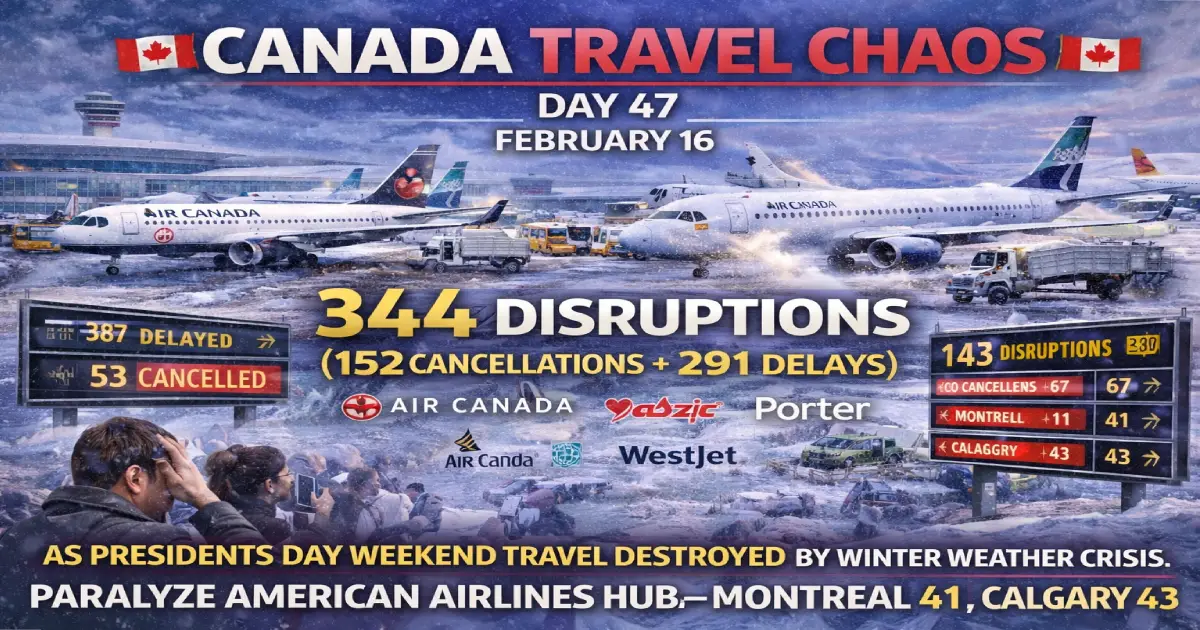
DAY 47 RELENTLESS CRISIS: Canada’s aviation nightmare reached its 47th consecutive day Sunday, February 16, 2026, as 53 flight cancellations and 291 delays destroyed Presidents Day weekend travel for thousands of passengers, with Toronto Pearson recording 143 total disruptions (30 cancellations + 113 delays), Vancouver International experiencing 67 disruptions (9 cancellations + 58 delays), Montreal-Trudeau suffering 41 disruptions, and Calgary International hit with 43 disruptions as Air Canada, WestJet, Jazz Aviation (Air Canada Express), Porter Airlines, WestJet Encore, and regional carriers struggled against persistent winter weather conditions (snow, extreme cold, ice), operational bottlenecks, and systemic fragilities that have plagued Canadian aviation since January 1—leaving passengers stranded, missing international connections, and scrambling for rebooking as Canada’s ongoing aviation crisis, which has now disrupted an estimated 5,500+ flights over 47 days affecting over 500,000 passengers, shows absolutely no signs of resolution heading into the critical March Break travel period when experts predict catastrophic disruptions.
Published: February 16, 2026 (Sunday – Presidents Day Weekend / Day 47)
Total Disruptions: 344 flights (53 cancellations + 291 delays)
Crisis Duration: Day 47 since January 1, 2026
Airlines Affected: Air Canada, WestJet, Jazz Aviation (Air Canada Express), Porter Airlines, WestJet Encore, Envoy Air, Air India, Hong Kong Airlines, Air Inuit, and more
Airports Hit: Toronto Pearson (143 disruptions), Vancouver (67), Montreal-Trudeau (41), Calgary (43), Ottawa, Quebec City, regional airports
Weather Cause: Winter weather (snow, extreme cold, ice), operational constraints
Passengers Affected Today: Estimated 25,000-30,000
Cumulative Crisis (Jan 1 – Feb 16): ~5,500 flights disrupted, 500,000+ passengers affected
Next Threat: March Break (March 2026) = projected catastrophic disruptions
The Numbers: 344 Total Disruptions (Day 47)
Overall Impact (Sunday, February 16, 2026)
Canadian Airspace:
- ✈️ 53 CANCELLATIONS (flights outright cancelled)
- ✈️ 291 DELAYS (many exceeding 1-3+ hours)
- ✈️ 344 TOTAL DISRUPTIONS
- ✈️ Estimated 25,000-30,000 passengers affected today
- ✈️ Presidents Day weekend = three-day holiday return travel destroyed
Context:
- Canada operates ~2,000-2,500 flights daily (domestic + international)
- 344 disruptions = ~15% of daily Canadian operations affected
- Day 47 of continuous aviation crisis (since January 1, 2026)
- Cumulative disruptions (Jan 1 – Feb 16): ~5,500 flights, 500,000+ passengers
Airport-by-Airport Breakdown
Toronto Pearson International (YYZ) – The Epicenter
Sunday February 16 impact:
- 30 CANCELLATIONS
- 113 DELAYS
- 143 TOTAL DISRUPTIONS (41.6% of Canada’s total)
Why Toronto was worst affected:
- Canada’s busiest airport: 50 million passengers annually
- Hub concentration: 50% of Canada’s international traffic flows through Pearson
- Air Canada, WestJet, Porter, regional carriers: All operate major Toronto bases
- Winter weather vulnerability: Snow, ice, de-icing operations
Routes affected:
Domestic trunk routes:
- Toronto → Vancouver: High-frequency business route, multiple delays
- Toronto → Montreal: Eastern Canada corridor, delays
- Toronto → Calgary: Transcontinental, cancellations
- Toronto → Ottawa: Government travel, delays
- Toronto → Halifax: Atlantic connection, cancellations
US transborder:
- Toronto → New York (JFK/LaGuardia/Newark): Presidents Day weekend return traffic
- Toronto → Chicago O’Hare: Business route, significant delays
- Toronto → Miami, Fort Lauderdale: Florida leisure returns, cancellations
- Toronto → Los Angeles, San Francisco: West Coast connections, delays
International long-haul:
- Toronto → London Heathrow: Delayed domestic feeds = missed connections to Europe
- Toronto → Frankfurt, Paris, Amsterdam: European business travel, delays
- Toronto → Tokyo, Hong Kong, Seoul: Asia-Pacific connections severed
Vancouver International (YVR) – West Coast Gateway
Sunday February 16 impact:
- 9 CANCELLATIONS
- 58 DELAYS
- 67 TOTAL DISRUPTIONS (19.5% of Canada’s total)
Why Vancouver affected:
- Pacific gateway: Major Asia-Pacific hub (connects Canada to Tokyo, Seoul, Beijing, Hong Kong, Shanghai)
- US transborder: Heavy Seattle, Portland, San Francisco traffic
- Regional BC routes: Weather impacts smaller airports (Nanaimo, Victoria, Kelowna)
Routes affected:
Asia-Pacific (international):
- Vancouver → Tokyo Narita/Haneda: Major business/tourism route, delays
- Vancouver → Hong Kong: Key Asian connection, delays
- Vancouver → Seoul: Growing Korean traffic, cancellations
- Vancouver → Beijing, Shanghai: China connections, delays
US transborder:
- Vancouver → Seattle: High-frequency shuttle, multiple delays
- Vancouver → Los Angeles, San Francisco: California connections, delays
- Vancouver → Las Vegas, Phoenix: Leisure destinations, cancellations
Domestic:
- Vancouver → Toronto: Transcontinental, delays (missed connections at YYZ)
- Vancouver → Calgary: Alberta corridor, delays
Montreal-Trudeau International (YUL) – Quebec Hub
Sunday February 16 impact:
- ESTIMATED 8-10 CANCELLATIONS
- ESTIMATED 30-35 DELAYS
- 41 TOTAL DISRUPTIONS (11.9% of Canada’s total)
Why Montreal affected:
- Quebec’s largest airport: Gateway to French-speaking Canada
- Air Canada, Porter, Air Transat: Major carriers all operate YUL bases
- European connections: Strong Montreal → Paris, London, Brussels traffic
Routes affected:
Domestic:
- Montreal → Toronto: Eastern corridor, delays
- Montreal → Vancouver: Transcontinental, cancellations
- Montreal → Quebec City: Regional connection, delays
US transborder:
- Montreal → New York (JFK/LaGuardia/Newark): Presidents Day weekend returns
- Montreal → Miami, Fort Lauderdale: Florida leisure traffic
- Montreal → Chicago O’Hare: Business route
International:
- Montreal → Paris CDG: Strong Francophone connection, delays
- Montreal → London Heathrow: Business travel, delays
Calgary International (YYC) – Prairie Hub
Sunday February 16 impact:
- ESTIMATED 3-5 CANCELLATIONS
- ESTIMATED 38-40 DELAYS
- 43 TOTAL DISRUPTIONS (12.5% of Canada’s total)
Why Calgary affected:
- WestJet’s home base: Alberta carrier operates majority of Calgary flights
- Oil & gas industry: High business travel demand
- Extreme cold vulnerability: Alberta winter temperatures (-20°C to -40°C common)
Routes affected:
Domestic:
- Calgary → Toronto: Transcontinental business route, delays
- Calgary → Vancouver: Mountain/coast connection, delays
- Calgary → Edmonton: Alberta corridor, delays
US transborder:
- Calgary → Las Vegas, Phoenix: Sun destination leisure, cancellations
- Calgary → Los Angeles, San Francisco: California connections, delays
Other Affected Airports
Ottawa (YOW):
- Estimated disruptions: 15-20 total (government capital, Porter Airlines base)
Quebec City (YQB):
- Estimated disruptions: 8-12 total (small airport, limited alternatives)
Halifax (YHZ):
- Estimated disruptions: 10-15 total (Atlantic Canada gateway)
Edmonton (YEG):
- Estimated disruptions: 12-18 total (Alberta’s second airport)
Airline-by-Airline Breakdown
Air Canada: Flagship Carrier Struggles
Estimated Sunday impact:
- Cancellations: 15-20 flights
- Delays: 100-120 flights
- Total disruptions: 115-140 flights
Why Air Canada hit hard:
- Largest Canadian carrier: Operates most flights nationwide
- Hub concentration: Toronto, Montreal, Vancouver = all disrupted
- International connections: Delays cascade to European, Asian, American routes
Specific challenges:
- Widebody aircraft: Boeing 777, 787 Dreamliner delayed at Toronto = missed international departures
- Crew timing out: Delays = crews exceed duty time limits = next flights cancelled
- Aircraft out of position: Cancelled Toronto flights = aircraft stuck elsewhere
WestJet Airlines: Calgary Base Affected
Estimated Sunday impact:
- Cancellations: 8-12 flights
- Delays: 60-70 flights
- Total disruptions: 68-82 flights
Why WestJet struggled:
- Calgary home base: Alberta extreme cold = de-icing delays
- Point-to-point model: One delay cascades network-wide (no hub redundancy)
- High aircraft utilization: Planes fly 12-14 hours daily; delays destroy schedules
Routes affected:
- Calgary → sun destinations (Las Vegas, Phoenix, Los Angeles)
- Calgary → eastern Canada (Toronto, Montreal, Ottawa)
Jazz Aviation (Air Canada Express): Regional Collapse
Estimated Sunday impact:
- Cancellations: 10-15 flights
- Delays: 50-60 flights
- Total disruptions: 60-75 flights
Why Jazz disproportionately affected:
- Regional carrier: Operates Dash 8, CRJ-200, E175 (smaller aircraft more weather-vulnerable)
- Small airports: Limited de-icing infrastructure, crews, spare aircraft
- Tight schedules: Aircraft rotate through 6-8 cities daily
Communities affected:
- Ontario: Thunder Bay, Sault Ste. Marie, Sudbury
- Quebec: Quebec City, Val-d’Or, Sept-Îles
- Maritimes: Halifax, Fredericton, Sydney
Porter Airlines: Toronto Island Base
Estimated Sunday impact:
- Cancellations: 3-5 flights
- Delays: 20-25 flights
- Total disruptions: 23-30 flights
Why Porter affected:
- Billy Bishop Airport (Toronto Island): Weather-exposed location (island in Lake Ontario)
- Smaller aircraft: Dash 8 turboprops = more weather-sensitive
- US transborder focus: NYC, Boston, Chicago routes disrupted
WestJet Encore: Regional Subsidiary
Estimated Sunday impact:
- Cancellations: 2-3 flights
- Delays: 25-30 flights
- Total disruptions: 27-33 flights
Routes affected:
- Alberta regional (Calgary/Edmonton → small cities)
- BC interior (Vancouver → Kamloops, Kelowna, Prince George)
Other Airlines Affected
Envoy Air (American Eagle):
- US transborder feeder flights
- Toronto, Montreal → US hubs (Chicago, Dallas, Charlotte)
Air India:
- Toronto/Vancouver → New Delhi
- International long-haul delays
Hong Kong Airlines:
- Vancouver → Hong Kong
- Asia-Pacific connection delays
Air Inuit:
- Northern Quebec, Nunavut
- Remote community lifeline routes
Day 47: The Cumulative Crisis
January 1 – February 16, 2026: The Pattern
Major disruption days (500+ flights each):
- January 2: 598 delays + 98 cancellations = 696 total
- January 4: 1,650 delays + 102 cancellations = 1,752 total
- February 9: 316 delays + 67 cancellations = 383 total
- February 14 (Valentine’s Day): 301 delays + 65 cancellations = 366 total
- February 16 (TODAY): 291 delays + 53 cancellations = 344 total
Cumulative estimate (47 days):
- Total disruptions: ~5,500 flights
- Passengers affected: 500,000+ (assuming avg 90-100 passengers per disrupted flight)
- Economic impact: $300-500 million (lost productivity, tourism, compensation)
Why This Continues: Structural Problems
Hub Concentration Risk
80% of Canadian traffic flows through 4 airports:
- Toronto Pearson (50M passengers annually)
- Vancouver (26M)
- Montreal-Trudeau (20M)
- Calgary (18M)
Problem: Weather/delays at ONE hub = nationwide gridlock
Example cascade:
- Toronto weather → Vancouver delays (connecting passengers stranded)
- Vancouver delays → Calgary delays (aircraft out of position)
- Calgary delays → Toronto delays (aircraft can’t return)
Regional Carrier Fragility
Jazz, WestJet Encore, Porter:
- Operate tight schedules (no slack)
- Limited spare aircraft (no substitutions available)
- Minimal reserve crews (duty time limits = cancellations)
- Small airports: Less infrastructure (fewer de-icing pads, limited hotel availability)
One delay = entire day’s schedule destroyed
Labor Strife (Looming)
Air Canada strike deadline: February 28, 2026 (12 days away)
- 5,800 customer service agents (Unifor union)
- Contract expired: Negotiations ongoing
- Threat: If strike happens during March Break = catastrophic
Porter Airlines:
- Strike narrowly averted January 20
- Tentative agreement NOT fully ratified
- Tensions remain high
Winter Operational Limits
De-icing bottlenecks:
- Toronto Pearson: 8 de-icing pads (insufficient for peak demand)
- Normal capacity: 32-48 aircraft/hour (all pads operating)
- Extreme cold capacity: 12-18 aircraft/hour (de-icing time triples)
Result: Massive backlog, cascading delays
Passenger Impact: Day 47 Stories
Stranded in Toronto
Ottawa family returning from Florida:
- Miami → Toronto (Air Canada) delayed 3 hours
- Missed connecting flight Toronto → Ottawa
- Next available flight: Monday afternoon (Presidents Day)
- Lost: Sunday evening at home, Monday work/school
Vancouver-Toronto Miss
Vancouver business traveler:
- Vancouver → Toronto (Air Canada) delayed 2 hours
- Missed Toronto → London Heathrow flight
- Next LHR flight: Monday evening
- Lost: Monday business meetings in London, hotel (non-refundable)
Calgary Ski Trip Ruined
Calgary family returning from Whistler:
- Vancouver → Calgary (WestJet) cancelled
- Rebooked for Monday morning
- Lost: Sunday evening at home, Monday work/school
What Passengers Can Do
Immediate Actions
1. Check flight status continuously:
- Air Canada app/website
- WestJet app/website
- FlightAware, FlightRadar24
2. Rebook online (fastest):
- Airlines apps = self-service rebooking
- Phone lines = 2-4 hour waits
- Airport counters = even longer
3. Know your rights:
Canadian Air Passenger Protection Regulations:
- Weather delays: Airlines NOT required to pay compensation
- But: Must offer free rebooking OR refund
- Meals, hotels: Only if delay is airline’s fault (not weather)
4. Alternative transportation:
VIA Rail:
- Toronto → Montreal: 5-6 hours (frequent service)
- Toronto → Ottawa: 4.5 hours
- Montreal → Quebec City: 3 hours
- Advantage: Weather-resistant (trains operate in most conditions)
Buses:
- Greyhound, Megabus (slower but cheaper)
March Break Warning: Catastrophic Disruptions Ahead
Peak Family Travel Period
March Break 2026:
- Dates: March 7-21 (varies by province)
- Demand: Highest family travel period of year (outside summer, Christmas)
- Destinations: Florida, Caribbean, Mexico (sun escapes), ski resorts
Projected disruptions:
- Experts predict 3,000-5,000 March disruptions (based on current pattern)
- If Air Canada strike happens (Feb 28 deadline): Catastrophic
FAQs
Q: Will disruptions continue into next week? A: Yes. Structural problems (hub concentration, winter weather, labor issues) persist. Expect ongoing disruptions through March at minimum.
Q: Should I avoid flying in Canada? A: If possible, yes. Alternative transportation (VIA Rail, driving) more reliable in winter. If must fly, book morning flights (fewer cascade delays), refundable tickets.
Q: What if Air Canada strikes February 28? A: March Break would be catastrophic. WestJet, Porter couldn’t absorb Air Canada’s capacity. Thousands stranded.
Q: Can I get compensation for Day 47 delays? A: No. Weather = “extraordinary circumstances.” Only entitled to free rebooking or refund.
Q: Why doesn’t Canada fix this? A: Requires massive infrastructure investment (more de-icing pads, backup hubs, spare aircraft). Politically unpopular, expensive. No quick fixes.
The Bottom Line
Canada’s Day 47 aviation crisis, with 344 disruptions Sunday (53 cancellations + 291 delays) destroying Presidents Day weekend travel, exposed the relentless pattern of structural failures—Toronto Pearson’s 143 disruptions (30 cancellations + 113 delays), Vancouver’s 67 disruptions, Montreal’s 41 disruptions, and Calgary’s 43 disruptions—that have plagued Canadian aviation since January 1, affecting over 500,000 passengers across ~5,500 disrupted flights as Air Canada, WestJet, Jazz, Porter, and regional carriers continue to struggle against winter weather, hub concentration, operational fragility, and looming labor strife (Air Canada strike deadline February 28) with absolutely no resolution in sight heading into March Break when experts predict catastrophic disruptions will strand tens of thousands of Canadian families.
For Canadian travelers: Harsh reality:
- ✅ Day 47 = no end in sight (disruptions continuing through March minimum)
- ✅ Hub concentration = single point of failure (Toronto weather = nationwide chaos)
- ✅ March Break = projected disaster (especially if Air Canada strikes)
- ✅ Alternative transportation essential (VIA Rail, driving more reliable)
- ✅ Refundable tickets mandatory for winter/holiday travel
For Canada’s aviation system:
- 47 days of continuous crisis = systemic failure
- No quick fixes (infrastructure, hub diversification = years, billions)
- March Break looming = potential catastrophe
Whether Day 47’s disruptions become the catalyst for long-overdue reform—or merely another forgotten chapter in Canada’s winter 2026 aviation nightmare—remains to be seen. But for thousands of stranded passengers across Toronto, Vancouver, Montreal, and Calgary, February 16, 2026, marks yet another day of destroyed travel plans, missed connections, and growing frustration with a system that shows no signs of improvement.
For More Information:
Related Articles:
Posted By : Vinay
As a lead contributor for Travel Tourister, Vinay is dedicated to serving our Tier 1 audience (US, UK, Canada, Australia). His mission is to deliver precise, fact-checked news and actionable, data-driven articles that empower readers to make informed decisions, minimize travel risks, and maximize their adventure without compromising safety or budget.




 Call
Call Enquiry