Published on : 19 Feb 2026
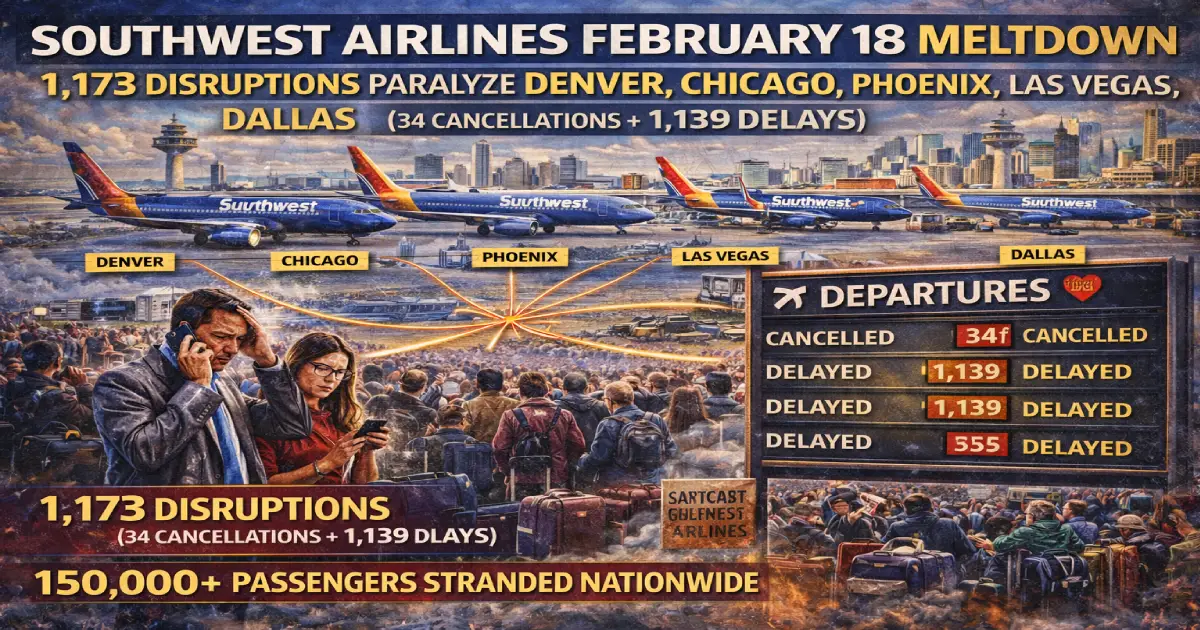
NATIONWIDE SOUTHWEST COLLAPSE: Southwest Airlines, America’s largest domestic carrier and budget traveler favorite, suffered a catastrophic operational meltdown Tuesday, February 18, 2026, recording 34 flight cancellations and a crushing 1,139 delays representing 1,173 total disruptions — the single largest single-carrier operational slowdown of 2026 to date — as the airline’s unique point-to-point network (rather than traditional hub-and-spoke scheduling) amplified cascading failures across Denver International (DEN), Chicago Midway (MDW), Phoenix Sky Harbor (PHX), Harry Reid Las Vegas (LAS), Dallas Love Field (DAL), Orlando International (MCO), Tampa International (TPA), Fort Lauderdale (FLL), Baltimore/Washington (BWI), Nashville (BNA), and dozens of other bases — strangling connections for an estimated 150,000-170,000 passengers (assuming 130-145 passengers per affected 737) as weather-related delays at Denver (high winds, thunderstorms, 122-minute average ground delays) triggered crew duty-time violations, aircraft out-of-position cascades, and synchronized chain breakdowns that rippled nationwide within hours, leaving families stranded, missed cruise embarkations at Port Everglades/Port Canaveral, destroyed business travel plans, and exposing Southwest’s operational model as structurally incapable of absorbing regional disruptions without collapsing the entire network — marking the airline’s worst single-day performance since the infamous December 2022 Christmas meltdown that cancelled 16,900 flights and stranded 2 million passengers.
Published: February 18, 2026 (Tuesday) Total Southwest Disruptions: 1,173 flights (34 cancellations + 1,139 delays) Percentage Delayed: ~30% of Southwest’s daily schedule (SW operates ~3,800 flights daily) Passengers Affected: 150,000-170,000 (estimated) Primary Trigger: Denver weather (high winds, thunderstorms, 122-min ground delays) Cascade Mechanism: Point-to-point network = no redundancy Major Airports Hit: Denver, Chicago Midway, Phoenix, Las Vegas, Dallas Love, Orlando, Tampa, Fort Lauderdale, Baltimore, Nashville, Charlotte, Myrtle Beach, Greenville, Savannah Crew Duty-Time Violations: Widespread (delays = crews timed out = subsequent cancellations) December 2022 Precedent: Worst since 16,900-flight Christmas meltdown Economic Impact: $50-75 million estimated (single day: compensation, hotels, rebooking, lost revenue) Structural Problem: Point-to-point model amplifies regional disruptions nationwide
Confirmed data: The airline logged a total of 1,173 affected flights, making it one of the most significant single-carrier operational slowdowns reported recently.
Context:
Denver’s role as trigger:
Why Denver triggered nationwide collapse:
Because Southwest operates an extensive point-to-point network rather than relying solely on traditional hub-and-spoke scheduling, disruptions in one region can quickly spread nationwide as aircraft rotate between cities throughout the day.
The cascade mechanism:
Confirmed data: Airports frequently appearing in affected route patterns included:
The cities and airports affected by the Southwest Airlines disruptions include Baltimore/Washington with Baltimore/Washington International (KBWI), Raleigh-Durham with Raleigh-Durham International (KRDU), Las Vegas with Harry Reid International (KLAS), Atlanta with Hartsfield-Jackson International (KATL), Denver with Denver International (KDEN), Chicago with Chicago Midway International (KMDW), Nashville with Nashville International (KBNA), Dallas with Dallas Love Field (KDAL), Charlotte with Charlotte/Douglas International (KCLT), Fort Lauderdale with Fort Lauderdale International (KFLL), Orlando with Orlando International (KMCO), Tampa with Tampa International (KTPA), Myrtle Beach with Myrtle Beach International (KMYR), Greenville/Spartanburg with Greenville/Spartanburg International (KGSP), and Savannah/Hilton Head with Savannah/Hilton Head International (KSAV).
Why Denver triggered everything:
Why Chicago matters:
Passenger impact:
Why Phoenix affected:
Confirmed disruptions from search data.
Why Las Vegas critical:
Confirmed as “primary hub” in search results: This facility serves as a primary hub for Southwest Airlines and any disruption here has significant consequences for the broader US flight network.
Why Dallas Love Field matters:
Orlando (KMCO):
Tampa (KTPA):
Fort Lauderdale (KFLL):
Baltimore/Washington (KBWI):
Nashville (KBNA):
Charlotte (KCLT):
Myrtle Beach, Greenville/Spartanburg, Savannah:
Traditional hub-and-spoke (Delta, United, American):
Southwest’s point-to-point:
Why point-to-point amplified February 18 chaos:
Aviation analysts explain that airline networks operate like synchronized chains. Each aircraft is scheduled for multiple flights daily, and crews must follow strict duty-time regulations. If one flight runs late, the aircraft assigned to the next flight may not arrive on time, automatically delaying subsequent departures.
Example cascade:
Crew duty limits:
How February 18 delays violated duty times:
Southwest’s crew shortage context:
Estimated passenger count:
Demographics:
Real passenger scenarios:
Missed cruise embarkation:
Stranded Disney family:
Missed business meeting:
Compensation costs:
Lost revenue:
Reputational damage:
Total estimated impact: $50-75 million for single day
December 2022 Christmas meltdown:
Similarities to February 18:
Key difference:
What February 18 reveals:
Immediate actions:
1. Rebook online:
2. Know your rights:
US DOT Passenger Rights:
3. Alternative airlines:
4. Travel insurance:
Q: Is Southwest safe to book for future travel? A: Operationally? Yes (safety record excellent). Reliability? Questionable. February 18 + December 2022 show structural problems persist. Consider paying premium for Delta/United/American on critical trips.
Q: Can I get compensation for my 6-hour Southwest delay? A: No cash compensation required (weather = “extraordinary circumstances”). But Southwest typically provides meals, hotels voluntarily. Full refund or rebooking guaranteed under US DOT rules.
Q: Why doesn’t Southwest fix its point-to-point network? A: Would require fundamental business model change. Point-to-point = cost advantage (no expensive hub infrastructure). But it’s structurally fragile. Southwest unlikely to change given cost implications.
Q: Will there be another Christmas 2022-scale meltdown? A: Possible. February 18 proves Southwest hasn’t fixed underlying problems (crew shortages, point-to-point fragility, no spare capacity). Next major weather event could trigger repeat.
Q: Should I avoid Southwest entirely? A: Depends on risk tolerance. Southwest = cheapest, most flexible (no change fees). But reliability questionable. For critical trips (weddings, cruises, business meetings), pay premium for Delta/United/American.
Southwest Airlines’ February 18, 2026 meltdown — 1,173 disruptions (34 cancellations + 1,139 delays) affecting 150,000-170,000 passengers — exposed the airline’s point-to-point network as structurally incapable of absorbing regional weather disruptions without collapsing nationwide, as Denver’s high winds and thunderstorms triggering 122-minute ground delays cascaded through synchronized chain breakdowns across Chicago Midway, Phoenix, Las Vegas, Dallas Love Field, Orlando, Tampa, Fort Lauderdale, Baltimore, Nashville, and dozens of other bases when crew duty-time violations, aircraft out-of-position failures, and zero spare capacity amplified the chaos — marking the worst single-day Southwest performance since the infamous December 2022 Christmas meltdown (16,900 flights cancelled, 2 million stranded, $1.1 billion cost) and proving that Southwest learned nothing from its 2022 catastrophe as the same structural fragilities — crew shortages, point-to-point vulnerability, operational inflexibility — persist unresolved, leaving millions of budget travelers gambling their vacations, business trips, and cruise embarkations on an airline whose network architecture remains one major weather event away from total collapse.
For Southwest passengers:
For More Information:
Related Articles:
Posted By : Vinay
This article is provided for general informational purposes only and is based on information available at the time of publication. Travel advisories, airline schedules, airport operations, visa requirements, government regulations, and other travel-related information are subject to change without prior notice. While Travel Tourister makes reasonable efforts to verify information using official announcements, government publications, airline and airport communications, and other reliable sources, we cannot guarantee that all information remains complete, accurate, or up to date at all times. Readers should independently verify any information that may affect their travel plans with the relevant airline, airport authority, government agency, embassy, or other official source before making travel, financial, or other decisions. Travel Tourister shall not be liable for any direct or indirect loss, inconvenience, or damages arising from the use of or reliance on the information contained in this article. Nothing in this publication constitutes legal, immigration, financial, or professional travel advice. If you believe any information in this article is inaccurate or outdated, please contact our editorial team. We review all credible correction requests promptly and update our content whenever appropriate.
Lastest News
2nd Floor, 39, Above Kirti Club, DLF Industrial Area, Kirti Nagar, New Delhi, Delhi 110015



Travel Tourister is a leading Travel portal where we introduce travellers to trusted travel agents to make their journey hasselfree, memorable And happy. Travel Tourister is a platform where travellers get Tour packages ,Hotel packages deals through trusted travel companies And hoteliers who are working with us across the world. We always try to find new and more travel agents and hoteliers from every nook and corners across the world so that you could compare the deals with different travel agents and hoteliers and book your tour or hotel with the one you have chosen according to your taste and budget.
Copyright © Travel Tourister, India. All Rights Reserved

 Call
Call Enquiry