Published on : 21 Mar 2026
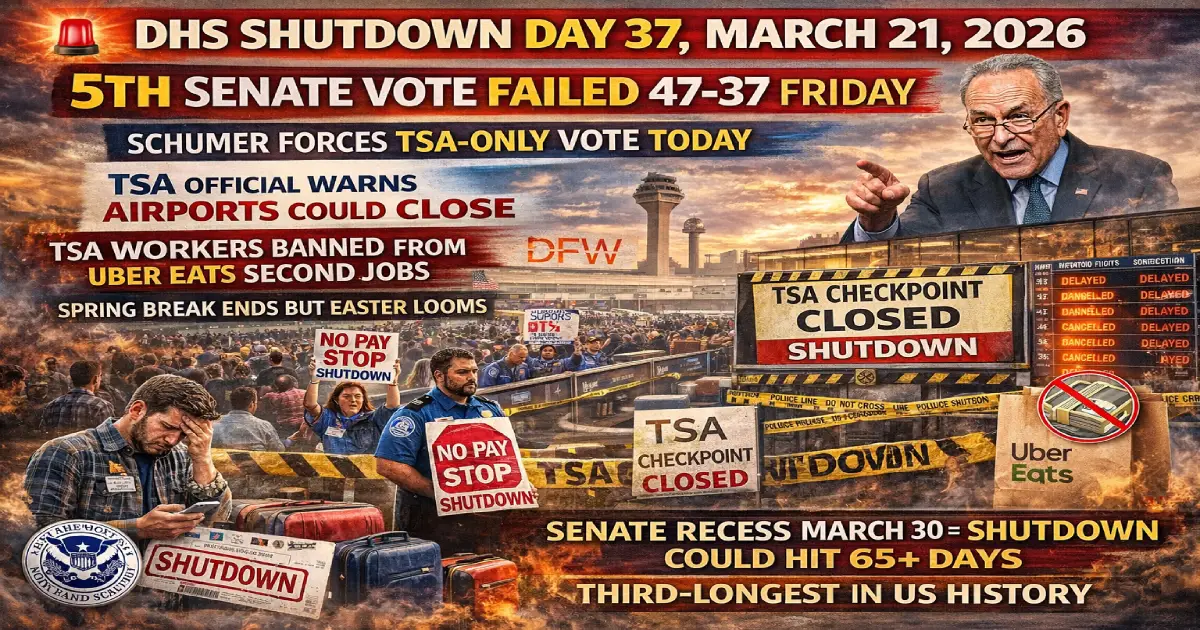
Breaking — Saturday March 21, DHS Shutdown Day 37: The most consequential political moment of the entire DHS shutdown crisis is unfolding RIGHT NOW on the Senate floor. After the fifth consecutive Senate vote failed on Friday — advancing a DHS funding bill by just 47-37, 13 votes short of the 60 needed to overcome a Democratic filibuster — Senate Democratic leader Chuck Schumer announced from the floor a dramatic escalation: Democrats would force a rare Saturday session to vote on a TSA-ONLY funding bill, separating TSA from the ICE/CBP funding fight entirely.
“The chaos at TSA is reaching a boiling point. We need to reopen it as quickly as possible. That is what Senate Democrats are intent on doing,” Schumer declared. “Tomorrow, America will see the matter crystal clear: which senators want to open up TSA, pay TSA workers, and end the chaos at our airports, and which senators are going to block TSA funding yet again.”
That vote is happening today, Saturday March 21 — right now.
The political stakes behind the Saturday vote are unprecedented: one TSA official warned this week that some airports might need to be shut down if the situation is not resolved soon. Not delayed. Not degraded. Shut down. For the first time since the DHS funding lapsed on February 14, a federal official has put airport closure on the table as an operational reality — not a political threat.
Meanwhile, inside America’s airports, the human reality of Day 37 has reached extraordinary levels of indignity. TSA workers desperate for supplemental income have turned to gig economy apps — only to discover they are banned from driving for Uber or delivering for Uber Eats without prior agency permission that can take weeks to obtain. And the shutdown has now become the third-longest in US history — surpassing the 34-day 2018-2019 Trump first-term shutdown — with the Senate recess from March 30 through April 10 meaning that if today’s Saturday vote fails, the shutdown is almost mathematically guaranteed to reach 65+ days, encompassing all of Easter 2026.
Published: March 21, 2026 (Saturday — DHS Shutdown Day 37 | Spring Break Final Day) Friday 5th Senate vote: Failed 47-37 — needed 60 ❌ Votes short: 13 Only Democrat to vote Yes: Sen. John Fetterman (PA) ✅ Senators who MISSED Friday vote: 16 from both parties Today’s Saturday vote: Schumer’s TSA-ONLY funding bill — vote underway/imminent Today’s vote expected outcome: Likely fail — Republicans expected to block TSA-only approach TSA closure warning: One TSA official warned airports might need to be shut down if not resolved soon TSA workers: Banned from Uber Eats / gig apps without prior agency approval ❌ Shutdown length: Day 37 — now third-longest in US history Record: 43 days (Oct–Nov 2025 shutdown under Trump) — if unresolved after March 30, 2026 shutdown could break that record Senate recess: March 30 – April 10 — no vote possible during recess If no deal by March 28: Shutdown hits 60+ days — Easter likely devastated Prediction markets (Kalshi/Polymarket): Shutdown through April 13 TSA officers resigned: 366+ (DHS confirmed) Worst single-day callout: Houston Hobby 55% on March 14 Tom Homan meetings: Second consecutive day of bipartisan meetings Friday — “still very apart” (Sen. Patty Murray) Negotiations signal: White House sent formal counteroffer Tuesday — first in 37 days Thune: “I see deal space there. The question is are the Dems serious?” Spring Break: Officially ends today (Saturday March 21) / Sunday March 22 for most US schools
Friday’s Senate vote was supposed to be the one that mattered. It was not.
The shutdown of the Department of Homeland Security stretched to 35 days on Friday as Senate Democrats voted to block a House-passed bill to fund Immigration and Customs Enforcement, the Transportation Security Administration and other critical federal agencies. A motion to advance the bill failed 47-37, falling short of the 60 votes it needed to overcome a Democratic filibuster. Centrist Sen. John Fetterman (Pa.) was the only Democrat to vote “yes.” Sixteen senators from both parties missed the Friday vote.
The 47-37 vote is actually worse than the raw number suggests. There were 100 senators and 16 were absent. Of the 84 who voted, 47 voted yes — a clear majority. But the Senate’s cloture rule requires 60 votes from the full body, not a majority of those present. In practical terms: even if every absent senator had been present and voted yes, the bill would still have fallen short without Democratic crossover votes beyond Fetterman.
The Friday vote by the numbers:
✈️ Yes (47): All Republicans present + Senator John Fetterman (D-PA) ✈️ No (37): All other Democrats present ✈️ Absent (16): Senators from both parties — including some Republicans whose presence would not have changed the outcome but whose absence attracted criticism ✈️ Needed to advance: 60 votes ✈️ Margin to overcome filibuster: 13 votes short
The vote lasted over two hours. Democrats declined to provide the support needed to move the funding measure toward final passage. Senate leaders kept the vote open as leadership grappled with the attendance situation and made last-minute calls to absent members — none of which produced the needed crossovers.
Why Friday failed — the core disagreement:
Democrats have dug in their heels against any bill that would fund ICE and Customs and Border Protection without implementing reforms to immigration enforcement operations, such as requiring federal officers to obtain judicial warrants before entering homes and banning them from wearing masks.
Republicans refuse to fund TSA without simultaneously funding ICE and CBP — because doing so would, in their view, validate the Democratic position that ICE funding can be severed from TSA funding as a legislative matter.
Democrats refuse to fund ICE and CBP without reform provisions — because doing so would give the administration continued unchecked authority over the enforcement operations that killed Alex Pretti and Renee Good in Minneapolis on January 24.
This is the deadlock in its clearest form. And it has produced five failed votes, 37 consecutive days of unpaid TSA screeners, and an airport security crisis that is now threatening to produce the first TSA-driven airport closures in American history.
Schumer’s Saturday manoeuvre is constitutionally creative and politically aggressive.
Schumer offered a motion Thursday to invoke cloture on Senate Rule XXV to set up Saturday’s vote on funding TSA but not ICE or CBP. “Tomorrow, America will see the matter crystal clear: which senators want to open up TSA, pay TSA workers, and end the chaos at our airports, and which senators are going to block TSA funding yet again.”
By forcing a TSA-only vote on a Saturday — when Congress is not normally in session — Schumer is making a specific political calculation: he wants every Republican senator to be on record either voting to fund TSA (which would separate it from ICE in exactly the way Republicans say they won’t allow) or voting to block TSA funding (which gives Democrats the attack ad of the shutdown).
Both sides have pursued creative approaches to remedy the funding lapse. Democrats then attempted to pass measures to fund TSA, CISA, the Coast Guard and FEMA, which DHS also oversees. Republicans blocked those.
Republicans have already blocked multiple unanimous consent attempts to fund TSA without ICE. The Saturday cloture vote gives this a formal procedural posture — but the expected outcome is the same. Senate Republicans are expected to block the TSA-only approach on the grounds that it validates the Democratic position on ICE severance.
If the Saturday vote fails (most likely outcome): ✈️ Six consecutive failed votes ✈️ The political pressure on both sides intensifies — but does not break the deadlock ✈️ Negotiations behind the scenes (Tom Homan + bipartisan senators) continue ✈️ Senate recess on March 30 is 9 days away — the shutdown clock accelerates
If the Saturday vote somehow passes (low probability): ✈️ TSA would receive funding within days ✈️ 366+ resigned officers would not return — but new hiring could begin ✈️ Callout rates would begin declining within 72–96 hours ✈️ Philadelphia checkpoints would begin reopening within 2 weeks ✈️ Easter travel would not be devastated
The most alarming development of the past 48 hours is not a vote count or an absence tally. It is a single sentence spoken by a TSA official and reported by CBS News.
One TSA official warned this week that some airports might need to be shut down if the situation is not resolved soon.
In the 25-year history of the TSA — which was created after September 11, 2001 as a mandatory security layer for all commercial aviation — no TSA airport security checkpoint has ever been formally closed due to staffing. This week, a federal official put that possibility on the table for the first time.
Which airports are most at risk of closure? Based on the available data:
✈️ Houston Hobby (HOU): 55% single-day callout on March 14 — the most at-risk US airport ✈️ New Orleans (MSY): 39% callout rate during the worst days of Spring Break ✈️ Philadelphia (PHL): Multiple checkpoints already closed — the closest to a precedent for a full-checkpoint closure ✈️ Small and regional airports: Multiple TSA spokespersons have indicated that smaller facilities with fewer screeners per shift are most vulnerable — if 5 officers call out at an airport that runs a 12-person shift, the math on minimum safe lane staffing collapses quickly
A TSA airport security closure would not mean the airport itself shuts. It would mean commercial flights cannot depart — because no passengers can clear the security checkpoint required by federal law before boarding. Airlines would have to cancel all departing flights. The airport would function as an arrival-only facility.
The optics of such a closure — which would be the first direct TSA-caused airport operational shutdown in US history — would generate enormous political pressure on both sides of the Senate aisle.
As senators debate on Saturday about whether to fund TSA, the workers at the centre of the crisis have discovered a regulatory catch-22 that perfectly encapsulates the absurdity of their situation.
TSA officers working without pay have turned to the gig economy for supplemental income. The problem: TSA officers are federal employees subject to federal ethics rules that require prior written approval from the agency before engaging in outside employment — including gig economy work like driving for Uber or delivering for Uber Eats. That approval process can take weeks and is not guaranteed.
Officers who began driving for Uber or delivering for DoorDash without prior approval are technically in violation of federal employment regulations — even though the agency that employs them has not paid them in 37 days.
TSA officer Angela Grana, who has been one of the most vocal public voices of the TSA workforce during the shutdown, highlighted this specific issue this week. Officers who want to earn money to cover rent, groceries and fuel costs cannot simply sign up for gig apps. They must first ask the agency that isn’t paying them for permission to earn money elsewhere — and then wait for a response.
TSA officer Joseph Cerletti, based at Oakland International Airport, described the situation as “figuratively an uphill gunfight.” His monthly expenses have not changed. His paycheck has gone to zero. His options for supplementing his income are legally restricted. And the Senate is holding a Saturday vote about whether to give him a paycheck while simultaneously debating immigration enforcement reforms that have nothing to do with his job.
As of today March 21, the DHS shutdown is 37 days old — and it has now become the third-longest shutdown in US history:
| Rank | Shutdown | Duration | End |
|---|---|---|---|
| 🥇 1st | 2025 Trump DHS shutdown | 43 days | Nov 12, 2025 |
| 🥈 2nd | 2018–2019 Trump government shutdown | 34 days | Jan 22, 2019 |
| 🥉 3rd | 2026 DHS shutdown (current) | 37 days so far | ONGOING |
| 4th | 1995–1996 Clinton government shutdown | 21 days | Jan 6, 1996 |
The path to breaking the all-time record:
If no deal is reached by April 22, 2026, this shutdown will become the longest in US history — surpassing the 2025 shutdown. Given the Senate recess from March 30 through April 10, and the prediction market base case of resolution around April 13, this shutdown has a meaningful probability of breaking the all-time record.
The Senate will be on recess from March 30 through April 10 — throughout the Easter 2026 holiday.
Nine days from today, the Senate goes on recess for 11 days. If no DHS funding deal is reached and voted on before March 30 — which requires not only a negotiated agreement but Senate scheduling time, floor debate, cloture votes (60 votes to advance), amendment process, and final passage — the shutdown automatically extends through April 10 at minimum.
The Easter 2026 devastation scenario:
Easter Sunday is April 5, 2026. The Easter travel period — which rivals Spring Break for US aviation volume — begins approximately April 2 and runs through April 7. If the shutdown runs through March 30 (Day 44) and then the recess takes it to April 10 (Day 55), the entire Easter travel period falls inside the shutdown.
This means: the same TSA staffing crisis that produced Houston’s 55% callout rate, 366+ resignations, Atlanta’s 120-minute security lines, Philadelphia’s closed checkpoints, and food drives at MCO and BWI would be operational during Easter weekend — potentially the busiest single travel period of the year.
Betting odds on how long the government shutdown lasts on Kalshi and Polymarket forecast the shutdown lasting through April 13, well beyond the Easter 2026 holiday.
Behind the public Senate floor drama, the real negotiation is happening in meetings between White House border czar Tom Homan and bipartisan senators.
Homan will meet with Democrats again later in the day Friday to continue the negotiations. Senate Majority Leader John Thune said the meeting would show how serious Democrats are about reopening DHS. “I see deal space there. The question is are the Dems serious or do they see this as a political issue?”
Sen. Patty Murray, the vice chair of the Senate Appropriations panel, said the two sides aren’t close to a deal. “We are negotiating right now over much-needed reforms for ICE and Border Patrol. The reality, which I think we do all understand, is that we are still very apart.”
The specific gap between the sides:
Democrats want: Judicial warrants required before ICE enters homes; ban on ICE agents wearing masks during operations; body camera requirements; restrictions on roving patrol authority (stopping individuals without specific grounds)
Republicans are offering: Some compromise on body cameras and warrant language — but refuse to restrict roving patrol authority or ban masks, arguing both are essential to operational safety
Thune’s assessment of “deal space”: The reference to “areas they had identified” suggests there may be tentative agreement on body cameras and limited warrant language — but the larger structural reforms Democrats want for roving patrols and mask bans remain unresolved.
The White House’s decision to send a formal counteroffer this past Tuesday was the first genuine negotiating signal in 37 days. Whether it produces a deal before March 30 remains genuinely uncertain.
If today’s Saturday TSA-only vote passes (low probability but watch for breaking news):
✈️ TSA funding restored — expect checkpoint staffing to normalise over 1–2 weeks ✈️ Philadelphia checkpoints would begin reopening within 10–14 days ✈️ Houston, Atlanta and New Orleans wait times would improve within 72–96 hours ✈️ Easter travel would be significantly less disrupted
If today’s Saturday TSA-only vote fails (expected outcome):
✈️ Day 38 begins Sunday — Spring Break is over, but the TSA crisis continues ✈️ Easter travel (April 2–7) is at serious risk of conditions worse than Spring Break ✈️ Airport closure risk at small and regional airports grows daily ✈️ Senate recess March 30 removes any legislative path until April 10 minimum
For travellers flying in the next 9 days (before March 30):
✈️ Houston (IAH/HOU): Still elevated risk — arrive 3+ hours before domestic departures ✈️ Philadelphia (PHL): Checkpoints still closed — 3.5 hours minimum before domestic ✈️ New Orleans (MSY): Elevated risk — 3 hours minimum ✈️ Atlanta (ATL): Improving but still above normal — 2.5 hours ✈️ Boston Logan (BOS): Confirmed running smoothly — 1.5 hours standard ✈️ TSA PreCheck: Operational throughout — if you don’t have it, enrol at tsa.gov/precheck ($78)
✅ Step 1 — Watch the Saturday Senate vote result. Monitor CBS News, PBS NewsHour or The Hill for the result of Schumer’s TSA-only vote. If it passes, conditions will improve rapidly. If it fails (expected), plan for continued shutdown conditions through at least April 13.
✅ Step 2 — Build extra time at elevated-risk airports. Houston, Philadelphia and New Orleans are still the most affected checkpoints. These cities have the highest callout rates and the fewest replacements. Do not cut your arrival time close at these airports regardless of PreCheck status.
✅ Step 3 — Book Easter travel with maximum flexibility. If you haven’t yet booked Easter flights (April 2–7), choose fully refundable fares or low/no change-fee carriers. The shutdown’s Easter impact is now the base case, not a tail risk.
✅ Step 4 — Delta waiver expires March 24 (Tuesday). If you have a disrupted Delta storm-week ticket, rebook TODAY via the Fly Delta app — do not wait until Tuesday when systems will be overwhelmed.
✅ Step 5 — TSA workers: know your rights on outside employment. If you are a TSA officer considering supplemental employment, review TSA’s Ethics Office guidance on outside employment approval (TSA MD 1200.3). Submit your request in writing today — begin the approval process now rather than risking an unauthorised employment violation.
Posted By : Vinay
This article is provided for general informational purposes only and is based on information available at the time of publication. Travel advisories, airline schedules, airport operations, visa requirements, government regulations, and other travel-related information are subject to change without prior notice. While Travel Tourister makes reasonable efforts to verify information using official announcements, government publications, airline and airport communications, and other reliable sources, we cannot guarantee that all information remains complete, accurate, or up to date at all times. Readers should independently verify any information that may affect their travel plans with the relevant airline, airport authority, government agency, embassy, or other official source before making travel, financial, or other decisions. Travel Tourister shall not be liable for any direct or indirect loss, inconvenience, or damages arising from the use of or reliance on the information contained in this article. Nothing in this publication constitutes legal, immigration, financial, or professional travel advice. If you believe any information in this article is inaccurate or outdated, please contact our editorial team. We review all credible correction requests promptly and update our content whenever appropriate.
Lastest News
2nd Floor, 39, Above Kirti Club, DLF Industrial Area, Kirti Nagar, New Delhi, Delhi 110015



Travel Tourister is a leading Travel portal where we introduce travellers to trusted travel agents to make their journey hasselfree, memorable And happy. Travel Tourister is a platform where travellers get Tour packages ,Hotel packages deals through trusted travel companies And hoteliers who are working with us across the world. We always try to find new and more travel agents and hoteliers from every nook and corners across the world so that you could compare the deals with different travel agents and hoteliers and book your tour or hotel with the one you have chosen according to your taste and budget.
Copyright © Travel Tourister, India. All Rights Reserved

 Call
Call Enquiry