Published on : 26 Mar 2026
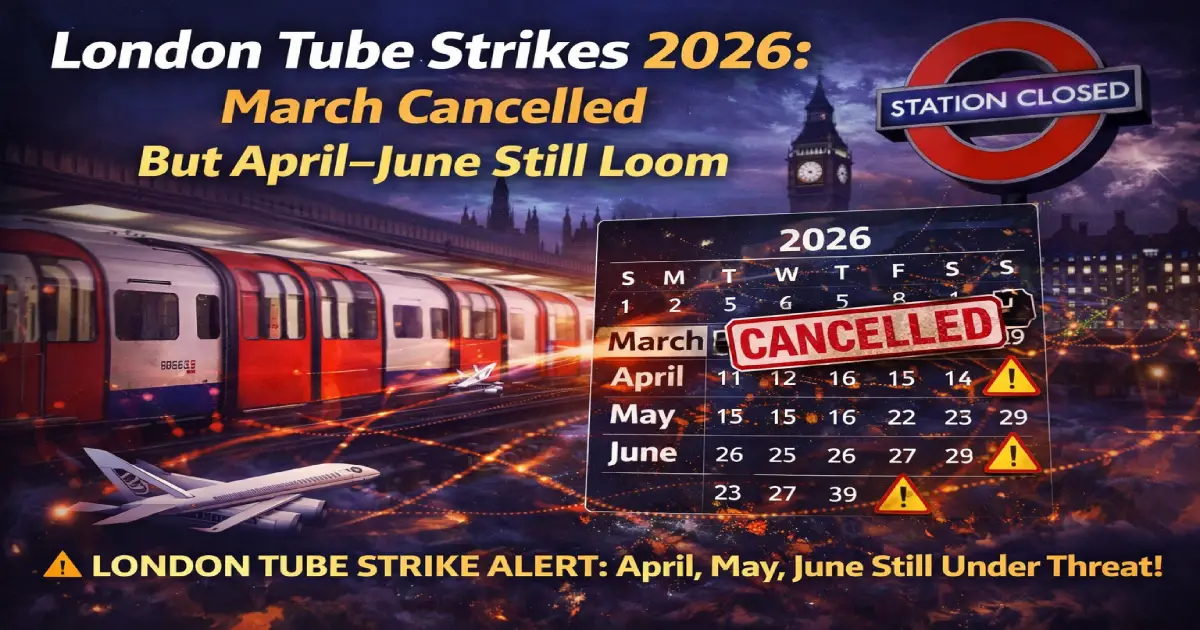
Breaking: London Underground faces months of potential travel chaos as RMT union suspends March 24-27 Tube strikes after “progress” in negotiations—but keeps April 21-24, May 19-22, and newly-added June 16-18 strike dates ACTIVE affecting millions of commuters, tourists, business travelers while separate London Overground Windrush line strike happens TODAY (March 26, 2026) creating dual-track disruption threat with Unite union balloting 150 bus controllers for potential combined Tube-plus-bus shutdown (results April 13) that could create “total transport vacuum” costing London economy £230 million weekly. Here’s what travelers must know now.
Published: March 25, 2026 March Strikes: CANCELLED (Mar 24-27 suspended after talks progress) April Strikes: STILL ACTIVE (Apr 21-24) May Strikes: STILL ACTIVE (May 19-22) June Strikes: NEW (Jun 16-18 just added) Windrush Line: STRIKING TODAY (Mar 26) + Apr 23 Bus Threat: Unite ballot closes Apr 13 (potential Tube+bus combined strike)
RMT union—representing 10,000 Transport for London staff including 1,800 Tube drivers—suspended planned March 24-27, 2026 strikes March 18 after “constructive progress” in negotiations with London Underground management, creating last-minute relief for 5 million daily Tube passengers who expected severe disruption Tuesday-Friday next week.
However, RMT general secretary Eddie Dempsey emphasized: “Through our show of industrial strength and unity, we have forced management into a position where they are now willing to seriously engage with the issues our members want addressing. Further talks will take place and the dispute remains live.”
Translation: March strikes cancelled BUT eight additional strike dates remain firm—and newly-added June dates demonstrate RMT preparing for prolonged conflict if talks fail.
Current strike schedule (24-hour walkouts, 12pm start):
❌ March 24-25: CANCELLED ❌ March 26-27: CANCELLED ✅ April 21-22: ACTIVE ✅ April 23-24: ACTIVE ✅ May 19-20: ACTIVE ✅ May 21-22: ACTIVE ✅ June 16-17: NEW (just added) ✅ June 18-19: NEW (just added)
Total: 8 strike dates (across 16 calendar days including overnight impacts) spanning April-June 2026
Compounding crisis: London Overground Windrush line strikes happening separately (TODAY March 26 + April 23) affecting Highbury & Islington-Clapham Junction-West Croydon-Crystal Palace routes in South London
Potential catastrophe: Unite union balloting 150 bus station/network traffic controllers (results April 13)—if they strike SIMULTANEOUSLY with RMT Tube walkout April 21, London faces first combined Tube-plus-bus shutdown in years creating “total transport vacuum”
Key Numbers:
🚇 5 million daily Tube passengers at risk 📅 8 strike dates confirmed (April-June) 🚌 6.5 million daily bus passengers threatened if Unite strikes 💷 £230 million weekly economic cost (Centre for Economics estimate) 🏨 67% hospitality booking drops (West End, previous strikes) ✈️ Heathrow disruption (Piccadilly line primary airport connection) 🗳️ April 13 Unite ballot results (bus controller strike decision)
Transport for London (Mayor Sadiq Khan’s administration) proposes “compressed four-day working week” for Tube drivers:
✅ Work 4 days instead of 5 (improved work-life balance) ✅ NO reduction in hours (still work full 37-40 hour week) ✅ Longer shifts per day (9-10 hours vs. current 7-8 hours) ✅ “Voluntary” participation (drivers can opt-in) ✅ Cost-neutral (no additional staffing expenses) ✅ Improve service reliability (better crew availability weekends/bank holidays)
TfL position: This modernizes working patterns, improves driver quality of life, enhances service without costing taxpayers more money.
Pilot program: Bakerloo line testing four-day week since January 2026
Union wants TRUE four-day week with reduced hours:
❌ Work 32 hours over 4 days (NOT 40 hours compressed) ❌ Maintain current pay (no reduction despite fewer hours) ❌ Shorter shifts (8 hours max, NOT 9-10 hours) ❌ Mandatory participation (all drivers benefit equally) ❌ Increased staffing (hire more drivers to cover gaps)
RMT concerns:
🚨 Driver fatigue: 10-hour shifts underground in loud, stressful environment create safety risks 🚨 Transfer difficulties: Compressed week makes driver transfers between lines/depots harder 🚨 Allocation problems: Four-day scheduling creates crew rostering nightmares 🚨 “False promise”: Calling it “four-day week” misleading when total hours unchanged
RMT general secretary Eddie Dempsey: “TfL trying to force longer shifts without reducing hours—that’s not a four-day week, that’s workforce exploitation disguised as progress.”
ASLEF—rival union also representing Tube drivers—SUPPORTS TfL’s plan:
“Four-day week represents one of most significant improvements to working conditions in decades. Yes, shifts are longer, but having 3-day weekends every week transforms quality of life. Our members overwhelmingly favor this change.”
Result: Union split creates complex negotiating environment where ~60% of drivers (ASLEF-represented) welcome changes while ~40% (RMT-represented) oppose them—meaning strikes will disrupt service but NOT create complete shutdown.
Centre for Economics and Business Research (CEBR): Single week of major Tube strikes costs London economy £230 million through:
💰 Lost productivity (workers can’t reach offices, arrive late, work remotely less efficiently) 💰 Reduced retail spending (tourists avoid central London, locals shop online instead) 💰 Hospitality collapse (restaurants, theaters, hotels see 50-70% booking drops) 💰 Alternative transport costs (taxis, Ubers, bike hires surge in price)
With 8 strike dates planned April-June = potential £1.8 billion economic damage if all proceed
TfL argues: Four-day week enables better weekend/bank holiday coverage improving service reliability year-round, offsetting short-term strike disruption with long-term operational gains.
RMT counters: Exhausted drivers working unsafe 10-hour shifts create accident risks costing far more than hiring additional staff properly.
Timing: Tuesday 12pm – Wednesday 11:59am, then Thursday 12pm – Friday 11:59am
Impact: Four consecutive days of severe disruption (midday Tuesday through late Friday morning)—devastating for:
✈️ Easter travel: April school holidays begin many UK regions, families heading to airports (Heathrow, Gatwick, Stansted, City, Luton) for spring vacations 🏨 Tourism peak: London attracts 30 million annual tourists with April representing shoulder-season surge before summer crowds 💼 Business quarter-end: Final week of Q1 fiscal reporting, critical meetings, deal closures
ASLEF effect: Because ASLEF union not striking, some Tube lines may run reduced service (30-50% normal frequency) rather than complete shutdown—but service will be unreliable, overcrowded, subject to last-minute changes
Alternative transport:
🚌 Buses: Normal service BUT massively overcrowded (expect 2-3x normal wait times, standing room only) 🚂 National Rail: London Overground, Elizabeth Line, Thameslink, Southeastern, Southern, South Western Railway providing alternative routes BUT 3-4x normal crowding 🚴 E-bikes/bikes: Santander Cycles, Lime, Tier seeing 400%+ usage spikes during previous strikes 🚕 Taxis/Ubers: Surge pricing (2-3x normal fares), long wait times, traffic gridlock 🚶 Walking: Central London distances manageable (King’s Cross-Oxford Circus 2 miles = 30-40 min walk)
Timing: Tuesday 12pm – Wednesday 11:59am, then Thursday 12pm – Friday 11:59am
Impact: Identical four-day disruption window during:
🌸 Late spring tourism: Peak London visit season (Chelsea Flower Show May 20-24, typically 150,000 visitors) 🎓 University exam period: London universities (LSE, King’s, Imperial, UCL) conducting final exams, students/staff require reliable transport 💼 Pre-summer business: Companies finalizing Q2 plans, arranging summer holiday coverage
Compounding factor: May 5 UK bank holiday Monday (3-day weekend) means many businesses operating short-staffed week of May 19-23—adding Tube strikes creates operational nightmare
Timing: Monday 12pm – Tuesday 11:59am, Wednesday 12pm – Thursday 11:59am
Impact: RMT escalating conflict by adding June dates (announced March 18)—signaling union preparing for prolonged battle if April-May talks fail
Strategic timing:
📅 June = summer tourist peak (London’s busiest travel month) 🎾 Wimbledon tennis championships typically late June/early July—major international sporting event ✈️ Summer holiday beginning (schools break late July, but families booking June getaways)
Message to TfL: RMT demonstrating willingness to disrupt peak summer tourism season unless four-day week demands met—raising economic stakes dramatically
Routes: Highbury & Islington → Clapham Junction / West Croydon / Crystal Palace Operator: London Overground (TfL-run) Service: Orbital route connecting North London, South London, avoiding central Tube Daily passengers: 100,000-150,000 (critical for South London commuters)
Different dispute: Windrush line strike involves Cleshar CS Ltd subcontracted signalling/telecoms staff (NOT Tube drivers)
Different union local: RMT members at Cleshar have separate workplace grievances (pay, conditions, job security) from main Tube driver four-day week dispute
Strike dates:
✅ TODAY March 26, 2026 (Wednesday) ✅ April 23, 2026 (Wednesday)
Historical precedent: February 2026 Windrush strike saw TfL operate “normal service”—meaning backup staff covered, passengers experienced minimal disruption. HOWEVER, no guarantee March 26/April 23 strikes produce same outcome.
South London isolation: Windrush line connects areas poorly served by Tube (Peckham, Brixton, Clapham, Crystal Palace)—when it strikes, residents face:
❌ No direct North-South London connection (must route via central Tube + bus) ❌ 30-45 minute journey time increases ❌ Overcrowding on replacement buses
Airport connections: Windrush line does NOT directly serve airports—but passengers using it to reach main Tube lines for Heathrow/Gatwick connections face delays
Who: 150 bus station controllers + network traffic controllers Roles: Safety-critical positions managing:
Dispute: Separate from Tube issues—Unite members demanding pay increases, better working conditions
Timeline:
March 10-April 13: Ballot period April 13: Results announced If YES vote: Strikes legally possible 14 days after (earliest April 27)
If Unite bus controllers strike SIMULTANEOUSLY with RMT Tube drivers April 21-24:
🚇 London Underground: Severe disruption (30-50% service if ASLEF runs, 0-10% if ASLEF also honors picket lines) 🚌 London Buses: Complete shutdown or severe safety reductions (without traffic controllers, Transport for London cannot safely operate 9,000-bus fleet)
Result: “Total transport vacuum”—5 million Tube passengers + 6.5 million bus passengers (11.5 million combined = 75% of London’s daily public transport) forced into:
🚕 Overwhelmed taxis/Ubers (demand 10-20x supply) 🚴 Bicycle mayhem (London’s bike infrastructure NOT designed for millions of simultaneous cyclists) 🚶 Walking chaos (pavements/zebra crossings gridlocked) 🏠 Work-from-home surge (London’s economy depends on office presence—mass WFH disrupts retail, hospitality, commercial property)
UKHospitality warning: Previous combined transport strikes saw West End bookings drop 67%—restaurants, theaters, hotels devastated when tourists cannot navigate city
Economic catastrophe: £230 million weekly for Tube strikes alone + additional £100-150 million for bus strikes = £330-380 million weekly if combined
Decision matrix:
LEISURE TRAVELERS (tourists, families):
⚠️ Avoid London entirely April 21-24, May 19-22, June 16-18 if possible—reschedule trip to non-strike weeks OR choose alternative UK destinations (Edinburgh, Manchester, Bath, Oxford, Cambridge, York, Lake District all accessible without London Tube)
⚠️ If trip non-reschedulable: Book hotels within walking distance of attractions (central London locations avoid Tube dependency), research bus routes extensively, download Citymapper app (real-time alternative route suggestions), budget 2-3x normal transport costs (taxis/Ubers surge pricing), allow 2-3x normal journey times
BUSINESS TRAVELERS:
⚠️ Reschedule London meetings if possible (propose video calls, alternate cities, different dates)
⚠️ If meetings mandatory: Stay near meeting location (walking distance), arrive day before (buffer against travel chaos), book late departure (allow flexibility if meetings run late due to others’ transport delays), use black cabs (professional drivers know alternative routes better than Uber drivers)
AIRPORT CONNECTIONS:
🚨 Heathrow: Piccadilly line (primary Tube connection) will be severely disrupted—use:
🚨 Gatwick: Gatwick Express unaffected (National Rail, not Tube)—use normally
🚨 Stansted: Stansted Express unaffected—use normally
🚨 Luton: Luton Airport Express unaffected—use normally
🚨 City: DLR may run (separate from Tube strike)—monitor updates
Allow 3-4x normal airport travel time on strike days (traffic gridlock as everyone drives/taxis instead of Tube)
Essential downloads:
📱 Citymapper: Real-time transport updates, alternative route suggestions, live crowding data 📱 TfL Go: Official Transport for London app with strike-specific service updates 📱 Uber/Bolt/Freenow: Pre-book where possible, expect 2-3x surge pricing 📱 Santander Cycles: London bike-share (£2 unlock + time charges) 📱 National Rail Enquiries: Check Overground, Thameslink, other alternatives
Websites to monitor:
🌐 tfl.gov.uk: Official strike updates (updated hourly on strike days) 🌐 RMT.org.uk: Union announcements (sometimes earlier than TfL updates) 🌐 bbc.com/travel: Live travel news updates
❌ Don’t assume “Tube strike = no Tube at all”: Some lines may run reduced service (ASLEF union members working), check TfL updates morning of strike ❌ Don’t drive into central London: Congestion Charge (£15/day) + strike traffic gridlock = nightmare, leave car at suburbs, take alternative transport ❌ Don’t book last-minute Heathrow transport: Pre-book taxis/coaches days in advance, strike days sell out fast ❌ Don’t plan tight connections: If changing between rail/Tube/bus, allow minimum 90-120 minutes buffer (vs. normal 30-45 minutes)
September 2025: RMT Tube drivers struck over pay dispute—severe disruption, resolved after 3 days of walkouts
March 2023: 4-day Tube strike over pension changes—first major action post-COVID
November 2022: Multiple strikes (Nov 10-11, Nov 25) over job cuts, working conditions
August 2022: Strike August 19-20 during tourist peak season—hospitality sector devastated
June 2022: Strikes June 6-7, June 21-22 coordinated with National Rail strikes—widest disruption in decades
Pattern: London averages 5-8 major Tube strike events annually (pre-COVID averaged 2-3 annually)—industrial relations deteriorating as cost-of-living crisis, post-pandemic financial pressures, workforce shortages create conflict
TfL funding crisis:
COVID-19 pandemic decimated fare revenue (ridership down 30% vs. pre-2020 levels, office workers permanently remote) UK government bailouts keeping TfL afloat but attaching conditions (cost cuts, service reductions, fare increases) Mayor Sadiq Khan caught between union demands for pay increases and government demands for budget cuts
Union militancy:
Cost-of-living crisis (UK inflation peaked 11% in 2022, now ~4% but wages haven’t caught up) makes workers demand pay restoration Post-pandemic workforce shortages give unions leverage (TfL cannot easily replace striking staff) Successful strikes (unions often win concessions after walkouts) encourage future action
Political dimension:
Mayor of London (Labour, currently Sadiq Khan) traditionally pro-union, reluctant to impose harsh terms Conservative UK government (assuming Tories still in power 2026—or Labour if they won general election) may pressure Khan to resist union demands to avoid “rewarding strikes” National Rail strikes (separate but related) create coordination opportunities for maximum disruption
Londoners/visitors experiencing “strike fatigue”:
😤 Constant uncertainty (strikes announced, then suspended, then re-announced) 😤 Economic impact (businesses losing revenue, workers losing productivity) 😤 Quality of life degradation (unreliable transport makes London less livable) 😤 Tourism reputation damage (international visitors choosing Paris, Amsterdam, Barcelona instead)
March 18, 2026 last-minute suspension of March 24-27 Tube strikes provides temporary relief—but “constructive progress” in talks does NOT equal resolution, and eight confirmed strike dates April-June (with newly-added June 16-18 demonstrating RMT’s determination) plus potential Unite bus controller strikes (ballot closes April 13) plus separate Windrush line strikes TODAY March 26 create months of transport chaos threatening London’s economy, reputation, and liveability.
For travelers: If visiting London April-June 2026, assume transport disruption WILL occur, plan accordingly, build extensive buffers, research alternatives, accept higher costs, consider rescheduling. London’s £230 million weekly strike cost reflects real economic damage—that’s YOUR hotel fully booked then empty, YOUR restaurant reservation cancelled, YOUR Heathrow connection missed.
For Londoners: Prepare for prolonged industrial action. TfL-RMT negotiations may resolve four-day week dispute before April 21—but history suggests strikes often proceed before settlement. Alternative transport (walking, cycling, river boats, black cabs, Overground, Elizabeth Line) will be essential April-June.
For London’s economy: Hospitality, retail, tourism, commercial property sectors face devastating spring-summer if strikes proceed. £230M weekly x 8 potential strike dates = £1.8 billion economic damage IF all dates activate. UKHospitality’s 67% West End booking drop warnings are NOT hyperbole—when tourists cannot navigate city, they DON’T come.
For the dispute: RMT’s four-day week demands (32 hours across 4 days at full pay) vs. TfL’s compressed week (40 hours across 4 days) represent fundamental philosophical divide. ASLEF’s acceptance of TfL’s plan creates union split allowing partial service continuation—but guarantees conflict persists as RMT members see ASLEF “selling out” while ASLEF views RMT as “obstruction to progress.”
The strikes were suspended. The crisis continues. London’s transport—and economy—hang in balance.
Are the London Tube strikes still happening in March 2026?
NO. RMT union suspended planned March 24-27 strikes on March 18 after “constructive progress” in negotiations with Transport for London. However, eight strike dates April-June remain ACTIVE: April 21-22, April 23-24, May 19-20, May 21-22, June 16-17, June 18-19. Additionally, separate London Overground Windrush line strikes happen March 26 (TODAY) and April 23. Unite union’s bus controller ballot closes April 13—if they vote to strike, combined Tube+bus shutdown possible.
What is the four-day week dispute about?
TfL proposes “compressed four-day week”—drivers work 4 days instead of 5 BUT maintain full 37-40 hour workweek through longer shifts (9-10 hours per day vs. current 7-8 hours). RMT demands TRUE four-day week—32 hours across 4 days at full pay (8-hour shifts maximum). TfL says RMT’s demand costs £50M+ annually hiring additional staff (unaffordable given £500M budget deficit). RMT says TfL’s plan creates driver fatigue and safety risks. ASLEF union (rival union representing ~60% of drivers) SUPPORTS TfL’s plan calling it “significant improvement to working conditions”—meaning strikes will disrupt but NOT completely shut down Tube.
Will London buses run during Tube strikes?
YES… probably. London buses operated normally during previous Tube strikes (September 2025, March 2023, 2022 strikes). HOWEVER: Unite union balloting 150 bus station/network traffic controllers (results April 13). If they vote to strike AND coordinate with RMT Tube strike April 21-24, London faces COMBINED Tube+bus shutdown for first time in years—creating “total transport vacuum” affecting 11.5 million daily public transport passengers. Monitor Unite ballot results April 13 closely.
How do I get to Heathrow during Tube strikes?
Piccadilly line (primary Tube connection to Heathrow) will be severely disrupted. ALTERNATIVES: (1) Elizabeth Line (Heathrow Express alternative, Paddington-Heathrow 30 min, £12.80), (2) Heathrow Express train (Paddington-Heathrow 15 min, £25-37 depending on booking timing), (3) National Express coach (Victoria Coach Station-Heathrow, £6-10, 40-70 min depending on traffic), (4) Black cab (Central London-Heathrow £50-80, 45-90 min depending on traffic). Book transport 3-4x earlier than normal—strike days create traffic gridlock as everyone drives instead of Tube. Pre-book coaches/taxis days in advance.
Should I cancel my London trip during strike dates?
DEPENDS on flexibility and tolerance for chaos. LEISURE TRAVELERS: Strongly consider rescheduling to non-strike weeks if possible—April 21-24, May 19-22, June 16-18 will see severe disruption, 2-3x transport costs, 2-3x journey times, frustration navigating alternative routes. If trip non-reschedulable, book hotels within walking distance of attractions, download Citymapper app, budget extra time/money. BUSINESS TRAVELERS: Reschedule London meetings if possible (propose video calls, different cities, alternate dates). If mandatory, stay near meeting location, arrive day before, allow extensive buffers. AIRPORT CONNECTIONS: Allow 3-4x normal travel time, pre-book transport, consider arriving day before early morning flights.
Will the strikes definitely happen or might they be cancelled?
UNCERTAIN. March 24-27 strikes were suspended March 18 due to “progress” in talks—proving last-minute cancellations possible. However, RMT emphasized “dispute remains live” and ADDED June 16-18 dates (announced March 18)—demonstrating union preparing for prolonged conflict if talks fail. Likelihood April 21-24 strikes proceed: 70% (substantial progress required by April 15 to avoid walkout). Likelihood May 19-22 proceed: 50% (depends on April outcome). Likelihood June 16-18 proceed: 40% (distant enough that settlement may occur first). Monitor tfl.gov.uk and RMT.org.uk for updates—cancellations typically announced 24-72 hours before scheduled strike start.
What other UK transport is affected by strikes?
Currently, ONLY London Underground and London Overground Windrush line strikes confirmed. National Rail (Avanti, LNER, GWR, Southern, etc.) NOT striking concurrently—meaning Londoners can use mainline trains, Thameslink, Southeastern, South Western Railway, Overground (except Windrush), Elizabeth Line as alternatives. However, these services will be 3-4x more crowded than normal. Check nationalrail.co.uk for updates—historically, Rail unions sometimes coordinate strikes with Tube for maximum pressure, though currently no such coordination announced.
Is the Elizabeth Line affected by Tube strikes?
NO. Elizabeth Line (opened 2022, connecting Reading-Heathrow-Central London-Essex) operates under different management/staff contracts than London Underground. Elizabeth Line will run NORMALLY during RMT Tube strikes—making it critical alternative for East-West London travel and Heathrow connections. However, expect 3-4x normal crowding as Tube passengers divert to Elizabeth Line. Central London Elizabeth Line stations (Paddington, Bond Street, Tottenham Court Road, Farringdon, Liverpool Street, Whitechapel) will be extremely busy—allow extra time for platform queuing.
For More Resources:
Related Articles:
 DHS Shutdown Day 40: Trump Torpedoes Overnight Deal With SAVE Act “Make This One For Jesus” — ICE at 13 Airports, 12% TSA Callout Record, Delta Waiver Expired US Flight Chaos March 25, 2026: LaGuardia 310 Cancels on Single Runway, 450+ TSA Quit, Houston 4-Hour Lines, ICE Passes Out Water Bottles, Private Jets +39%, FAA O’Hare Cap 4 Days DHS Shutdown Day 37: 5th Vote Failed 47-37, Schumer TSA-Only Vote Saturday, Airports Could Close, Third-Longest Shutdown in History
 Spring Break 2026 Final Report Card: Worst Aviation Week in US History — 51,000+ Disruptions, 10 Records Broken, TSA Crisis
Posted By : Vinay
This article is provided for general informational purposes only and is based on information available at the time of publication. Travel advisories, airline schedules, airport operations, visa requirements, government regulations, and other travel-related information are subject to change without prior notice. While Travel Tourister makes reasonable efforts to verify information using official announcements, government publications, airline and airport communications, and other reliable sources, we cannot guarantee that all information remains complete, accurate, or up to date at all times. Readers should independently verify any information that may affect their travel plans with the relevant airline, airport authority, government agency, embassy, or other official source before making travel, financial, or other decisions. Travel Tourister shall not be liable for any direct or indirect loss, inconvenience, or damages arising from the use of or reliance on the information contained in this article. Nothing in this publication constitutes legal, immigration, financial, or professional travel advice. If you believe any information in this article is inaccurate or outdated, please contact our editorial team. We review all credible correction requests promptly and update our content whenever appropriate.
Lastest News
2nd Floor, 39, Above Kirti Club, DLF Industrial Area, Kirti Nagar, New Delhi, Delhi 110015



Travel Tourister is a leading Travel portal where we introduce travellers to trusted travel agents to make their journey hasselfree, memorable And happy. Travel Tourister is a platform where travellers get Tour packages ,Hotel packages deals through trusted travel companies And hoteliers who are working with us across the world. We always try to find new and more travel agents and hoteliers from every nook and corners across the world so that you could compare the deals with different travel agents and hoteliers and book your tour or hotel with the one you have chosen according to your taste and budget.
Copyright © Travel Tourister, India. All Rights Reserved

 Call
Call Enquiry