Las Vegas Trip Cost 2026 — From $75/Day Budget to $1,000+/Day Luxury
By Travel Tourister | Updated March 2026
Las Vegas is simultaneously one of America’s most expensive and most affordable travel destinations—the same city where a suite at the Wynn costs $800/night also offers $29 hotel rooms at the Plaza, where a Joël Robuchon tasting menu runs $425 per person and a shrimp cocktail at the Golden Gate costs $1.99, where nightclub bottle service starts at $500 and free concerts happen on the Fremont Street Experience every night. Understanding how Las Vegas pricing works—and how to control it—is the difference between a $200/day trip and a $1,500/day one delivering the same core experience.
I’ve visited Las Vegas across dozens of trips at every budget level—sleeping at the Wynn and at budget properties off-Strip, eating at Michelin-starred restaurants and $8 bánh mì on Spring Mountain Road, seeing Cirque du Soleil and catching free Fremont Street performances, gambling $20 at penny slots and watching high-rollers at the baccarat tables. Each trip revealed the same truth: Las Vegas costs what you decide it costs. The city’s architecture is designed to extract money continuously, but informed travelers can choose exactly where to spend and where to save.
This comprehensive 2026 budget guide breaks down every Las Vegas expense category using current verified pricing from Visit Las Vegas, direct hotel rates, and on-the-ground research. We’ll cover hotels, flights, food, shows, gambling, transportation, and hidden costs—building complete daily budgets for budget, mid-range, and luxury travelers, and identifying every meaningful money-saving opportunity Las Vegas offers.
Whether planning a $500 weekend getaway, a $2,000 mid-range long weekend, or a no-limits luxury experience, this guide gives you the numbers, the strategies, and the honest assessments needed to budget your Las Vegas trip accurately and spend confidently.
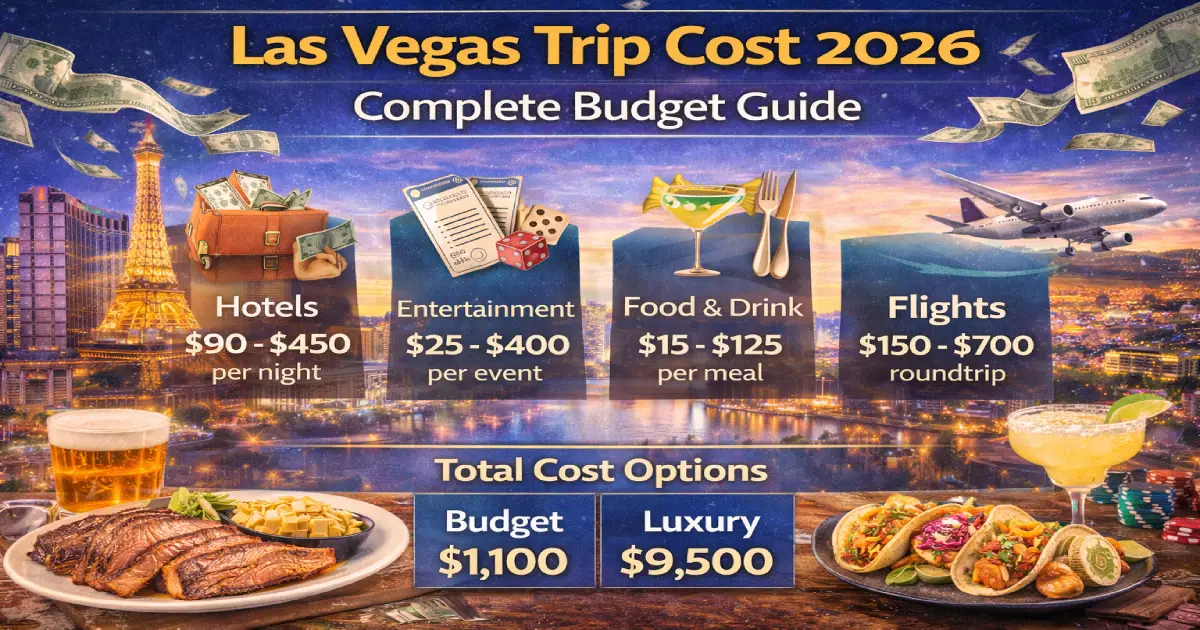
Las Vegas Trip Cost Summary — 2026
Expense Category
Budget
Mid-Range
Luxury
Hotel (per night)
$29–$79
$120–$250
$350–$800+
Food (per day)
$25–$45
$80–$150
$200–$500+
Shows / Entertainment
$0–$50
$80–$180
$200–$600+
Gambling (daily budget)
$20–$50
$100–$300
$500–$5,000+
Transportation
$10–$20
$25–$50
$60–$200+
Resort Fees (per night)
$0–$15
$35–$45
$45–$65
Total Daily Cost (per person)
$75–$130
$250–$450
$700–$2,000+
Las Vegas Hotel Costs 2026
Budget Hotels: $29–$90/Night
Who It’s For: Solo travelers, couples prioritizing experiences over accommodation, anyone planning to spend minimal time in their room. Las Vegas’s budget hotels are genuinely functional—clean, casino-floor-adjacent, and often better value than equivalent-priced hotels in other cities.
Best Budget Options:
The Plaza (Downtown): $35–$75/night, Fremont Street location, renovated rooms, rooftop pool ($35 resort fee)
Circus Circus (Strip): $29–$65/night, classic Strip location, genuinely budget-friendly, great for families with young children
Excalibur (Strip): $40–$85/night, central Strip location, castle theme, multiple restaurants and entertainment on property
Luxor (Strip): $45–$90/night, pyramid-shaped icon, convenient location, good value for Strip access
Ellis Island Hotel (off-Strip): $35–$70/night, no resort fee, excellent karaoke bar, locals’ favorite
Budget Hotel Reality:
Midweek (Sunday–Thursday) rates 40–60% lower than weekends
Resort fees add $25–$45/night even at budget properties—always factor in
Room quality varies widely—read recent reviews before booking
Booking direct with hotel sometimes cheaper than OTAs; check both
Average nightly cost (with resort fee): $65–$120
Mid-Range Hotels: $120–$280/Night
Best Mid-Range Options:
MGM Grand: $130–$220/night, massive property, central Strip location, excellent pool, multiple dining and entertainment options ($39 resort fee)
Paris Las Vegas: $120–$200/night, Eiffel Tower replica, French theming, excellent Strip location, Gordon Ramsay restaurant on property ($45 resort fee)
New York-New York: $110–$190/night, roller coaster, Tom Poppa’s bar, great value mid-Strip ($39 resort fee)
Planet Hollywood: $130–$230/night, Miracle Mile Shops attached, central location, frequent entertainment ($39 resort fee)
Harrah’s Las Vegas: $110–$200/night, central Strip, Total Rewards casino loyalty benefits, good value ($37 resort fee)
The STRAT: $80–$150/night, north Strip, observation tower, best views in Las Vegas for the price ($30 resort fee)
Average nightly cost (with resort fee): $160–$320
Luxury Hotels: $280–$800+/Night
Top Luxury Properties:
Bellagio: $280–$550/night, fountain views command premium, most iconic Strip hotel, exceptional service and amenities ($45 resort fee)
The Venetian / Palazzo: $250–$500/night, all-suite property (largest standard rooms on Strip at 650 sq ft), extraordinary scale, no resort fee on select bookings
Wynn Las Vegas / Encore: $300–$600/night, Forbes Five-Star, best pool complex on Strip, exceptional dining and casino floor ($45 resort fee)
Cosmopolitan: $270–$500/night, Strip-view terraces in standard rooms, best hotel restaurant collection, young/stylish crowd ($45 resort fee)
Four Seasons (non-gaming): $400–$800+/night, no resort fee, no casino, quietest luxury option on Strip, extraordinary service
Suite Pricing: Entry-level suites $400–$900/night; penthouse and sky suites $1,500–$10,000+/night
Average nightly cost (with resort fee): $320–$650
Resort Fees: The Hidden Hotel Cost
What You Need to Know: Las Vegas resort fees are mandatory, non-negotiable daily charges added to every hotel bill—even budget properties charge them. They cover Wi-Fi, pool access, and fitness center use that were previously free.
Current Resort Fee Ranges (2026):
No resort fee: Four Seasons, Waldorf Astoria, some off-Strip properties
4-Night Stay Resort Fee Impact: $100–$260 added to your bill regardless of room rate. Always calculate total cost including resort fee when comparing hotel prices.
Las Vegas Food Costs 2026
Budget Eating: $25–$45/Day
Best Budget Food Strategies:
In-N-Out Burger (LINQ Promenade): Double-Double Animal Style $7.50—best fast food value on the Strip, open late
Golden Gate shrimp cocktail (Downtown): $1.99–$3.99—Las Vegas tradition since 1955, genuinely good
Spring Mountain Road (Chinatown): Bánh mì $7–$9, ramen $16–$20, Korean BBQ AYCE $35–$45—best food value in Las Vegas
Mob Museum (partial): Ground floor accessible free; full museum $30
Budget Shows: $30–$80
Penn & Teller (Rio): $55–$85/person—best magic show value in Las Vegas, legendary performers
Mac King Comedy Magic (Harrah’s): $35–$45/person—afternoon show, family-friendly, consistently excellent
Tournament of Kings (Excalibur): $65–$80/person including dinner—medieval jousting dinner show, good family value
Comedy shows at The Laugh Factory (Tropicana): $30–$50/person—rotating stand-up comedians
Free concert stages (Fremont Street): $0—cover bands and tribute acts nightly on multiple outdoor stages
Mid-Range Shows: $80–$180
Cirque du Soleil — O (Bellagio): $107–$195/person—aquatic Cirque, most celebrated show in Las Vegas history, worth every dollar
Cirque du Soleil — Mystère (Treasure Island): $82–$125/person—classic acrobatic Cirque, original Las Vegas production
Blue Man Group (Luxor): $79–$119/person—percussion, comedy, audience interaction
David Copperfield (MGM Grand): $85–$150/person—world’s most famous magician still performing nightly
MJ Live (Sahara): $79–$99/person—Michael Jackson tribute show, surprisingly high production value
Premium Shows & Residencies: $150–$600+
Major music residencies (T-Mobile Arena / Dolby Live): $150–$600+/person depending on artist and seat; check MSG Sphere for immersive concert experiences ($100–$400)
UFC / Boxing events (T-Mobile Arena): $200–$2,000+/person depending on card and seat—major fight weekends sell out months ahead
Sphere experiences: $79–$199/person for immersive visual productions unique to the venue
Celine Dion / Adele-tier residencies: $150–$800/person for premium seats at announced shows
Nightclub Costs
Las Vegas Nightclub Budget Reality:
Cover charge (men): $30–$50 general admission at Omnia, Hakkasan, XS, Marquee
Cover charge (women): $20–$30, or free before midnight on many nights
Table minimum (bottle service): $500–$2,000+ per table depending on night and location; premium New Year’s Eve and holiday tables $5,000–$20,000+
Drinks at bar (no table): $16–$22 per cocktail
Pool party dayclubs: $30–$60 general admission; cabana rentals $300–$1,500+
Budget nightlife strategy: Arrive before midnight (reduced or free cover), drink at casino floor bars before entering (free if gambling), limit to 2–3 drinks per night ($35–$65 total)
Las Vegas Gambling Costs 2026
Setting a Gambling Budget
The Most Important Las Vegas Financial Advice: Treat your gambling budget as entertainment cost—money spent for the experience of playing, not an investment. Set your total gambling budget before arriving, withdraw it in cash, and stop when it’s gone. This single discipline prevents the most common Las Vegas overspending.
Minimum Bets by Game (2026 Strip averages):
Slot machines: $0.01–$1.00 per spin (penny slots to $1 machines); average $20–$50/hour at penny slots
Blackjack: $10–$25 minimum on Strip, $5 minimum at some Downtown properties; $50–$100 minimum at premium tables
Roulette: $5–$15 minimum per spin on Strip
Craps: $5–$15 minimum per roll; one of best house edges if playing correctly
Baccarat: $15–$25 minimum on main floor; $100–$500 minimum in private rooms
Video poker: $0.25–$5 per hand; some machines offer near 100% return with perfect strategy
House Edge Reality:
Slots: 5–15% house edge (worst odds)
Keno: 20–35% house edge (avoid entirely)
Roulette (American, double zero): 5.26% house edge
Blackjack (basic strategy): 0.5–1% house edge (best odds)
Craps (pass line): 1.41% house edge
Baccarat (banker bet): 1.06% house edge
Gambling Budget by Travel Style
Casual Gambler ($50–$100 total trip): Penny slots for entertainment, $10 at roulette, $20 blackjack session—enough to feel the casino experience without significant loss risk
Regular Gambler ($200–$500 total trip): Daily $50–$100 sessions across blackjack and craps, using basic strategy, realistic entertainment budget for 3–4 day trip
Serious Gambler ($500–$2,000 total trip): $25 minimum blackjack tables, craps with odds bets, possible comp benefits from casino players club enrollment
High Roller ($5,000+): Private gaming rooms, dedicated hosts, complimentary suites, meals, and show tickets provided by casino—the economics flip entirely at this level
Casino Comps: How to Reduce Costs
Players Club Cards Are Free—Always Get One: Enrolling in MGM Rewards, Caesars Rewards, or Wynn Rewards costs nothing and earns points on every dollar wagered—redeemable for free play, food credits, and hotel discounts.
MGM Rewards: Points earned across all MGM properties (Bellagio, Aria, Vdara, etc.)
Caesars Rewards: Points across Caesars, Paris, Bally’s, Harrah’s, Horseshoe
Myvegas Slots (mobile game): Earn real Las Vegas comps playing free mobile slots—legitimately effective for small freebies
Comp reality: Average gambler earns $5–$15 in comps per $100 wagered—meaningful over a full trip
Las Vegas Flight Costs 2026
Average Flight Prices to Las Vegas (Harry Reid International)
Departure City
Budget (Spirit/Frontier)
Mid-Range (Southwest/Delta)
Premium (United/American)
Los Angeles
$39–$79 RT
$89–$149 RT
$120–$250 RT
New York / Newark
$149–$229 RT
$199–$349 RT
$280–$550 RT
Chicago
$99–$179 RT
$159–$279 RT
$220–$420 RT
Dallas
$89–$149 RT
$139–$249 RT
$180–$380 RT
Seattle
$79–$149 RT
$129–$229 RT
$170–$350 RT
International (UK/AU)
$550–$750 RT
$750–$1,200 RT
$1,200–$3,500 RT
Best time to book flights: 6–8 weeks ahead for domestic, 3–4 months for international. Avoid booking for major fight weekends, New Year’s Eve, and Memorial Day—prices spike 3–5x above normal.
Las Vegas Transportation Costs 2026
Airport to Strip
Rideshare (Uber/Lyft): $18–$30 to Strip hotels, $25–$40 to Downtown; surge pricing during arrivals rush adds 30–50%
Vegas Loop (Boring Company tunnel): $3/person from airport to Strip stations—best value airport transfer, operates 24/7
Taxi: $25–$45 flat rate to Strip; metered to Downtown ($30–$50)
Airport shuttle: $10–$15/person shared shuttle—cheapest but slowest (multiple stops)
Rental car: Only worth renting if planning off-Strip day trips (Grand Canyon, Hoover Dam, Red Rock); $50–$120/day plus $25–$45/day airport fees
Getting Around Las Vegas
Walking the Strip: FREE—the entire central Strip from Mandalay Bay to the Wynn is 4.2 miles, walkable in 1.5 hours; most casinos are adjacent or connected via skybridge
Las Vegas Monorail: $5/ride, $15 unlimited day pass—runs along east side of Strip, MGM Grand to SLS (SAHARA)
Vegas Loop (tunnel system): $3/person between Convention Center, Strip casinos, and airport—expanding network of stations
Uber/Lyft between Strip casinos: $8–$15 per trip; surge pricing on Friday/Saturday nights adds $5–$15
Deuce Bus (RTC): $2/ride, $8 unlimited 24-hour pass—runs entire Strip and Downtown, slow but comprehensive
Transportation budget for 4-night trip: Budget traveler $15–$25 total (walking + occasional bus); mid-range $60–$100 (Uber + monorail); luxury $150–$300 (Uber throughout + airport transfer)
Las Vegas Day Trip & Activity Costs
Popular Day Trips from Las Vegas
Day Trip
Distance
Self-Drive Cost
Tour Cost
Grand Canyon South Rim
4.5 hours each way
$35 park entry + gas
$85–$200/person
Grand Canyon West (Skywalk)
2.5 hours each way
$50–$80 entry
$79–$160/person
Hoover Dam
45 minutes
$10–$30 entry
$40–$80/person
Red Rock Canyon
30 minutes
$15 entry
$45–$90/person
Zion National Park
2.5 hours each way
$35 park entry + gas
$120–$250/person
Grand Canyon Helicopter
Flies from Las Vegas
N/A
$350–$650/person
Las Vegas Attraction Costs
High Roller Observation Wheel (LINQ): $25–$37/person (happy hour cabins have bar service included $37)
MSG Sphere experience: $79–$199/person depending on production
Mob Museum: $30/adult, $20/child—genuinely excellent museum, worth the price
Neon Museum (Neon Boneyard): $22–$25/person—historic Las Vegas signs, great photo opportunity
Gondola rides at The Venetian: $29–$39/person—touristy but romantic, indoor Grand Canal setting
CSI: The Experience (MGM Grand): $32/person—interactive crime scene exhibit
Indoor skydiving (iFLY): $85–$119/person for beginner experience
Complete Las Vegas Trip Cost Examples
Budget Weekend Trip: 3 Nights — $450–$600 Per Person
Assumptions: Solo traveler or couple splitting costs, midweek travel, budget hotel, off-Strip eating strategy, free entertainment focus
Flights (from LA, Southwest): $89–$120 RT
Hotel (Excalibur, 3 nights with resort fee): $180–$240 total
Food (3 days at $35/day budget strategy): $105
Entertainment (Penn & Teller + free shows): $65–$85
Gambling budget: $100
Transportation (airport + Uber x3): $45–$60
Alcohol (casino floor drinking while gambling): $15 in tips
Total estimate: $600–$725 per person (solo traveler, midweek, budget choices throughout)
Mid-Range Weekend Trip: 4 Nights — $1,200–$1,800 Per Person
Assumptions: Couple, weekend travel, mid-range Strip hotel, mix of Strip and off-Strip dining, one major show
Flights (from Chicago, Delta): $200–$280 RT
Hotel (Paris Las Vegas, 4 nights with resort fee): $560–$780 total
Food (4 days at $100/day): $400
Entertainment (Cirque du Soleil O + 1 night out): $150–$200
Total estimate: $1,770–$2,360 per person (shared hotel costs with partner halve hotel expense)
Luxury Long Weekend: 4 Nights — $3,500–$6,000 Per Person
Assumptions: Couple, weekend travel, luxury Strip hotel, Michelin dining, major show or residency, meaningful gambling
Flights (from New York, business class upgrade): $600–$1,200 RT
Hotel (Wynn Las Vegas, 4 nights with resort fee): $1,400–$2,600 total
Food (4 days at $250/day — 1 Michelin dinner + quality meals): $1,000
Entertainment (residency concert + nightclub): $400–$800
Gambling budget: $1,000–$2,000
Transportation (Uber throughout + airport transfer): $150–$200
Spa and wellness (Wynn Spa): $200–$400
Total estimate: $4,750–$8,200 per person (before any casino losses beyond gambling budget)
Las Vegas Hidden Costs & Money-Saving Tips
Hidden Costs That Surprise Visitors
Resort fees: $25–$65/night added to every hotel bill—calculate total nightly cost always
Parking fees: Most Strip hotels now charge $15–$30/night for self-parking (was free until 2016)—free parking available at Palazzo/Venetian and a few others
ATM fees inside casinos: $5–$10 per withdrawal—use bank ATMs before arriving on Strip
Tipping culture: 20% at restaurants, $1–$2 per casino drink, $2–$5 per hotel service—budget $20–$40/day for tips
Minibar and in-room charges: Hotel minibars charge 3–5x retail price—avoid entirely and use CVS
Show dynamic pricing: Popular show tickets booked last-minute can cost 2–3x the base price; book 2–4 weeks ahead for best rates
Fight/event weekend surcharges: Hotel rates and Uber surge pricing on major event weekends can double or triple normal costs
Best Money-Saving Strategies
Travel midweek (Sunday–Thursday): Hotel rates 40–60% lower than Friday–Saturday peak; shows less crowded; restaurants easier to get into without reservations
Book hotel packages: Flight + hotel packages on Expedia, Priceline, and direct hotel sites often 20–35% cheaper than booking separately
Eat off-Strip at Spring Mountain Road: Spring Mountain Road Chinatown offers equivalent or better food quality at 40–60% of Strip pricing
Drink while gambling: Free cocktails on casino floors are a genuine Las Vegas perk—tip $1–$2/drink and stay at one table/machine
Walk the Strip instead of rideshares: The central Strip is walkable—save $40–$80 in Uber fees over a 3-night trip
Use the Vegas Loop tunnel: $3/person between airport and Strip vs $25–$35 by Uber—saves $44–$64 per round trip for two people
Enroll in players clubs immediately: Free to join, earns comps from first dollar wagered—small but meaningful over a full trip
Las Vegas Trip Cost: Frequently Asked Questions
How much does a Las Vegas trip cost for two people for 3 nights?
Budget couple trip (midweek, budget hotel, smart eating): $1,000–$1,400 total. Mid-range couple trip (weekend, mid-tier Strip hotel, mix of dining): $2,400–$3,600 total. Luxury couple trip (weekend, top-tier hotel, fine dining, show): $6,000–$12,000+ total. The biggest variables are hotel choice (which drives the most cost difference between tiers) and gambling losses (unpredictable—budget conservatively). A realistic mid-range Las Vegas weekend for two people should be budgeted at $2,500–$3,500 with a $200–$400 gambling allowance each.
What is the cheapest time to visit Las Vegas?
Midweek travel in non-peak months delivers the lowest Las Vegas prices: January (after New Year’s, before Super Bowl), February (excluding Valentine’s Day weekend), August (extreme heat keeps some visitors away—108°F+ temperatures but hotels are cheap), and September–early October (before the fall convention season). Avoid: New Year’s Eve (most expensive night of the year—$500+ for rooms that normally cost $150), major boxing and UFC fight weekends, Memorial Day and Labor Day weekends, CES (January, fills Downtown), and March Madness. Midweek vs weekend hotel rate difference alone can save $150–$300 per night at mid-range properties.
Are Las Vegas buffets worth the cost?
The best ones are a reasonable value—Bacchanal at Caesars ($55–$75 dinner) and Wicked Spoon at the Cosmopolitan ($50–$65 dinner) offer enough quality seafood, prime beef, and variety to justify the price for a single substantial meal. Budget buffets at lower-tier properties have declined significantly in quality since 2020 and often represent poor value at $35–$45 for mediocre food. The Studio B Buffet at the M Resort (off-Strip, $19–$35) is the best value buffet in Las Vegas. General rule: buffets are worth it at Caesars-tier and above properties; below that, the same money buys a better meal at a restaurant.
How much should I budget for gambling in Las Vegas?
Budget the amount you’re comfortable losing entirely—because statistically, you will lose it. For casual gamblers wanting the casino experience without serious financial exposure: $100–$200 total trip. For regular gamblers planning multiple casino sessions: $300–$600. For serious gamblers who want meaningful table play: $1,000–$2,500. The house edge means longer play increases expected losses regardless of short-term luck. Best odds games (blackjack with basic strategy, craps pass line) extend your money furthest. Worst odds (keno, slot machines) deplete budgets fastest. Never gamble with money allocated for other trip expenses—keep gambling funds entirely separate.
Is Las Vegas expensive compared to other US cities?
Las Vegas is uniquely bimodal—simultaneously one of America’s cheapest and most expensive destinations depending entirely on your choices. Budget travelers can eat well for $25–$40/day (Spring Mountain Road, casino food courts, In-N-Out), sleep for $50–$80/night, and find free entertainment everywhere—making it genuinely affordable. High-spenders can drop $5,000/night at the Wynn and $425/person at Joël Robuchon. The middle ground is slightly more expensive than comparable US leisure destinations—mid-range Strip hotels ($160–$280/night with resort fee) cost more than equivalent hotels in most US cities, and restaurant prices on the Strip run 30–50% above market rates due to casino overhead. The key insight: Las Vegas rewards travelers who know where to save (off-Strip food, free entertainment, midweek booking) and where to splurge strategically (one exceptional show, one Michelin dinner).
Do I need to tip a lot in Las Vegas?
Tipping is essential and generous in Las Vegas—the service industry workforce depends on gratuities significantly more than in most US cities. Standard rates: 20% at restaurants (22–25% at fine dining), $1–$2 per casino drink (ensures prompt service from cocktail servers), $2–$5 per hotel service (housekeeping, bellhop, valet), $1–$2 per bag for bellhops, 15–20% for spa services. Budget $25–$50/day for tips at mid-range travel levels—this is not optional and should be built into your trip budget explicitly. The casino floor free drink service in particular requires consistent tipping to receive attentive service; $1/drink is the absolute minimum.
What’s the biggest mistake people make budgeting for Las Vegas?
Three equal mistakes: (1) Forgetting resort fees—many visitors budget based on the advertised room rate and are shocked by $150–$250 in resort fees added to their final hotel bill; always calculate total nightly cost including resort fees; (2) Underestimating alcohol spend—drinks in Las Vegas bars and nightclubs are $16–$22 each, and it’s easy to spend $100–$150 on drinks in a single evening without noticing; (3) Having no gambling loss limit—setting a gambling budget before arriving and stopping when it’s gone is the single most important financial discipline for Las Vegas. Visitors who don’t pre-set limits frequently overspend by $200–$1,000+ in casino losses beyond their planned entertainment budget.
Final Thoughts: Budgeting Smart for Las Vegas 2026
After dozens of Las Vegas trips at every budget level, three principles emerge for spending well—neither wastefully nor so parsimoniously that you miss the point:
1. Las Vegas’s true cost is entirely self-determined—more so than any other destination. The city’s architecture—casino floors between every entrance and exit, ATMs at every corner, cocktail servers circulating constantly—is engineered to extract continuous small spending that accumulates invisibly. Visitors who arrive without a clear budget across all categories (hotel, food, gambling, entertainment, drinks, tips) consistently overspend by 30–60% versus their expectations. The solution isn’t restriction—it’s pre-decision. Deciding in advance what you’ll spend on each category, then spending freely within those categories, produces both financial control and genuine enjoyment. Las Vegas is far more fun when you’re spending intentionally rather than anxiously watching an unknown total rise.
2. The midweek vs weekend price differential is the single most powerful budget lever. Sunday–Thursday hotel rates average 40–60% below Friday–Saturday at the same properties—a $200/night Cosmopolitan room costs $120 midweek, saving $240 over a 3-night stay versus weekend pricing. Combined with shorter queues at shows, easier restaurant reservations, and less crowded casino floors, midweek Las Vegas is objectively better in almost every dimension except the social energy of a peak-weekend Strip crowd. If your schedule is even slightly flexible, shifting a trip from a Friday–Sunday to a Wednesday–Friday delivers $200–$500 in savings with equal or better experience quality.
3. Spending strategically—one exceptional splurge, smart savings everywhere else—beats both penny-pinching and undifferentiated luxury. The visitor who stays at a mid-range hotel ($160/night), eats at Spring Mountain Road for lunch ($25/person), and spends $195/person on Cirque du Soleil O has a more memorable Las Vegas experience than one who pays premium for a mediocre Strip buffet dinner ($65), a forgettable celebrity chef restaurant ($120), and skips the show entirely to save money. Identify the one or two experiences that genuinely matter to you—a Michelin dinner, a major residency concert, a top-tier hotel for one night—spend fully on those, and save aggressively on everything surrounding them. This is how Las Vegas regulars travel, and it produces both better memories and better value.
Las Vegas in 2026 remains one of America’s great travel experiences precisely because it accommodates every budget while offering world-class options at every tier. The $75/day budget traveler and the $2,000/day luxury traveler walk the same Strip, see the same Bellagio fountains, and can access equally remarkable food, entertainment, and human spectacle. The city’s genius—and its trap—is that it makes it easy to spend far more than you planned. Budget clearly, decide deliberately, and Las Vegas delivers extraordinary value at whatever level you choose.
For current hotel rates, show schedules, and Las Vegas travel planning, consult Visit Las Vegas, Eater Vegas for dining updates, and individual hotel websites for direct booking rates that often beat third-party platforms.
—
Best Las Vegas Hotels 2026: Strip vs Off-Strip Guide
Best Time to Visit Las Vegas: Weather & Crowds Guide
Best Las Vegas Shows 2026: Residencies & Entertainment
Best Day Trips from Las Vegas: Grand Canyon & Beyond
—
About Travel TouristerTravel Tourister’s Las Vegas specialists provide honest budget guidance based on extensive on-the-ground research across every hotel tier, dining category, and entertainment option the city offers. We understand Las Vegas pricing requires strategic planning—balancing resort fees, gambling budgets, show costs, and food choices to deliver maximum experience value at every spend level.Need help planning your Las Vegas trip budget? Contact our specialists who can recommend optimal hotel-to-experience spending ratios, identify the best value opportunities for your travel dates, and help you avoid the hidden costs that catch most visitors off guard. We help travelers enjoy Las Vegas fully without the financial surprises.
Posted By : Vinay
As a lead contributor for Travel Tourister, Vinay is dedicated to serving our Tier 1 audience (US, UK, Canada, Australia). His mission is to deliver precise, fact-checked news and actionable, data-driven articles that empower readers to make informed decisions, minimize travel risks, and maximize their adventure without compromising safety or budget.
Travel Tourister is a leading Travel portal where we introduce travellers to trusted travel agents to make their journey hasselfree, memorable And happy. Travel Tourister is a platform where travellers get Tour packages ,Hotel packages deals through trusted travel companies And hoteliers who are working with us across the world. We always try to find new and more travel agents and hoteliers from every nook and corners across the world so that you could compare the deals with different travel agents and hoteliers and book your tour or hotel with the one you have chosen according to your taste and budget.






 Call
Call Enquiry