Published on : 12 Jan 2026
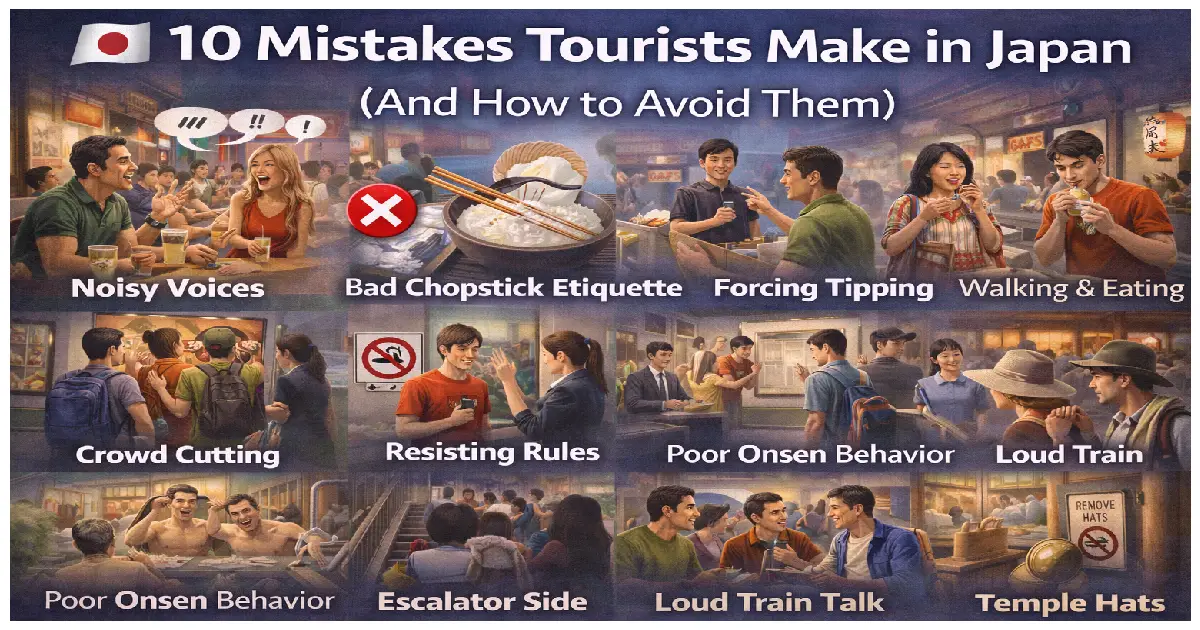
I watched it happen again last week in Kyoto. A family of four stood blocking the entrance to Fushimi Inari Shrine, wrestling with an oversized suitcase up stone steps while a line of irritated locals waited behind them.
They’d made Mistake #3 on this list.
After eight years living in Tokyo and helping hundreds of first-time visitors navigate Japan, I’ve seen the same errors repeated constantly. These aren’t minor inconveniences—they’re trip-ruining mistakes tourists make in Japan that cost time, money, and goodwill.
The frustrating part? Every single one is completely avoidable.
This guide draws from personal experience, conversations with Japanese friends and business owners, and observing thousands of tourists. I’m not here to shame anyone. Japan is complex! But understanding these common pitfalls will transform your experience from stressful to seamless.
Here’s what nobody tells you before booking: Japanese infrastructure wasn’t designed for Western-sized luggage.
Train aisles are narrow. Hotel rooms are compact. Escalators are steep. Coin lockers won’t fit standard 28-inch suitcases. Crowded trains during rush hour? Forget it.
I’ve seen tourists spend 45 minutes trying to navigate Tokyo Station with two large suitcases and a carry-on. What should take 10 minutes becomes an exhausting ordeal. Locals can’t pass. Station staff get frustrated. Your trip starts on the worst possible note.
The real problem: Most tourists pack for a two-week European vacation, not Japan. Different culture, different needs.
One carry-on sized bag per person. That’s it.
Here’s the formula that works:
What about longer trips? Use Japan’s incredible laundry infrastructure. Every neighborhood has coin laundromats. Many hotels offer same-day laundry service. Washing clothes twice beats dragging excessive luggage everywhere.
The Forwarding Solution: For multi-city trips, use takuhaibin (luggage forwarding services). Send bags from Tokyo to Osaka for ¥2,000-3,000. They arrive next-day. You travel light on the Shinkansen. This is what savvy travelers do.
Bring:
Skip:
“Japan is a cash society.” You’ve heard this. Maybe you dismissed it as outdated advice.
It’s not.
Yes, major department stores and chain hotels accept cards. But the best restaurants? Cash only. Local izakayas? Cash only. Temple admission fees? Cash only. Small shops in Osaka’s best food districts? Definitely cash only.
I watched tourists discover this the hard way at a phenomenal ramen shop in Shibuya. No card reader. No Apple Pay. The closest ATM was eight blocks away. They never returned.
The uncomfortable truth: Even places displaying credit card stickers often have “broken” readers or prefer cash. It’s not personal—credit card processing fees hurt small businesses.
Carry ¥30,000-50,000 ($200-350 USD) in cash at all times.
This sounds excessive to Western travelers. It’s not. Here’s why:
Daily cash needs:
Multiply by trip length, add buffer for shopping and emergencies.
Where to withdraw:
Pro tip: Withdraw the maximum amount each time (usually ¥50,000-100,000). Multiple small withdrawals waste money on fees. Japan is extraordinarily safe—carrying cash is normal.
Get a Suica or PASMO card immediately.
These rechargeable cards work on trains, buses, vending machines, and increasingly at convenience stores and restaurants. Load ¥5,000-10,000 at a time.
They’re not substitutes for cash, but they reduce daily cash needs for transportation.
I call it the “European vacation mindset.” Tourists arrive in Japan with military precision itineraries:
This fails spectacularly.
Why? Because Japan operates at a different pace. Temple visits take longer than expected (removing shoes, washing hands, proper etiquette). Trains require navigation time. Restaurants might have 30-minute waits. You’ll want to linger at places.
By day three, tourists following rigid schedules are exhausted, stressed, and resentful.
Plan anchor activities, leave everything else flexible.
Here’s what works:
Morning (9:00-12:00): One major activity or neighborhood Afternoon (12:00-4:00): Lunch + one minor activity or wandering Evening (6:00-9:00): Dinner area + possible evening activity
Example of realistic Tokyo day:
That’s it. Three things, plus meals. You’ll enjoy each experience instead of racing between them.
The buffer rule: Add 30-50% extra time to every activity. If you think something takes one hour, budget 90 minutes.
For every 3-4 days of sightseeing, schedule one “slow day”:
These days prevent burnout and often become favorite memories.
Most Japanese people forgive tourist errors. But some behaviors cross lines:
Walking and eating: Don’t do it. Food is consumed where purchased or at designated eating areas. Walking down the street eating takoyaki marks you as disrespectful.
Talking on trains: Keep conversations quiet. Phone calls are taboo. Japanese trains are remarkably silent—match that energy.
Shoes indoors: If there’s a genkan (entrance area with step-up), remove shoes. Slippers might be provided. Never wear outside shoes on tatami mats.
Chopstick violations:
Blowing your nose in public: Highly inappropriate. Sniffling is acceptable; loud nose-blowing is not. Use restrooms.
Visiting an onsen (hot spring) is quintessentially Japanese. It’s also where tourists make spectacular errors.
Non-negotiable rules:
Long hair must be tied up. Hair touching water is unhygienic.
The washing step isn’t optional or quick. Soap thoroughly, rinse completely, then enter the bath. Locals watch—and judge.
Don’t tip. Seriously, it confuses staff and sometimes offends. Excellent service is standard.
Wait to be seated. Don’t grab open tables. Say “Sumimasen” to get attention, then point at your party to indicate how many people.
Use the oshibori (wet towel) correctly. It’s for hands before eating, not face-wiping.
Pour drinks for others, not yourself. If dining with Japanese colleagues or new friends, watch for empty glasses and pour for others. They’ll reciprocate.
Say “itadakimasu” before eating and “gochisousama” after. Simple phrases that show respect.
The JR Pass costs ¥50,000-80,000 ($330-530) depending on duration. Travel blogs call it “essential.” It’s not.
The math often doesn’t work.
A 7-day JR Pass costs approximately ¥50,000. Let’s check if a typical itinerary justifies this:
Sample costs without JR Pass:
You’d waste ¥17,000-20,000 buying the pass.
The JR Pass only makes financial sense for specific itineraries—usually involving three or more long-distance Shinkansen trips within the pass validity period.
Use our JR Pass calculator to determine if it’s worth buying, but here are general rules:
Buy the pass if:
Skip the pass if:
IC Cards (Suica/PASMO): Perfect for local transportation. Rechargeable, work nationwide, accepted at vending machines and stores.
Discount tickets: Kakuyasu kippu (discount ticket shops) sell Shinkansen tickets at 5-10% off face value.
Regional passes: JR East Pass, Kansai Area Pass, and other regional options offer better value for focused itineraries.
Budget airlines: Peach, Jetstar, and ANA offer domestic flights cheaper than Shinkansen for long distances (Tokyo to Fukuoka, for example).
Yes, Tokyo has English signage. Yes, major tourist sites accommodate English speakers. But 73% of Japanese adults have limited English proficiency.
What this means practically:
I’ve seen tourists stand in restaurants for 15 minutes waiting to order, not realizing they needed to tell someone they’d arrived. Cultural and language barriers overlap.
Google Translate app with offline Japanese downloaded: The camera feature is magic. Point at menus, signs, instructions—instant translation.
Learn these 15 phrases:
Print allergy cards in Japanese. If you have serious food allergies, get professional translations printed. Show these to restaurant staff.
Offline maps: Download Tokyo, Kyoto, Osaka sections in Google Maps before arrival.
Pointing works universally. Don’t overthink it. Point at menu items, photos, other diners’ food.
Use numbers. Hold up fingers to indicate quantity. Write numbers on your phone for prices and times.
Smile and bow slightly. Acknowledging effort bridges language gaps. Frustrated attitudes make situations worse.
Hotel concierge is your friend. They’ll call restaurants for reservations, write addresses in Japanese for taxi drivers, and translate requests.
Cherry blossom season (late March-early April) and fall foliage season (November) are magical. They’re also when Japan becomes uncomfortably crowded.
Peak season realities:
I watched a couple have a tearful argument in Kyoto’s Arashiyama Bamboo Grove during peak sakura season. They’d imagined peaceful walks through serene nature. Instead: shoulder-to-shoulder crowds, selfie sticks everywhere, and zero tranquility.
The expectation mismatch ruins trips.
If you must visit during peak times:
Wake up early. Seriously. 5:30-6:00 AM starts mean you’ll experience temples and shrines with minimal crowds. By 9:00 AM, the masses arrive.
Book accommodations 6-9 months ahead. Last-minute bookings during cherry blossom season mean either unavailable rooms or ¥40,000+ per night prices.
Use weekdays strategically. Saturday-Sunday see domestic tourists flooding sites. Tuesday-Thursday are relatively calmer.
Visit B-list attractions. Everyone goes to Fushimi Inari. Consider alternatives like Kurama Temple or Ohara. Beautiful, less crowded.
Avoid Kyoto entirely. Controversial advice, but Kyoto during peak sakura is miserable. Consider staying in Osaka and doing day trips, or skip Kyoto altogether this visit.
Late May-June: Post-cherry blossom, pre-rainy season. Weather is mild, crowds are moderate, prices are reasonable. Rainy season starts mid-June.
September-early November: Post-summer heat, before peak fall foliage (mid-late November). Comfortable temperatures, fewer tourists.
January-February: Cold but clear. Lowest prices, smallest crowds. Winter illuminations are stunning. Skiing in nearby areas becomes an option.
Tokyo’s train system is world-class—efficient, clean, punctual. It’s also overwhelmingly complex for first-timers.
Rush hour times to avoid:
During these windows, trains reach 180-200% capacity. Bodies press together. Breathing room disappears. If you’re traveling with luggage (see Mistake #1), you’ll block aisles and irritate commuters.
I’ve watched tourists attempt boarding packed trains with roller bags, causing delays and receiving angry stares. Station staff sometimes prevent boarding entirely.
Priority seating: End seats are for elderly, pregnant women, disabled passengers, and people with small children. Young, healthy tourists sitting there receive disapproving looks.
Backpacks: Remove them and hold them or place them on overhead racks. Wearing backpacks on crowded trains makes you take up double space.
Standing position: Face forward, don’t block doors. If standing near doors, step off at stations to let others exit, then re-board.
Phone usage: Switch to silent mode. No phone conversations. Texting is fine. Gaming with sound is not.
Food and drink: Not on commuter trains. Water is sometimes acceptable. Full meals wait until you’re off the train.
Use Google Maps religiously. It shows:
Learn train line colors. Tokyo’s Yamanote Line is green. Ginza Line is orange. Colors help when kanji is overwhelming.
Take photos of station exits. When you find a good exit leading to your hotel or frequently visited area, photograph the signage. Returning becomes easier.
The platform app: Japan Transit Planner (Jorudan) is more accurate than Google Maps for complex routes.
Japan is safe. Crime is low. But medical costs are astronomical for uninsured visitors.
Real costs I’ve seen:
Japan’s healthcare is excellent. It’s also expensive without insurance. The government requires travel insurance for visa-free visitors from many countries—though enforcement is inconsistent.
Medical coverage minimum: $100,000
Additional important coverage:
For Americans, check out our guide on travel insurance in the USA. British visitors should look for policies covering Japan specifically.
Cost: Comprehensive coverage typically costs $50-120 for 2-week trips. That’s 2-3% of total trip cost—cheap compared to one ER visit.
Assuming credit card insurance suffices: Credit card travel insurance is limited. It rarely covers medical expenses adequately and often requires you to pay for entire trip with that card.
Buying at the last minute: Get insurance when booking your trip. Many policies only cover pre-existing conditions if purchased within 14-21 days of initial trip deposit.
Not reading exclusions: Adventure activities (skiing, scuba diving, hiking) might require additional coverage. Alcohol-related incidents often aren’t covered.
Tourists treat Japan like an open-air museum. Everything becomes a photo opportunity—including people.
What’s NOT okay:
In Kyoto’s Gion district, tourists harassing geishas for photos became so problematic that certain streets now ban photography entirely. Violators face fines.
Japanese culture values personal space differently than Western cultures. Some rules seem contradictory:
Crowded trains: Physical contact is unavoidable and tolerated. But inappropriate touching (chikan) is a serious problem. Keep hands visible, avoid unnecessary contact.
Public spaces: Maintain distance when possible. Don’t touch people to get their attention—say “sumimasen” instead.
Queueing: Lines are sacred. Cutting queues is deeply disrespectful. Even appearing to cut (standing too close to the front) draws criticism.
Escalators: Stand on the left (Tokyo) or right (Osaka). The other side is for walking. This is taken seriously.
Before posting:
The Instagram Effect: Popular locations become overwhelmed when influencers share exact locations. Consider whether your post contributes to overtourism problems.
Expecting large meal portions: Japanese serving sizes are smaller than American portions. That’s intentional—quality over quantity. Order multiple dishes if needed.
Not making dinner reservations: Popular restaurants book weeks in advance. Walk-ins work for casual places, but mid-range and high-end spots require reservations.
Wearing shoes that are difficult to remove: You’ll remove shoes 10+ times per day. Wear slip-on friendly footwear.
Only eating “Japanese food”: Japan has incredible international cuisine. Don’t force yourself to eat raw fish three meals daily if that’s not appealing.
Assuming everywhere is expensive: Convenience stores sell delicious, affordable meals. ¥1,000-1,500 buys satisfying lunches. Check our detailed Japan trip cost breakdown for realistic budgeting.
Not downloading offline maps and translation apps: Internet connectivity isn’t always available. Prepare before arriving.
Expecting fast wifi everywhere: Many places offer wifi, but it’s often slow or requires registration. Get a pocket wifi device or SIM card.
Booking ryokans without understanding expectations: Traditional inns include dinner and breakfast, have strict check-in times, and require specific etiquette. They’re phenomenal but aren’t hotels.
Most Japanese people understand tourists make mistakes. They’re generally gracious about cultural errors. But understanding and forgiving aren’t the same as not noticing.
The unspoken reality: Japanese culture values harmony (wa). Rather than confronting rude tourists directly, locals simply avoid interaction. You might never know you’ve offended someone.
That restaurant that “doesn’t have availability”? Might actually be full. Or they might be declining foreign customers after previous negative experiences.
Those locals who seem cold? Language barriers and past interactions with demanding tourists make some hesitant.
Research before you go. Spend hours reading guides (like this one). Watch YouTube videos about Japanese etiquette. The preparation pays off immediately.
Observe before acting. Watch how locals behave. How do they board trains? Where do they eat their food? How do they handle chopsticks?
Ask questions humbly. Hotel staff, tour guides, and friendly locals will help if you approach respectfully. “I’m not sure about the etiquette here—could you help me?” works wonders.
Accept imperfection. You’ll make mistakes. That’s okay. Apologize (sumimasen), learn, and move forward.
From my experience, bringing too much luggage causes the most immediate, persistent problems. It affects transportation, accommodation comfort, and daily mobility. Every other mistake on this list can be corrected mid-trip, but luggage follows you everywhere.
Yes and no. The basics (eating, sleeping, transportation) are similar everywhere. But Japan’s cultural expectations around public behavior, etiquette, and social harmony are distinctly different from Western norms. What’s considered normal in the US or UK might be rude in Japan, and vice versa.
Absolutely. Millions do it annually. But expect challenges. Learning 15-20 basic phrases and using translation apps bridges most gaps. The experience is richer with some language ability, but it’s not required.
Usually nothing dramatic. Japanese people might look uncomfortable or avoid eye contact, but direct confrontation is rare. Serious violations (like photography in forbidden areas) might result in requests to stop or leave. Apologize sincerely if corrected.
Not necessarily. If you understand expectations, prepare accordingly, and accept crowds as part of the experience, peak seasons offer stunning natural beauty. Just don’t expect serene, empty temples. For a calmer experience, visit during shoulder seasons (May-June, September-October).
¥10,000-15,000 ($65-100) covers most days comfortably. This assumes you’ve already paid for accommodation and have money reserved for any planned major purchases or expensive dinners. Adjust based on your spending style.
For about 40% of tourists, no. Run the calculations using our JR Pass calculator tool. If your itinerary involves three or more long-distance Shinkansen trips within 7-14 days, it might make sense. Tokyo-Kyoto-only itineraries rarely justify the pass.
Watch locals carefully. Notice where they stand on escalators, how they board trains, where they eat street food, how they handle payment at registers. Observation teaches more than reading in many cases. YouTube channels about Japanese culture supplement this well.
✓ Pack only carry-on sized luggage ✓ Purchase comprehensive travel insurance ✓ Calculate JR Pass necessity using actual itinerary costs ✓ Download offline maps for Tokyo, Kyoto, Osaka ✓ Install Google Translate with offline Japanese ✓ Book accommodation 2-6 months ahead (depending on season) ✓ Learn 15 essential Japanese phrases ✓ Print allergy cards if needed ✓ Research specific onsen policies (if planning visits) ✓ Create realistic, flexible daily plans (not hour-by-hour schedules)
✓ Withdraw ¥50,000 cash at airport ATM ✓ Purchase Suica/PASMO IC card ✓ Test Google Maps train navigation with simple route ✓ Identify nearest convenience store, ATM, and pharmacy to accommodation ✓ Ask hotel staff about local etiquette questions ✓ Practice removing/wearing shoes efficiently ✓ Set phone to silent mode ✓ Review restaurant reservation requirements for planned dinners
✓ Wake early to beat crowds at popular sites ✓ Carry ¥10,000+ cash daily ✓ Eat food only in designated areas (not while walking) ✓ Remove shoes when entering traditional spaces ✓ Keep train conversations quiet ✓ Bow slightly when saying thanks or sorry ✓ Wait to be seated at restaurants ✓ Build 30-50% buffer time into plans ✓ Observe locals before acting in uncertain situations
I made seven of these ten mistakes during my first Japan visit in 2014. I brought a massive suitcase. I attempted using credit cards everywhere. I tried visiting six temples in one day.
The trip was still wonderful—but unnecessarily stressful.
My second visit six months later avoided these pitfalls. The difference was dramatic. Less stress, more enjoyment, deeper cultural understanding, and better interactions with Japanese people.
The goal isn’t perfection. You’ll make mistakes. Every visitor does. The goal is avoiding the preventable ones that diminish your experience.
These mistakes tourists make in Japan aren’t character flaws—they’re information gaps. Now you have the information. Use it to create the Japan experience you deserve.
Japan rewards preparation, observation, and cultural sensitivity. Show up with appropriate luggage, sufficient cash, realistic expectations, and basic etiquette knowledge. The country reveals its magic.
The best part? Many of these lessons apply beyond Japan. The habits you develop—traveling light, carrying cash backups, learning basic local phrases, respecting cultural norms—improve every future trip.
Japan is waiting. Go prepared.
Staying only in Shinjuku or Shibuya: These neighborhoods are overwhelming for first-timers. Consider staying in quieter areas like Ueno, Asakusa, or Yanaka for better rest and authentic local experiences. Our Tokyo itinerary guide covers neighborhood choices in detail.
Assuming Tokyo represents all of Japan: Tokyo is uniquely cosmopolitan and fast-paced. Kyoto, Osaka, and rural areas offer completely different experiences.
Not using train apps: Tokyo’s 13 train lines, multiple operators, and complex transfer system requires navigation apps. Don’t wing it.
Trying to see everything in 2-3 days: Kyoto has 2,000+ temples and shrines. Slow down. Visit 3-4 major sites daily maximum.
Wearing inappropriate clothing to temples: Shoulders and knees should be covered. Some temples refuse entry for revealing clothing.
Visiting during peak hours: Temples open early. Arrive at 8:00 AM for peaceful experiences before tour buses arrive.
Expecting Tokyo’s formality: Osaka is friendlier, more casual, and less rigid about rules. Locals are chattier. Don’t be surprised by informal interactions.
Skipping the food: Osaka’s food scene is Japan’s best value. Missing takoyaki, okonomiyaki, and kushikatsu because you’re “saving appetite” is a mistake.
Standing on wrong escalator side: Osaka stands on the RIGHT, walks on the left. Tokyo does the opposite.
About the Author: After eight years living in Tokyo and traveling throughout Japan 40+ times, I’ve made every mistake on this list personally. This guide draws from those errors, extensive conversations with Japanese colleagues and friends, and helping hundreds of first-time visitors navigate Japan successfully. I update this guide quarterly to reflect changing conditions and new insights.
Related Reading:
Posted By : Vinay
Latest Article
2nd Floor, 39, Above Kirti Club, DLF Industrial Area, Kirti Nagar, New Delhi, Delhi 110015



Travel Tourister is a leading Travel portal where we introduce travellers to trusted travel agents to make their journey hasselfree, memorable And happy. Travel Tourister is a platform where travellers get Tour packages ,Hotel packages deals through trusted travel companies And hoteliers who are working with us across the world. We always try to find new and more travel agents and hoteliers from every nook and corners across the world so that you could compare the deals with different travel agents and hoteliers and book your tour or hotel with the one you have chosen according to your taste and budget.
Copyright © Travel Tourister, India. All Rights Reserved

 Call
Call Enquiry