Thai Islands Comparison 2026: Which Island is Right for You?

Published on : 27 Jan 2026
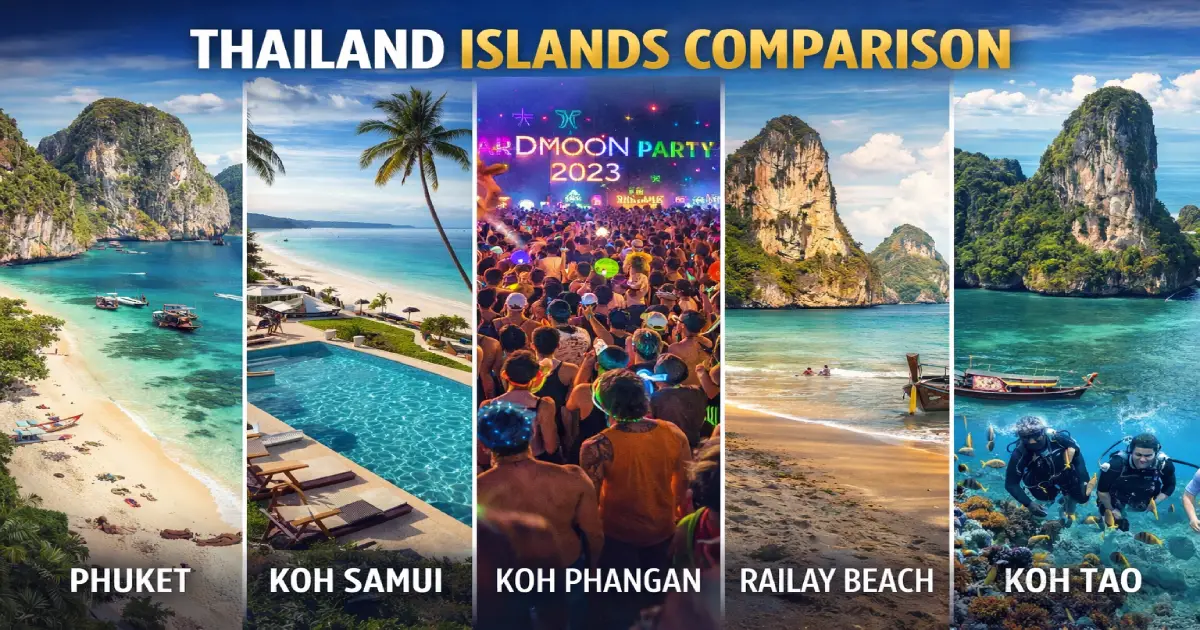
Thailand islands comparison collage showing Phuket beaches with limestone cliffs, Koh Samui luxury beachfront resorts, Koh Phangan Full Moon Party crowds, dramatic Railay Beach karsts, and Koh Tao underwater diving scenes representing diverse island experiences

Standing on the ferry dock in Phuket last February, I overheard a British couple arguing over their phones. “The Instagram photos show Koh Phi Phi is paradise,” she insisted. “But three different blogs say it’s overcrowded and ruined.”

He scrolled through conflicting reviews. “Maybe we should just stay in Phuket? Or go to Koh Samui? I don’t know anymore.”

I felt their frustration. They were suffering from Thai island paralysis.

After visiting eighteen different Thai islands over nine years—from party-crazed Koh Phangan during Full Moon to serene Koh Lanta’s quiet beaches, from Phuket’s mega-resorts to Koh Chang’s rustic bungalows—I’ve learned this: choosing the right Thai island matters far more than most travelers realize.

Thailand has over 1,400 islands. Guidebooks feature maybe a dozen. Instagram showcases the same six. But here’s what they don’t tell you: Phuket, Koh Samui, Koh Phangan, Krabi’s islands, Koh Phi Phi, and Koh Chang offer fundamentally different experiences that suit completely different travelers.

Choosing wrong means disappointment. The party animal stuck on family-friendly Koh Lanta. The honeymoon couple drowning in Patong Beach’s neon chaos. The budget backpacker bleeding money on upscale Koh Samui.

This isn’t another listicle ranking “Thailand’s 10 Best Islands.” This is a detailed comparison of the major Thai islands based on what actually matters: beaches, atmosphere, activities, accessibility, seasonality, and—critically—which type of traveler each island suits best.

I’ll show you exactly what each island delivers, who loves it, who hates it, and how to match your travel style with the right destination. Whether you’re planning your first Thai beach trip or your fifth, you’ll know precisely which island deserves your limited vacation days.


Quick Summary: Thai Islands at a Glance

Let’s start with the essential comparison:

Island Best For Vibe Beaches Price Level Best Season
Phuket First-timers, families, variety seekers Busy, developed, options galore Good variety, some crowded Mid-High Nov-Apr
Koh Samui Luxury travelers, couples, convenience Polished, upscale, comfortable Excellent, less crowded High Jan-Aug
Koh Phangan Backpackers, yogis, party-goers Divided: party vs. wellness Beautiful, varied Budget-Mid Jan-Aug
Koh Tao Divers, budget travelers Laid-back, dive-focused Small, rocky in places Budget-Mid Jan-Aug
Krabi/Railay Rock climbers, nature lovers Dramatic, adventurous Stunning, unique Mid-High Nov-Apr
Koh Phi Phi Young travelers, partiers Intense, crowded, beautiful World-famous, packed Mid-High Nov-Apr
Koh Lanta Families, relaxation seekers Quiet, peaceful, slow-paced Long, uncrowded Budget-Mid Nov-Apr
Koh Chang Bangkok escapees, nature lovers Rustic, authentic, less touristy Excellent, quieter Budget-Mid Nov-Apr

Critical Thailand geography lesson:

Thailand has TWO distinct coastal regions with OPPOSITE monsoon seasons:

Andaman Coast (West): Phuket, Krabi, Phi Phi, Lanta

  • Best: November-April (dry season)
  • Avoid: May-October (monsoon, rough seas)

Gulf Coast (East): Koh Samui, Koh Phangan, Koh Tao

  • Best: January-August (mostly dry)
  • Avoid: October-November (wettest months)

This opposite pattern means you can visit Thai beaches nearly year-round if you choose the right coast for your travel dates.

Our comprehensive Best Time to Visit Thailand Guide explains seasonal patterns in detail.


Understanding the Major Island Groups

Before diving into individual islands, understand how they’re geographically organized:

Andaman Sea Islands (West Coast)

Phuket Province:

  • Phuket Island (largest, most developed)
  • Koh Yao islands (quiet, authentic)
  • Coral Island, Racha islands (day trips)

Krabi Province:

  • Railay Peninsula (accessible only by boat)
  • Koh Phi Phi archipelago
  • Koh Lanta
  • Koh Poda, Hong Island (day trips)

Phang Nga Province:

  • James Bond Island
  • Similan Islands (diving mecca, seasonal)

Trang Province:

  • Koh Kradan, Koh Mook (undeveloped gems)

Gulf of Thailand Islands (East Coast)

Surat Thani Province:

  • Koh Samui (second-largest island)
  • Koh Phangan (Full Moon Party fame)
  • Koh Tao (diving certification capital)
  • Ang Thong Marine Park (42-island archipelago)

Eastern Seaboard

Trat Province:

  • Koh Chang (third-largest island)
  • Koh Mak
  • Koh Kood

Chonburi Province:

  • Koh Samet (weekend escape from Bangkok)
  • Koh Larn (Pattaya day trip)

Detailed Island Comparisons

Phuket: Thailand’s Biggest Island Playground

The headline: Everything under one roof, for better and worse.

Size: 543 km² (Thailand’s largest island)

Population: 400,000+ residents

Airport: Phuket International (HKT) – major hub with international flights

What Phuket Delivers

Beaches (Variety is the strength):

  • Patong Beach: Main tourist beach, long sandy stretch, water sports, nightlife central, crowded
  • Kata & Karon: Family-friendly, cleaner than Patong, surf-able waves
  • Nai Harn: Beautiful crescent bay, less developed, local favorite
  • Kamala: Mid-range development, quieter than Patong
  • Mai Khao: Long, quiet, near airport, sea turtle nesting site
  • Surin: Upscale, luxury resorts, less swimming-friendly

What makes Phuket unique:

  • Most variety: luxury to budget, party to family-friendly, busy to quiet—all on one island
  • Best accessibility: International airport, easy transfers, excellent infrastructure
  • Day trip central: Phi Phi, James Bond Island, Similan Islands all reachable
  • Full services: Hospitals, shopping malls, international restaurants
  • Weather reliability: November-April near-perfect conditions

What frustrates visitors:

  • Patong’s seediness: Go-go bars, aggressive touts, overdevelopment
  • Traffic: Getting anywhere takes longer than map suggests
  • Tourist prices: More expensive than smaller islands
  • Less “authentic Thailand”: Can feel generic/international
  • Crowds: Peak season swarms major beaches

Who Loves Phuket

Perfect for:

  • First-time Thailand visitors wanting safety net of familiarity
  • Families needing variety (kids’ clubs, water parks, easy food)
  • Travelers wanting options without island hopping
  • Those with limited time (fly directly in/out)
  • People who want beach + culture + nightlife in one place

Skip Phuket if you:

  • Seek authentic, quiet Thailand
  • Hate crowds and development
  • Want pristine, untouched beaches
  • Prefer intimate, small-island vibes

Phuket Costs

Accommodation:

  • Budget: ฿500-1,000/night (hostels, basic guesthouses)
  • Mid-range: ฿1,500-3,500/night (3-star hotels, nice Airbnbs)
  • Luxury: ฿4,500-15,000+/night (5-star resorts, beachfront villas)

Food:

  • Street food/local: ฿60-150 per meal
  • Tourist restaurants: ฿200-400 per meal
  • Upscale dining: ฿800-2,000+ per meal

Activities:

  • Beach activities: Free-฿500
  • Phi Phi day tour: ฿1,200-1,800
  • Diving (2 dives): ฿2,500-3,500
  • James Bond Island tour: ฿1,500-2,200

Getting there: Direct flights from Bangkok (1h 20m, ฿1,500-3,500), international flights from Singapore, KL, major Asian hubs

Getting around: Metered taxis, Grab, tuk-tuks, motorbike rental (฿200-350/day)

Phuket Verdict

Rating: 4/5

Strengths: Accessibility, variety, infrastructure, day trip options Weaknesses: Crowds, commercialization, traffic, higher prices

Bottom line: Phuket works for almost everyone but excels for no one. It’s the safe, sensible choice that rarely disappoints but rarely amazes. Choose Phuket when convenience and options matter more than authenticity and pristine beauty.


Koh Samui: The Polished Paradise

The headline: Upscale island living with international polish.

Size: 228 km² (Thailand’s second-largest island)

Population: 65,000+ residents

Airport: Samui International (USM) – boutique airport, Bangkok Airways near-monopoly

What Koh Samui Delivers

Beaches (High-end and varied):

  • Chaweng: Longest, busiest, 7km white sand, water sports, nightlife, commercial
  • Lamai: Second-longest, less crowded than Chaweng, good value, beach bars
  • Maenam: Quieter north coast, family-friendly, long stretch
  • Bophut (Fisherman’s Village): Boutique vibe, dining scene, Friday night market
  • Choeng Mon: Upscale, quiet, perfect crescent bay
  • Bang Rak (Big Buddha Beach): Airport proximity, Big Buddha temple

What makes Samui special:

  • Polished infrastructure: Excellent roads, reliable electricity, consistent WiFi
  • Luxury focus: More 4-5 star resorts than any Thai island except Phuket
  • Wellness scene: World-class spas, yoga retreats, detox centers
  • Foodie destination: International dining rivals Bangkok
  • Convenience: Own airport (though expensive), easy island hopping to Phangan/Tao
  • Ang Thong Marine Park: 42-island archipelago day trip

What disappoints visitors:

  • Expensive: Accommodation, transport, dining all 20-30% higher than similar quality elsewhere
  • Bangkok Airways monopoly: Flights cost ฿2,500-4,500 vs. ฿1,200-2,000 to Phuket
  • Development: Urbanization along main roads, less pristine feeling
  • Traffic: Ring road gets congested, distances farther than expected
  • Less dramatic: Beautiful but not jaw-dropping like Krabi’s limestone

Who Loves Koh Samui

Perfect for:

  • Honeymoon couples wanting luxury without roughing it
  • Wellness seekers (yoga, spa, detox retreats)
  • Travelers prioritizing comfort and service
  • Foodies wanting excellent international dining
  • Those visiting July-August when Andaman Coast has monsoon

Skip Samui if you:

  • Travel on tight budget
  • Prefer rustic, authentic island vibes
  • Want dramatic scenery over convenience
  • Seek party atmosphere (less intense than Phi Phi/Phangan)

Koh Samui Costs

Accommodation:

  • Budget: ฿700-1,200/night (rare, limited options)
  • Mid-range: ฿2,000-4,000/night (boutique hotels, nice resorts)
  • Luxury: ฿6,000-20,000+/night (Four Seasons, Six Senses, beachfront villas)

Food:

  • Local restaurants: ฿100-250
  • Tourist restaurants: ฿250-500
  • Upscale dining: ฿1,000-3,000+

Activities:

  • Ang Thong Marine Park tour: ฿1,800-2,500
  • Spa treatments: ฿1,500-5,000+
  • Diving: ฿2,500-3,500
  • Elephant sanctuary: ฿1,800-2,500

Getting there: Fly to Samui (1h 15m from Bangkok, ฿2,500-4,500) OR ferry from Surat Thani (2.5 hours, ฿400-600)

Getting around: Songthaews (shared taxis, ฿30-100), private taxis (expensive), motorbike rental (฿200-350/day)

Koh Samui Verdict

Rating: 4.5/5 for luxury travelers, 3/5 for budget travelers

Strengths: Luxury accommodation, infrastructure, wellness scene, year-round appeal Weaknesses: Expensive, less dramatic scenery, development, flight monopoly

Bottom line: Samui is Thailand’s upscale island—polished, comfortable, and reliably excellent. Worth the premium if you value service and amenities. Budget travelers get better value elsewhere.


Koh Phangan: Split Personality Island

The headline: Full Moon madness meets yoga wellness—seriously.

Size: 125 km²

Population: 13,000 residents

Airport: None (ferry from Samui or Surat Thani)

What Koh Phangan Delivers

The bizarre duality:

South/Southeast (Haad Rin area):

  • Full Moon Party central (30,000+ people monthly)
  • Budget hostels, party-focused accommodation
  • Neon buckets, beach bars, fire shows
  • Loud, chaotic, young crowds
  • “Where travelers go to lose themselves”

North/Northwest coast:

  • Yoga retreats, wellness centers
  • Quiet beaches, jungle bungalows
  • Meditation, detox programs
  • Peaceful, spiritual vibe
  • “Where travelers go to find themselves”

Beaches:

  • Haad Rin: Party beach, wide sandy crescent, full moon madness
  • Thong Nai Pan: Beautiful twin bays, upscale, quiet
  • Bottle Beach (Haad Khuat): Boat-access only, pristine, backpacker favorite
  • Haad Yao: Long beach, good swimming, development increasing
  • Haad Salad: Quiet, sunset views, family-friendly
  • Malibu Beach: Hippie vibe, basic bungalows, authentic

What makes Phangan unique:

  • The Full Moon Party: Love it or hate it, it’s legendary
  • Yoga capital: Orion, Samma Karuna, Wonderland—world-class centers
  • Jungle waterfalls: Than Sadet, Phaeng waterfalls worth exploring
  • Unspoiled areas: Still has quiet, undeveloped pockets
  • Budget-friendly: Cheaper than Samui or Phuket
  • Island hopping base: Easy access to Samui and Koh Tao

What frustrates visitors:

  • Geographic split: Party and peace exist uncomfortably on same island
  • Infrastructure gaps: Rough roads, power outages in remote areas
  • Seasonal fluctuation: Dead outside high season in some areas
  • Limited luxury: Few high-end resorts compared to Samui
  • Transport challenges: Getting around requires motorbike or expensive taxis

Who Loves Koh Phangan

Perfect for:

  • Party travelers: Full Moon Party bucket list item
  • Yoga enthusiasts: World-class retreats at fraction of Bali prices
  • Budget backpackers: Cheap accommodation, food, beaches
  • Adventure seekers: Jungle hikes, secret beaches, motorbike exploration
  • Detox seekers: Multiple fasting/cleansing centers

Two types BOTH love Phangan (just different parts):

  1. 22-year-olds on gap year seeking Full Moon chaos
  2. 32-year-olds recovering from corporate burnout seeking yoga silence

Skip Phangan if you:

  • Want consistent luxury and service
  • Seek family-friendly, calm environment
  • Prefer developed infrastructure
  • Hate crowds (during Full Moon periods)

Koh Phangan Costs

Accommodation:

  • Budget: ฿400-800/night (fan bungalows, hostels)
  • Mid-range: ฿1,200-2,500/night (air-con bungalows, small resorts)
  • Luxury: ฿3,500-8,000/night (limited options, mainly Thong Nai Pan)

Food:

  • Thai food: ฿60-150
  • Western food: ฿150-300
  • Yoga retreat meals: Often included

Activities:

  • Full Moon Party: Entry usually free, drinks ฿100-200 each
  • Yoga classes: ฿300-600 per session
  • Yoga retreats: ฿15,000-40,000 per week (all-inclusive)
  • Waterfalls: ฿100 national park fee

Getting there: Ferry from Koh Samui (30 mins, ฿350-600) or Surat Thani (3-5 hours, ฿400-800)

Getting around: Motorbike rental (฿150-250/day), songthaews (expensive, ฿100-300), taxi (very expensive)

Koh Phangan Verdict

Rating: 4.5/5 for party/wellness travelers, 3/5 for middle-ground travelers

Strengths: Unique duality, budget-friendly, wellness scene, party scene, beautiful beaches Weaknesses: Infrastructure gaps, geographic split, limited luxury, rough roads

Bottom line: Phangan works brilliantly for two opposite traveler types and confuses everyone else. Know which Phangan you want—party south or peaceful north—and stay there.


Koh Tao: Diving Certification Central

The headline: Learn to dive cheap, stay for the chill vibe.

Size: 21 km² (small!)

Population: 2,500 residents

Airport: None (ferry access only)

What Koh Tao Delivers

Diving focus:

  • Cheapest PADI certification in the world: Open Water ฿8,500-12,000 (vs. ฿15,000-20,000 elsewhere)
  • 40+ dive sites: Chumphon Pinnacle, Shark Island, Sail Rock
  • Year-round diving: Best Jan-Aug, possible Oct-Dec
  • Dive shop density: 50+ schools on tiny island
  • Marine life: Whale sharks, turtles, rays (seasonal)

Beaches:

  • Sairee Beach: Main beach, longest, budget accommodation, social
  • Mae Haad: Arrival pier area, convenient, less swimming-friendly
  • Chalok Baan Kao: South coast, quieter, family vibe
  • Tanote Bay: Snorkeling, cliff jumping, small, authentic
  • Shark Bay: Good snorkeling, rocky
  • Freedom Beach: Boat/hike access, pristine, worth effort

What makes Tao special:

  • Budget paradise: Cheapest major Thai island
  • Dive community: Social, international, tight-knit
  • Small-island intimacy: Walk/motorbike entire island easily
  • Beautiful water: Exceptionally clear, vibrant coral
  • Chill atmosphere: Laid-back, no-pressure vibe
  • Sunset views: West-facing viewpoints spectacular

What disappoints visitors:

  • Limited beaches: Small island = limited beach variety
  • Rocky coastline: Much of island not swimming-friendly
  • Party scene: Smaller than Phangan but nightly bar scene
  • Tourist development: Sairee Beach increasingly commercial
  • Limited luxury: Few upscale options
  • Ferry-dependent: Rough seas can cancel transport

Who Loves Koh Tao

Perfect for:

  • Aspiring divers: Get certified cheap in beautiful setting
  • Budget travelers: Excellent value accommodation and food
  • Divers: Continued diving after certification
  • Social travelers: Easy to meet people at dive schools/bars
  • Island hoppers: Perfect stop between Samui and Phangan

Skip Tao if you:

  • Don’t care about diving (limited other activities)
  • Want pristine, long sandy beaches
  • Seek luxury accommodation and service
  • Prefer quiet, no-nightlife destinations

Koh Tao Costs

Accommodation:

  • Budget: ฿400-700/night (fan bungalows, dorms)
  • Mid-range: ฿1,000-2,000/night (air-con bungalows, small hotels)
  • Upscale: ฿2,500-6,000/night (limited options, mainly Chalok)

Food:

  • Thai/Western mix: ฿80-200 per meal
  • Tourist restaurants: ฿150-350
  • Diving-package deals: Often include meals

Activities:

  • PADI Open Water: ฿8,500-12,000 (4 days)
  • Fun diving (2 dives): ฿1,800-2,500
  • Snorkeling tour: ฿600-1,200
  • Motorbike rental: ฿150-250/day

Getting there: Ferry from Koh Samui (2-3 hours, ฿500-750) or Koh Phangan (1 hour, ฿350-500) or Surat Thani (3-5 hours, ฿600-900)

Getting around: Walk (Sairee area), motorbike (whole island), songthaew taxi (฿50-150)

Koh Tao Verdict

Rating: 4.5/5 for divers, 3/5 for non-divers

Strengths: Diving value, budget-friendly, social atmosphere, clear water Weaknesses: Limited beaches, rocky coastline, ferry-dependent, increasing development

Bottom line: Tao exists for diving. If you’re getting certified or love diving, it’s perfect. If you don’t care about diving, better islands exist for beach holidays.


Krabi & Railay: Limestone Drama

The headline: Most dramatic scenery in Thailand—period.

Krabi is a mainland province, not an island, but its beaches are accessible only or mainly by boat, giving them island-like qualities.

What Krabi Delivers

Railay Peninsula (boat-access only):

  • Four beaches: Railay West, Railay East, Phra Nang, Tonsai
  • Phra Nang Cave Beach: Consistently rated Thailand’s most beautiful beach
  • Limestone cliffs: Tower 200+ meters, iconic Thailand image
  • Rock climbing mecca: 700+ routes, beginners to advanced
  • No roads: Peaceful, pedestrian-only
  • Intimate scale: Walk entire area in 15 minutes

Ao Nang (mainland, main hub):

  • Tourist beach: Convenient, commercialized, less spectacular
  • Base camp: Hotels, restaurants, tour operators
  • Longtail boats: Depart to Railay, islands, beaches

Nearby islands:

  • Koh Phi Phi: See separate section below
  • Koh Lanta: See separate section below
  • Hong Island: Day trip, stunning lagoon
  • Poda Island: Photo-worthy limestone stack
  • Chicken Island: Named for rock formation

What makes Krabi unique:

  • Visual drama: No Thai destination matches the limestone karst scenery
  • Adventure focus: Rock climbing, sea kayaking, jungle trekking
  • Variety: Beach relaxation + adventure activities
  • Day trip central: Easy access to multiple stunning destinations
  • Romantic atmosphere: Particularly Railay Peninsula

What frustrates visitors:

  • Accessibility: Railay’s boat-only access means weather-dependent transport
  • Expense: Railay accommodation significantly pricier than nearby mainland
  • Limited nightlife: Quiet evenings (pro or con depending on perspective)
  • Tide-dependent: Low tide makes some beaches rocky, swimming difficult
  • Ao Nang: Main town lacks character, feels generic

Who Loves Krabi/Railay

Perfect for:

  • Rock climbers: World-class limestone climbing
  • Photographers: Most Instagram-worthy scenery in Thailand
  • Honeymoon couples: Romantic, beautiful, isolated
  • Nature lovers: Caves, lagoons, wildlife, stunning landscapes
  • Active travelers: Kayaking, climbing, hiking, island hopping

Skip Krabi/Railay if you:

  • Want easy accessibility and development
  • Prefer long, wide sandy beaches for walking
  • Need nightlife and entertainment
  • Travel on strict budget (Railay expensive)
  • Have mobility issues (climbing, boat transfers challenging)

Krabi/Railay Costs

Accommodation:

Railay:

  • Budget: ฿800-1,500/night (basic bungalows, limited)
  • Mid-range: ฿2,000-4,000/night (nice resorts)
  • Luxury: ฿6,000-15,000+/night (Rayavadee, high-end)

Ao Nang:

  • Budget: ฿500-1,000/night
  • Mid-range: ฿1,200-2,500/night
  • Luxury: ฿3,500-8,000/night

Food:

  • Thai restaurants: ฿80-200 (Railay), ฿60-150 (Ao Nang)
  • Tourist restaurants: ฿200-400 (Railay pricier)

Activities:

  • Rock climbing lesson: ฿800-1,500
  • Sea kayaking: ฿800-1,500
  • Four Island Tour: ฿600-1,200
  • Hong Island Tour: ฿800-1,500

Getting there: Fly to Krabi (1.5 hours from Bangkok, ฿1,200-2,500), then taxi to Ao Nang (45 mins, ฿400-600), then longtail to Railay (10 mins, ฿100 per person)

Getting around:

  • Railay: Walk only
  • Ao Nang/Krabi: Songthaews, taxis, motorbikes

Krabi/Railay Verdict

Rating: 5/5 for scenery, 4/5 overall

Strengths: Unmatched drama, adventure activities, romantic atmosphere, variety Weaknesses: Accessibility challenges, expense (Railay), limited nightlife, tide issues

Bottom line: If scenery matters most, Krabi/Railay wins Thailand. The limestone karsts and Phra Nang Cave Beach are genuinely world-class. Worth the access hassle for the views alone.


Koh Phi Phi: Beautiful Chaos

The headline: Stunning natural beauty meets spring break atmosphere.

Size: 12.5 km² (Phi Phi Don, inhabited island)

Population: 2,500 residents

Airport: None (ferry access only)

What Koh Phi Phi Delivers

The visual spectacle:

  • Phi Phi Leh (Maya Bay): The Beach movie location, limestone cliffs, turquoise water
  • Viewpoint: Climb 300+ steps for spectacular 360° bay views
  • Dramatic setting: Vertical limestone cliffs encircling twin bays
  • Crystal water: Visibility 15-25 meters, perfect for snorkeling

The party scene:

  • Tonsai Village: Central area, pedestrian-only, bar after bar
  • Fire shows: Beach performances nightly
  • Reggae bars: Music until 2-3 AM
  • Bucket drinks: Cheap alcohol, party atmosphere
  • Young crowd: 18-28 demographic dominates

Beaches:

  • Tonsai Bay: Arrival point, swimming marginal, longtail parking
  • Loh Dalum Bay: Party beach, fire shows, busy
  • Long Beach: Quieter, 15-minute walk, better swimming
  • Laem Tong: North tip, peaceful, family resorts
  • Monkey Beach: Day trip, viewing only

What makes Phi Phi unique:

  • No vehicles: Pedestrian-only island (except service carts)
  • Compact intensity: Everything within 10-minute walk
  • Natural beauty: Genuinely stunning despite development
  • Social atmosphere: Easy to meet travelers
  • Central location: Day trips to surrounding islands

What frustrates visitors:

  • Crowds: Overwhelming, especially day-trippers (10 AM-4 PM)
  • Noise: Music from multiple bars competing volume-wise
  • Trash: Environmental damage visible
  • Expensive: Higher prices due to ferry-only access
  • Maya Bay recovery: Still limiting visitors after environmental damage
  • Party focus: Dominates island character

Who Loves Koh Phi Phi

Perfect for:

  • Young travelers (18-28): Party atmosphere, social scene
  • First-time Thailand visitors: Iconic destination, bucket-list appeal
  • Social butterflies: Easy to meet people, group activities
  • Day-trippers: Visit without staying (smart strategy)

Skip Phi Phi if you:

  • Value peace and quiet
  • Seek authentic Thai culture
  • Want uncrowded beaches
  • Are sensitive to noise
  • Travel with young children
  • Prefer eco-conscious destinations

Koh Phi Phi Costs

Accommodation:

  • Budget: ฿600-1,200/night (fan rooms, noise guaranteed)
  • Mid-range: ฿1,800-3,500/night (air-con, still loud)
  • Luxury: ฿4,500-12,000/night (quieter areas, Laem Tong)

Food:

  • Thai food: ฿100-200 (expensive for Thailand)
  • Western food: ฿200-400
  • Restaurants pricier than mainland due to transport costs

Activities:

  • Viewpoint hike: Free
  • Snorkeling tour: ฿800-1,500
  • Diving (2 dives): ฿2,500-3,500
  • Maya Bay tour: ฿1,000-1,800
  • Kayak rental: ฿300-500

Getting there: Ferry from Phuket (2 hours, ฿400-600) or Krabi (1.5 hours, ฿350-500)

Getting around: Walk everywhere (island tiny), longtail boats to distant beaches (฿100-300)

Koh Phi Phi Verdict

Rating: 5/5 for scenery, 2/5 for peaceful holiday, 4/5 for party holiday

Strengths: Stunning natural beauty, social atmosphere, no vehicles, iconic status Weaknesses: Overcrowded, loud, environmental damage, expensive, party-dominated

Bottom line: Phi Phi’s beauty is undeniable, but the party scene and crowds overwhelm it. Visit on a day trip from Phuket or Krabi to see the scenery without enduring the chaos. Staying overnight works only if you embrace the party atmosphere or pay premium for distant quiet resorts.


Koh Lanta: The Peaceful Alternative

The headline: What Phi Phi could be without the crowds.

Size: 81 km² (long, narrow)

Population: 30,000 residents

Airport: None (ferry + van from Krabi)

What Koh Lanta Delivers

Family-friendly paradise:

    • Long, uncrowded beaches: Space to spread out
    • Gentle atmosphere: No party scene, no crowds
      • Diverse beaches: Different character on each coast
      • Local culture: Muslim fishing communities, authentic feel
      • Nature focus: National park, mangroves, wildlife
      • Manageable size: Big enough for variety, small enough to explore

      Beaches (North to South):

      • Klong Dao: Long, wide, family-friendly, plenty of accommodation
      • Phra Ae (Long Beach): Longest beach, most developed, restaurants/bars
      • Klong Khong: Bohemian vibe, small resorts, relaxed
      • Klong Nin: Beautiful curve, quieter, excellent swimming
      • Kantiang Bay: South end, stunning, more secluded, upscale
      • Bamboo Beach: Far south, pristine, minimal development

      What makes Lanta special:

      • Relaxation focus: Deliberately slow-paced
      • Family-friendly: Safe swimming, calm atmosphere, kid activities
      • Authentic culture: Actual Thai/Muslim communities, not just tourists
      • Nature activities: Mu Ko Lanta National Park, mangrove kayaking
      • Sunset coast: West-facing beaches perfect for evening viewing
      • Aging hippy vibe: Remnant of what Thailand used to be

      What disappoints visitors:

      • Limited nightlife: Few bars, quiet evenings (pro for many)
      • Spread out: Need motorbike or taxi to explore
      • Seasonal: Many places close May-October
      • Limited activities: Fewer tours/options than bigger islands
      • No wow factor: Beautiful but not dramatic like Railay
      • Ferry dependency: Access more complicated than Phuket

      Who Loves Koh Lanta

      Perfect for:

      • Families with children: Safe, calm, uncrowded
      • Couples seeking quiet: Romantic without party scene
      • Digital nomads: Reliable WiFi, peaceful work environment
      • Long-term travelers: Monthly stays common
      • Those recovering from Phi Phi: Antidote to chaos
      • 50+ travelers: Appreciated by older demographics

      Skip Lanta if you:

      • Want nightlife and party scene
      • Prefer everything within walking distance
      • Need constant activity and entertainment
      • Want dramatic scenery over peaceful beaches
      • Traveling solo and seeking social scene

      Koh Lanta Costs

      Accommodation:

      • Budget: ฿500-900/night (fan bungalows, guesthouses)
      • Mid-range: ฿1,200-2,800/night (nice resorts, beachfront)
      • Upscale: ฿3,500-10,000/night (luxury resorts, villas)

      Food:

      • Thai restaurants: ฿60-150
      • Tourist restaurants: ฿150-350
      • Seafood restaurants: ฿200-500

      Activities:

      • Four Island snorkeling tour: ฿800-1,500
      • Diving (2 dives): ฿2,200-3,000
      • Kayaking mangroves: ฿600-1,200
      • National park entry: ฿200
      • Motorbike rental: ฿200-300/day

      Getting there: Ferry from Krabi (2 hours, ฿350-500) or Koh Phi Phi (1.5 hours, ฿400-600), or van+ferry combo from Krabi airport (3 hours, ฿450-600)

      Getting around: Motorbike essential (฿200-300/day), songthaews expensive (฿100-300), taxis very expensive

      Koh Lanta Verdict

      Rating: 4.5/5 for families/peace-seekers, 2.5/5 for party travelers

      Strengths: Peaceful, family-friendly, authentic, uncrowded, diverse beaches Weaknesses: Spread out, limited nightlife, seasonal, ferry-dependent, less dramatic

      Bottom line: Lanta is what people imagine when they dream of peaceful Thai island life. It’s deliberately unhip, family-oriented, and blissfully quiet. If you’re escaping stress or traveling with kids, Lanta might be perfect. If you’re 23 and seeking adventure, it’ll bore you.


      Koh Chang: Bangkok’s Rustic Escape

      The headline: Thailand’s third-largest island that tourists somehow miss.

      Size: 217 km² (big!)

      Population: 5,500 residents

      Airport: Trat Airport (small, limited flights) – most arrive via bus from Bangkok

      What Koh Chang Delivers

      Underdeveloped charm:

      • 70% jungle: Mountainous interior, waterfalls, hiking
      • Less touristy: Fewer international visitors, more Thai tourists
      • Beach variety: White Sand, Klong Prao, Kai Bae, Lonely Beach
      • Adventure activities: Jungle trekking, waterfall chasing, snorkeling
      • Authentic feel: Still developing, rougher edges showing

      Beaches (West coast, developed):

      • White Sand Beach: Main beach, most developed, family-friendly
      • Klong Prao: Long, quiet, upscale resorts
      • Kai Bae: Mid-range development, popular with Thais
      • Lonely Beach: Backpacker zone, party vibe, young travelers
      • Bang Bao: Fishing village on stilts, pier to islands

      East coast: Largely undeveloped, fishing villages, mangroves

      What makes Chang special:

      • Proximity to Bangkok: 5-6 hours overland, popular weekend escape
      • Size: Big enough to feel uncrowded even during high season
      • Nature focus: Real jungle, waterfalls, wildlife
      • Budget-friendly: Cheaper than Samui/Phuket
      • Authentic Thailand: Less adapted to foreign tourists
      • Island hopping: Day trips to Koh Mak, Koh Kood

      What frustrates visitors:

      • Long journey: 5-6 hours from Bangkok including ferry
      • Infrastructure: Rough roads, occasional power outages
      • Weather-dependent: Monsoon (May-Oct) limits activities
      • Limited English: Outside main hotels, English rare
      • Steep roads: Motorbike rental dangerous for inexperienced
      • Limited luxury: Few high-end resorts

      Who Loves Koh Chang

      Perfect for:

      • Bangkok residents: Weekend/short break escape
      • Nature lovers: Hiking, waterfalls, jungle trekking
      • Budget travelers: Good value for accommodation/food
      • Adventurous spirits: Exploration, off-beaten-path appeal
      • Those seeking authenticity: Less westernized than major islands

      Skip Chang if you:

      • Want polished infrastructure and services
      • Prefer easy accessibility (flights)
      • Need consistent luxury options
      • Seek dramatic scenic beauty
      • Have limited time (long journey from Bangkok)

      Koh Chang Costs

      Accommodation:

      • Budget: ฿400-800/night (fan bungalows, basic)
      • Mid-range: ฿1,000-2,500/night (air-con resorts)
      • Upscale: ฿3,000-8,000/night (limited luxury options)

      Food:

      • Thai restaurants: ฿60-120
      • Tourist restaurants: ฿120-250
      • Seafood: ฿150-400

      Activities:

      • Snorkeling tour: ฿600-1,200
      • Waterfall hikes: Free-฿100 national park fee
      • Jungle trekking: ฿800-1,500 guided
      • Diving: ฿2,000-3,000
      • Motorbike rental: ฿200-300/day

      Getting there:

      • Bus from Bangkok (Ekkamai terminal, 5-6 hours including ferry, ฿250-400)
      • Private van (฿800-1,500)
      • Flight to Trat (1 hour, ฿2,000-3,500) then taxi+ferry (1.5 hours, ฿400-600)

      Getting around: Motorbike (฿200-300/day), songthaews (฿50-100), taxis (expensive)

      Koh Chang Verdict

      Rating: 4/5 for nature lovers, 3/5 for beach-focused travelers

      Strengths: Nature, budget-friendly, authentic, uncrowded, size Weaknesses: Long journey, rough infrastructure, limited luxury, steep roads

      Bottom line: Chang offers authentic Thai island experience without tourist polish. It’s big, jungle-covered, and still developing. Perfect if you want adventure and don’t mind rough edges. Not ideal if you want convenience and refinement.


      Decision Matrix: Match Your Priorities

      Priority: Best Beaches for Swimming & Relaxation

      Winner: Koh Samui or Koh Lanta Runner-up: Phuket (Kata/Nai Harn), Railay (tide-dependent)

      Why: Samui and Lanta offer long, sandy, swimmable beaches with calm water most of the season. Phuket’s best beaches compete but have crowds. Railay’s dramatic but tide-dependent.


      Priority: Best Value for Money

      Winner: Koh Tao Runner-up: Koh Phangan (north side), Koh Chang

      Why: Tao offers cheapest diving certification and accommodation. Phangan and Chang provide good value with less development premium.


      Priority: Best for Partying

      Winner: Koh Phangan (Full Moon Party) Runner-up: Koh Phi Phi (nightly parties)

      Why: Phangan’s Full Moon Party is legendary. Phi Phi offers consistent party atmosphere year-round. Phuket’s Bangla Road more seedy than fun.


      Priority: Best for Families with Children

      Winner: Koh Lanta Runner-up: Phuket (Kata/Karon), Koh Samui (Maenam/Choeng Mon)

      Why: Lanta’s calm beaches, quiet atmosphere, and family resorts win. Phuket and Samui offer more activities but also more crowds.


      Priority: Best Scenery & Photography

      Winner: Krabi/Railay Runner-up: Koh Phi Phi (if you can handle crowds)

      Why: The limestone karsts at Railay and Phra Nang Cave Beach are Thailand’s most dramatic. Phi Phi’s beauty undeniable despite overtourism.


      Priority: Best for Diving

      Winner: Koh Tao (certification) Runner-up: Similan Islands (day trips from Phuket/Khao Lak)

      Why: Tao offers cheapest certification and good dive sites. Similans have world-class diving but seasonal (Nov-Apr) and expensive.


      Priority: Best for Digital Nomads

      Winner: Koh Samui Runner-up: Koh Lanta, Phuket

      Why: Samui has reliable internet, coworking spaces, long-stay accommodation, and comfort without sacrificing beach access.


      Priority: Most Authentic Thai Experience

      Winner: Koh Chang Runner-up: Koh Lanta, Koh Phangan (north side)

      Why: Chang sees fewer international tourists and maintains traditional character. Lanta and northern Phangan also more authentic than Phuket/Samui.


      Priority: Best for Couples/Honeymoon

      Winner: Krabi/Railay Runner-up: Koh Samui

      Why: Railay’s romantic, isolated, dramatic setting perfect for couples. Samui offers luxury resorts and convenience for those wanting more comfort.


      Priority: Best Solo Travel / Meeting People

      Winner: Koh Tao Runner-up: Koh Phi Phi, Koh Phangan (Haad Rin)

      Why: Tao’s dive schools create instant social groups. Phi Phi and Phangan’s party scenes facilitate meeting travelers.


      Practical Comparison Tables

      Accessibility Comparison

      Island Airport From Bangkok From Phuket Ferry Required
      Phuket Yes (HKT) 1h 20m flight N/A No
      Koh Samui Yes (USM) 1h 15m flight N/A (fly or ferry+bus) Optional
      Koh Phangan No Ferry from Samui Ferry (via Phi Phi) Yes
      Koh Tao No Ferry from Samui Ferry (via Phi Phi) Yes
      Krabi/Railay Yes (KBV) 1h 30m flight 3h drive Railay: Yes
      Koh Phi Phi No Ferry from Phuket/Krabi 2h ferry Yes
      Koh Lanta No Ferry from Krabi Ferry (via Phi Phi) Yes
      Koh Chang Trat (small) 5-6h bus+ferry N/A Yes

      Best Season Comparison

      Island Best Months Good Months Avoid Why
      Phuket Nov-Feb Mar-Apr, Oct May-Sep Andaman monsoon
      Koh Samui Jan-Aug Sep, Dec Oct-Nov Gulf monsoon opposite
      Koh Phangan Jan-Aug Sep, Dec Oct-Nov Gulf coast
      Koh Tao Jan-Aug Sep, Dec Oct-Nov Gulf coast
      Krabi/Railay Nov-Apr May, Oct Jun-Sep Andaman monsoon
      Koh Phi Phi Nov-Apr May, Oct Jun-Sep Andaman monsoon
      Koh Lanta Nov-Apr Oct May-Sep Andaman monsoon
      Koh Chang Nov-Feb Mar-Apr, Oct May-Sep Eastern seaboard monsoon

      Vibe & Crowd Comparison

      Island Crowd Level Development Nightlife Atmosphere
      Phuket Very High Heavily developed Very active (Patong) Mixed, busy
      Koh Samui High Well developed Moderate Polished, upscale
      Koh Phangan Medium-High Moderate Very active (south) Split personality
      Koh Tao Medium Moderate Active nightly Social, dive-focused
      Krabi/Railay Medium Moderate (Railay low) Quiet Romantic, adventurous
      Koh Phi Phi Very High Moderate Very active Party central
      Koh Lanta Low-Medium Low-Moderate Very quiet Peaceful, family
      Koh Chang Low Low Quiet-Moderate Rustic, authentic

      Island Hopping Strategies

      The Classic Loop (2-3 Weeks)

      Andaman Coast: Bangkok → Phuket (3 days) → Phi Phi (2 days) → Krabi/Railay (3 days) → Koh Lanta (3 days) → Back to Phuket

      Pros: See variety, efficient routing, major highlights Cons: Lots of packing/moving, ferry-dependent


      The Gulf Coast Circuit (2 Weeks)

      Route: Bangkok → Koh Samui (4 days) → Koh Phangan (3 days) → Koh Tao (4 days) → Back to Samui

      Pros: Similar weather pattern, easy ferry connections, dive + beach + party Cons: Misses dramatic Andaman scenery


      The Best of Both (3 Weeks)

      Route: Bangkok → Phuket (2 days) → Krabi/Railay (3 days) → Fly to Koh Samui (4 days) → Koh Phangan (3 days) → Koh Tao (3 days) → Fly back to Bangkok

      Pros: See both coasts, major highlights, manageable pace Cons: Requires internal flight, more expensive


      The Deep Dive (Single Island, 1-2 Weeks)

      Best for: Relaxation, settling in, avoiding travel fatigue

      Choose:

      • Phuket: If you want variety without moving
      • Koh Samui: If you want luxury and comfort
      • Koh Lanta: If you want peace and family-friendly
      • Koh Chang: If you want nature and authenticity

      Common Mistakes to Avoid

      Mistake #1: Visiting Wrong Coast at Wrong Time

      The problem: Booking Phuket in July (monsoon) or Koh Samui in November (wettest month)

      The solution: Understand Andaman vs. Gulf Coast seasons. Use the seasonal table above.


      Mistake #2: Underestimating Travel Time

      The problem: “It’s just a few islands, we’ll hop around easily”

      The reality: Ferries take 2-4 hours, only run certain times, get cancelled in bad weather, require arriving at pier early.

      The solution: Allow full days for island transfers. Don’t pack in 5 islands in 7 days.


      Mistake #3: Choosing Wrong Island for Your Style

      The problem: Budget backpacker on expensive Koh Samui, or luxury-seeker on rustic Koh Chang

      The solution: Read the “Who Loves” sections above. Be honest about your priorities.


      Mistake #4: Staying Only in Tourist Areas

      The problem: Limiting Phuket to Patong, or Samui to Chaweng, missing quieter beautiful areas

      The solution: Rent motorbike (if experienced), explore different beaches, stay in 2+ areas on larger islands


      Mistake #5: Visiting Phi Phi for 3+ Days

      The problem: Beautiful but exhausting, party noise relentless, crowds overwhelming

      The solution: Day trip from Phuket/Krabi or stay 1-2 nights max, then move to quieter island


      Final Verdict: The Right Island for Your Trip

      After visiting eighteen Thai islands, I’ve learned that the “best” island doesn’t exist—only the best island for YOUR priorities.

      That British couple on the Phuket ferry? They were paralyzed by choice because they hadn’t defined what mattered most to them. Scenery? Parties? Budget? Family-friendliness? Each priority leads to different answers.

      Here’s what I want you to understand:

      No island does everything well. Phuket offers variety but lacks authenticity. Phi Phi delivers drama but exhausts with crowds. Samui provides luxury but charges premium. Phangan splits between opposites. Choose based on your top 2-3 priorities.

      Seasons determine success. The same island transforms between November (perfect) and August (monsoon). Andaman Coast and Gulf Coast have opposite patterns—use this to visit Thai beaches nearly year-round.

      Accessibility matters. Islands with airports (Phuket, Samui, Krabi) work better for limited time. Ferry-dependent islands (Phi Phi, Phangan, Tao, Lanta, Chang) reward longer stays and flexibility.

      Your age and travel style predict satisfaction. 22-year-olds love Phi Phi and hate Lanta. 42-year-old families love Lanta and hate Phi Phi. 32-year-old divers love Tao regardless of age. Match your demographic.

      One island isn’t enough. Thailand’s island diversity means combining different islands creates richer experiences than staying on one. But 5 islands in 10 days creates transfer exhaustion.

      Start with this decision tree:

      Limited time (3-7 days)? → Phuket (variety + accessibility)

      Luxury honeymoon? → Koh Samui or Krabi/Railay

      Budget backpacker? → Koh Tao or Koh Phangan (north)

      Family with kids? → Koh Lanta or Phuket (Kata/Karon)

      Diving certification? → Koh Tao (cheapest, best)

      Party/social scene? → Koh Phangan (Full Moon) or Phi Phi

      Dramatic scenery? → Krabi/Railay (limestone karsts)

      Peace and authenticity? → Koh Lanta or Koh Chang

      Visiting July-August? → Gulf Coast (Samui/Phangan/Tao) – Andaman has monsoon

      Visiting November-April? → Any island works; Andaman Coast at its best

      Your perfect Thai island is waiting. Now you know exactly which one to book.


      Essential Reading for Thailand Travel:

Posted By : Vinay

As a lead contributor for Travel Tourister, Vinay is dedicated to serving our Tier 1 audience (US, UK, Canada, Australia). His mission is to deliver precise, fact-checked news and actionable, data-driven articles that empower readers to make informed decisions, minimize travel risks, and maximize their adventure without compromising safety or budget.

How to reach

2nd Floor, 39, Above Kirti Club, DLF Industrial Area, Kirti Nagar, New Delhi, Delhi 110015

Payment Methods

card

Connect With Us

Travel Tourister is a leading Travel portal where we introduce travellers to trusted travel agents to make their journey hasselfree, memorable And happy. Travel Tourister is a platform where travellers get Tour packages ,Hotel packages deals through trusted travel companies And hoteliers who are working with us across the world. We always try to find new and more travel agents and hoteliers from every nook and corners across the world so that you could compare the deals with different travel agents and hoteliers and book your tour or hotel with the one you have chosen according to your taste and budget.

Your Tour Package Requirement

Copyright © Travel Tourister, India. All Rights Reserved

Travel Tourister Rated 4.6 / 5 based on 22924 reviews.