Published on : 10 Feb 2026
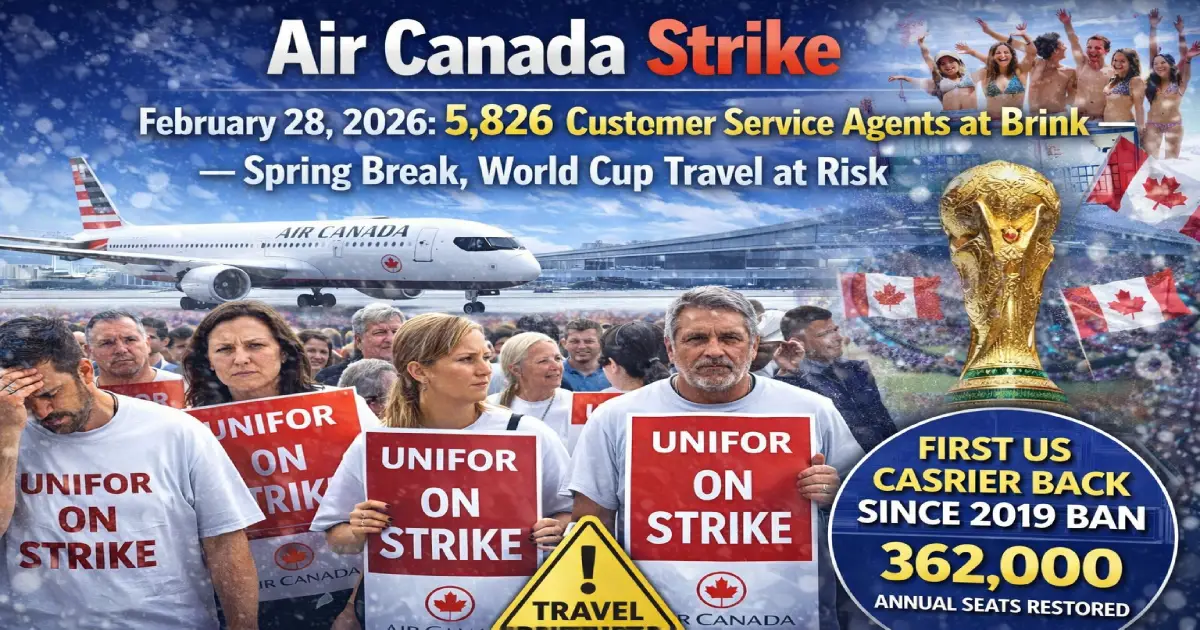
Breaking: Air Canada is heading toward a potentially devastating labour crisis as 5,826 customer service agents represented by Unifor Local 2002 enter contract negotiations with Canada’s flag carrier ahead of their collective agreement expiry on February 28, 2026 — with the looming deadline threatening to strand tens of thousands of Spring Break travellers at Toronto Pearson, Vancouver International, and Montréal-Trudeau, and raising alarm bells for the 13 FIFA World Cup 2026 matches set to be played in Toronto and Vancouver this June. Here is everything you need to know right now.
Published: February 10, 2026 Contract Expiry: February 28, 2026 (18 days away) Workers at Risk: 5,826 Unifor Local 2002 customer service agents Union: Unifor Local 2002 — Canada’s largest private-sector union Primary Hub: Toronto Pearson International Airport (YYZ) Other Hubs Affected: Vancouver (YVR), Montréal-Trudeau (YUL), Calgary (YYC), Ottawa (YOW) Bargaining Opened: January 28, 2026 Last Major Strike: August 16–19, 2025 (flight attendants) — 500,000 passengers stranded, 3,000+ flights cancelled High-Risk Travel Periods: Spring Break (Feb 28–March 22), FIFA World Cup 2026 (June 11–July 19)
Unifor opened collective bargaining with Air Canada on behalf of customer service agents — who work at airports, call centres, and provide services such as customer relations and customer journey management across the country — with the current collective agreement set to expire on February 28, 2026.
The talks cover nearly 6,000 members of Unifor Local 2002 who provide frontline passenger support including ticketing, reservations, travel changes, Aeroplan assistance, and help with online transactions. These workers also manage customer relations and support during disruptions.
These are not back-office staff. These are the people you see first when your flight is cancelled, when your connection is missed, when your bag disappears. They are the frontline human face of Air Canada at every major Canadian airport — and on February 28, their contract runs out.
Unifor says negotiations began January 28, and members are seeking higher wages, more predictable scheduling, and improved working conditions, arguing these roles are central to the passenger experience during disruptions and day-to-day operations. Customer service agents handle check-in, ticketing, rebooking, and frontline problem-solving at major airports including Toronto Pearson International Airport and in contact centres, so any labour action could quickly manifest as longer queues, slower re-accommodation, and increased pressure on airport operations.
“Air Canada’s customer service agents are the backbone of the passenger experience,” said Unifor National President Lana Payne. “They manage delays, disruptions, and customer care under immense pressure, yet too often without the staffing and protections that reflect the value of their work. This bargaining round is about respect, safety, and fairness for the workers who keep Canada flying.”
Unifor Local 2002 President Tammy Moore added: “Our members are the people travellers rely on when flights are cancelled, connections are missed, or plans fall apart. They deserve improved wages, predictable schedules, and working conditions that allow them to do their jobs properly.”
The union’s key demands centre on four areas:
Wages: Current pay deemed below industry standards and below inflation growth since the previous contract. Agents argue their real purchasing power has declined significantly since 2022.
Unpaid time: Much of the work service agents do happens under intense pressure and “includes unpaid time spent in uniform before and after shifts, as well as ongoing mandatory training to meet strict regulatory requirements.” This mirrors the exact issue that sparked the August 2025 flight attendant strike — unpaid hours are the central grievance in Canadian aviation labour disputes right now.
Staffing levels: Unifor continues to call for changes across Canada’s aviation sector through its Air Transportation Workers’ Charter of Rights, which urges action on chronic understaffing, contracting out, unsafe workloads, and inadequate training.
Job security: Concerns about contracting out of customer service roles to third-party providers, particularly at smaller regional airports where Air Canada uses ground handlers rather than direct employees.
As of February 10, 2026, Air Canada has not issued any public statement on the progress of negotiations. No counter-offer has been confirmed publicly. No mediator has been formally appointed. As of early February 2026, the public record shows active bargaining but no strike notice. Unifor’s published updates frame this as a “critical moment” and emphasize demands tied to wage increases and working conditions.
The silence from Air Canada management is being read by union observers as a possible repeat of the August 2025 flight attendant playbook — where the airline waited until the final hours before responding with an offer, banking on government intervention to end any strike.
This is the most important thing Canadian travellers need to understand: a strike cannot legally happen the moment the contract expires on February 28.
Canada’s robust Labour Code sets clear parameters for what happens when a contract between employers and unions ends. Once Air Canada’s contract with Unifor Local 2002 expires, the union and the airline enter a 60-day conciliation period. During this time, federal mediators help the two parties negotiate a new agreement. If the process fails, a 21-day cooling-off period follows, preventing any work stoppages.
The realistic strike timeline therefore looks like this:
| Stage | Timeline | What Happens |
|---|---|---|
| Contract expires | February 28, 2026 | Bargaining continues under Canada Labour Code |
| Conciliation triggered | March–April 2026 | Federal mediator appointed, up to 60 days |
| Cooling-off period | April–May 2026 | 21 days after conciliator files report |
| Earliest legal strike | May–June 2026 | 72-hour notice required before any job action |
| World Cup begins | June 11, 2026 | 13 matches in Toronto + Vancouver |
Critical Insight: The legal process means a worst-case strike could fall directly during the FIFA World Cup 2026 group stage — the single most travel-intensive period in Canadian aviation history.
The union says it is “too early to speculate on a strike date.” For now, the focus is “on negotiating a fair agreement, not on job action.”
However, travellers who remember August 2025 know that “too early to speculate” can become a 72-hour strike notice within weeks.
The last Air Canada labour crisis is the single most important context for understanding what is at stake right now.
The 2025 Air Canada flight attendants strike refers to a labour dispute between 10,517 flight attendants working with the Canadian Union of Public Employees (CUPE), and Air Canada, that evolved into a strike from August 16–19, 2025.
Air Canada was forced to cancel more than 3,000 flights — 1,534 domestic and 1,613 international flights — according to aviation analytics firm Cirium.
Air Canada chief operations officer Mark Nasr estimated that over 100,000 Canadians had been stranded by the strike who were still trying to get home, and explained in an interview that the airline would need 7 to 10 days to restore normal flight operations. BBC estimates suggested that over 500,000 passengers had been impacted by August 19.
The August 2025 flight attendant strike lasted just 3 days (August 16–18) — yet took 7–10 days to fully recover from. This is because Air Canada operates a tightly synchronized network where one disruption cascades through the entire system.
Now consider what a customer service agent strike would mean:
The August 2025 strike grounded aircraft. A Unifor Local 2002 customer service agent strike would not ground aircraft — but it would paralyse every airport check-in desk, every rebooking desk, every Aeroplan counter, every phone support line, and every online chat support channel simultaneously.
Passengers would arrive at Toronto Pearson to find:
The chaos would be different from August 2025 — but for ordinary travellers without lounge access or travel agents, it could be worse.
This is the angle no other outlet has covered yet: a protracted Air Canada labour dispute intersecting with the FIFA World Cup 2026.
From June 11 to July 19, 2026, the biggest tournament in FIFA history will take place, bringing together 48 countries for 104 games across 16 cities. Canada will host 13 matches, in Toronto and Vancouver.
The City of Toronto will welcome nations competing in six FIFA World Cup 2026 matches at Toronto Stadium located at Exhibition Place, kicking off with a historic milestone as Canada plays its first men’s FIFA World Cup match on home soil, facing the European Playoff A winner on Friday, June 12, 2026, at 3 p.m. ET. FIFA’s economic impact assessment, prepared by Deloitte Canada, estimated the tournament could generate up to $940 million in positive economic output for the Greater Toronto Area, including a projected $520 million in GDP growth.
Canada will be in Group B. Its opponents will be: UEFA Playoff A (Wales, Bosnia and Herzegovina, Italy, Northern Ireland) on June 12 in Toronto; Qatar on June 18 in Vancouver; and Switzerland on June 24 in Vancouver.
The scale of World Cup travel through Canadian airports:
Toronto Pearson (YYZ) and Vancouver International (YVR) are the two primary gateways for international fans flying in to attend matches. Conservative estimates project:
A customer service agent strike or work-to-rule action during the World Cup group stage (June 11–July 2) would be a national and international embarrassment — and a travel catastrophe for the hundreds of thousands of foreign visitors arriving at Canada’s flagship airports.
The Strike-World Cup Overlap Math:
If bargaining breaks down at contract expiry (Feb 28) and conciliation fails within the 60-day maximum window, and cooling-off takes the full 21 days:
February 28 + 60 days = April 29 → + 21 days = May 20 → + 72-hour notice = earliest legal strike: May 23, 2026
That is 19 days before the World Cup opens on June 11.
Air Canada, the Canadian government, and FIFA are all aware of this collision course. Which is why the pressure on both sides to reach a deal before Spring Break is immense — and why the union holds extraordinary leverage it has not had in previous rounds of bargaining.
Even without a legal strike, February 28 contract expiry creates immediate travel risk for Spring Break passengers.
Spring Break 2026 in Canada falls across three waves:
Wave 1 — Ontario/Quebec: March 7–15 (most Ontario school boards) Wave 2 — Western Canada: March 14–22 (British Columbia, Alberta) Wave 3 — Atlantic Canada: March 21–29 (Nova Scotia, New Brunswick, PEI)
Air Canada operates approximately 130,000 passengers per day across its network during normal operations. During Spring Break this swells to 145,000–160,000 passengers per day as families flood southbound routes to Mexico, the Caribbean, and Florida.
Worst-Case Spring Break Scenario:
If talks break down immediately after February 28, and Unifor files for federal conciliation on March 1, the conciliation process would run through March and early April — precisely during peak Spring Break travel. During this period, agents could legally work-to-rule (strict adherence to contract terms, no voluntary overtime, no flexibility on scheduling) without triggering an illegal strike.
Work-to-rule impact at YYZ during Spring Break:
No cancelled flights — but thousands of missed connections, lost vacations, and destroyed family trips.
This is not Air Canada’s first labour dispute, and the pattern is deeply concerning for travellers.
2025 — Flight Attendants (CUPE): The strike affected flights from August 16–19, 2025. The disruption was expected to affect 130,000 passengers per day, with Air Canada needing 7 to 10 days to restore normal flight operations after the strike ended.
2024 — WestJet Flight Attendants: WestJet flight attendants struck during the Canada Day long weekend (July 2024), cancelling hundreds of flights at the worst possible travel moment.
2023 — Air Canada Pilots (near-miss): Air Canada pilots’ contract dispute came within 48 hours of a strike before a last-minute deal was reached.
The Pattern: Air Canada consistently negotiates to the absolute deadline, banks on government back-to-work orders when strikes occur, and then spends 7–14 days recovering operationally. Passengers absorb the full cost of this strategy — in missed vacations, lost non-refundable hotel bookings, and ruined celebrations.
Unifor Local 2002 knows this pattern. Their leverage in 2026 is higher than any previous union: the World Cup gives them a nuclear option that flight attendants in August 2025 didn’t have.
A Unifor Local 2002 customer service agent strike would hit all Air Canada customer-facing operations simultaneously:
Whether or not a strike materialises, the February 28 contract expiry creates real, actionable risk for anyone flying Air Canada in the next 6 months. Here is your complete protection strategy:
Action 1: Book flexible fares if possible
If you haven’t yet purchased Spring Break tickets, choose the Flex or Latitude fare class rather than standard or basic economy. Yes, they cost more. Yes, it is worth it — these fares allow free changes/cancellations if disruption occurs.
Action 2: Consider alternative carriers
For high-stakes, non-refundable trips (cruise connections, resort packages, destination weddings), seriously evaluate flying non-Air Canada:
Action 3: Purchase travel insurance NOW
If booking Air Canada for Spring Break or summer:
Action 4: Monitor Unifor’s bargaining updates
Bargaining updates for Air Canada Unifor members are published at unifor.org/aircanada.
Watch for three red-flag announcements:
This is the highest-risk booking category. If you have purchased Air Canada flights for June 11–July 19, 2026 travel related to the World Cup:
✅ Check refund/change policy immediately — know your options before a crisis hits ✅ Screenshot and save your booking confirmation — in all formats (email, app, PDF) ✅ Register for Air Canada flight status alerts — get 24-hour SMS/email notification of any changes ✅ Identify backup carriers NOW — for Toronto and Vancouver routes, know which airlines serve your origin city (Delta, United, American, British Airways, Lufthansa, KLM, etc.) ✅ Book travel insurance immediately — do not wait. CFAR policies must be purchased near booking date ✅ Contact your travel agent or corporate travel manager — if this is a business trip, escalate to your company’s travel risk management team
Unlike passengers in the UK (UK261) or Europe (EU261), Canadian air passenger rights are significantly weaker when it comes to labour disputes.
Under the Canadian Air Passenger Protection Regulations (APPR):
Practical advice: If your Air Canada flight is cancelled during a strike, do NOT accept a future travel credit if you need a cash refund. Demand a full cash refund to original payment method. Under APPR, you are entitled to this for any cancelled flight regardless of fare type.
The most powerful factor in this dispute is not the union, not Air Canada, and not the legal timeline. It is the Canadian federal government.
The Canadian federal government has issued back-to-work orders to halt or prevent strikes eight times since June 2024. Air Canada flight attendants were the first in that period to defy the order.
The current government faces an impossible calculation on a World Cup summer strike:
If they intervene early: Unions across Canada (not just aviation) will accuse the government of systematically stripping collective bargaining rights. A political crisis.
If they don’t intervene: 500,000+ international World Cup visitors arrive at Canadian airports to find Air Canada customer service collapsed. An international embarrassment unprecedented in Canadian tourism history.
The World Cup leverage is real: FIFA contracts with host nations include minimum service guarantees for international visitors. A Canadian government that allowed Air Canada customer service to collapse during the World Cup would face FIFA consequences, international media humiliation, and a tourism damage that would take years to repair.
Most likely outcome: The Canadian government will apply enormous behind-the-scenes pressure on both sides to reach a deal before Spring Break. If talks stall through March, expect federal conciliation to be fast-tracked — and potentially a pre-emptive announcement of “essential service” designations for World Cup match dates.
Air Canada’s 5,826 Unifor Local 2002 customer service agents are 18 days from contract expiry on February 28, 2026. A legal strike cannot happen immediately — Canadian law requires 60-day conciliation plus 21-day cooling-off before any job action. But the worst-case timeline places a potential strike directly during Spring Break travel peaks and dangerously close to the FIFA World Cup 2026 opening matches in Toronto and Vancouver. With August 2025’s flight attendant strike stranding 500,000 passengers still fresh in every Canadian traveller’s memory, and Air Canada’s history of negotiating to the last minute, the risk of disruption is real and rising.
Action Checklist for Air Canada Passengers:
✅ Spring Break flights booked on AC? Buy CFAR travel insurance before February 21 (14-day purchase window closes) ✅ World Cup travel booked on AC? Screenshot everything, identify backup carriers, buy insurance NOW ✅ Critical trip coming up? Book Flex/Latitude fare, consider WestJet/Porter alternative ✅ Monitor strike alerts: Follow Unifor at unifor.org/aircanada ✅ Know your rights: Demand full cash refund (not travel credit) if AC cancels your flight ✅ Escalate early: If 72-hour strike notice is issued, book alternative carrier immediately — seats disappear within hours
For the latest Air Canada operational status, visit aircanada.com. For Unifor Local 2002 bargaining updates, visit unifor.org/aircanada.
For More Resources:
Related Articles:
Posted By : Vinay
Lastest News
2nd Floor, 39, Above Kirti Club, DLF Industrial Area, Kirti Nagar, New Delhi, Delhi 110015



Travel Tourister is a leading Travel portal where we introduce travellers to trusted travel agents to make their journey hasselfree, memorable And happy. Travel Tourister is a platform where travellers get Tour packages ,Hotel packages deals through trusted travel companies And hoteliers who are working with us across the world. We always try to find new and more travel agents and hoteliers from every nook and corners across the world so that you could compare the deals with different travel agents and hoteliers and book your tour or hotel with the one you have chosen according to your taste and budget.
Copyright © Travel Tourister, India. All Rights Reserved

 Call
Call Enquiry