Air New Zealand Strike TODAY February 12-13: 44 Flights Cancelled as Cabin Crew Walk Out Over Pay Dispute—16,000 Passengers Stranded, Auckland to Los Angeles, San Francisco, Tokyo, Hong Kong Grounded, Wide-Body Network Paralyzed

Published on : 12 Feb 2026
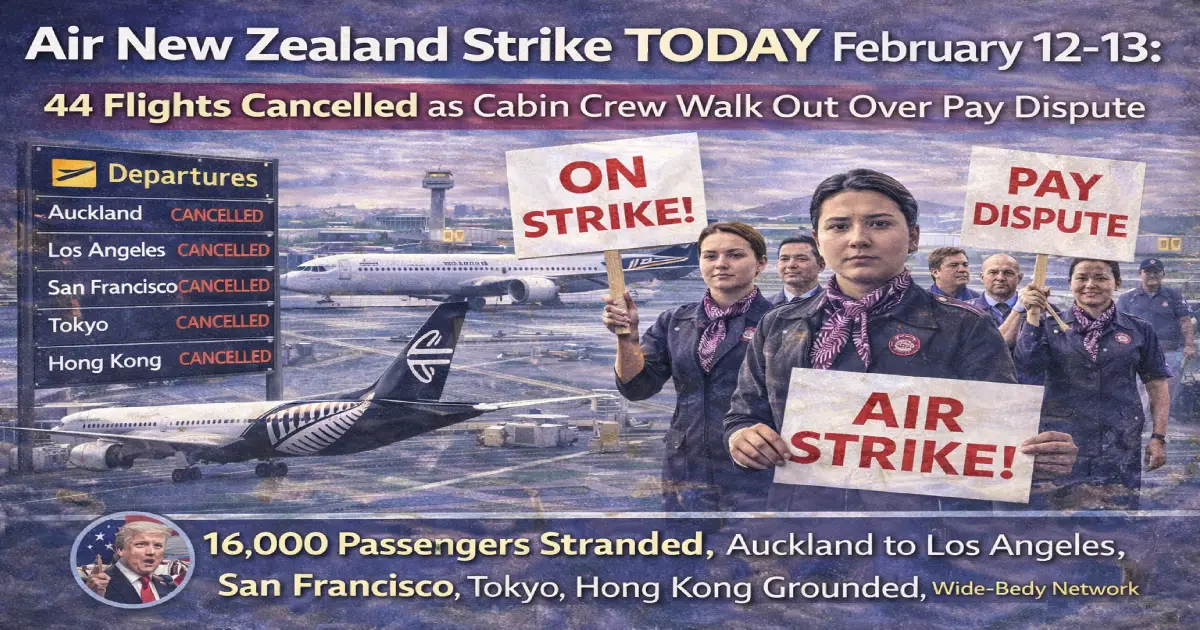
Air New Zealand strike February 12-13 2026 Auckland Airport cabin crew walkout 44 flights cancelled 16000 passengers stranded pay dispute cant afford rent

BREAKING DISRUPTION: Air New Zealand passengers are facing unprecedented chaos TODAY (February 12-13, 2026) as unionized international cabin crew execute a 48-hour strike grounding virtually ALL long-haul wide-body operations from Auckland—with 44 flights cancelled affecting approximately 16,000 passengers traveling to North America (Los Angeles, San Francisco), Asia (Tokyo, Hong Kong, Singapore), and beyond as the Flight Attendants’ Association of New Zealand (FAANZ) and E tÅ« union escalate a months-long pay dispute after management offered salary increases of just 4.14%-6.41% that cabin crew say leaves them unable to afford Auckland rent on starting wages below New Zealand’s living wage. While short-haul Tasman (Australia) and Pacific Island routes operate normally using narrow-body aircraft, the strike decimates Air New Zealand’s international connectivity—forcing thousands to scramble for alternative bookings on Star Alliance partners or accept travel credits as the airline warns further industrial action could follow with just 14 days’ notice if facilitated bargaining through the Employment Relations Authority fails to resolve what has become New Zealand aviation’s most significant labor dispute in recent memory.


Published: February 12, 2026
Strike Dates: TODAY & TOMORROW – February 12-13, 2026
Duration: 48 hours (Thursday-Friday)
Flights Cancelled: 44 (primarily long-haul)
Passengers Affected: ~16,000
Routes Grounded: Auckland → Los Angeles, San Francisco, Tokyo, Hong Kong, Singapore, more
Aircraft Type: Wide-body only (Boeing 777, 787 Dreamliner)
NOT Affected: Tasman (Australia), Pacific Islands (narrow-body aircraft)
Unions: Flight Attendants’ Association of NZ (FAANZ), E tÅ«
Core Dispute: Pay below living wage, working conditions
Management Offer: 4.14%-6.41% first-year increases (REJECTED)
Next Step: Employment Relations Authority facilitated bargaining


What’s Happening TODAY: Strike Timeline

Thursday-Friday, February 12-13 – Complete Wide-Body Shutdown

ALL DAY (48 hours):

  • International cabin crew working Boeing 777 and 787 Dreamliner aircraft refuse to work
  • 44 flights cancelled (primarily Auckland departures to North America/Asia)
  • ~16,000 passengers affected
  • Auckland Airport: Long-haul check-in counters shuttered for most routes
  • Short-haul (Australia, Pacific Islands): Operating normally

Specific Routes GROUNDED:

North America (Hardest Hit):

  • Auckland → Los Angeles (NZ2/NZ6/NZ8) – CANCELLED
  • Auckland → San Francisco (NZ6/NZ10) – CANCELLED
  • Auckland → Chicago (if operating) – CANCELLED
  • Auckland → Honolulu (if operating) – CANCELLED

Asia (Significant Disruption):

  • Auckland → Tokyo Narita (NZ90/NZ92) – CANCELLED
  • Auckland → Hong Kong (NZ80/NZ82) – CANCELLED
  • Auckland → Singapore (NZ281/NZ283) – CANCELLED
  • Auckland → Shanghai (if operating) – CANCELLED
  • Auckland → Seoul (if operating) – CANCELLED

Other Long-Haul:

  • Auckland → Buenos Aires (via Sydney/Santiago connections) – CANCELLED
  • Auckland → London (via Asia/Middle East connections) – DISRUPTED

Routes OPERATING Normally:

Tasman (Australia):

  • Auckland → Sydney, Melbourne, Brisbane, Perth, Adelaide
  • Wellington → Sydney, Melbourne
  • Christchurch → Sydney, Melbourne
  • Using Airbus A320/A321 narrow-body aircraft (different crew)

Pacific Islands:

  • Auckland → Fiji (Nadi), Rarotonga (Cook Islands), Tonga, Samoa, Tahiti
  • Using narrow-body aircraft (not affected by wide-body crew strike)

The Pay Dispute: Why Crew Are Striking

The core issue isn’t just percentages—it’s survival in one of the world’s most expensive cities:

Starting Pay vs. Cost of Living

Cabin crew starting salary:

  • Base pay: Approximately NZ$45,000-$50,000 annually (US$27,000-$30,000)
  • Below New Zealand’s living wage of ~NZ$52,000 for 2025-2026

Auckland cost of living (2026):

  • Median rent (1-bedroom apartment): NZ$600-$800/week = NZ$31,200-$41,600/year
  • Rent alone consumes 62-83% of starting cabin crew salary
  • Utilities, food, transport, insurance: Additional NZ$300-$400/week
  • Reality: Starting cabin crew literally cannot afford to live in Auckland on their salary

One source told Aviation A2Z:

“Air New Zealand Cabin Crew Strike as They Are Unable to Pay Rent”

Management’s Offer (REJECTED)

Air New Zealand proposed:

  • First-year increases: 4.14%-6.41% (varies by seniority)
  • Multi-year agreement (total duration not disclosed)
  • Additional benefits: Unspecified

Why unions rejected:

  • Even 6.41% on NZ$50,000 = NZ$53,205 (barely above living wage)
  • Doesn’t address existing shortfall (crew already behind)
  • Multi-year deal locks in inadequate pay
  • Inflation in Auckland running ~5-6% annually (gains erased by year 2)

What Unions Want

FAANZ President David Featherby:

“Our members love their jobs. They’re the safety ambassadors of Air New Zealand and they represent New Zealand to the world. We want passengers to continue to have that exceptional service on board. But we just have to get through the next couple of months with the negotiations that are currently taking place.”

Union demands (specifics not fully disclosed):

  1. Base pay above living wage for all cabin crew (including starting positions)
  2. Cost-of-living adjustments tied to inflation
  3. Improved roster flexibility (work-life balance)
  4. Better layover accommodations on international routes
  5. Retention incentives (prevent exodus to foreign carriers)

Negotiations status:

  • Months of talks: Since at least late 2025
  • 7+ bargaining sessions: No agreement reached
  • Strike originally planned: 3 days (reduced to 2 days)
  • Next step: Employment Relations Authority facilitated bargaining (government-mediated)

Impact on International Travelers

16,000 Passengers Affected

Who’s hit hardest:

1. US Travelers:

  • Americans flying Auckland → Los Angeles/San Francisco to connect home
  • Australians/Kiwis visiting US (West Coast entry point)
  • Impacts: Missed US connections, hotel rebookings, extended trips

2. Asian Travelers:

  • Japanese, Singaporean, Hong Kong visitors to New Zealand
  • New Zealanders traveling to Asia for business/leisure
  • Impacts: Missed Asian connections, delayed returns, tour disruptions

3. Australians:

  • Long-haul flights from Australia routing through Auckland (e.g., Sydney → Auckland → Los Angeles)
  • Impacts: Stranded in Auckland, forced to rebook direct Australia-US routes (expensive)

4. New Zealanders:

  • Citizens returning home from overseas
  • Kiwis traveling abroad for work, family visits
  • Impacts: Delayed homecomings, missed international events

Rebooking Chaos

Air New Zealand’s rebooking policy:

Option 1: Rebook on Air New Zealand

  • Timeline: 2-3 days either side of strike (e.g., Feb 10-11 or Feb 14-15)
  • Fare difference: Waived (no extra charge)
  • Challenge: Limited seats available (16,000 passengers competing for few spots)

Option 2: Star Alliance Partners

  • Airlines: United, Singapore Airlines, Thai Airways, Air Canada, others
  • Availability: Limited (partners also near capacity)
  • Routes: May require different routings (e.g., Auckland → Sydney → Los Angeles instead of direct)

Option 3: Travel Credit

  • Value: Full fare amount held for future travel
  • Expiry: Typically 12 months (Air NZ specific terms)
  • Use: Any Air New Zealand flight

Option 4: Full Refund

  • Eligibility: Any passenger whose flight was cancelled
  • Fare rules: Waived (even non-refundable tickets get refunds)
  • Timeline: 7-14 business days (credit cards), 6-8 weeks (other methods)

Chief Customer Officer Jeremy O’Brien:

“We’ve actually provided re-accommodation options for all of the impacted customers on the flights two to three days either side of the strike days. For not every customer that’s going to be suitable, and for those customers, they’re entitled to and should request either a credit to fly later or a refund.”

Alternative Airlines (If You Must Fly This Week)

US Routes:

  • United Airlines: Auckland → San Francisco (daily)
  • American Airlines: Sydney → Los Angeles → US connections (indirect)
  • Qantas: Auckland → Sydney → Los Angeles (2-stop)
  • Problem: Limited availability, expensive last-minute fares

Asian Routes:

  • Singapore Airlines: Auckland → Singapore (daily)
  • Thai Airways: Auckland → Bangkok (multiple weekly)
  • Cathay Pacific: Auckland → Hong Kong (if operating)
  • JAL/ANA: Sydney/Melbourne → Tokyo (indirect via Australia)

Cost implications:

  • Last-minute fares: 2-5X normal prices
  • Air NZ supposed to cover fare difference, but in practice difficult
  • May require purchasing new ticket, claiming reimbursement later (risky)

Why Wide-Body vs. Narrow-Body Matters

The Aircraft Divide

Wide-body aircraft (GROUNDED):

  • Boeing 777-200ER, 777-300ER: Long-range, 300+ seats
  • Boeing 787-9 Dreamliner: Ultra-long-range, 300+ seats
  • Crew requirements: ~12-16 cabin crew per flight (international long-haul standards)
  • Routes: North America, Asia, South America

Narrow-body aircraft (OPERATING):

  • Airbus A320, A321neo: Short-medium range, 150-200 seats
  • Crew requirements: ~4-6 cabin crew per flight
  • Routes: Australia, Pacific Islands, domestic New Zealand

Why narrow-body flights continue:

  • Different crew pool: Narrow-body cabin crew are in different union bargaining unit (or not striking)
  • Shorter flights: Less crew intensive
  • Domestic/regional focus: Not part of international cabin crew negotiations

This is strategic: Union knows wide-body routes = highest revenue, most critical to Air NZ. Targeting those maximizes pressure while minimizing collateral damage to domestic/regional travelers.


Historical Context: Rare Labor Action

Air New Zealand’s Labor Relations History

Generally harmonious:

  • Air NZ historically had relatively good labor relations
  • Strikes are RARE compared to European/North American carriers
  • Last major disruption: [Unknown—this appears to be unprecedented in recent years]

Why this is significant:

  • New Zealand’s “fair work” culture typically resolves disputes before strikes
  • Employment Relations Authority (government mediator) usually successful
  • Reaching strike stage = negotiations REALLY broke down

Comparing to Global Airline Strikes (2026)

Recent strikes:

  • Lufthansa pilots (Germany): February 12, 2026 (same day!) over pension dispute
  • Italy airline strikes: February 16, 2026 (ITA Airways, Vueling)
  • Porter Airlines threat (Canada): January 20, 2026 deadline (averted at last minute)
  • UK airport chaos: Multiple January 2026 staffing crises

Pattern: Global airline labor unrest post-pandemic as workers demand compensation after years of wage freezes and staff shortages.


What Air New Zealand Says

Management Response

Chief Customer & Digital Officer Jeremy O’Brien (Newstalk ZB interview):

“This is no different than other disruptions that we manage on an ongoing basis. It’s just part of business as usual. The key thing for us is when we know that we’ve got a disruption to the schedule that we go out and offer as many alternatives and options as possible to the customers and in this case, the whole business is rallying around and been able to do that.”

Describing strike as “controllable disruption”:

  • Proactive cancellations (gave passengers advance notice)
  • Re-accommodation across 2-3 day window
  • Star Alliance partner bookings
  • Meals, accommodation where required

Chief People Officer Nikki Dines (interviewed TODAY):

  • Confirmed pay is central issue
  • Said negotiations ongoing
  • Emphasized airline’s financial constraints

Airline’s Position

Financial challenges cited:

  • Aircraft delivery delays (Boeing 787 backlogs)
  • High operating costs in New Zealand
  • Competition from budget carriers (Jetstar, others)
  • Need to remain financially sustainable

Management argues:

  • 4.14%-6.41% first-year increases are “competitive” within NZ industry
  • Multi-year agreement provides stability
  • Larger increases economically unsustainable

Future Strikes Possible

14-Day Notice Requirement

New Zealand employment law:

  • Any future strike action requires 14 days’ advance notice to employer
  • Cannot surprise Air NZ with sudden walkout
  • Gives passengers/airline time to prepare

What this means:

  • If facilitated bargaining fails, union could announce next strike anytime
  • Passengers would have 14 days’ warning
  • Could be longer duration (3+ days)
  • Could target peak travel periods (school holidays, summer)

Employment Relations Authority Process

Next step:

  • Government-appointed mediator facilitates negotiations
  • Both sides present positions
  • Mediator proposes compromise solutions
  • NOT binding arbitration (parties can still reject)

Timeline:

  • Could resolve quickly (days/weeks) if both sides willing
  • Could drag on for months if positions entrenched
  • Strike action can continue during facilitated bargaining

Scenarios:

  1. Best case: Agreement reached within weeks, no more strikes
  2. Moderate case: Multiple negotiation rounds, occasional strikes continue
  3. Worst case: Prolonged dispute, repeated strikes through 2026

What Passengers Should Do

If Your Flight Was Cancelled

Immediate actions:

1. Check Email/SMS:

  • Air NZ should have contacted you via email, SMS, phone
  • Check spam folder (automated messages sometimes filtered)

2. Rebook Online:

  • Air NZ website: “Manage Booking” section
  • Mobile app (iOS/Android): Fastest option
  • Select from available alternative flights (2-3 days either side)

3. Call if Online Fails:

  • New Zealand: 0800 737 000
  • Australia: 13 24 76
  • US/Canada: 1-800-262-1234
  • UK: 0800 028 4149
  • Expect: Long wait times (thousands calling simultaneously)

4. Request Refund if Rebooking Unsuitable:

  • Online: “Manage Booking” → Request refund
  • Refund issued to original payment method
  • Full fare amount refunded (even non-refundable tickets)

If You’re Booking Future Air NZ Flights

Risk assessment:

  • Strike resolved? Safe to book
  • Negotiations ongoing? Risk of future strikes (14-day notice)

Protection strategies:

  • Book refundable fares (higher cost, but flexibility)
  • Travel insurance: Check if policy covers “labor strikes” (many don’t)
  • Alternative airlines: Consider routing via Australia on Qantas/Virgin Australia
  • Monitor news: Follow negotiations (if no agreement, expect more strikes)

Alternative Routes to Consider

US-bound:

  • Fly to Sydney/Melbourne first (Air NZ narrow-body OK)
  • Then Sydney → Los Angeles on Qantas/United/Delta
  • Adds time, but avoids strike risk

Asia-bound:

  • Similar strategy: Transit via Australia
  • Sydney → Singapore/Tokyo/Hong Kong on Qantas/Singapore Airlines/JAL/ANA

Cost: More expensive, but greater reliability


The Broader New Zealand Tourism Impact

Inbound Tourism Affected

Peak season:

  • February = late summer in New Zealand (prime tourism)
  • International visitors (especially US, Europe, Asia) rely on Air NZ
  • Strike during peak = maximum tourism damage

Tourism New Zealand concerns:

  • Reputation damage (“Is NZ accessible?”)
  • Lost tourism revenue (cancelled trips = lost hotel, tour, restaurant spending)
  • Future booking hesitation (travelers avoid Air NZ due to strike risk)

Economic impact (estimated):

  • 16,000 passengers × avg NZ$2,000-3,000 spending per visitor
  • Potential NZ$32-48 million in lost tourism spending (if visitors cancel entirely)
  • Ripple effects: Hotels, rental cars, tours, restaurants

Outbound New Zealand Travel

Kiwis traveling overseas:

  • Business travel disrupted (missed meetings, conferences)
  • Family visits delayed (expats unable to visit NZ)
  • Educational travel affected (students starting university abroad)

Alternative: Fly from Australia (but requires traveling to Sydney/Melbourne first)


FAQs

Q: Will my Air NZ flight be cancelled if it’s after February 13?
A: Not automatically. The current strike is only February 12-13. However, if negotiations fail, future strikes are possible with 14 days’ advance notice.

Q: Can I get compensation for the strike delay?
A: No. Strikes are considered “extraordinary circumstances” under passenger rights laws, exempting airlines from compensation. But you’re entitled to rebooking or refund.

Q: What if I’m connecting through Auckland from Australia to the US?
A: If booked on single ticket, Air NZ must rebook you on alternative routing (e.g., direct Australia-US flight on partner airline). If separate tickets, you’re responsible for your own arrangements.

Q: Are domestic New Zealand flights affected?
A: No. Domestic flights use narrow-body aircraft and different crew pool.

Q: Why aren’t Australia flights affected?
A: Tasman routes (NZ-Australia) use narrow-body aircraft (Airbus A320/A321) which aren’t staffed by striking wide-body cabin crew.

Q: Should I avoid booking Air New Zealand?
A: Union President David Featherby urges passengers NOT to avoid Air NZ: “Our members love their jobs… We want passengers to continue to have that exceptional service.” But be aware of potential future strikes if negotiations fail.

Q: What happens if strike is extended?
A: Any extension requires 14 days’ advance notice, giving passengers time to adjust plans.


The Bottom Line

Air New Zealand’s 48-hour international cabin crew strike (February 12-13, 2026) represents an unprecedented disruption to New Zealand’s aviation connectivity as 44 flights cancelled affecting 16,000 passengers expose the financial strain on airline workers struggling to afford Auckland rent on starting salaries below the national living wage despite management’s 4.14%-6.41% pay increase offers. While short-haul Tasman and Pacific Island routes operate normally using narrow-body aircraft, the strike decimates critical long-haul links to North America (Los Angeles, San Francisco) and Asia (Tokyo, Hong Kong, Singapore)—forcing thousands to scramble for alternative bookings on Star Alliance partners or accept travel credits as the airline and Flight Attendants’ Association of New Zealand (FAANZ) head to government-mediated facilitated bargaining that will determine whether this becomes a one-time disruption or the beginning of prolonged industrial action requiring 14-day advance notice for any future strikes.

For travelers: Key takeaways:

  • ✅ Check flight status immediately if traveling February 12-13
  • ✅ Rebook online (faster than phone/airport)
  • ✅ Know your rights (rebooking or refund guaranteed, but no cash compensation)
  • ✅ Future travel: Monitor negotiations—strike could recur if no agreement
  • ✅ Alternative routes: Consider routing via Australia on Qantas/partners

For Air New Zealand:

  • Strike exposes pay inadequacy (crew can’t afford rent)
  • Reputation damage during peak tourism season
  • Financial pressure to resolve quickly (each strike = millions lost)

For the union:

  • Strike demonstrates worker solidarity
  • Wide-body targeting maximizes leverage
  • Public sympathy likely (housing crisis is national issue)

Whether this marks a turning point in New Zealand aviation labor relations or a brief disruption depends on what happens in the Employment Relations Authority facilitated bargaining room—but for 16,000 passengers stranded TODAY, the impact is immediate and undeniable.


For More Information:

Related Articles:

Posted By : Vinay

As a lead contributor for Travel Tourister, Vinay is dedicated to serving our Tier 1 audience (US, UK, Canada, Australia). His mission is to deliver precise, fact-checked news and actionable, data-driven articles that empower readers to make informed decisions, minimize travel risks, and maximize their adventure without compromising safety or budget.

Lastest News

How to reach

2nd Floor, 39, Above Kirti Club, DLF Industrial Area, Kirti Nagar, New Delhi, Delhi 110015

Payment Methods

card

Connect With Us

Travel Tourister is a leading Travel portal where we introduce travellers to trusted travel agents to make their journey hasselfree, memorable And happy. Travel Tourister is a platform where travellers get Tour packages ,Hotel packages deals through trusted travel companies And hoteliers who are working with us across the world. We always try to find new and more travel agents and hoteliers from every nook and corners across the world so that you could compare the deals with different travel agents and hoteliers and book your tour or hotel with the one you have chosen according to your taste and budget.

Your Tour Package Requirement

Copyright © Travel Tourister, India. All Rights Reserved

Travel Tourister Rated 4.6 / 5 based on 22924 reviews.