Published on : 11 Feb 2026
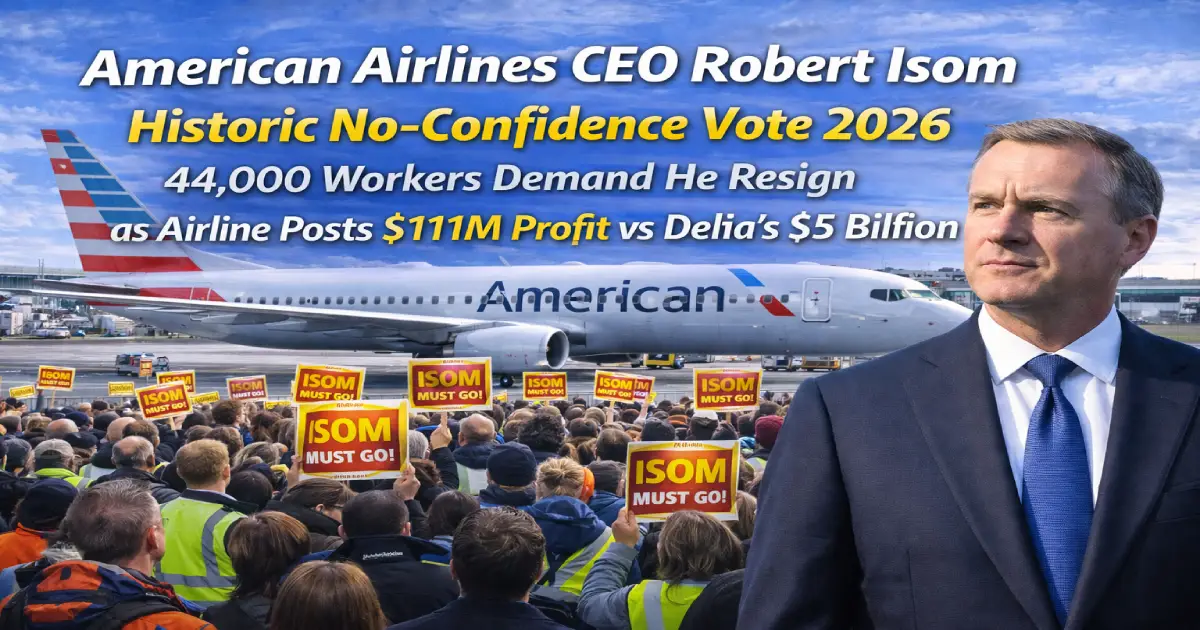
Breaking: American Airlines CEO Robert Isom faces the most serious internal rebellion in the 100-year history of America’s largest airline after the Association of Professional Flight Attendants issued a unanimous no-confidence vote on February 9, 2026 — the first such vote against an American Airlines CEO in APFA’s nearly 50-year history — simultaneously with the Allied Pilots Association representing 16,000 pilots publicly declaring they have “lost confidence in management’s ability to correct course,” creating a combined workforce revolt of 44,000 frontline employees demanding leadership change at an airline that made just $111 million in 2025 while Delta earned $5 billion and United earned $3.4 billion on similar revenue. Here is the complete story and what it means for passengers.
Published: February 11, 2026 Vote Date: February 9, 2026 Historic First: First-ever no-confidence vote against an American Airlines CEO in APFA’s 50-year history Union: Association of Professional Flight Attendants (APFA) Workers Represented: 28,000 American Airlines flight attendants (APFA) + 16,000 pilots (APA) = 44,000 total CEO Under Fire: Robert Isom (in role since March 2022) AA 2025 Profit: $111 million (down 87% year-over-year) Delta 2025 Profit: $5 billion (45x larger than American) United 2025 Profit: $3.4 billion (31x larger than American) AA Revenue 2025: $54.6 billion (similar capacity to Delta + United) Winter Storm Fern Impact: 9,000+ cancellations, $150M–$200M revenue hit CEO Response: Referred media to January earnings call comments only
In a historic first, the Association of Professional Flight Attendants Board of Directors, reflecting the collective voice of 28,000 American Airlines flight attendants, issued a unanimous vote to address the “relentless downward spiral” under Isom’s leadership. The vote is a clear message that American Airlines’ largest unionized workgroup has no confidence or trust in management led by CEO Robert Isom. The Union is demanding accountability, improved operational support and leadership change at American Airlines.
The vote was unanimous amongst the board of directors for the Association of Professional Flight Attendants — the first time they have taken such an action against a sitting chief executive in its nearly 50-year history. It comes less than two weeks after the union called for new leadership.
In plain language: American Airlines’ 28,000 flight attendants — the people who keep you alive and comfortable on every single AA flight — have officially told the world their CEO has failed them. Not privately. Not through backchannels. Publicly, unanimously, and historically.
The flight attendants didn’t act alone. The Allied Pilots Association, which represents 16,000 American Airlines pilots, said it may call its own vote of no-confidence in Robert Isom. In a letter sent to the American Airlines board of directors, the union asked for a meeting between the two boards. The union’s board of directors wants to meet with the American Airlines board to address the airline’s struggle to compete with other airlines.
Captain Dennis Tajer, spokesperson for the Allied Pilots Association Communications Committee, told FOX Business that the pilots’ union “understands” the APFA’s “deep frustration” with Isom. The APA “understands and respects their deep frustration with Mr. Isom’s leadership and his stewardship of American’s lacklustre financial recovery, to include the lack of a long-term strategy to catch Delta and United while defining an identity.”
American Airlines’ pilots added that they “have lost confidence in management’s ability to correct course” and called for “decisive action.” “We require leaders who are willing, equipped, and empowered to get the house in order,” the pilot’s union stated. “Leadership must change the culture of this airline, define American’s business identity, develop a strategy to not just improve but to outperform our competitors, and restore pride across the organisation.”
Combined workforce in open revolt: 44,000 people. Every pilot flying your aircraft. Every flight attendant on your flight. All demanding the same thing — a new CEO.
The no-confidence vote was not a vague, emotional reaction. In a letter to union members, the APFA detailed the reasons behind their unanimous no-confidence vote across five specific categories.
American Airlines made $111 million last year, while rivals Delta Air Lines and United Airlines posted $5 billion and more than $3 billion in profit, respectively.
The numbers are staggering in context:
| Airline | 2025 Revenue | 2025 Net Profit | Profit Margin |
|---|---|---|---|
| Delta Air Lines | $61.6B | $5.0B | 8.1% |
| United Airlines | $57.1B | $3.4B | 5.9% |
| American Airlines | $54.6B | $111M | 0.2% |
American has taken in $163 billion in revenue over the last three years and earned just $1.07 billion combined. Delta took in $180 billion during the same stretch and retained $13 billion, while United accrued $170 billion with $10 billion retained.
For every $1 billion of 2025 revenue, American produced roughly $2 million of GAAP net income. Delta produced about $79 million. United produced about $57 million.
While profits collapsed, executive pay didn’t. APFA noted significant increases in CEO Robert Isom’s compensation and benefits despite poor financial and operational performance, and top executives “receiving substantial compensation packages” even after Isom stated he was “not satisfied” with results.
The flight attendants who kept flying every single day received: 0.3% profit sharing in 2025.
“I know that it is a meager profit-sharing, a very small profit-sharing pool this year. Again, when you break even, that’s the kind of profit-sharing you have,” Isom told employees after releasing earnings results on January 27, according to a recording of the event reviewed by CNBC. “I’m disappointed in that.”
The union cited the airline’s meltdown during Winter Storm Fern, which led to over 9,000 cancellations and an estimated $200 million impact on the airline’s early-2026 results, as an example of inherent management failure. “Ongoing chaotic and mismanaged operations during weather events, service inconsistencies and declining customer trust indicate broader operational struggles noted by unionised workgroups at the carrier.”
“When the recent winter storm hamstrung our operations to the point where Flight Attendants were sleeping on airport floors, Robert Isom’s response was that it was just ‘part of our job,'” said Julie Hedrick, President of the APFA. “His tone-deaf leadership shows a complete disregard for the human element and is actively harming both American Airlines and the people who keep it running every day.”
American cancelled 653 flights on January 29 alone — 46 times more than competitors Delta and United on the same day. American said the storm made Sunday January 26 the largest flight cancellation day since the pandemic hit in early 2020. The airline had to cancel more than 9,000 flights over four days.
For context, while American’s crews slept on airport floors during Fern, Delta and United — operating in the same weather — ran near-normal operations. The storm wasn’t the problem. American’s management systems were.
APFA also highlighted the airline’s failed corporate sales and distribution strategy, which alienated key business customers and reduced revenue, but did not result in a financial penalty for the executive who developed it. “After departing American abruptly in June 2024, the former chief commercial officer responsible for the sales debacle received more than $462,000 in base pay through January 31, 2025, and nearly $1 million in severance,” the union stated.
The strategy — pushed by former Chief Commercial Officer Vasu Raja — pulled American Airlines tickets from corporate booking tools and travel management companies. The result: businesses switched their employees en masse to Delta and United. American has spent 2024–2025 desperately trying to win them back. Despite criticism of that strategy, Raja reportedly received substantial compensation after leaving the airline, angering labour groups who argue management rewards contrast sharply with employee sacrifices.
In May 2025, J.D. Power ranked American Airlines last in first/business class customer satisfaction, with economy and basic economy also trailing major competitors.
United CEO Scott Kirby — whom American actually fired in 2016 — has vowed to keep his old employer at bay. Around the time American reported earnings, United posted a digital billboard in Chicago that read: “More on time, less canceled flights. Aadvantage, United” — using the same spelling as American’s own AAdvantage loyalty program.
Being publicly mocked on a billboard by the CEO you fired. That is where American Airlines finds itself in its 100th year.
“By October 2025, all Unions representing American Airlines workers jointly called on management to present a credible turnaround strategy to address worsening performance gaps. The plan never materialised.”
The unions didn’t arrive at this no-confidence vote suddenly. They spent months requesting a strategy. They were ignored. The February 9 vote is the consequence of that silence.
American Airlines has yet to release a comment concerning the vote; however, they sent statements Isom made during a recent earnings call.
In response to media requests for comment, American Airlines referred to remarks Isom made during the airline’s recent earnings call: “Our strategy to deliver on American’s revenue potential centers on four key areas: delivering a consistent, elevated customer experience, maximizing the power of our network and fleet, building partnerships that deepen loyalty and lifetime value, and continuing to advance our sales, distribution, and revenue management efforts. While this has been a multi-year effort, 2026 will be the year these efforts start to bear fruit.”
Separately, after the pilots union wrote to the board, Isom sent a letter saying he would call APA President Nick Silva Monday to set up a time to meet. “The board and I are aligned with you in the desire to make American the strongest airline possible in every respect,” Isom wrote.
The problem: Sending a two-week-old earnings call quote in response to a historic no-confidence vote — and offering a phone call — does not project urgency. It projects the exact tone-deafness that the union accused Isom of in the first place.
Union reaction to the response was swift. APFA leaders called it inadequate. Pilots said it did not address their substantive concerns. The press cycle amplified the optics of a CEO hiding behind a PR team while 44,000 employees demanded his resignation publicly.
Isom has been in the CEO role since March 2022. He came up through the airline industry via America West Airlines — the same path as his predecessor Doug Parker. He was widely seen as Parker’s chosen successor, promoted through the ranks as a loyal operator rather than a visionary transformational leader.
His tenure has coincided with:
One industry observer noted: “I continue to think that while Isom is a nice guy, he’s not the person who can turn the airline around. American needs a hard reset, with all employees rallying behind a new vision. Isom has simply lost — or maybe never had — the support of frontline workers, and he’s not doing much to inspire them.”
The irony is total: American Airlines entered 2026 celebrating its 100th anniversary — a century of aviation history. Instead of celebrating, it is fighting for its competitive soul.
This is the question every American Airlines passenger and investor is asking right now.
The honest answer: Not directly — but indirectly, it changes everything.
While such votes do not remove executives, they represent a serious and public rebuke from frontline employees.
No union vote has ever directly fired a US airline CEO. That power belongs exclusively to the board of directors. However, here is why this vote is different from symbolic gestures:
1. The Board Is Watching
American’s board of directors now has a formal, public, unanimous declaration from its largest frontline workforce that they have no confidence in the CEO. Every board member who votes to retain Isom is now personally on record endorsing him against that declaration. That is a different kind of accountability.
2. Investors Are Watching
American’s stock is roughly flat this year. Its competitor 20 miles away in Dallas, Southwest Airlines, is also trying to remake itself, and its stock is up more than 30% in 2026. Shares of United and Delta are up more than 3% and more than 8%, respectively, for the year.
A CEO who cannot retain the confidence of pilots AND flight attendants AND investors simultaneously is in a genuinely precarious position.
3. Operational Risk Escalates Immediately
So far, there is no indication that American Airlines’ board plans leadership changes. However, APFA leaders say they will continue coordinating with other unions to demand accountability and operational improvements. Union leadership has made clear that replacing current leadership remains a key objective if performance does not improve.
The practical impact of a public no-confidence vote on operations is measurable: morale drops, sick call rates rise, voluntary overtime disappears, and work-to-rule behaviour increases. Every one of those factors directly translates to more delays, more cancellations, and worse passenger experience — creating a self-reinforcing cycle.
4. Spring and Summer Travel Is the Test
American has promised 2026 will be “the year it starts to bear fruit.” If Spring Break 2026 and Summer 2026 produce another wave of cancellations and operational chaos, the board’s position becomes untenable. The no-confidence vote has set a clock ticking.
To understand why the unions reached this point, you need to fully absorb what American’s financial underperformance actually looks like in human terms.
American earned $111 million on $54.6 billion in revenue in 2025.
That is a 0.2% profit margin. On 54.6 billion dollars.
Alaska Airlines, with a fraction of American’s revenue, produced almost the same bottom-line profit in nominal dollars — $100 million versus $111 million. That is not a typo. That is a punchline.
What $111 million actually buys:
What Delta employees received: Profit sharing from $5 billion in net income — approximately $1.4 billion distributed to Delta’s workforce in February 2026, averaging $7,000+ per eligible employee.
The gap in one sentence: Delta employees received roughly 10 times more profit sharing than American employees in 2026, working the same flights, carrying the same bags, at the same airports.
If you fly American Airlines regularly — or have flights booked on AA in the coming months — the no-confidence vote has direct, practical implications:
Elevated cancellation risk: Morale-driven sick call spikes historically follow high-profile labour disputes. American’s February 2026 operational baseline is already fragile after Winter Storm Fern. Expect cancellation rates above normal through at least March.
Presidents Day weekend (Feb 14–16): Highest-risk American Airlines travel weekend in years. The no-confidence vote lands 5 days before the busiest travel weekend of Q1. Book first flights of the day only. Allow 3+ hours at DFW. Have backup carrier options ready (Delta, United, Southwest).
Customer service quality: Gate agents, flight attendants, and call centre staff feeling publicly disrespected by their CEO provide minimum contractual service. Rebooking speed, upgrade courtesy, and problem resolution all suffer during high-tension labour periods.
Summer 2026 = critical test: Isom has promised 2026 will show results. If AA’s summer operational performance mirrors Delta and United, the board pressure to act on the no-confidence vote subsides. If it doesn’t — if summer 2026 brings another round of meltdowns — expect a CEO change before Q4 2026.
Frequent flyer programme risk: AAdvantage miles are safe regardless of management changes. However, if AA’s financial spiral deepens, devaluation of miles and elite status benefits becomes a board-level option to improve short-term cashflow.
Transatlantic routes: AA has been expanding European routes aggressively — Philadelphia to Budapest (May 2026), new summer frequency additions. If revenue from premium cabins doesn’t materialise as promised, route cuts hit international first.
✅ For urgent travel (next 30 days): Consider Delta or United over American — better operational performance track record in current climate
✅ For future bookings (Spring/Summer): Book refundable AA fares if choosing American — uncertainty warrants flexibility
✅ AAdvantage members: Burn miles on near-term travel rather than hoarding — management instability creates programme uncertainty
✅ Business travellers: If your company switched back to AA after the sales strategy debacle, review Q1 performance before committing full 2026 corporate spend
✅ Transatlantic bookings on AA: Check whether alternative carriers (British Airways oneworld partner, Iberia) offer comparable routings — diversify long-haul exposure
Now in its 100th year as a company, American is facing increasing pressure to drive up profits to keep pace with rivals United and Delta.
American Airlines was founded April 15, 1926. It helped build the US air travel system from scratch, pioneered frequent flyer programmes, flew the first Boeing 707 jet service, built the Sabre reservation system that became the backbone of global travel booking. For a century it was synonymous with American aviation itself.
In 2026 — its centennial year — its own workforce has publicly declared it is in a “relentless downward spiral.” Its profit is 2% the size of Delta’s. Its stock is flat while competitors soar. Its crews are sleeping on airport floors during winter storms.
APFA emphasises the need for transparent leadership, responsible decision-making and a strategic plan to restore operational performance and rebuild customer confidence. The message also indicates that Flight Attendants, Union siblings and supporters will soon gather to demand accountability, improved operational support, and leadership change at American Airlines.
A protest rally. At America’s largest airline. During its 100th anniversary year.
The February 9, 2026 no-confidence vote against CEO Robert Isom is not a footnote in American Airlines’ history — it is a watershed moment. For the first time in APFA’s nearly 50-year existence, the union representing 28,000 flight attendants has unanimously declared the sitting CEO unfit to lead. The Allied Pilots Association representing 16,000 pilots has echoed the call for “decisive action.” Together, 44,000 frontline workers — every pilot flying your plane and every flight attendant serving your coffee — have said publicly that the current leadership has failed. With $111 million profit against Delta’s $5 billion, 9,000 Winter Storm Fern cancellations, a $462,000 severance for the executive who destroyed the corporate sales strategy, and a board that has not yet responded, American Airlines in 2026 is a 100-year-old icon at a genuine crossroads.
Key Facts to Remember:
✅ Historic first: No-confidence vote against AA CEO — first in APFA’s 50-year history ✅ 44,000 in revolt: 28,000 flight attendants + 16,000 pilots demanding leadership change ✅ The profit gap: AA earned $111M in 2025. Delta earned $5B. Same capacity. Same market. ✅ Isom’s response: Referred press to two-week-old earnings call quote — no direct statement ✅ Board position: No indication yet of leadership changes ✅ Passenger risk: Elevated cancellations and delays expected through Spring 2026 due to morale collapse ✅ The test: Summer 2026 operational performance will determine whether Isom survives or goes
For the latest American Airlines operational status and flight information, visit aa.com. For APFA union updates, visit apfa.org.
For More Resources:
Related Articles:
Posted By : Vinay
Lastest News
2nd Floor, 39, Above Kirti Club, DLF Industrial Area, Kirti Nagar, New Delhi, Delhi 110015



Travel Tourister is a leading Travel portal where we introduce travellers to trusted travel agents to make their journey hasselfree, memorable And happy. Travel Tourister is a platform where travellers get Tour packages ,Hotel packages deals through trusted travel companies And hoteliers who are working with us across the world. We always try to find new and more travel agents and hoteliers from every nook and corners across the world so that you could compare the deals with different travel agents and hoteliers and book your tour or hotel with the one you have chosen according to your taste and budget.
Copyright © Travel Tourister, India. All Rights Reserved

 Call
Call Enquiry