Published on : 17 Feb 2026
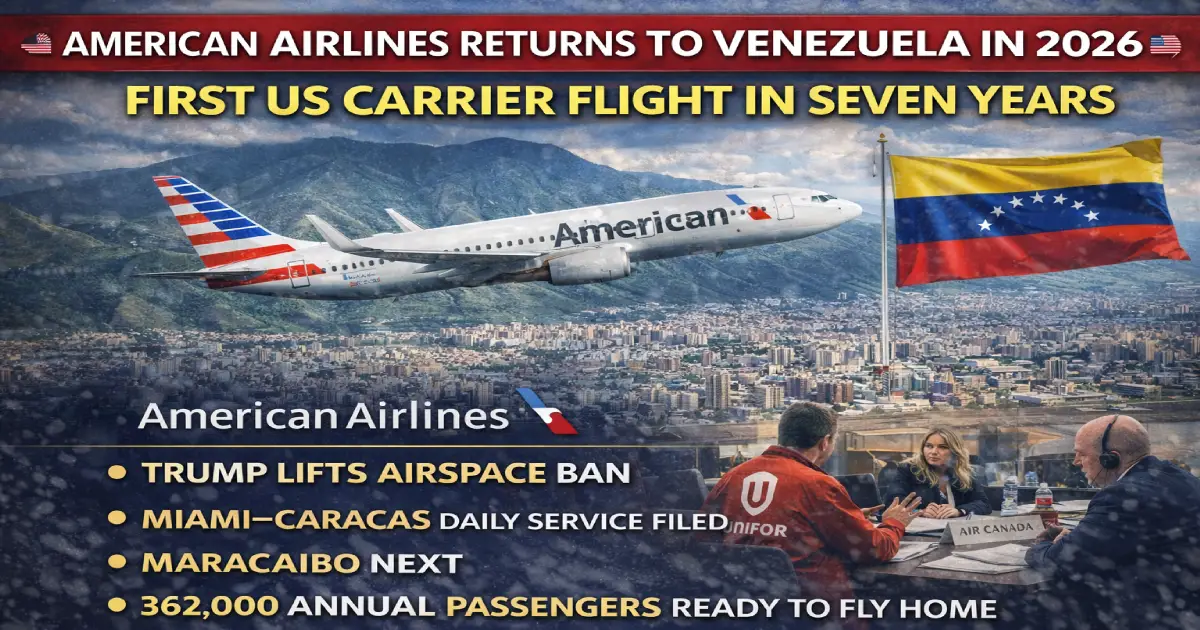
Breaking: American Airlines has formally filed with the United States Department of Transportation to resume daily nonstop service between Miami International Airport and Simón Bolívar International Airport in Caracas, Venezuela — becoming the first US carrier to announce plans to reconnect the United States and Venezuela after a seven-year aviation blackout that stranded millions of Venezuelan-Americans from their families, with the filing coming just 19 days after President Donald Trump personally instructed the DOT to lift the standing ban on US–Venezuela commercial air traffic on January 29, 2026, itself triggered by the January 3 US military operation that resulted in the capture of Venezuelan President Nicolás Maduro, with the timeline for the first flight currently estimated for late March or April 2026 depending on the speed of regulatory approvals , Venezuelan airline Avior simultaneously filing for Miami and Houston service, Laser Airlines requesting Miami–Caracas charter authority, American having provided 362,000 two-way seats between the US and Venezuela in 2018 accounting for about 58% of overall capacity , and hundreds of thousands of Venezuelans in South Florida who have been enduring 12-hour multi-connection journeys to reach family now facing the prospect of a direct 3-hour Miami–Caracas flight for the first time since March 2019. Here is everything every Venezuelan-American, travel planner, and South Florida passenger needs to know right now.
Published: February 17, 2026 Filing Date: January 29–February 3, 2026 Estimated First Flight: Late March or April 2026 (pending approvals) Route Filed — Phase 1: Miami (MIA) → Caracas (CCS) — daily nonstop Route Filed — Phase 2: Miami (MIA) → Maracaibo (MAR) — daily nonstop Distance MIA–CCS: 1,360 miles (~3 hours flight time) Distance MIA–MAR: 1,189 miles (~2h45 flight time) Aircraft Expected: Boeing 737-800 or 737 MAX 8 (mainline) or Envoy Air regional jet (initial phase) Airspace Ban Lifted: January 29, 2026 — Trump/DOT directive Maduro Captured: January 3, 2026 — US military operation AA Venezuela History: 1987–2019 — 32 years of service AA Venezuela Peak (2018): 362,000 two-way seats, 58% of total US–Venezuela capacity Other Carriers Filing: Avior Airlines (Venezuela), Laser Airlines (Venezuela) State Department Advisory: Level 4 Do Not Travel — still in effect AA Centennial Year: 2026 — “Forever Forward” milestone Venezuelan Diaspora US: 500,000+ in South Florida alone
American Airlines is proud to be the first airline to announce plans to reinstate nonstop service between the United States and Venezuela. The airline remains in close contact with federal authorities, and is ready to commence flights to Venezuela, pending government approval and security assessments.
“We have a more than 30-year history connecting Venezolanos to the U.S., and we are ready to renew that incredible relationship,” said Nat Pieper, American’s Chief Commercial Officer. “By restarting service to Venezuela, American will offer customers the opportunity to reunite with families and create new business and commerce with the United States.”
For the hundreds of thousands of Venezuelans living in South Florida — the largest Venezuelan diaspora community outside Venezuela itself — those words carry weight that transcends aviation scheduling. Since March 2019, when American halted its final Venezuela services, the Miami–Caracas corridor has been severed completely from the US side. Venezuelans needing to travel home have faced journeys through Bogotá, Panama City, Lima, or Mexico City — adding 8 to 12 hours and hundreds of dollars to every family reunion, medical emergency trip, or humanitarian visit.
For the millions of Venezuelans residing in the United States, particularly in South Florida, the announcement is being hailed as a transformative humanitarian milestone. The ability to travel directly from Miami to Caracas in approximately three hours, compared to the gruelling 12-hour multi-leg journeys of the past, is expected to drive a massive surge in VFR (Visiting Friends and Relatives) traffic.
The resumption of US–Venezuela flights did not happen organically. It is the direct consequence of a rapid-fire sequence of geopolitical events that unfolded in January 2026 — each one triggering the next within days.
The announcement comes amid a broader recalibration of US–Venezuela relations after a January 3 US military operation that resulted in the capture of Venezuelan President Nicolás Maduro, triggering intensified enforcement of oil sanctions and renewed debate in Washington over diplomatic, economic and security engagement with Caracas.
Nicolás Maduro had governed Venezuela since 2013 — his presidency the source of the political crisis that drove the original US airline suspension in 2019. His capture on January 3, 2026 by US special operations forces removed the single largest obstacle to US–Venezuela aviation normalisation.
On January 13, Panama’s Copa Airlines announced the resumption of flights to and from Caracas. Copa’s return — operating through Panama City hub — was the first signal that the airspace environment had stabilised sufficiently for commercial operations. Copa’s move gave other carriers confidence that Venezuelan airports were functioning and accessible.
Last November, Trump declared that Venezuela’s airspace should be considered “completely closed.” A flurry of NOTAM warnings led international airlines to suspend their connections to the Caribbean country.
A major breakthrough was achieved on January 29, 2026, when President Donald Trump instructed the US Department of Transportation and Secretary Sean Duffy to lift the standing ban on commercial air traffic.
The same administration that closed Venezuelan airspace in November 2025 reopened it on January 29, 2026 — 26 days after Maduro’s capture. The policy reversal was immediate and total: Venezuelan Acting President Delcy Rodríguez welcomed the “lifting of restrictions on the country’s commercial airspace,” which had been in place since last November, following talks with the US government. Speaking at a rally, Rodríguez said she received a phone call from US President Donald Trump and Secretary of State Marco Rubio. Trump described present relations with Caracas as “very good and very solid.”
American Airlines plans to resume daily flights to Venezuela, becoming the first US carrier to restart service to Venezuela after airlines paused flights citing unrest. “American will share additional details about its return to service in the coming months as it works closely with federal authorities on all necessary permissions and security assessments prior to resuming service,” the carrier said.
The speed of American’s filing — on the same day as Trump’s airspace directive — signals that the airline had been preparing this application in advance, anticipating the policy change. American’s legal and regulatory teams had clearly been monitoring the geopolitical situation closely and had DOT filing paperwork ready to submit the moment the ban lifted.
American began operating in Venezuela in 1987 and, before suspending service in March 2019, was the only US airline serving the country after Delta Air Lines and United Airlines exited the market in 2017.
The depth of American’s historical Venezuela relationship is extraordinary even by the standards of Latin American aviation:
1987: American launches first Venezuela service — Miami to Caracas. The route becomes one of AA’s most profitable Latin American connections as Venezuela’s oil boom drives business and leisure travel.
1990s–2000s: American expands to Maracaibo (Venezuela’s second city and oil capital), Valencia, and Mérida. At peak operations, AA operates multiple daily widebody frequencies. An Admirals Club lounge opens at Simón Bolívar International Airport — one of only a handful of AA lounges in Latin America.
2005: AA deploys Airbus A300-600, Boeing 737-800, and Boeing 757-200 on various US–Venezuela routes.
2018 — Peak Year: American provided 362,000 two-way seats between the US and Venezuela, accounting for about 58% of overall capacity, with nonstop flights from Miami to Caracas and Maracaibo. Overall O&D traffic totalled nearly 602,000 two-way passengers that year according to Sabre Market Intelligence data.
602,000 passengers in a single year on a single bilateral market. That is the demand base American is returning to recapture.
March 2019 — Suspension: American halted service to Venezuela in March 2019 after its pilots’ union told its members to refuse trips to the country following the State Department advising US citizens to leave the country and pulling its diplomats from Venezuela because of unrest.
The pilots’ union refusal was the operational trigger — but the underlying cause was Venezuela’s complete political and economic collapse under Maduro. Hyperinflation, power blackouts, airport security failures, and the absence of US diplomatic presence made continued operations impossible regardless of demand.
American intends to launch the 1,360-mile route from Miami (MIA) to Caracas (CCS). Expedited approval is being requested for this application, though no launch date has been planned yet.
Miami–Caracas is the flagship route — the emotional and commercial heart of the US–Venezuela corridor. Miami is home to the largest Venezuelan diaspora in the United States, with an estimated 500,000+ Venezuelans in Broward and Miami-Dade counties. The demand for direct Miami–Caracas service has been suppressed for seven years — it has not disappeared. Every Venezuelan-American who has been routing through Bogotá or Panama City represents a passenger who will switch immediately to a direct AA flight the moment it is available.
Expected flight details:
American intends to launch the 1,189-mile route from Miami to Maracaibo (MAR).
Maracaibo is Venezuela’s second-largest city and the capital of Zulia state — the heart of Venezuela’s oil industry. The Maracaibo route has different strategic significance than Caracas: while Caracas is the diaspora and business hub, Maracaibo is the energy hub. With the Trump administration actively seeking to reactivate Venezuela’s oil sector under international oversight, the Miami–Maracaibo route serves the energy industry workforce — engineers, executives, and contractors — who will begin moving between the US and Venezuela’s oil fields as investment resumes.
Industry observers note: “If it is safe enough to fly there at all, just turn the planes around. Start small, gauge demand, then if it exceeds capacity of RJs, go mainline with A319s. If security issues can be taken care of, ATL, IAH, NYC will also see service.”
Atlanta, Houston, and New York City all have significant Venezuelan diaspora populations. If Miami–Caracas launches successfully and demand proves as strong as AA’s 2018 data suggests, additional US gateway cities are the logical next step — likely within 6–12 months of the Miami inaugural.
American has filed with the Department of Transportation requesting the right to launch flights with Envoy Air aircraft from Miami to both Caracas and Maracaibo.
The Envoy Air detail is significant. Envoy operates American Eagle regional jets — Embraer E175s and E145s — on behalf of American Airlines. Filing for Envoy aircraft suggests American’s initial strategy may be to start with smaller-gauge regional jets on the inaugural service, testing operational reliability and security protocols before committing mainline Boeing 737 or Airbus A319 equipment.
As noted, “at least initially, crews would do a same day turn” — meaning no overnight crew positioning in Caracas during the initial phase.
A same-day turn strategy means the aircraft departs Miami in the morning, arrives Caracas mid-afternoon, turns around, and returns to Miami in the evening — with crews never spending the night in Venezuela. This minimises security exposure for American’s employees while establishing the route’s operational viability.
The progression is likely: Envoy E175 inaugural → verify security + demand → upgrade to 737-800 or 737 MAX 8 mainline → add Maracaibo → expand to additional US gateways.
American halted service to Venezuela in March 2019 after its pilots’ union told its members to refuse trips to the country following the State Department advising US citizens to leave the country.
The resumption is not a sure bet, as labour unions will have a lot of concerns. “I’m curious to see if American is actually able to follow through on this service in terms of the security assessment, working with labour unions.”
This is the critical variable that no DOT filing or Trump directive can resolve: American’s pilots and flight attendants must agree to operate these routes. The Allied Pilots Association (APA) — already having issued a no-confidence vote in AA CEO Robert Isom — has leverage it did not have in 2019. Any APA concerns about crew security in Caracas could delay or complicate the service resumption.
American will work closely with regulatory agencies, key stakeholders, union partners and team members across the airline on safely resuming service to Venezuela.
The phrase “union partners” in the official press release is deliberate — AA is signalling that crew buy-in is central to its Venezuela strategy, not an afterthought. How quickly and smoothly AA secures APA and APFA (flight attendants) cooperation will directly determine whether the late March/April launch timeline is achievable.
American is not the only carrier moving to recapture the US–Venezuela market.
Venezuelan airline Avior filed with the US Department of Transportation on February 3, 2026, asking for approval to resume previously approved US service and to add flights to Miami and Houston. The carrier is seeking a two-year authorization. Avior has long held approval for scheduled service between Barcelona, Venezuela, and Miami, as well as charter authority between the two countries.
Avior emphasised that it is a privately owned Venezuelan company with no financial ties to the Venezuelan government and remains owned and controlled by Venezuelan nationals. The carrier said it has previously been found financially fit to operate service to the United States.
Venezuelan airline Laser Airlines also requested authorization from the US Department of Transportation to operate regular and charter flights between Miami and Caracas.
Three carriers are now racing to recapture the Miami–Caracas corridor — American Airlines, Avior, and Laser. This competitive dynamic is excellent news for Venezuelan-American passengers: competition drives fares down and frequency up. The 2018 duopoly of American and CONVIASA (Venezuelan state airline) no longer exists — the post-Maduro aviation landscape is more open.
Despite the optimism, a Level 4: Do Not Travel advisory remains in effect from the State Department, citing ongoing concerns regarding crime and health infrastructure. Travellers are being cautioned to weigh these warnings against the convenience of the new routes.
Level 4 is the State Department’s highest advisory level — equivalent to active war zones like Ukraine and Sudan. The contrast between a Level 4 advisory and a daily commercial airline service is stark and requires passenger awareness.
What Level 4 means practically:
The airline remains confident that by working closely with federal authorities, a regulated and secure environment for travel can be maintained.
Who should still consider travelling:
Who should exercise extreme caution:
The Miami–Caracas route resumption will have an outsized economic impact on South Florida — a region whose Venezuelan community has been one of the fastest-growing immigrant groups of the past decade.
It was noted by the carrier that the move is designed to facilitate family reunifications and stimulate new avenues for commerce that have been frozen for years.
Miami International Airport stood to gain significantly from the resumption — MIA already handles the highest volume of Latin American international traffic of any US airport. A daily Caracas service adds to the 170+ destinations AA serves from MIA and strengthens Miami’s position as the undisputed gateway between the US and Latin America.
South Florida’s Venezuelan community will drive early demand — family visits suppressed for seven years, humanitarian travel needs, and business connections will all generate immediate bookings the moment AA opens reservations. Travel agents in Doral, Weston, and Brickell — the heart of South Florida’s Venezuelan suburbs — are already fielding enquiries.
The move represents a centennial milestone for the airline, which celebrates 100 years of operation in 2026. By returning to Venezuela during this landmark year, the carrier is reinforcing its commitment to its “Forever Forward” spirit.
American Airlines was founded in 1926. In its 100th year, it is simultaneously facing a historic pilot and flight attendant no-confidence vote against its CEO AND launching what may be the most emotionally significant new route of the decade. The centennial symmetry is striking: an airline celebrating a century of connecting people choosing its landmark year to reconnect a diaspora community that has been separated from its homeland for seven years.
✅ Do NOT book third-party tickets yet — American has not opened reservations. When AA opens bookings, purchase directly at aa.com — third-party sites will add fees and may not have accurate pricing
✅ Set a fare alert — Google Flights, Hopper, and Kayak all allow fare alerts for MIA–CCS. Set one now so you are notified the moment AA opens the route for booking
✅ Check travel insurance — any policy for Venezuela travel must explicitly cover Level 4 State Department advisory destinations. Standard travel insurance excludes Level 4. Specialised policies exist — World Nomads and Global Rescue both offer Level 4 coverage
✅ Passport validity — Venezuela requires 6 months passport validity beyond intended stay. If your passport expires within 6 months, renew before booking
✅ Venezuelan passport holders — check current Venezuelan government requirements for US-resident nationals returning. Regulations have changed significantly post-Maduro
✅ Maracaibo route is your priority — Miami–Maracaibo serves the Zulia oil region directly. Monitor AA’s DOT filings at regulations.gov for Maracaibo service approval timeline
✅ Corporate security briefing — any company sending employees to Venezuela should obtain a current security assessment. Control Risks, Kroll, and G4S all provide Venezuela security briefings
✅ Embassy registration — until US Embassy Caracas reopens, register your travel with the Smart Traveler Enrollment Program (STEP) at step.state.gov. Nearest US consular assistance: Bogotá, Colombia
✅ Prepare VFR packages — Visiting Friends and Relatives demand will be the dominant market. Miami–Caracas package itineraries with accommodation, ground transport, and travel insurance will sell immediately on launch
✅ Monitor DOT approval timeline — American’s expedited approval request means the DOT could issue a ruling within 30–45 days. Watch the DOT docket at regulations.gov for American Airlines Venezuela filing
✅ Avior and Laser competition — brief clients that multiple carriers are filing. American will likely have the fastest DOT approval given its prior certification, but Avior and Laser may offer lower initial fares
American Airlines’ filing to resume Miami–Caracas and Miami–Maracaibo service marks the end of a seven-year aviation blackout between the United States and Venezuela — triggered by Maduro’s January 3 capture, accelerated by Trump’s January 29 airspace reopening, and formalised by America’s first-ever US carrier Venezuela DOT application filed the same day. With 362,000 annual seats and 602,000 passengers at peak in 2018, the pent-up demand from 500,000-plus Venezuelan-Americans in South Florida alone guarantees that Miami–Caracas will be one of the highest-load-factor routes in AA’s Latin American network from the moment it opens. The challenges are real — pilot union security concerns, Level 4 State Department advisory, FAA airport safety assessments — but the timeline of late March or April 2026 is achievable if regulatory approvals proceed at the speed American’s expedited request is seeking. In its centennial year, American Airlines is reconnecting families that have been separated for seven years. That is the most powerful route launch story of 2026.
Your Venezuela Flight Action Checklist:
✅ Set fare alert NOW — Google Flights MIA→CCS — you want day-one notification when AA opens bookings ✅ Check travel insurance — must cover Level 4 advisory — standard policies won’t. Try World Nomads or Global Rescue ✅ Passport validity — 6 months beyond stay required for Venezuela entry ✅ STEP registration — register at step.state.gov — nearest US consulate is Bogotá until Caracas Embassy reopens ✅ Monitor DOT approval — regulations.gov → American Airlines Venezuela docket ✅ Maracaibo coming too — energy sector travellers, Miami–MAR daily service also filed ✅ Competition: Avior + Laser also filing — multiple carrier options may emerge
Track American Airlines Venezuela development:
For More Resources:
Related Articles:
Posted By : Vinay
Lastest News
2nd Floor, 39, Above Kirti Club, DLF Industrial Area, Kirti Nagar, New Delhi, Delhi 110015



Travel Tourister is a leading Travel portal where we introduce travellers to trusted travel agents to make their journey hasselfree, memorable And happy. Travel Tourister is a platform where travellers get Tour packages ,Hotel packages deals through trusted travel companies And hoteliers who are working with us across the world. We always try to find new and more travel agents and hoteliers from every nook and corners across the world so that you could compare the deals with different travel agents and hoteliers and book your tour or hotel with the one you have chosen according to your taste and budget.
Copyright © Travel Tourister, India. All Rights Reserved

 Call
Call Enquiry