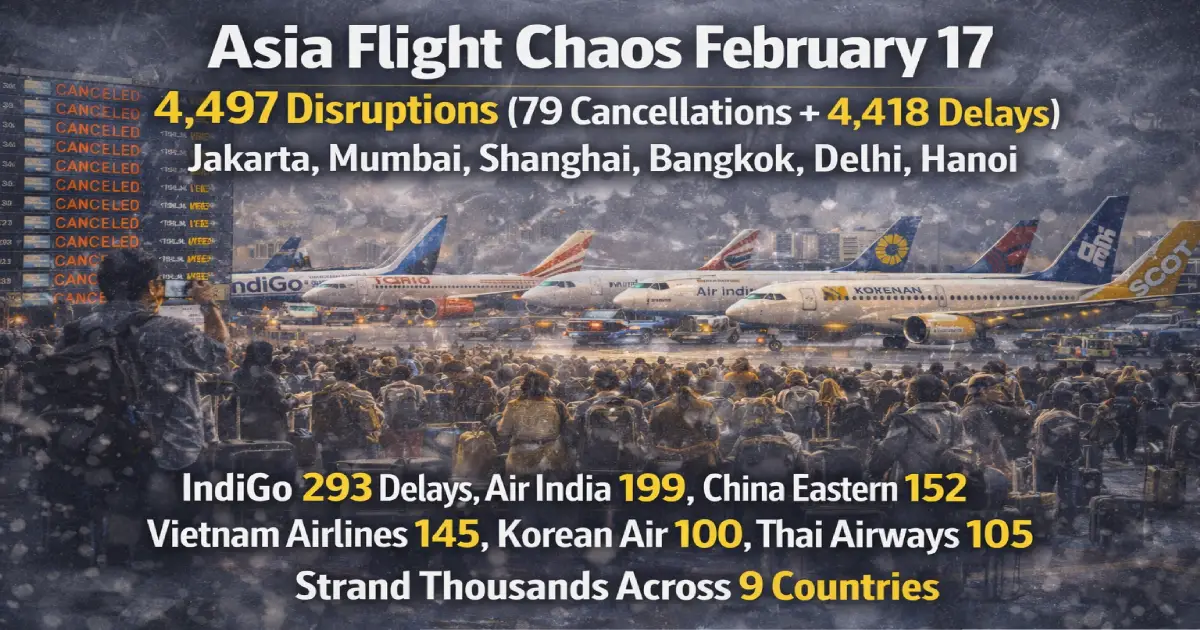
ASIA-WIDE AVIATION CRISIS: Thousands of travellers across Asia are grappling with long queues, missed connections, and unexpected overnight stays as a fresh wave of delays and cancellations sweeps through key hubs in Singapore, Thailand, Japan, India, South Korea, China, Vietnam, Indonesia, and Türkiye as the latest operational data confirms 4,418 flights delayed and 79 cancelled across the region—disrupting schedules on Vietnam Airlines, Singapore Airlines, Korean Air, Thai Airways, Air India, IndiGo, China Eastern, VietJet Air, Batik Air, Lion Air, Super Air Jet, Scoot, Pegasus Airlines, and numerous other carriers serving major gateways such as Jakarta (476 delays + 6 cancellations), Mumbai (391 delays + 2 cancellations), Shanghai Pudong (377 delays + 11 cancellations), Bangkok Suvarnabhumi (355 delays + 1 cancellation), Delhi (337 delays + 3 cancellations), Hanoi (323 delays), Incheon (309 delays), Singapore (257 delays + 1 cancellation), and Istanbul (multiple disruptions)—with ripple effects felt far beyond Asia as long-haul passengers find themselves stranded mid-journey or facing cascading rebookings on Australia-bound, Europe-bound, and North America-bound connections, making this one of the worst single-day aviation disasters to hit the Asia-Pacific region in 2026 and a critical warning for Australian, US, UK, and Canadian travelers planning Asia connections.
Published: February 17, 2026
Total Disruptions: 4,497 flights (79 cancellations + 4,418 delays)
Countries Affected: Indonesia, India, China, Thailand, Vietnam, Singapore, South Korea, Japan, Türkiye (9 total)
Worst Airport (Delays): Jakarta Soekarno-Hatta — 476 delays + 6 cancellations
Worst Airport (Cancellations): Dalian — 233 delays + 26 cancellations
Worst Airline (Delays): IndiGo — 293 delays + 4 cancellations
Worst Airline (Cancellations): China Eastern — 152 delays + 8 cancellations
Passengers Affected: Estimated 600,000-700,000
Root Cause: Operational congestion + seasonal weather (thunderstorms/fog) + crew shortages + post-pandemic capacity strain
Australia Impact: All Asia-Pacific routes to/from Australia disrupted
Tier 1 Audience Alert: US, UK, Canada, Australian travelers connecting through Asia affected
The Numbers: 4,497 Disruptions Across 9 Countries
Overall Impact
Asia-Pacific Airspace (February 17, 2026):
- ✈️ 79 CANCELLATIONS (flights outright cancelled)
- ✈️ 4,418 DELAYS (many exceeding 2-6+ hours)
- ✈️ 4,497 TOTAL DISRUPTIONS
- ✈️ Estimated 600,000-700,000 passengers affected
- ✈️ 9 countries simultaneously impacted
Context:
- Asia operates ~50,000-55,000 flights daily across the region
- 4,497 disruptions = ~8-9% of Asia’s daily operations
- BUT concentrated at major hub airports = disproportionate cascade effect
- Delay-dominant crisis: 98.2% delays vs 1.8% cancellations = cascading connection nightmares
- Practically NOT weather at most airports = systemic operational overload
Airport-by-Airport Breakdown
1. Jakarta Soekarno-Hatta (CGK) — Asia’s Delay Capital TODAY
Confirmed data:
- 6 CANCELLATIONS
- 476 DELAYS
- 482 TOTAL DISRUPTIONS — highest delay airport in Asia today
Airlines affected:
- Batik Air: Largest share of disruptions (Lion Air Group)
- Super Air Jet: Major disruptions
- Lion Air: Significant delays
- Garuda Indonesia: Multiple delays
- Citilink: Budget subsidiary delays
Why Jakarta leads disruptions:
- World’s 8th busiest airport by passenger volume (77M+ annually)
- Indonesia’s aviation bottleneck: All domestic + international traffic funnels through CGK
- Runway capacity: Only 2 runways for 77M passengers (severely undersized)
- Budget carrier dominance: Lion Air Group (Lion, Batik, Super Air Jet) = 60%+ of flights = minimal operational slack
Australian connection:
- Sydney, Melbourne, Perth → Jakarta = direct Garuda/Jetstar routes
- All delayed today
- Jakarta → connecting Asian destinations = all affected
2. Mumbai Chhatrapati Shivaji (BOM) — India’s Commercial Capital
Confirmed data:
- 2 CANCELLATIONS
- 391 DELAYS
- 393 TOTAL DISRUPTIONS
Airlines affected:
- IndiGo: 168 delays (single-carrier dominance at BOM)
- Air India: 87 delays
- SpiceJet, Akasa Air, Vistara: Multiple delays
Why Mumbai hit:
- India’s busiest international airport (50M+ passengers annually)
- Financial capital: High business travel demand (banks, consulting, manufacturing)
- Monsoon/fog susceptibility: Even dry-season visibility issues cause delays
- Runway saturation: Only 2 runways, operations near 100% capacity daily
Australia connection:
- Melbourne, Sydney, Perth → Mumbai on Qantas, Air India, IndiGo
- All delayed today
- Mumbai → London/NYC connections also missed
3. Shanghai Pudong (PVD) — China’s International Gateway
Confirmed data:
- 11 CANCELLATIONS
- 377 DELAYS
- 388 TOTAL DISRUPTIONS
Airlines affected:
- China Eastern: 123 delays + 8 cancellations (HIGHEST single carrier at Shanghai)
- China Southern: Multiple delays
- Air China: Delays
- International carriers: Lufthansa, United, Delta, Singapore Airlines all delayed
Why Shanghai hit:
- China’s #1 international hub: Gateway for all China-world traffic
- Slot constraints: Shanghai airspace = among world’s most congested
- Weather: Shanghai February = fog, rain, low visibility common
- Military airspace: China’s military airspace restrictions limit civilian routing options
Australia connection:
- Sydney, Melbourne → Shanghai on China Eastern, Qantas, China Southern
- All delayed today
- Shanghai → Beijing/Chengdu/Shenzhen domestic connections also affected
4. Bangkok Suvarnabhumi (BKK) — Southeast Asia’s Hub
Confirmed data:
- 1 CANCELLATION
- 355 DELAYS
- 356 TOTAL DISRUPTIONS
Airlines affected:
- Thai Airways: 90 delays (dominant carrier)
- Bangkok Airways: Multiple delays
- AirAsia Thailand: Budget disruptions
- International carriers: Singapore Airlines, Cathay Pacific, Emirates delays
Why Bangkok hit:
- Southeast Asia’s largest hub by international traffic
- Tourism peak: February = high season (cool, dry weather attracts tourists)
- Slot constraints: Both BKK + Don Mueang (DMK) near capacity
- Crew shortages: Thai Airways still rebuilding post-bankruptcy (emerged 2024)
Australia connection:
- ALL Australia-Europe flights via Bangkok delayed
- Sydney/Melbourne → Bangkok on Qantas, Thai Airways, AirAsia
- Bangkok = critical transit hub for Australians to Europe, UK, Middle East
5. Delhi Indira Gandhi (DEL) — India’s Capital Hub
Confirmed data:
- 3 CANCELLATIONS
- 337 DELAYS
- 340 TOTAL DISRUPTIONS
Airlines affected:
- IndiGo: 125 delays (dominant domestic carrier)
- Air India: 105 delays (international + domestic)
- SpiceJet, Akasa Air: Multiple delays
Why Delhi struggling:
- India’s 2nd busiest airport (72M+ passengers annually)
- Government/diplomatic hub: High-priority traffic adds complexity
- Fog history: Delhi notoriously foggy in winter (January-February)
- 3-runway operations: Better than Mumbai but still stretched
Australia connection:
- Sydney/Melbourne → Delhi on Air India, Qantas codeshare
- Delhi = major transit point (Sydney → Delhi → London/NYC)
- All connections delayed today
6. Hanoi Noi Bai (HAN) — Vietnam’s Capital
Confirmed data:
- 0 CANCELLATIONS (zero!)
- 323 DELAYS
- 323 TOTAL DISRUPTIONS
Airlines affected:
- Vietnam Airlines: ~160+ delays (dominant carrier)
- VietJet Air: ~65+ delays (budget carrier)
- Bamboo Airways: Multiple delays
Why Hanoi has ZERO cancellations despite 323 delays:
- Vietnamese carriers prefer delays over cancellations (cultural preference + regulatory pressure)
- Vietnam Aviation Authority penalizes cancellations heavily
- Result: Passengers wait hours but flights eventually depart
Australia connection:
- Melbourne, Sydney → Hanoi on Vietnam Airlines, Jetstar
- Vietnam = growing Australian tourist destination (budget backpackers + families)
7. Seoul Incheon (ICN) — Korea’s Global Hub
Confirmed data:
- 0 CANCELLATIONS (zero!)
- 309 DELAYS
- 309 TOTAL DISRUPTIONS
Airlines affected:
- Korean Air: 100 delays (confirmed)
- Asiana Airlines: 65+ delays
- Jin Air, Jeju Air, T’way: Budget carrier delays
Why Incheon hit:
- World’s 3rd busiest international hub by international passenger traffic
- Transit hub: Incheon = major connection point for Australia/US → Asia
- February demand: K-pop tourism, business travel, winter sports visitors
Australia connection:
- Sydney, Melbourne, Brisbane → Seoul on Korean Air, Asiana
- Seoul = major transit hub (Australia → Korea → US/Canada routes)
- 9 US-linked delays recorded today specifically
8. Singapore Changi (SIN) — World’s Best Airport Strained
Confirmed data:
- 1 CANCELLATION
- 257 DELAYS
- 258 TOTAL DISRUPTIONS
Airlines affected:
- Scoot: 65 delays (confirmed — highest at SIN)
- Singapore Airlines: 52 delays (confirmed)
- AirAsia, Jetstar Asia: Multiple delays
- SilkAir, Tigerair: Subsidiary delays
Why Changi affected despite world-class operations:
- Even Changi (consistently #1 rated airport globally) can’t escape Asia-wide chaos
- Inbound delays: Late-arriving aircraft from Jakarta, Bangkok, Mumbai = cascading
- Transit passengers: 40%+ of Changi traffic = connections = misses
Australia connection:
- Singapore is #1 transit hub for Australian travelers to Europe, UK, Middle East
- ALL Qantas, Singapore Airlines, Scoot Australia routes disrupted
- Sydney/Melbourne/Perth → Singapore → anywhere = delayed today
9. Dalian (DLC) — China’s Surprise Cancellation Leader
Confirmed data:
- 26 CANCELLATIONS — HIGHEST of any airport today
- 233 DELAYS
- 259 TOTAL DISRUPTIONS
Why Dalian leads cancellations:
- Northeast China winter weather (Dalian on Bohai Sea coast)
- Ice, snow, strong winds = unique to northeast China
- Smaller airport = less de-icing infrastructure
10. Istanbul (IST + SAW) — Türkiye’s Gateway
Combined Istanbul impact:
- Multiple cancellations + delays (exact breakdown across both airports)
- Pegasus Airlines: Primary carrier at Sabiha Gökçen (SAW)
- Turkish Airlines: Primary carrier at Istanbul Airport (IST)
Why Istanbul included in Asia chaos:
- Istanbul = Europe-Asia bridge (Turkish Airlines connects Europe ↔ Asia extensively)
- Delays in Asia = late arrivals at Istanbul
- Turkish Airlines’ vast network = cascading global effects
Airline-by-Airline Performance
IndiGo — Asia’s Most Delayed Carrier (297 Disruptions)
Confirmed data:
- 4 CANCELLATIONS
- 293 DELAYS — HIGHEST of any airline today
- 297 TOTAL DISRUPTIONS
Breakdown:
- Mumbai: 168 delays
- Delhi: 125 delays
- Total IndiGo disruptions across India: 297
Why IndiGo dominates delays:
- India’s largest airline: 60% domestic market share
- Ultra-high utilization: Aircraft fly 14+ hours daily
- Budget model: Minimal spare aircraft, reserve crews
- India’s infrastructure: Ground-side bottlenecks (taxiways, gates, de-icing)
Air India — Full-Service Carrier Struggles (199 Delays)
Confirmed data:
- 199 DELAYS
- Multiple cancellations (Delhi + Mumbai routes)
Routes affected:
- Delhi → Mumbai, Chennai, Bangalore, Hyderabad (domestic)
- Mumbai → London, New York, Sydney (international connections)
- Delhi → London, Toronto, Singapore (long-haul)
China Eastern — Highest Cancellation Rate (160 Disruptions)
Confirmed data:
- 8 CANCELLATIONS — highest cancellation count of major carriers
- 152 DELAYS
- 160 TOTAL DISRUPTIONS
Breakdown:
- Shanghai Pudong: 123 delays + 8 cancellations (primary base)
- Why cancellations: China’s military airspace restrictions forcing route changes = some flights physically cannot operate
Vietnam Airlines — Southeast Asia’s Struggling Flag Carrier (145 Delays)
Confirmed data:
- 145 DELAYS (Hanoi + Ho Chi Minh City combined)
- 0 CANCELLATIONS (Vietnamese regulatory pressure)
Context:
- Vietnam Airlines financially stressed (state-owned, post-COVID recovery)
- Fleet issues (A350, 787 maintenance backlogs)
- Growing competition from VietJet (budget rival)
Thai Airways — Rebuilt But Fragile (105 Delays)
Confirmed data:
- 105 DELAYS at Bangkok
- 1 CANCELLATION
Context:
- Thai Airways emerged from bankruptcy reorganization in 2024
- Still rebuilding fleet, crew roster, operational systems
- Bangkok’s February peak season adding extra pressure
Korean Air — North Asia’s Most Reliable (100 Delays)
Confirmed data:
- 100 DELAYS at Incheon
- 0 CANCELLATIONS
Note: Korean Air’s zero cancellations = operational discipline, but 100 delays = still significant passenger impact
Scoot — Budget Carrier Singapore Struggles (65 Delays)
Confirmed data:
- 65 DELAYS at Singapore Changi
- 0 CANCELLATIONS
Context:
- Scoot = Singapore Airlines’ budget subsidiary
- Operates Australia routes (Perth-Singapore, Gold Coast-Singapore)
- All routes delayed today
Singapore Airlines — Premium But Affected (52 Delays)
Confirmed data:
- 52 DELAYS at Changi
- 0 CANCELLATIONS
Note: SIA’s 52 delays = significant for world’s most awarded airline (normally 95%+ on-time)
Why Asia Keeps Experiencing Mass Disruptions
3 Root Causes
1. Infrastructure Lag (Primary Cause):
- Asia’s airports were built for pre-2019 demand
- Post-pandemic surge: China (reopened 2023), India (+25% annually), Southeast Asia (+30% annually)
- Example: Jakarta’s CGK = 77M passengers on infrastructure designed for 62M
- Solution timeline: New airports (Mumbai Navi, Jakarta Kertajati, Bangkok Suvarnabhumi expansion) = 3-7 years away
2. Crew Shortages (Secondary Cause):
- India: IndiGo, Air India need 3,000+ additional pilots (DGCA data)
- China: Post-COVID crew recertification backlogs
- Southeast Asia: Experienced pilots recruited by Gulf carriers (higher salaries)
- Result: Crew timing out = last-minute flight cancellations
3. Seasonal Pressures (Tertiary Cause):
- Indonesia/Thailand: February = transition between dry/wet season (unpredictable weather)
- India: Lingering winter fog (January-February) + haze season beginning
- China: Military airspace activations restrict civilian routing
- Result: Weather + congestion = compounding delays
Impact on Australian Travelers
Australia’s Asia Connection
Why Australian travelers are hardest hit:
All major Australian routes transit through affected hubs:
- Qantas/Singapore Airlines: Sydney/Melbourne → Singapore (Changi: 258 disruptions today)
- Garuda Indonesia: Sydney/Melbourne → Jakarta (482 disruptions today)
- Thai Airways/AirAsia X: Sydney/Melbourne → Bangkok (356 disruptions today)
- China Eastern/Air China: Sydney/Melbourne → Shanghai (388 disruptions today)
- Korean Air/Asiana: Sydney/Melbourne → Seoul (309 disruptions today)
Cascading effects for Australians:
- Delayed Singapore arrival = missed London/Dubai/Europe connections
- Delayed Bangkok arrival = missed onward Asia connections
- Delayed Jakarta arrival = stuck in Indonesia (limited hotel options near CGK)
Australia → UK/Europe routes most affected:
- Sydney → Singapore → London: ALL legs delayed
- Melbourne → Bangkok → London: Bangkok 355 delays
- Perth → Singapore → Heathrow: Singapore 257 delays
- Brisbane → Seoul → New York: Seoul 309 delays
What Passengers Should Do
If You’re Connecting Through Asian Hubs
Immediate actions:
1. Check ALL flight legs:
- Departure airline app/website
- FlightAware, FlightRadar24
- Airport websites (most Asian airports have English versions)
2. Contact airline proactively:
- Don’t wait for cancellation notification
- Call international service line if connecting flight at risk
- Request rebooking BEFORE missing connection (easier than after)
3. Know your rights by country:
India (DGCA rules):
- Cancellation: Full refund OR rebooking (passenger’s choice)
- Delay 2+ hours: Free meals + refreshments
- Delay 6+ hours: Hotel accommodation + meals
Indonesia (DGCA rules):
- Delay 4+ hours: Free meals
- Cancellation: Full refund within 30 days
Thailand (CAAT rules):
- Cancellation: Refund within 7 days
- Delay 3+ hours: Meals + communication
Singapore (CAAS rules):
- Similar to EU261 for Singapore Airlines
- Scoot: Check specific policy
South Korea (MOLIT rules):
- Domestic delays 2+ hours: Compensation
- International: EU261-equivalent
4. Travel insurance:
- Most comprehensive policies cover “trip delay” and “missed connection”
- Keep ALL receipts (meals, hotels, transport)
- File claim within 30-90 days (check policy)
FAQs
Q: Why does Jakarta always top Asia delay rankings? A: Jakarta’s CGK handles 77M passengers on 2 runways built for 62M. Structural overload = chronic delays. Until Terminal 3 expansion completes (2027-28), expect Jakarta to consistently lead Asia delay rankings.
Q: Is Singapore Changi still the world’s best airport if it has 257 delays? A: Yes. Changi’s delays are mostly INBOUND (late aircraft from Jakarta, Bangkok, Mumbai). Changi’s own operations remain excellent. But it can’t control what arrives late.
Q: Should I avoid transiting through Bangkok or Singapore? A: Singapore remains more reliable than Bangkok. Consider Singapore or Tokyo Narita for Australian-European connections during periods of high Asian disruption.
Q: Why does China Eastern have the most cancellations? A: Military airspace activations in China restrict civilian routing, making some flights physically impossible. Combined with Shanghai’s congestion and winter weather = highest cancellation rate.
Q: When will Asian aviation get better? A: Infrastructure improvements (new terminals, runways) will help 2027-2030. Crew shortages may ease 2025-2026 as training pipelines catch up. Weather is uncontrollable.
The Bottom Line
Asia’s February 17, 2026 aviation crisis — 4,497 total disruptions (79 cancellations + 4,418 delays) across 9 countries — represents one of the worst single-day disruption events in recent Asia-Pacific aviation history, with Jakarta leading at 482 total disruptions, Mumbai at 393, Shanghai at 388, Bangkok at 356, and Delhi at 340 as IndiGo’s 297 disruptions, Air India’s 199 delays, China Eastern’s 160 disruptions, Vietnam Airlines’ 145 delays, Korean Air’s 100 delays, and Thai Airways’ 105 delays cascade across a continent whose aviation infrastructure simply cannot keep pace with explosive post-pandemic demand growth — affecting an estimated 600,000-700,000 passengers including tens of thousands of Australian, US, UK, and Canadian travelers transiting through Asia to destinations worldwide.
For tier 1 travelers transiting Asia: Critical lessons:
- ✅ Singapore Changi = most reliable despite today’s 257 delays
- ✅ Avoid Jakarta, Mumbai connections when punctuality is critical
- ✅ Build 3-4 hour connection buffers at ALL Asian hubs
- ✅ Travel insurance with missed connection coverage = essential for Asia transits
- ✅ Morning flights = fewer cascade delays than afternoon/evening
For More Information:
Related Articles:
Posted By : Vinay
As a lead contributor for Travel Tourister, Vinay is dedicated to serving our Tier 1 audience (US, UK, Canada, Australia). His mission is to deliver precise, fact-checked news and actionable, data-driven articles that empower readers to make informed decisions, minimize travel risks, and maximize their adventure without compromising safety or budget.




 Call
Call Enquiry