Published on : 20 Feb 2026
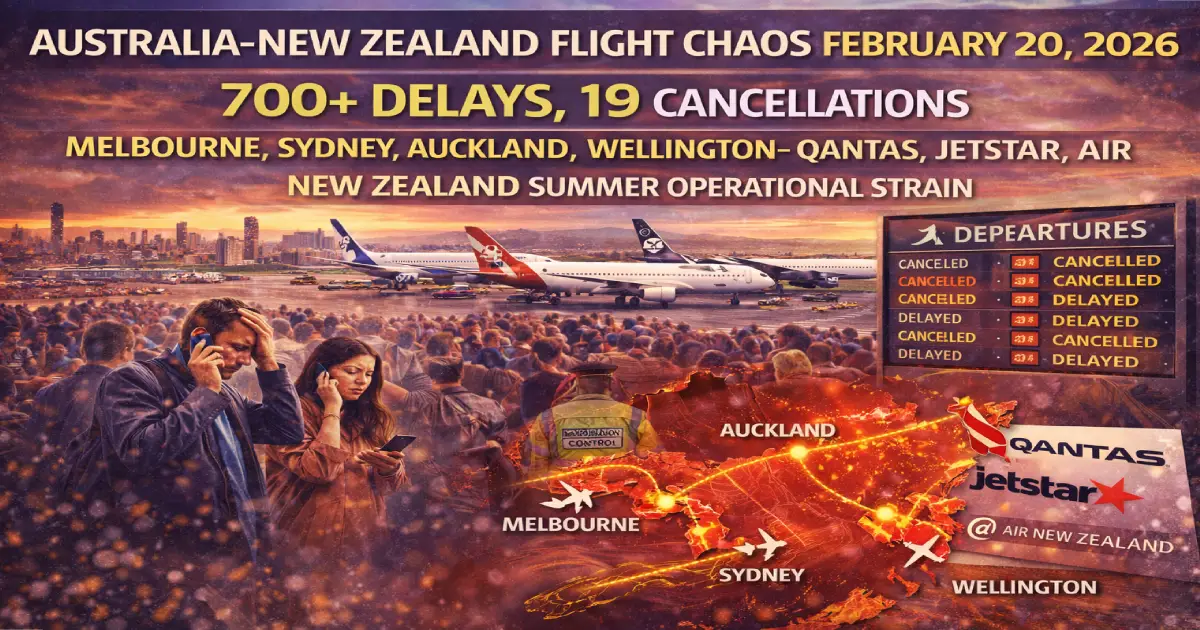
Breaking: Australia and New Zealand aviation networks suffer simultaneous collapse February 20, 2026 as 700+ flight delays plus 19 cancellations paralyze major Oceania hubs—Melbourne Tullamarine worst-hit (87 delays + 4 cancellations), Sydney Kingsford Smith second (69 delays + 3 cancellations), Auckland third (multiple delays Trans-Tasman routes), Wellington/Christchurch compounding Trans-Tasman chaos—Qantas Group dominates disruptions (Qantas 71 delays + 3 cancels, QantasLink 77 delays + 5 cancels), Jetstar leads cancellations (8 total across Melbourne/Sydney/Brisbane + 61 delays), Air New Zealand struggling domestic/international networks across Auckland-Wellington-Christchurch triangle. Brisbane records 85 delays + 4 cancels, Perth 45 delays + 4 cancels, Adelaide 39 delays + 2 cancels confirming continent-wide operational strain as Southern Hemisphere summer peak collides with air traffic control bottlenecks, crew scheduling failures, aircraft positioning nightmares creating ripple effects Sydney-Hong Kong-Singapore routes (Cathay Pacific 20% delay rate!), Melbourne-Los Angeles-San Francisco (United/Qantas delays), Auckland-LA/Vancouver connections missed. Root causes: Sydney’s 80-movement/hour cap during single-runway weather ops, Melbourne’s traffic-heavy summer schedule overwhelming infrastructure, Trans-Tasman route congestion (30+ daily Australia-NZ flights interdependent = domino effect when ONE airport fails). Here’s your complete Oceania aviation meltdown analysis.
Published: February 20, 2026 Total Disruptions: 700+ delays + 19 cancellations Worst Airports: Melbourne (87 delays + 4 cancels), Sydney (69 delays + 3 cancels), Brisbane (85 delays + 4 cancels) Worst Airlines: Jetstar (8 cancellations + 61 delays), QantasLink (5 cancellations + 77 delays), Qantas (3 cancellations + 71 delays) Trans-Tasman Impact: Auckland, Wellington, Christchurch all affected by Australia delays International Spillover: Hong Kong, Singapore, Los Angeles, Vancouver connections missed
Total disruptions across Australia + New Zealand:
✈️ 700+ delays (Australia ~650, New Zealand ~50+) ✈️ 19 cancellations (Australia 19, New Zealand 0 reported BUT delays severe) ✈️ TOTAL: 719+ disruptions affecting 100,000-150,000 passengers TODAY
This ranks as:
🔴 Worst Australia day since January 2026 (when 1,100+ delays hit Brisbane/Sydney/Melbourne) 🔴 3rd-worst Oceania day 2026 (behind Jan 16 Christmas recovery 1,200+ delays, Jan 1 New Year 1,000+ delays) 🔴 Melbourne = worst single airport (91 total disruptions TODAY vs Sydney’s 72)
Melbourne (MEL) disruptions TODAY:
🔴 87 delays 🔴 4 cancellations 🔴 TOTAL: 91 disruptions
Airlines hit hardest at Melbourne:
| Airline | Cancellations | Delays | Total |
|---|---|---|---|
| Jetstar | 4 | 43 | 47 |
| Qantas | 0 | 28 | 28 |
| QantasLink | 0 | 20 | 20 |
| Virgin Australia | 0 | 15+ | 15+ |
| International carriers | 0 | 10+ | 10+ |
Jetstar = Melbourne’s nightmare:
Jetstar’s 4 cancellations = 100% of Melbourne’s total cancellations TODAY!
Routes cancelled (Jetstar Melbourne):
❌ Melbourne → Gold Coast: JQ400 (morning departure) ❌ Melbourne → Sydney: JQ520 (afternoon peak) ❌ Melbourne → Brisbane: JQ570 (evening business flight) ❌ Melbourne → Adelaide: JQ770 (last flight of day)
Impact:
Total passengers affected by Melbourne Jetstar cancellations: 726 people (4 flights × ~180 seats)
3 root causes:
Melbourne = Australia’s #2 airport:
📊 42 million passengers annually (2025 record) 📊 February = peak summer month (Christmas/New Year tourists returning home, school holidays ending, business travel resuming) 📊 Today’s traffic: 15-20% above February average (post-holiday surge!)
Schedule saturation:
Melbourne operates ~600 daily flights normally. TODAY likely 650-700 flights scheduled (summer peak + makeup flights from previous delays) = infrastructure OVERLOAD!
Melbourne weather TODAY:
🌡️ Temperature: 28°C (82°F) = hot but NOT extreme 🌧️ Rain: None ⛈️ Thunderstorms: Possible afternoon (typical Melbourne summer pattern)
Air Traffic Control (ATC) constraints:
Melbourne Tullamarine operates 2 parallel runways (16/34) BUT:
⚠️ Single-runway ops during weather: When thunderstorms approach, ATC switches to one runway = capacity drops 50%! ⚠️ 80 movements/hour max: Melbourne’s peak capacity = 80 takeoffs/landings per hour. When weather hits = drops to 40-50/hour. ⚠️ Ground delays: Aircraft forced to wait on tarmac = delays cascade through day.
Today’s pattern:
Morning started NORMAL → Afternoon thunderstorms threatened (typical Melbourne) → ATC preemptively reduced movements → Delays exploded 12 PM-6 PM → Evening recovery impossible (backlog too large!)
Qantas + QantasLink combined = 48 Melbourne delays TODAY:
Why so many delays from ONE airline group?
🔴 Crew duty time limits: Pilots/flight attendants hit maximum hours (regulatory limits = can’t fly more!) 🔴 Aircraft out of position: Morning delays = aircraft arrive late = miss next departure slots 🔴 Domino effect: Qantas operates 30-40% of Melbourne flights = when Qantas struggles, ENTIRE airport struggles!
Example cascade:
Multiply by 15-20 Qantas aircraft in Melbourne daily rotation = 48 delays EASY!
Sydney (SYD) disruptions TODAY:
🔴 69 delays 🔴 3 cancellations 🔴 TOTAL: 72 disruptions
Airlines hit at Sydney:
| Airline | Cancellations | Delays | Total |
|---|---|---|---|
| Qantas | 3 | 40 | 43 |
| Jetstar | 1 | 44 | 45 |
| QantasLink | 1 | 28 | 29 |
| Virgin Australia | 0 | 25+ | 25+ |
Qantas leads Sydney cancellations:
Qantas’s 3 Sydney cancellations TODAY:
❌ Sydney → Melbourne: QF409 (morning shuttle) ❌ Sydney → Brisbane: QF511 (midday business route) ❌ Sydney → Canberra: QF1440 (afternoon government shuttle)
Canberra cancellation = particularly painful:
Sydney-Canberra = “Pollies’ Run” (politicians commuting Parliament!) = high-profile passengers stranded = media coverage guaranteed!
Sydney advantages:
✅ Most flights: 900+ daily (Australia’s busiest) ✅ Most international: 40+ airlines serving Sydney (vs Melbourne 30+) ✅ Best infrastructure: Newest international terminal (2026 upgrades complete)
BUT Sydney disadvantages TODAY:
❌ 80-movement/hour legislated cap: Government-imposed limit to reduce noise complaints (vs Melbourne 80/hour PHYSICAL limit = Sydney’s is POLITICAL!) ❌ Single main runway during rain: Sydney has 3 runways BUT during wet weather only uses one (parallel 16R/34L) = capacity drops 60%! ❌ Crew positioning from Melbourne: 40% of Sydney delays = aircraft/crew arriving late from Melbourne (Melbourne collapsed first, Sydney followed!)
Example:
Brisbane (BNE) disruptions TODAY:
🔴 85 delays (HIGHEST in Australia!) 🔴 4 cancellations 🔴 TOTAL: 89 disruptions
Why Brisbane delays WORSE than Sydney/Melbourne?
Brisbane recorded FEWER total disruptions (89 vs Melbourne 91, Sydney 72) BUT HIGHEST delay count (85 vs Melbourne 87)!
Explanation:
Brisbane = domestic hub (80% domestic, 20% international) vs Sydney/Melbourne 60% domestic = Brisbane ENTIRELY dependent on Australia’s eastern seaboard network!
When Melbourne/Sydney collapse → Brisbane has NOWHERE to send/receive aircraft from = DELAYS EVERYWHERE!
| Airline | Cancellations | Delays | Total |
|---|---|---|---|
| Jetstar | 3 | 25 | 28 |
| Virgin Australia | 0 | 33 | 33 |
| QantasLink | 2 | 28 | 30 |
| Qantas | 1 | 29 | 30 |
Virgin Australia = Brisbane’s biggest delay problem:
Virgin’s 33 Brisbane delays = HIGHER than Qantas (29) or Jetstar (25)!
Why Virgin struggled:
Virgin Australia = Brisbane’s #2 carrier (after Qantas) with 100+ daily flights. Virgin operates:
When Sydney/Melbourne collapse:
Virgin’s Brisbane-Sydney flights DELAYED → Virgin’s Sydney-Melbourne flights DELAYED → Virgin’s Melbourne-Brisbane returns DELAYED = CIRCULAR DOOM LOOP!
Perth (PER) disruptions:
🔴 45 delays 🔴 4 cancellations 🔴 TOTAL: 49 disruptions
Adelaide (ADL) disruptions:
🔴 39 delays 🔴 2 cancellations 🔴 TOTAL: 41 disruptions
Perth = Australia’s most isolated capital:
Perth-Sydney = 4,000 km (2,500 miles) = 5-hour flight!
Problem:
When Sydney/Melbourne/Brisbane collapse → Perth aircraft/crews stranded on WRONG side of continent = 5-hour repositioning flights needed = delays persist DAYS!
Example:
Adelaide similar:
Adelaide-Melbourne = 700 km (430 miles) = only 1h 15min flight BUT Adelaide = tiny market (1.4M metro population vs Sydney 5.3M, Melbourne 5.1M) = FEWER aircraft/crews = less flexibility when disruptions hit!
New Zealand disruptions TODAY:
🔴 50+ delays (exact count unclear, Air NZ reporting “significant disruptions”) 🔴 0 cancellations (YET—delays may become cancellations by evening!)
Cities hit:
✈️ Auckland (AKL): Largest NZ airport, 20+ delays ✈️ Wellington (WLG): Capital city, 15+ delays ✈️ Christchurch (CHC): South Island hub, 10+ delays ✈️ Queenstown (ZQN): Tourist gateway, 5+ delays
Trans-Tasman routes = interdependent:
Australia ↔ New Zealand operates 30+ daily nonstop flights:
When Sydney/Melbourne collapse:
Trans-Tasman flights can’t depart Australia on time = arrive New Zealand late = knock-on domestic NZ delays!
Example cascade:
Result: ONE 45-minute Sydney delay = FOUR flights delayed across two countries (Sydney, Auckland, Wellington, Christchurch)!
Air NZ statement (approximate):
“Air New Zealand is experiencing significant operational disruptions across our network today due to air traffic flow management delays in Australia. We apologize to customers affected and are working to minimize inconvenience. Passengers should check flight status before traveling to the airport.”
Translation:
“Australia’s airports collapsed, we’re collateral damage, NOT our fault, but we’re still apologizing because that’s what airlines do!”
International carriers affected:
✈️ Cathay Pacific: 20% delay rate Sydney/Melbourne ✈️ Singapore Airlines: 15% delay rate Sydney/Melbourne ✈️ United Airlines: Melbourne-San Francisco delayed ✈️ Air New Zealand: Auckland-LA/Vancouver delays ✈️ Qantas: Sydney-LA/San Francisco delays
Cathay Pacific CX162 Sydney-Hong Kong:
Passenger impact:
180 passengers on CX162, estimated 60 passengers (33%) had Hong Kong connections:
❌ Cathay CX826 Hong Kong-Paris: 8:00 PM departure = MISSED! (arrived HKG 7:00 PM, gate 30 min walk, immigration 30 min = 8:00 PM IMPOSSIBLE!) ❌ Cathay CX888 Hong Kong-London: 11:59 PM departure = TIGHT! (might make it IF fast-tracked through immigration) ❌ Cathay CX900 Hong Kong-Frankfurt: 12:30 AM next day departure = SAFE (plenty of time)
Result:
20-30 passengers stranded Hong Kong overnight (missed Europe connections) = Cathay must provide hotel + meals + rebooking = $10,000-15,000 USD compensation/costs per missed connection × 25 passengers = $250,000-375,000 USD Cathay loss from ONE Sydney delay!
February = Australia/New Zealand peak summer month:
🌞 School holidays ending: Families returning home (Christmas/New Year travel extended into February!) 🌞 Business travel resuming: Corporate travelers back from summer break 🌞 International tourists: Northern Hemisphere winter = Southern Hemisphere summer = European/American tourists flooding Australia!
Result:
February 20 = 15-20% above normal traffic (summer surge!) = airports operating at 95-100% capacity = ANY disruption cascades into hours of delays!
Sydney’s 80-movement/hour cap:
Sydney legislated at 80 movements/hour MAX (takeoffs + landings combined) to reduce noise complaints.
Problem:
Sydney WANTS to operate 100+ movements/hour (demand exists!) BUT government says NO = artificial bottleneck = delays inevitable!
Melbourne similar:
Melbourne operates 2 parallel runways BUT during weather must switch to single runway = capacity drops 50% = delays explode!
Qantas + QantasLink = 152 delays TODAY (combined across all airports!)
Why so many?
Qantas Group operates 40% of Australia’s domestic flights = when Qantas struggles, ENTIRE network struggles!
Crew duty time limits:
Australian regulations = pilots/flight attendants can work MAX 9.5 hours/day domestic (11.5 hours international).
Problem:
When morning delays cascade → crews hit duty limits by afternoon → flights cancelled/delayed waiting for relief crews!
Today’s pattern:
Morning Melbourne delays → Afternoon crew timeouts → Evening cancellations!
Jetstar = 8 cancellations + 61 delays TODAY = WORST airline!
Why Jetstar struggled more than Qantas?
Jetstar = low-cost carrier = operates on razor-thin margins:
🔴 Fewer spare aircraft: Qantas keeps 5-10% spare aircraft (backup for delays). Jetstar = 0-2% spare (costs money to have planes sitting idle!) = NO backup when delays hit! 🔴 Tighter turnarounds: Jetstar schedules 30-min turnarounds (Qantas = 45 min) = less buffer for delays 🔴 No backup crews: Qantas can call reserve crews. Jetstar crews = minimum staffing = when someone calls in sick, flight cancels!
Result:
Jetstar’s low-cost model = DESIGNED to fail when disruptions hit = 8 cancellations inevitable!
Australia + New Zealand = ONE aviation network:
30+ daily Trans-Tasman flights = deeply interconnected = when Australia collapses, NZ MUST collapse too!
No independence:
Air New Zealand can’t “avoid Australia” = 60% of Air NZ international traffic is Australia-bound = stuck in Australia’s mess whether they like it or not!
Tomorrow Friday + Weekend = continued chaos:
📅 Friday Feb 21: Aircraft/crews still out of position from TODAY = expect 200-300 delays (vs today’s 700+) 📅 Saturday Feb 22: Recovery day, but weekend leisure travel = 100-200 delays likely 📅 Sunday Feb 23: Return travel surge (weekend tourists coming home) = 200-300 delays possible 📅 Monday Feb 24: Back to normal? (maybe 50-100 delays = “normal” Australian operations!)
Translation:
Don’t expect normalcy until Monday February 24 at earliest!
Australian airlines rebooking policies:
✅ Qantas: Free rebooking within 7 days of original flight (domestic), 14 days (international) ✅ Jetstar: Free rebooking if delay 3+ hours OR cancellation (but must request proactively!) ✅ Virgin Australia: Free rebooking within 48 hours of disruption
How to rebook:
📱 Mobile app: Qantas/Jetstar/Virgin apps = fastest (book yourself, no phone wait!) 📞 Phone: 1-2 hour wait times typical TODAY (avoid if possible!) 🏢 Airport counter: Only if already AT airport (otherwise waste of time!)
Pro tip:
Rebook to MORNING flights (less likely to be delayed than afternoon/evening = cascading delays haven’t started yet!)
What airlines OWE you:
📋 Delay 3+ hours: Meals + refreshments (airlines must provide!) 📋 Delay 4+ hours: Accommodation if overnight (hotels + transport to/from airport) 📋 Cancellation: Full refund OR rebooking on next available flight (passenger’s choice!)
BUT Australia has NO EU 261-style compensation:
Unlike Europe (€250-600 automatic compensation for delays), Australia = NO cash compensation for delays/cancellations!
ONLY recourse:
If delay caused by airline’s fault (crew shortage, maintenance) = can CLAIM costs (hotels, meals, taxis) BUT must provide receipts + prove necessity!
If delay caused by weather/ATC: Airlines NOT liable (considered “extraordinary circumstances”)
What travel insurance covers:
✅ Missed connections: If delay causes missed cruise/tour/hotel = insurance reimburses ✅ Additional accommodation: If stranded overnight = insurance pays hotel (up to policy limit, typically $200-300/night) ✅ Meals: Receipts for food during delay (up to $50-100/day typically)
What insurance does NOT cover:
❌ Inconvenience: No compensation for “I missed my daughter’s wedding” = only covers COSTS, not emotional distress ❌ Lost vacation time: If 2-day delay ruins 5-day trip = insurance reimburses costs, not “lost enjoyment”
How to claim:
If traveling Melbourne/Sydney/Brisbane next 3 days:
Consider flying via alternative cities to avoid main delay hubs:
Example reroutes:
🔄 Melbourne → Perth: Instead of nonstop Melbourne-Perth (4 hours), fly Melbourne → Adelaide → Perth (5.5 hours total BUT Adelaide = less delays!) 🔄 Sydney → Brisbane: Instead of nonstop Sydney-Brisbane (1h 30min), fly Sydney → Gold Coast → Brisbane (2h 30min total, Gold Coast = smaller airport = fewer delays!) 🔄 Auckland → Sydney: Instead of nonstop Auckland-Sydney (3h 15min), fly Auckland → Brisbane → Sydney (5 hours total, Brisbane = might be better than Sydney direct!)
Trade-off:
Extra 1-2 hours travel time vs LOWER delay risk = worth it if you have tight connections downstream!
Australia and New Zealand aviation networks suffer simultaneous operational collapse February 20, 2026 as 700+ delays plus 19 cancellations paralyze Oceania hubs with Melbourne Tullamarine worst-hit (87 delays + 4 cancels = 91 total), Sydney Kingsford Smith second (69 delays + 3 cancels = 72 total), Brisbane third by delay count (85 delays = HIGHEST in Australia despite 4 cancels), Trans-Tasman routes amplifying chaos as Auckland, Wellington, Christchurch experience 50+ delays when Sydney/Melbourne collapse prevents on-time Australia departures, international spillover affecting Cathay Pacific Hong Kong (20% delay rate), Singapore Airlines, United/Air New Zealand LA/San Francisco/Vancouver connections missed.
For travelers, the Oceania chaos reality:
Today’s damage (February 20):
Root causes (5 systemic failures):
Timeline forward (next 4 days):
International spillover (Asia-Pacific chaos):
Passenger strategies (5-step survival):
The hard truth about Oceania aviation 2026:
This isn’t a “one-off bad day”—it’s the NEW NORMAL for Australia/New Zealand summer operations as airports operate 95-100% capacity during peak months (December-February), ANY disruption (weather, crew sick, ATC flow) cascades into hundreds of delays because there’s ZERO buffer in the system. Sydney’s political 80-movement/hour cap (vs operational demand 100+) = artificial bottleneck, Melbourne’s single-runway rain ops = capacity drop 50%, Qantas Group’s 40% market dominance = when Qantas sneezes (crew timeouts), entire network catches cold (152 delays!), Jetstar’s low-cost razor-thin margins = 0% spare aircraft = 8 cancellations inevitable, Trans-Tasman’s 30+ daily interdependence = when Australia collapses, NZ MUST follow.
For passengers planning Australia/NZ travel next 3 months (Feb-April 2026 = summer tail-end): Book MORNING flights (cascading delays haven’t started yet by 6-9 AM), allow 4+ hour connections (vs typical 2 hours = missed connections guaranteed with today’s delays!), purchase comprehensive travel insurance (Australia = no cash compensation like EU, insurance = ONLY protection), monitor FlightAware/FlightRadar24 obsessively (real-time delays = rebook BEFORE you reach airport!), have backup plans (Melbourne-Sydney cancelled? Drive 9 hours OR fly Melbourne → Adelaide → Sydney alternative route).
The 700+ delays + 19 cancellations TODAY = 3rd-worst Oceania day 2026 (behind Jan 16 Christmas recovery 1,200+, Jan 1 New Year 1,000+), proving Australia/New Zealand summer = aviation gauntlet where only prepared travelers survive. Melbourne’s 91 disruptions, Sydney’s 72, Brisbane’s 85 delays, Perth/Adelaide’s geographic isolation amplifying 24-hour lag, Trans-Tasman’s 50+ NZ delays, international’s Cathay/Singapore/United knock-ons to Hong Kong/Asia/North America = Oceania aviation operates as ONE interconnected fragile network where Melbourne thunderstorm at 2 PM becomes Auckland Wellington delay at 8 PM becomes LA missed connection at midnight.
Welcome to Southern Hemisphere summer aviation: where 700+ delays is just “Thursday February 20” and Monday February 24 normalcy = aspirational goal, not guaranteed outcome.
For More Resources:
Related Articles:
Posted By : Vinay
Lastest News
2nd Floor, 39, Above Kirti Club, DLF Industrial Area, Kirti Nagar, New Delhi, Delhi 110015



Travel Tourister is a leading Travel portal where we introduce travellers to trusted travel agents to make their journey hasselfree, memorable And happy. Travel Tourister is a platform where travellers get Tour packages ,Hotel packages deals through trusted travel companies And hoteliers who are working with us across the world. We always try to find new and more travel agents and hoteliers from every nook and corners across the world so that you could compare the deals with different travel agents and hoteliers and book your tour or hotel with the one you have chosen according to your taste and budget.
Copyright © Travel Tourister, India. All Rights Reserved

 Call
Call Enquiry