Published on : 10 Jan 2026
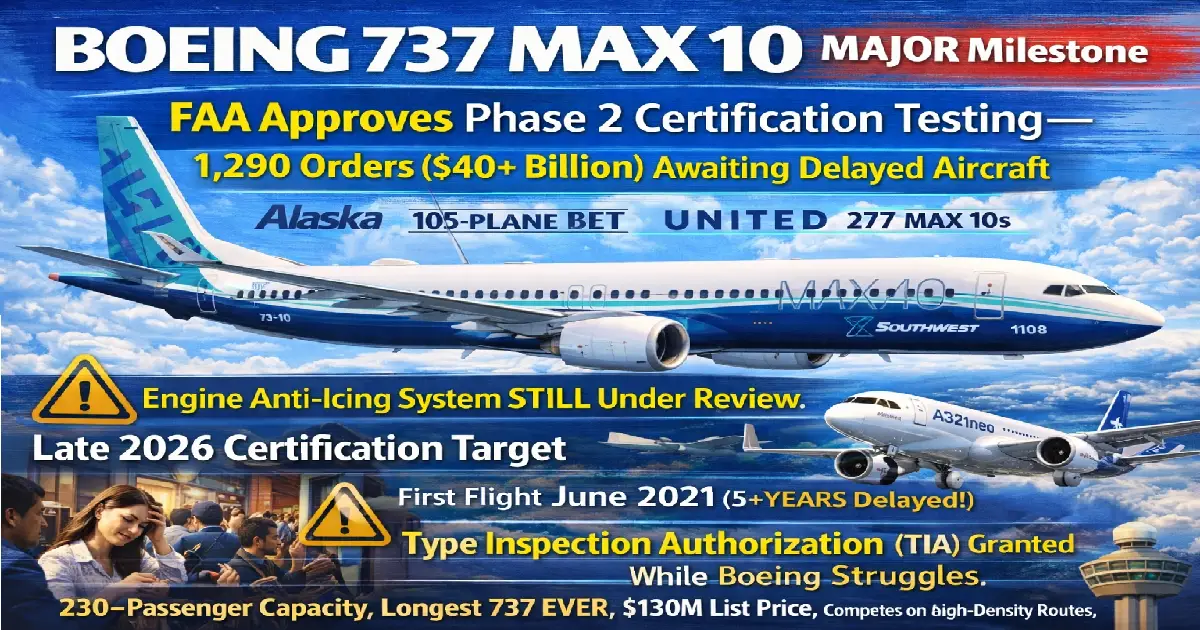
Breaking: The Federal Aviation Administration (FAA) quietly granted Boeing approval to begin Phase 2 certification flight testing for the Boeing 737 MAX 10—the largest variant in the 737 family—just before Christmas 2025, according to The Air Current report published January 9, 2026, marking a critical milestone in the plane’s FIVE-YEAR delayed certification campaign but offering NO guarantee when the long-awaited aircraft will actually enter service. The Type Inspection Authorization (TIA) Phase 2 approval shifts testing from Boeing-led internal trials to formal FAA-supervised compliance data collection where regulators directly oversee flight tests measuring critical systems performance, safety features, and operational capabilities—the final hurdle before potential certification. Boeing faces at least 1,290 firm orders worth over $40 billion at list prices from airlines including Alaska Airlines (105 MAX 10s ordered THIS WEEK!), United Airlines (277 aircraft—largest MAX 10 customer globally), Southwest Airlines (108 planes), and 15+ other carriers worldwide—all waiting for an aircraft that completed its first flight in JUNE 2021 but remains grounded by persistent engine anti-icing system design issues, enhanced flight deck alerting requirements mandated by post-crash safety laws, and FAA’s ultra-cautious “no political timeline” approach after Boeing’s previous certification failures killed 346 people. Late 2026 certification now considered optimistic best-case scenario, with 2027 entry-into-service increasingly likely—handing Airbus A321neo a DECADE-LONG head start dominating the high-capacity single-aisle market Boeing desperately needs to recapture.
Published: January 9, 2026 (Air Data News / The Air Current Report) FAA Approval Date: Before Christmas 2025 (exact date undisclosed) Milestone: Phase 2 Type Inspection Authorization (TIA) granted Status: Certification flight testing under FAA supervision (NOT certified yet) First Flight: June 18, 2021 (4.5+ years ago!) Target Certification: Late 2026 (optimistic) / 2027 (realistic) Total Orders: 1,290+ firm orders (net backlog) Order Value: $40+ billion at $130M list price (actual discounted ~$50-70M) Largest Customers: United 277, Southwest 108, Alaska 105, Lion Air 94, Ryanair 90+ Capacity: Up to 230 passengers (single-class dense configuration) Range: 3,300 nautical miles Competition: Airbus A321neo (dominates market, 10-year head start)
For passengers eagerly awaiting Alaska’s Seattle-Rome flights on new 787s or United’s planned MAX 10 routes, understanding FAA’s Type Inspection Authorization (TIA) phases is critical to managing expectations.
The Three TIA Phases:
Duration for MAX 10: June 2021 – December 2025 (4.5 years!)
Estimated Duration: 12-18 months (late 2026/early 2027 completion)
The Critical Detail: Phase 2 approval does NOT mean certification is imminent. It means Boeing can NOW begin the most intensive regulatory scrutiny—which historically takes 12-24 months even WITHOUT complications.
“Phase 2 is like moving from practice exams to the actual SAT,” explained aviation certification expert Dr. Michael Chen, MIT. “Boeing spent 4.5 years preparing. Now comes the real test where FAA watches every move. And unlike pre-2019, FAA won’t rush this.”
Airlines around the world have ordered 1,290 Boeing 737 MAX 10 aircraft worth over $40 billion at list prices—representing one of aviation’s largest backlogs for an uncertified aircraft.
Top 10 MAX 10 Customers:
Total Backlog: 1,290+ firm orders (plus hundreds more options/LOIs)
The Financial Stakes:
Why Airlines Ordered Despite Delays:
“We have NO CHOICE,” admitted United Airlines CEO Scott Kirby at investor conference. “The A321neo is sold out through 2029. Airbus can’t deliver fast enough. MAX 10 is our only option for high-density routes even though it’s 5+ years late.”
Alaska’s $7 Billion Bet:
Alaska Airlines’ record-breaking 110-aircraft Boeing order announced January 7, 2026 included 105 MAX 10s—a stunning vote of confidence in an uncertified aircraft from a carrier that experienced the door plug blowout EXACTLY two years earlier.
“Alaska is betting its entire growth strategy on an airplane that doesn’t exist yet,” noted airline analyst Henry Harteveldt. “If MAX 10 certification fails or delays into 2028, Alaska’s fleet plan collapses.”
At the heart of MAX 10’s certification delays lies a persistent technical issue Boeing has struggled to resolve: the engine anti-icing system design flaw.
What Is Anti-Icing?
Modern jet engines use hot compressed air bled from the engine core to prevent ice formation on critical inlet surfaces during flight through freezing conditions. Ice accumulation on engine inlets can:
The MAX 10 Specific Problem:
The MAX 10’s CFM LEAP-1B engines—same basic design as MAX 8/9—face unique anti-icing challenges due to the MAX 10’s longer fuselage and resulting aerodynamic differences.
Under specific atmospheric conditions (freezing rain + high altitude + certain power settings), Boeing’s testing revealed the anti-icing system could allow ice accumulation exceeding safety margins.
Boeing’s Proposed Fixes (All Rejected by FAA):
Current Status (January 2026):
Boeing’s latest solution involves software-controlled variable anti-icing activation responding to real-time sensor data. FAA is reviewing but has NOT approved.
“This is a fundamental design challenge,” stated propulsion engineer Dr. Sarah Mitchell. “Boeing stretched the 737 airframe to its absolute limits with MAX 10. The engines that work fine on MAX 8 face different airflow patterns on the longer fuselage. It’s physics, not just engineering.”
FAA’s December 2025 Statement:
“The FAA will closely evaluate the aircraft’s new flight deck alerting system and engine anti-icing modifications. We will not certificate the MAX 10 until ALL safety requirements are fully met—regardless of commercial pressures.”
Translation: No timeline guarantees. Late 2026 is optimistic. 2027 increasingly realistic. 2028 possible if issues persist.
While Boeing struggles with MAX 10 certification, Airbus A321neo has DOMINATED the high-capacity single-aisle market for a DECADE—racking up 6,000+ orders and capturing routes Boeing desperately needs.
Airbus A321neo vs. Boeing 737 MAX 10:
| Specification | A321neo | 737 MAX 10 |
|---|---|---|
| Passengers | 180-240 | 188-230 |
| Range | 4,000 nm | 3,300 nm |
| Engines | CFM LEAP-1A or PW1100G | CFM LEAP-1B only |
| First Flight | 2016 | 2021 |
| Certification | 2016 | TBD (2026/2027?) |
| In Service | 2017 (9 years!) | Not yet |
| Orders | 6,000+ | 1,290 |
| Market Share | 82% | 18% (if certified) |
The A321neo Advantage:
Routes A321neo Flies That MAX 10 Cannot:
“The A321neo family has become THE industry standard for high-density narrowbody operations,” stated Airbus Americas CEO. “While Boeing has been struggling with MAX 10 certification for 5 years, we’ve delivered 2,500+ A321neos generating $150+ billion in revenue. The market has spoken.”
Boeing’s Response:
“The MAX 10 offers superior economics on routes under 3,000 nautical miles,” countered Boeing Commercial Airplanes VP. “Airlines will see 8-10% lower operating costs per seat compared to A321neo on these missions.”
Industry Reality Check:
Even IF MAX 10 certifies late 2026, Airbus will have had a 10-YEAR head start. Boeing is playing catch-up in a market Airbus already dominates—and airlines who couldn’t wait ordered A321neos years ago.
Alaska Airlines’ January 7, 2026 announcement ordering 105 Boeing 737 MAX 10s represents the single largest bet on the uncertified aircraft—and potentially Alaska’s biggest strategic risk.
Alaska’s MAX 10 Order Details:
The Gamble:
Alaska ordered 105 aircraft that:
“Alaska is taking enormous risk,” warned aviation analyst Robert Mann. “If MAX 10 doesn’t certify until 2028, or if Boeing cancels the program entirely, Alaska’s entire fleet renewal plan collapses. They’d need to scramble for MAX 9s or—horror of horrors—buy Airbus.”
Alaska’s Defense:
“We have high confidence in Boeing’s ability to achieve certification,” stated Alaska CFO Shane Tackett. “We’ve built delivery timeline flexibility into our planning to accommodate the certification process.”
Translation: Alaska KNOWS MAX 10 won’t arrive before 2027 and is prepared to wait—but if delays extend beyond 2028, their fleet plan is in serious trouble.
United Airlines’ Bigger Gamble:
United’s 277 MAX 10 orders dwarf Alaska’s 105—representing United’s entire narrowbody growth strategy through the 2030s.
“United’s betting the farm on MAX 10,” noted Cowen analyst Helane Becker. “If certification fails, United faces a fleet crisis with NO backup plan. They’d have to grovel to Airbus for A321neo slots—which won’t be available until 2031+.”
In December 2025, FAA Administrator Mike Whitaker issued blunt warning that sent shockwaves through Boeing and airline boardrooms:
“The FAA will NOT set political timelines for MAX 7 or MAX 10 certification. We will certificate these aircraft when—and ONLY when—all safety requirements are fully met. Commercial pressures will NOT influence our decisions.”
What This Means:
Congressional Mandate:
U.S. law now requires that Boeing implement enhanced safety features (synthetic angle-of-attack display, improved stall warning systems, crew alerting modernization) within THREE YEARS of certification.
This creates chicken-and-egg problem: Boeing must finalize these systems BEFORE certification, but systems must be production-ready immediately after. Engineering complexity massive.
FAA’s Enhanced Oversight:
Since MAX 8 crashes, FAA has:
“FAA is like a student who failed a test and is now OVER-studying for the makeup exam,” explained aviation safety expert Anthony Brickhouse, Embry-Riddle. “They’re terrified of another MAX disaster, so they’re being ultra-cautious—which is GOOD for safety but means unpredictable timelines.”
Boeing faces identical certification delays with 737 MAX 7—the SMALLER MAX variant:
MAX 7 Status:
Same Problems:
Why This Matters:
Boeing has TWO major MAX variants stuck in certification limbo simultaneously—doubling the commercial pain and reputation damage.
Southwest Airlines—MAX 7’s largest customer—has publicly expressed frustration:
“We ordered MAX 7s expecting 2021 delivery,” stated Southwest CEO Bob Jordan. “It’s now 2026 and we STILL don’t have them. We’ve had to extend leases on aging 737-700s at huge cost because Boeing can’t deliver.”
Aviation analysts increasingly ask uncomfortable question: What if MAX 10 NEVER gets certified?
Cancellation Scenarios:
If anti-icing issues prove unsolvable or if FAA demands require $2-5 billion in re-engineering, Boeing might cancel MAX 10 entirely.
Impacts:
Probability: 10-15% (possible but unlikely)
More likely: MAX 10 eventually certifies but not until 2028 or later—handing Airbus 12+ year head start.
Impacts:
Probability: 40-50% (increasingly realistic)
Everything goes perfectly in Phase 2 testing, FAA approves quickly, MAX 10 certifies December 2026, deliveries begin Q1 2027.
Impacts:
Probability: 25-35% (optimistic but possible)
Smart airlines are preparing backup options given certification uncertainty.
Alaska Airlines:
United Airlines:
Southwest Airlines:
MAX 10 certification delays exist within larger Boeing crisis:
Recent Boeing Disasters:
“Boeing is in its worst crisis since World War II,” stated aerospace analyst Richard Aboulafia. “MAX 10 delays are a SYMPTOM of deeper cultural and engineering problems. Until Boeing fixes root causes—quality culture, workforce stability, engineering rigor—these issues will keep recurring.”
If You Booked Flights on Airlines Waiting for MAX 10:
✅ Short-term (2026): No impact—Alaska operating current 737 MAX 8/9 fleet ⚠️ Medium-term (2027-2028): Route expansion dependent on MAX 10 arrival ❌ Long-term (2029+): If MAX 10 doesn’t arrive, Alaska’s international growth plan collapses
✅ Short-term (2026): United has sufficient 737/A320 fleet for current operations ⚠️ Medium-term (2027-2028): High-density routes (transcons, Caribbean, Mexico) capacity-constrained without MAX 10 ❌ Long-term: United’s narrowbody fleet renewal entirely dependent on MAX 10
✅ 737-800/MAX 8 fleet sufficient for current network ⚠️ Growth limited without MAX 7/MAX 10 deliveries ❌ Aging 737-700s must retire soon—fleet crisis brewing if MAX delays continue
Bottom Line for Travelers:
MAX 10 delays won’t affect your 2026 flights. But if you’re planning 2028-2030 travel on Alaska’s new international routes or United’s expanded domestic network—those plans assume MAX 10 certification succeeds. If it doesn’t, route cuts likely.
FAA’s approval of Phase 2 certification testing for Boeing 737 MAX 10—announced before Christmas 2025 and reported publicly January 9, 2026—represents genuine progress after 4.5+ years of delays since first flight in June 2021. But calling this a “breakthrough” is premature: Phase 2 is where the HARDEST certification work begins, with FAA inspectors scrutinizing every test flight, system performance, and safety feature under the agency’s “no political timeline” mandate.
Boeing faces at least 1,290 firm orders worth $40+ billion from airlines desperately needing high-capacity narrowbody aircraft—including Alaska Airlines’ stunning 105-aircraft bet announced THIS WEEK despite the plane’s uncertified status. But persistent engine anti-icing design flaws, enhanced flight deck alerting requirements, and FAA’s ultra-cautious post-crash oversight mean late 2026 certification is optimistic at best, with 2027 entry-into-service increasingly realistic and 2028 still possible if technical issues prove stubborn.
Meanwhile, Airbus A321neo has enjoyed a 10-YEAR head start, capturing 6,000+ orders and dominating the high-density single-aisle market Boeing desperately needs to recapture. Even if MAX 10 certifies perfectly on Boeing’s optimistic timeline, Airbus will have delivered thousands of A321neos, locked in long-term airline relationships, and established operational track records Boeing can never overcome.
For travelers, the immediate impact is minimal—your 2026 flights operate on existing aircraft. But Alaska’s Seattle-Rome dreams, United’s domestic expansion, and Southwest’s fleet modernization ALL depend on MAX 10 certification succeeding. If it doesn’t, expect route cuts, capacity constraints, and higher fares as airlines scramble for alternatives in an Airbus-dominated market with NO available delivery slots until the 2030s.
Phase 2 is progress. But it’s only the beginning of Boeing’s long, uncertain road to MAX 10 certification.
Boeing:
FAA:
Airlines Awaiting MAX 10:
Aviation News:
Related Articles:
Posted By : Vinay
Lastest News
2nd Floor, 39, Above Kirti Club, DLF Industrial Area, Kirti Nagar, New Delhi, Delhi 110015



Travel Tourister is a leading Travel portal where we introduce travellers to trusted travel agents to make their journey hasselfree, memorable And happy. Travel Tourister is a platform where travellers get Tour packages ,Hotel packages deals through trusted travel companies And hoteliers who are working with us across the world. We always try to find new and more travel agents and hoteliers from every nook and corners across the world so that you could compare the deals with different travel agents and hoteliers and book your tour or hotel with the one you have chosen according to your taste and budget.
Copyright © Travel Tourister, India. All Rights Reserved

 Call
Call Enquiry