Published on : 24 Feb 2026
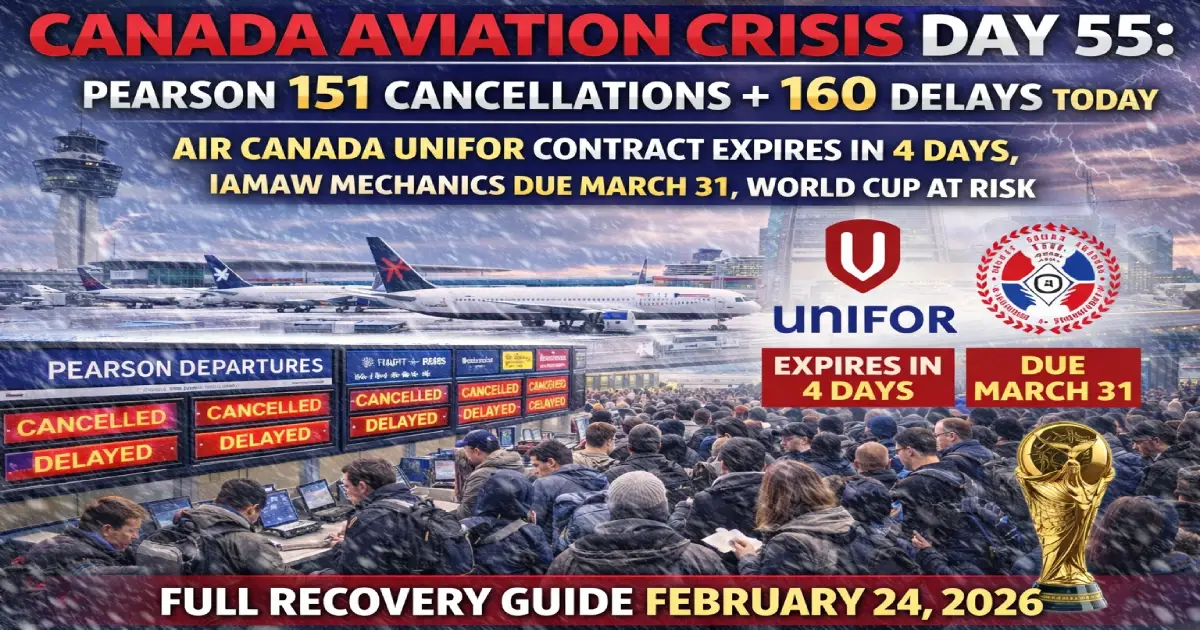
🔴 CANADA AVIATION CRISIS UPDATE | Published: February 24, 2026 | Last Updated: February 24, 2026, 8:00 AM EST
Crisis Day: Day 55 — January 1 to February 24, 2026 Today at Toronto Pearson (YYZ): 151 cancellations + 160 delays = 311 total disruptions Airlines Hit Today: Air Canada, Jazz (41% of all cancellations), Endeavor Air, Republic, WestJet, Porter Routes Severed: New York, Washington D.C., Halifax, London Heathrow, Amsterdam, Mexico City Unifor Local 2002 Contract Expiry: 4 DAYS — Saturday, February 28, 2026 Workers at Risk: 5,826 customer service agents at airports and call centres nationwide Wages Discussed: NOT YET — only non-monetary items covered in 27 days of talks Second Contract Expiry: Air Canada IAMAW mechanics + baggage handlers — March 31, 2026 March Break: March 7–21, 2026 — 3 million+ family travelers Earliest Legal Strike: Late April/May 2026 — March Break legally protected World Cup Risk Window: June 11–July 19, 2026 — Toronto + Vancouver matches directly in strike zone Cumulative 2026 Disruptions: 7,000+ flights, 700,000+ passengers affected since January 1
Canada’s aviation system has now endured 55 consecutive days of significant disruption — and today, February 24, is one of the worst yet.
Toronto Pearson International Airport, the country’s busiest gateway and a critical North American hub, is recording 151 cancellations and 160 delays as of this morning — with Jazz Aviation alone accounting for 41% of all cancellations at Pearson today, while Endeavor Air and Republic Airlines recorded 100% cancellation rates on their Pearson schedules, and Air Canada, WestJet, and Porter all reporting significant disruptions. Routes to New York, Washington D.C., Halifax, London Heathrow, and Amsterdam are among the hardest hit.
And in four days — Saturday, February 28, 2026 — the collective agreement between Air Canada and Unifor Local 2002, representing 5,826 customer service agents, expires. After 27 days at the bargaining table, wages — the central demand — have not been discussed once.
This is the complete picture of where Canada’s aviation crisis stands today, what the Unifor contract expiry actually means for your March Break plans, and why the real danger window for Canadian travelers is not this week — it is June.
Travel chaos has hit Toronto Pearson Airport today as Air Canada, Jazz, Endeavor, Republic, WestJet, and several other airlines struggle with 151 cancellations and 160 delays — a widespread disruption affecting Canada, the US, Mexico, and European cities, leaving thousands of passengers stranded or facing travel uncertainty.
The root cause today is a double compound problem. The disruption is largely attributed to severe storms in the US — which have caused havoc across major airports — with Toronto Pearson experiencing massive ripple effects, with flights to and from New York, Washington D.C., Halifax, London, and Amsterdam among those hit hardest.
| Airline | Cancellations | Delays | Notes |
|---|---|---|---|
| Jazz Aviation (ACA) | 62 (41% of total) | Significant | Worst single carrier today |
| Air Canada | High | 160+ system-wide | Regional + mainline |
| Republic Airlines (AAL) | 100% cancellation rate | — | All Pearson flights cancelled |
| Endeavor Air (DAL) | 100% cancellation rate | — | All Pearson flights cancelled |
| WestJet | Multiple | Multiple | Ongoing |
| Porter Airlines | Multiple | Multiple | Ongoing |
Key city pairs completely or heavily disrupted as of this morning:
This follows Day 53 — February 23 — when a powerful winter storm delivering severe snow, freezing rain, and icy conditions across Southern Ontario forced 94 flight cancellations and 397 delays, stranding thousands of passengers.
The cumulative toll since January 1, 2026 now exceeds 7,000 disrupted flights and an estimated 700,000+ affected passengers across Canada’s aviation network.
For readers encountering this story for the first time, a brief account of how Canada arrived at Day 55 is essential context.
Canada’s 2026 aviation crisis began on January 1 with a series of compounding winter storms that hit Toronto Pearson — already the most delay-prone major airport in North America — harder than any winter in recent memory. What began as weather-related disruption quickly exposed deep structural failures: chronic understaffing at Air Canada, Jazz, and regional carriers; de-icing bottlenecks; crew positioning failures; and an airport infrastructure at Pearson that was simply not built to handle the volume of traffic it now serves.
The cumulative cascading effect — where Day 1 disruptions create crew and aircraft positioning problems on Day 2, which compound further on Day 3 — produced Canada’s worst sustained aviation crisis since the COVID-19 pandemic groundings of 2020–2021.
The crisis has consumed five Labour incidents in the aviation sector simultaneously: the conclusion of the Air Canada CUPE flight attendant dispute through arbitration, the Unifor Local 2002 customer service contract expiry on February 28, the IAMAW mechanics contract expiry on March 31, active WestJet flight attendant negotiations, and Sunwing cabin crew contract expiry in May.
Here is the single most important thing every Canadian traveler needs to understand — and the thing that most media coverage has gotten wrong.
February 28 is NOT a strike date. It is a contract expiry date.
Under Canadian federal labour law — specifically the Canada Labour Code — the following mandatory steps must occur before any legal work stoppage:
Step 1: Contract Expiry — February 28, 2026 The collective agreement between Air Canada and Unifor Local 2002 expires at midnight Saturday, February 28. However, although the collective agreement expires on February 28, 2026, it remains in effect — this is called a statutory freeze — until a new agreement is ratified. Nothing changes automatically on February 28.
Step 2: Continued Bargaining (No Fixed Time Limit) The parties can continue bargaining under the protections of the Canada Labour Code after the contract expires — there is “no fixed length of time for collective bargaining itself — negotiations continue as long as progress is being made.”
Step 3: Conciliation Request (60 Days) If either party determines talks have stalled, they can request federal conciliation. A government-appointed conciliator works with both sides for up to 60 days to reach an agreement.
Step 4: Cooling-Off Period (21 Days) After the conciliator files their report, a mandatory 21-day cooling-off period begins. No strike or lockout can occur during this window.
Step 5: Legal Strike Eligibility Only after Steps 1–4 are completed — conciliation + cooling-off = minimum 81 days after conciliation is requested — can either party legally initiate job action.
If conciliation is requested immediately after February 28:
The passenger-critical verdict:
After 27 days since bargaining opened January 28, the state of negotiations is alarming for anyone hoping for a quick resolution.
Unifor Local 2002’s first official Bargaining Update from the Air Canada negotiating table reveals a concerning picture: nine days of talks covered only non-monetary items — wages have not been discussed at all — and 5,826 customer service agents’ central demands remain untabled.
The bargaining committee met with Air Canada from January 28 until February 6, focusing on non-monetary items such as editorial changes, clarifying language, and discussion about notice items that have arisen over the life of the collective agreement.
As of February 24 — four days from expiry — no Bargaining Update #2 has been published. That silence is notable.
Unifor National President Lana Payne stated: “Air Canada’s customer service agents are the backbone of the passenger experience. They manage delays, disruptions, and customer care under immense pressure, yet too often without the staffing and protections that reflect the value of their work. This bargaining round is about respect, safety, and fairness for the workers who keep Canada flying.”
Tammy Moore, President of Unifor Local 2002, added: “Our members are the people travellers rely on when flights are cancelled, connections are missed, or plans fall apart. They deserve improved wages, predictable schedules, and working conditions that allow them to do their jobs properly.”
The key demands centre on:
Wages: Air Canada reported a record revenue year in 2025 while customer service agents’ base pay has not kept pace with inflation. The union argues that agents responsible for rebooking 130,000 passengers during the August 2025 flight attendant strike deserve compensation that reflects that critical role.
Scheduling: Agents cite chronic unpredictability in shift patterns, making childcare and personal planning difficult. Minimum scheduling guarantees are a primary non-monetary demand.
Staffing levels: The union’s Air Transportation Workers’ Charter of Rights has long called for action on chronic understaffing, contracting out, unsafe workloads, and inadequate training across the industry.
Unpaid time: Much of the work service agents do happens under intense pressure and “includes unpaid time spent in uniform before and after shifts, as well as ongoing mandatory training to meet strict regulatory requirements.” Compensation for this unpaid time is a central demand.
While all attention is on the Unifor February 28 deadline, a second — potentially more operationally devastating — contract expiry is approaching six weeks later.
The International Association of Machinists and Aerospace Workers (IAMAW) represents Air Canada’s mechanics and baggage handlers. Their collective agreement expires March 31, 2026 — directly during the March Break travel period.
Unlike customer service agents, IAMAW mechanics are responsible for aircraft maintenance, safety certifications, and ground handling operations. A work-to-rule campaign or strike by IAMAW would not just slow check-in lines — it would ground aircraft entirely.
Applying the same legal timeline to IAMAW:
The convergence of two separate Air Canada contract expiries — Unifor February 28, IAMAW March 31 — both feeding into potential strike windows that overlap with the 2026 FIFA World Cup, is the defining labour risk for Canadian aviation this year.
McGill University aviation expert John Gradek has warned: “They all have the potential to shut down the airlines.”
The fear gripping Canadian travelers is not hypothetical — it is rooted in very recent, very painful experience.
In August 2025, Air Canada’s flight attendants — represented by the Canadian Union of Public Employees (CUPE) — initiated a strike after months of failed contract negotiations over wages and compensation for duties performed on the ground. The walkout began on August 16, 2025, with the airline cancelling most of its roughly 700 daily flights and affecting an estimated 130,000 passengers per day as travellers were left stranded or forced to rebook.
The federal government intervened by directing the Canada Industrial Relations Board (CIRB) to enforce binding arbitration to end the work stoppage, though CUPE initially resisted the order before mediated talks culminated in a tentative settlement on August 19, 2025 that allowed operations to gradually resume.
The CUPE settlement has now been formally concluded. An arbitrator reviewing wages for flight attendants at Air Canada finalized rates on February 18, 2026, bringing an end to the labour dispute that saw travel disrupted for thousands of people last summer. The arbitrator maintained the rates agreed to in a tentative deal for flight attendants at Air Canada’s main line but bumped up the increase in the first year for those at Rouge.
The CUPE chapter is closed. The Unifor chapter is just beginning — and the union knows exactly how little leverage the August 2025 flight attendants ultimately extracted through their strike action.
Canada co-hosts the 2026 FIFA World Cup alongside the United States and Mexico. Matches are scheduled at:
World Cup match dates in Canada: June 11–July 19, 2026
The convergence of this with Air Canada labour timelines creates a leverage dynamic that no previous Air Canada union dispute has had. For Unifor and potentially IAMAW, the World Cup is the single largest piece of bargaining leverage in Canadian aviation labour history.
Hundreds of thousands of international fans — from across Europe, South America, Africa, and Asia — will be flying into Toronto and Vancouver for these matches. A significant portion will fly Air Canada. A Unifor customer service agent strike would paralyze check-in, rebooking, and support operations at both venues’ primary airports. An IAMAW mechanics’ strike would ground flights entirely.
The Canadian government would almost certainly invoke back-to-work legislation — as they did for CUPE in August 2025 — but the operational and reputational damage of even a 48–72 hour stoppage during World Cup would be catastrophic and internationally embarrassing.
Both sides know this. It is the single most important context for understanding where these negotiations will ultimately resolve.
Understanding the practical passenger impact of each potential job action is essential for travel planning:
What stops:
What continues (not Unifor members):
Net operational impact: Air Canada could technically still operate flights — but without customer service agents, the passenger experience would collapse. Check-in would default to self-service kiosks and online check-in only. Any passenger requiring human assistance — special needs, unaccompanied minors, oversized baggage, disruption rebooking — would face no support. The airline would almost certainly preemptively cancel significant portions of its schedule, as it did in August 2025.
What stops:
Net operational impact: Unlike a customer service agent strike, an IAMAW mechanics’ strike would physically prevent aircraft from being legally certified to fly. Every Air Canada flight would require third-party maintenance certification or face grounding. This is an existential operational threat — the government would intervene far faster than for a customer service disruption.
You are legally protected from any direct strike action. The statutory freeze and mandatory conciliation timeline make a March strike impossible. However, the ongoing 55-day winter crisis, not the labour situation, is your primary risk this month. Take these steps:
This is the earliest theoretically at-risk window. Conciliation must be requested AND conclude AND the 21-day cooling-off period must end before any strike is legal. Victoria Day is extremely tight on the legal timeline. Monitor unifor.org/aircanada for any conciliation filing announcement.
This is the genuine high-risk window. Take these steps now:
You do not need to check the news every day. These are the three specific events that would trigger immediate action:
🔴 Signal 1 — Unifor files for federal conciliation after February 28 This is the most critical signal. It starts the 60-day + 21-day legal clock. When this filing happens, calculate the earliest legal strike date and assess your summer travel exposure immediately.
🔴 Signal 2 — IAMAW files for conciliation after March 31 Second critical signal. Apply the same 81-day calculation to determine World Cup risk from mechanics.
🟠 Signal 3 — Unifor issues a strike mandate vote Even before a legal strike is possible, a strike mandate vote signals that the union is preparing for confrontation. This is a serious escalation signal — typically announced publicly and widely covered by Canadian media.
🟢 Signal 4 — A tentative agreement is reached The resolution signal. If Air Canada and Unifor announce a tentative deal, summer travel risk drops significantly (though IAMAW remains a separate concern).
Monitor: unifor.org/aircanada — this is the only authoritative source for bargaining updates directly from the union.
| Union | Workers | Contract Expiry | Earliest Legal Strike | Key Risk Period |
|---|---|---|---|---|
| Unifor Local 2002 | 5,826 customer service agents | Feb 28, 2026 | ~May 20, 2026 | World Cup June–July |
| IAMAW | Mechanics + baggage handlers | March 31, 2026 | ~June 20, 2026 | World Cup June–July |
| CUPE (flight attendants) | 10,000+ flight attendants | ✅ SETTLED — Feb 18, 2026 | N/A | Resolved |
| WestJet CUPE | WestJet flight attendants | Active 2026 negotiations | TBD | Summer 2026 |
| Sunwing cabin crew | Sunwing attendants | May 31, 2026 | ~Sept 2026 | Late summer |
With Pearson recording 311 disruptions today alone, thousands of passengers are potentially owed compensation under Canada’s Air Passenger Protection Regulations. Here is a quick reference:
If your flight is delayed 3–6 hours (for reasons within airline control):
If your flight is delayed 6–9 hours (for reasons within airline control):
If your flight is cancelled OR delayed 3+ hours at arrival (within airline control):
Important: Weather cancellations are generally classified as “extraordinary circumstances” outside airline control — compensation is NOT required for weather. However, if the airline fails to offer meals, hotel, or rebooking in accordance with regulations even for weather delays, you can still file a complaint at otc-cta.gc.ca.
Today’s distinction: The ripple-effect cancellations at Pearson caused by the US blizzard’s impact on aircraft and crew positioning may be classified as within-airline-control depending on the specific circumstances. If Jazz, Air Canada, or WestJet cancelled your flight today due to crew or aircraft unavailability — and NOT directly due to weather at Pearson — you may be entitled to full APPR compensation. Document everything and file at otc-cta.gc.ca.
| Resource | Contact |
|---|---|
| Toronto Pearson live status | gtaa.com / @TorontoPearson |
| Air Canada flight status | aircanada.com or Air Canada app |
| WestJet flight status | westjet.com |
| APPR complaints | otc-cta.gc.ca |
| Unifor bargaining updates | unifor.org/aircanada |
| Environment Canada weather | weather.gc.ca |
| Air Canada customer service | 1-888-247-2262 |
| WestJet customer service | 1-888-937-8538 |
1. February 28 is not a strike date — it is a contract expiry date. The statutory freeze means everything continues as-is after Saturday. The earliest any legal strike can occur is late May 2026. March Break is legally protected. Stop panicking about this week.
2. The World Cup window is the real danger zone. Both Unifor (February 28 expiry) and IAMAW (March 31 expiry) feed into potential strike timelines that converge directly on World Cup matches in Toronto and Vancouver this June and July. If you have Air Canada World Cup travel booked, buy CFAR travel insurance today.
3. Today’s 311 disruptions at Pearson are Day 55 of an ongoing crisis — not a new one. Canada’s aviation system has been broken since January 1. The weather disruptions, structural staffing failures, and ripple effects from the US blizzard are real and ongoing. Plan for disruption, know your APPR rights, and file complaints when airlines fail to meet their legal obligations.
Canada’s aviation crisis is not ending soon. But armed with accurate information — not panic — you can protect your travel plans.
For More Resources:
Related Articles:
Published: February 24, 2026. Information sourced from FlightAware, Unifor official bargaining update #1 (February 10, 2026), unifor.org/aircanada, CBC News (February 18, 2026), Vancouver Is Awesome, TravelPulse Canada, Aviation A2Z, Avioâ Space, Fasken LLP labour advisory (February 23, 2026), McGill University aviation expert John Gradek, Canada Labour Code provisions, Transport Canada, and the Canadian Transportation Agency. All figures accurate as of 8:00 AM EST February 24, 2026.
Posted By : Vinay
Lastest News
2nd Floor, 39, Above Kirti Club, DLF Industrial Area, Kirti Nagar, New Delhi, Delhi 110015



Travel Tourister is a leading Travel portal where we introduce travellers to trusted travel agents to make their journey hasselfree, memorable And happy. Travel Tourister is a platform where travellers get Tour packages ,Hotel packages deals through trusted travel companies And hoteliers who are working with us across the world. We always try to find new and more travel agents and hoteliers from every nook and corners across the world so that you could compare the deals with different travel agents and hoteliers and book your tour or hotel with the one you have chosen according to your taste and budget.
Copyright © Travel Tourister, India. All Rights Reserved

 Call
Call Enquiry