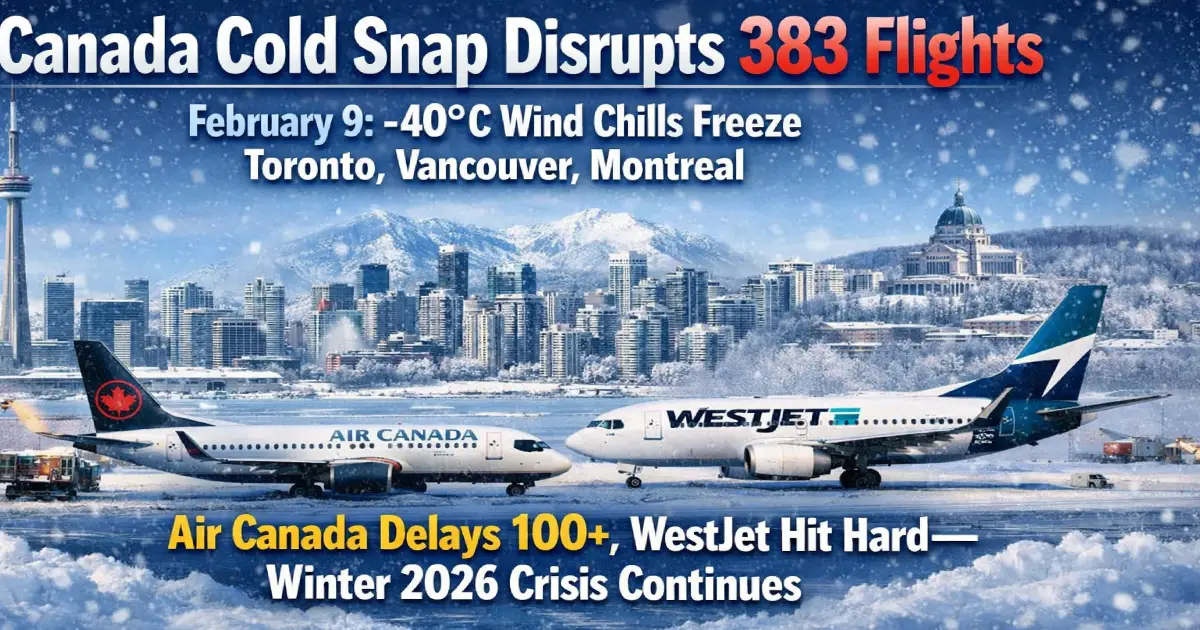
BREAKING: Canada faces ANOTHER Arctic blast on Sunday, February 9, 2026, triggering 383 flight disruptions (67 cancellations + 316 delays) across major hubs as Environment Canada’s extreme cold warning brings -35°C to -40°C wind chills to Toronto, Ottawa, Vancouver, and Montreal. Air Canada accounts for 100+ delays alone as ground crews battle frigid conditions that slow de-icing operations, freeze jet fuel, and create hazardous working environments for baggage handlers and ramp staff. This marks the SEVENTH major weather event disrupting Canadian aviation in just 38 days (since January 2), with cumulative disruptions now exceeding 4,500 flights as the nation’s tightly-stretched airline network buckles under relentless Arctic fronts.Thousands of passengers are stranded across Canada today—many connecting international travelers from US, UK, and Australia facing missed connections and extended delays. Here’s the complete breakdown of today’s crisis and what travelers need to know NOW.
Published: February 9, 2026
Crisis Date: Sunday, February 9, 2026 (TODAY)
Total Disruptions: 383 flights (67 cancellations + 316 delays)
Airlines Affected: Air Canada (100+ delays), WestJet, Jazz, Porter, international carriers
Airports Hit Hardest: Toronto Pearson, Vancouver, Montreal, Ottawa, Edmonton
Weather Cause: Extreme cold (-35°C to -40°C wind chill), yellow warning across Canada
Winter 2026 Total (Jan 2-Feb 9): 4,500+ disruptions in 38 days
Pattern: 7th major weather event since January 2
Today’s Disruption Breakdown (February 9)
Sunday morning’s extreme cold is creating widespread operational chaos across Canadian aviation:
Total Impact:
- ✈️ 67 CANCELLATIONS (affecting 7,000-10,000 passengers)
- ✈️ 316 DELAYS (many extending 2-5+ hours)
- ✈️ 383 TOTAL DISRUPTIONS (approximately 35,000-40,000 passengers impacted)
- ✈️ Airports paralyzed: Toronto Pearson, Vancouver, Montreal, Ottawa, Edmonton, more
- ✈️ Airlines overwhelmed: Air Canada, WestJet, WestJet Encore, Jazz, Porter, international carriers
Key Affected Airports:
Toronto Pearson International (YYZ):
- Delays: 85-100+
- Cancellations: 20-25
- Total disruptions: 105-125 (affecting ~30% of Sunday operations)
- Wind chill: -30°C to -35°C
- Biggest issues: De-icing delays (30-45 min per aircraft), frozen ground equipment
Vancouver International (YVR):
- Delays: 45-55
- Cancellations: 12-15
- Total disruptions: 57-70
- Wind chill: -10°C to -15°C (mild for Canada, but fog + cold = visibility issues)
- Issues: Fog reducing visibility, cold impacting operations
Montreal-Trudeau International (YUL):
- Delays: 60-70
- Cancellations: 10-12
- Total disruptions: 70-82
- Wind chill: -35°C to -40°C (COLDEST in network today)
- Issues: Extreme cold freezing jet fuel, ground crew safety concerns
Ottawa Macdonald-Cartier (YOW):
- Delays: 25-30
- Cancellations: 5-7
- Total disruptions: 30-37
- Wind chill: -35°C to -40°C
- Issues: Smaller airport, less de-icing capacity overwhelmed
Edmonton International (YEG):
- Delays: 30-35
- Cancellations: 8-10
- Total disruptions: 38-45
- Wind chill: -40°C to -45°C (Prairie cold)
- Issues: Extreme cold affecting all operations
Calgary International (YYC):
- Delays: 20-25
- Cancellations: 4-6
- Total disruptions: 24-31
- Wind chill: -30°C to -35°C
- Issues: Moderate impact compared to other hubs
Halifax Stanfield (YHZ):
- Delays: 15-20
- Cancellations: 3-5
- Total disruptions: 18-25
- Wind chill: -20°C to -25°C
- Issues: Atlantic cold, snow showers
Airline-by-Airline Breakdown
Air Canada – Largest Canadian Carrier
Impact TODAY (Feb 9):
- Delays: 100-120 flights (approximately 20-25% of Sunday schedule)
- Cancellations: 15-20 flights
- Total disruptions: 115-140
Hardest-hit routes:
- Toronto ↔ Montreal (high-frequency shuttle route, multiple cancellations)
- Toronto ↔ Ottawa (regional operations struggling)
- Toronto ↔ Vancouver (transcontinental delays)
- Montreal ↔ US destinations (LaGuardia, Newark affected)
- Vancouver ↔ Calgary (Western Canada cold)
Air Canada’s statement (via website/app): “Extreme cold temperatures at Toronto, Montreal, and other Canadian airports are causing flight delays and some cancellations. Customers may rebook at no additional cost. We apologize for the inconvenience.”
Travel waiver: Active for flights February 9-10
- Covered airports: Toronto (YYZ), Montreal (YUL), Ottawa (YOW), Edmonton (YEG)
- Rebook by: February 12
- New travel by: February 15
- Fee waiver: No change fees, no fare difference if same class
WestJet – Major Domestic Carrier
Impact TODAY (Feb 9):
- Delays: 50-60 flights
- Cancellations: 12-15 flights
- Total disruptions: 62-75
Hardest-hit routes:
- Calgary ↔ Toronto (primary route affected)
- Calgary ↔ Vancouver (Western operations)
- Toronto ↔ Edmonton (Prairie cold)
- Vancouver ↔ Montreal (transcontinental delays)
WestJet’s response: Similar travel waiver to Air Canada, allowing free rebooking for affected passengers.
Jazz Aviation (Air Canada Express) – Regional Operator
Impact TODAY (Feb 9):
- Delays: 40-50 flights
- Cancellations: 10-12 flights
- Total disruptions: 50-62
Why Jazz is hit hard:
- Smaller regional aircraft (more susceptible to cold weather delays)
- Lower priority for de-icing (mainline jets go first)
- Connecting flights (delays cascade through network)
Porter Airlines – Toronto-Based Carrier
Impact TODAY (Feb 9):
- Delays: 30-40 flights
- Cancellations: 8-10 flights
- Total disruptions: 38-50
Porter-specific issues:
- Billy Bishop Airport (Toronto Island) has limited de-icing capacity
- Turboprop fleet (Q400 aircraft more sensitive to cold)
- Short-haul routes (frequent operations mean delays compound quickly)
International Carriers
United, Delta, American (US Carriers):
- Combined disruptions: 30-40 flights
- Routes affected: US-Canada transborder (Newark-Toronto, Chicago-Toronto, Boston-Montreal)
- Cascading delays: Canadian delays ripple into US network
European Carriers (Air France, Lufthansa, British Airways):
- Impact: Moderate delays (10-20 flights combined)
- Long-haul operations: Less affected (larger aircraft, longer turnaround times absorb delays)
Why -40°C Wind Chill Paralyzes Operations
Extreme cold doesn’t just inconvenience passengers—it fundamentally disrupts aircraft operations:
1. De-Icing Takes 2-3X Longer
Normal conditions (0°C to -10°C):
- De-icing time: 10-15 minutes per aircraft
- Fluid type: Type I (basic orange glycol)
Extreme cold (-30°C to -40°C):
- De-icing time: 30-45 minutes per aircraft
- Fluid type: Type I + Type IV (thicker, longer-lasting green fluid for holdover protection)
- Multiple applications needed (cold causes fluid to freeze rapidly)
Bottleneck effect:
- Toronto Pearson has 12 de-icing pads
- At 15 min/aircraft: Can process 48 aircraft/hour = 576/12-hour day
- At 45 min/aircraft: Can process 16 aircraft/hour = 192/12-hour day
- Result: 384 fewer aircraft de-iced daily = MASSIVE backlog
2. Jet Fuel Freezes (Literally)
Jet-A fuel freezing point: -40°C to -47°C
When ambient temperature WITH wind chill reaches -40°C:
- Fuel in wing tanks (exposed to airflow) approaches freezing point
- Airlines must add Fuel System Icing Inhibitor (FSII) to prevent ice crystals
- Fueling operations slow down (cold fuel flows slower, pump slower)
- Pre-flight fuel temperature checks take extra time
Real impact:
- Fueling that normally takes 20 minutes → takes 35-40 minutes
- Added safety checks (fuel temp monitoring) → +10 minutes
- Total delay: 25-30 minutes PER AIRCRAFT
3. Ground Equipment Failures
What fails in extreme cold:
- Baggage loaders: Hydraulic fluid thickens, lifts fail
- Pushback tugs: Diesel engines struggle to start, batteries die
- Belt loaders: Motors freeze, conveyor belts snap
- Jet bridges: Hydraulic systems freeze, won’t extend/retract
- Ground power units (GPU): Won’t start or maintain power
Consequence:
- Flights delayed waiting for working equipment
- Manual baggage loading (slower, limited capacity)
- Aircraft pushed back by hand (rare, time-consuming)
- Passengers board via stairs in -40°C (dangerous, slow)
4. Worker Safety Limits
Transport Canada regulations:
- Workers cannot be exposed to -35°C+ wind chill for more than 10-15 minutes continuously
- Mandatory warm-up breaks every 10-15 minutes
- Reduced work efficiency (thick gloves, layers slow movements)
Operational impact:
- Ground crew rotations every 10-15 min (vs 30-45 min in normal cold)
- Fewer workers on ramp at any given time
- De-icing, fueling, baggage all slow down
5. Aircraft Systems Struggles
Cold-soaked aircraft (parked overnight in -40°C):
- Hydraulic systems: Fluid viscosity increases, slow response
- Electrical systems: Batteries lose 30-50% capacity
- Avionics: Displays slow to boot, systems sluggish
- Landing gear: Brakes freeze, tires lose pressure
Pilots must:
- Run engines longer before taxi (warm hydraulics)
- Check all systems meticulously (cold-related failures common)
- Conduct additional safety checks
- Result: +15-20 minutes per departure
Environment Canada’s Yellow Warning
What “Yellow Warning – Cold” Means:
Issued: Saturday evening, February 8 Effective: Sunday morning – Monday afternoon (Feb 9-10) Areas: Ontario (Toronto, Ottawa), Quebec (Montreal), Prairies (Calgary, Edmonton), BC (Vancouver – modified warning)
Warning text:
“Extreme cold warnings remain in effect for much of Ontario and Quebec with wind chill values near -35 to -40. Frostbite can develop within minutes on exposed skin. Limit time outdoors and ensure proper winter clothing is worn.”
Travel-specific impacts noted:
- “Airport delays expected due to operational slowdowns”
- “Road conditions may be hazardous – ice, reduced visibility”
- “Public transit disruptions possible”
Historical context:
- Last comparable cold snap: January 24-25, 2026 (-55°C Prairies)
- Yellow warnings issued 4-5 times this winter already
- Pattern: Repeated Arctic outbreaks every 7-10 days
The Relentless Pattern: 7 Weather Events in 38 Days
Today’s disruptions aren’t an isolated incident—they’re part of a catastrophic winter 2026 pattern:
Winter 2026 Canadian Aviation Disruptions Timeline
Event 1: January 2, 2026
- Disruptions: 696 flights (598 delays + 98 cancellations)
- Cause: Winter storms, snow, strong winds
- Hardest hit: Toronto, Vancouver, Montreal
Event 2: January 10, 2026
- Disruptions: 1,752 flights (estimated, major multi-day event)
- Cause: Blizzards, extreme snow
- Hardest hit: Nationwide
Event 3: January 16, 2026
- Disruptions: 984 flights (327 cancellations + 657 delays)
- Cause: 40cm Toronto snowstorm
- Hardest hit: Toronto Pearson (327 cancellations alone)
Event 4: January 21, 2026
- Disruptions: 436 flights (104 cancellations + 332 delays)
- Cause: Arctic cold, freezing rain, fog
- Hardest hit: Calgary, Montreal, Vancouver
Event 5: January 24-25, 2026
- Disruptions: 560+ flights (400+ cancellations Jan 25 alone)
- Cause: Polar vortex (-55°C wind chill Prairies)
- Hardest hit: Toronto (46cm single-day record), Atlantic Canada
Event 6: January 25-27, 2026
- Disruptions: Additional 200-300 flights (recovery delays)
- Cause: Lingering effects, record snow cleanup
- Hardest hit: Toronto (88.2cm monthly record)
Event 7: February 9, 2026 (TODAY)
- Disruptions: 383 flights (67 cancellations + 316 delays)
- Cause: Extreme cold (-40°C wind chill)
- Hardest hit: Toronto, Montreal, Edmonton
CUMULATIVE TOTAL (Jan 2 – Feb 9):
- Total disruptions: 4,500+ flights in 38 days
- Average: 118 disruptions per day (when weather hits)
- Passengers affected: 500,000+ travelers (estimated)
- Pattern: Major event every 5-7 days
What Travelers Should Do RIGHT NOW
If You’re Flying TODAY (February 9)
Step 1: Check Flight Status IMMEDIATELY
- Air Canada: aircanada.com or mobile app
- WestJet: westjet.com or mobile app
- Porter: flyporter.com
- Jazz/regional: Check via Air Canada app
- FlightAware/FlightRadar24: Third-party trackers
Step 2: DON’T Go to Airport Without Confirmation
- If flight shows “delayed” → Wait for updates (don’t leave early)
- If flight shows “cancelled” → DON’T go to airport, rebook online/phone
- If flight shows “on-time” → Still monitor (status can change rapidly)
Step 3: Rebook Options
Air Canada passengers:
- Online: ac.com → “Manage Booking” → Select new flight (no fees during waiver)
- Phone: 1-888-247-2262 (expect 1-2 hour waits)
- App: Fastest way to rebook
WestJet passengers:
- Online: westjet.com → “Manage Trips”
- Phone: 1-888-937-8538
- App: WestJet app
Porter passengers:
- Online: flyporter.com
- Phone: 1-888-619-8622
Step 4: Know Your Rights
Weather delays = NO compensation required (airlines not liable for “acts of God”)
BUT airlines MUST:
- ✅ Rebook you on next available flight at no charge
- ✅ Provide alternative routing if available
- ✅ Refund if you choose not to travel
Airlines NOT required to:
- ❌ Pay for hotels (weather delay)
- ❌ Provide meal vouchers (weather delay)
- ❌ Compensate for missed events/connections
Exception: Some premium credit cards (Chase Sapphire, Amex Platinum) include trip delay insurance covering meals/hotels after 6-12 hour delays.
If You’re Flying Tomorrow-Tuesday (Feb 10-11)
Expect residual delays:
- Aircraft out of position (planes stuck in wrong cities)
- Crew out of position (pilots/flight attendants displaced)
- Backlog of passengers (everyone from today trying to fly tomorrow)
Recommendation:
- Book first flights of the day (6-8 AM departures less likely to be delayed)
- Avoid tight connections (add 2+ hour buffers)
- Monitor weather (another cold snap forecast later this week)
International Travelers: Missed Connections
The Hidden Crisis:
Today’s 383 disruptions primarily affect domestic Canadian flights, but thousands of international passengers connecting through Canada are collateral damage:
Common Affected Routes
Europe → Canada → US:
- Air Canada: London → Toronto → Chicago (if Toronto connection misses, stranded)
- Lufthansa: Frankfurt → Toronto → San Francisco
- Air France: Paris → Montreal → New York
US → Canada → Europe:
- United: Newark → Toronto → London
- Air Canada: Boston → Montreal → Paris
- Delta: Atlanta → Toronto → Amsterdam (via codeshare)
Asia-Pacific → Canada → US:
- Air Canada: Tokyo → Vancouver → Seattle
- ANA: Tokyo → Toronto → Los Angeles (codeshare)
- Qantas: Sydney → Vancouver → San Francisco
What Happens When You Miss Connection
Scenario: You fly London → Toronto on Air Canada, connecting to Toronto → New York. Toronto delays cause you to miss the New York flight.
Airline responsibilities:
- ✅ Rebook on next available flight (even if next day)
- ✅ Provide hotel voucher if overnight (sometimes, depends on ticket type)
- ✅ Meal vouchers (sometimes, discretionary)
What airline is NOT required to do:
- ❌ Upgrade you to make up for delay
- ❌ Compensate for missed events (wedding, cruise, etc.)
- ❌ Pay for alternative transportation (train, rental car)
Traveler tips:
- Book on single ticket (if separate tickets, airline not responsible for rebooking)
- Allow 3+ hour connections in Canadian cities during winter
- Buy travel insurance covering missed connections
The Bigger Picture: Canadian Aviation’s Winter Vulnerability
Today’s 383 disruptions are a symptom of systemic issues in Canadian aviation:
Why Canada Struggles More Than Other Cold Countries
Compare to Nordic Countries (Finland, Norway, Sweden):
- Finland (Helsinki Airport): Rarely cancels flights despite -30°C winter temps
- Norway (Oslo Airport): Operates smoothly through Arctic conditions
- Sweden (Stockholm Arlanda): Minimal winter disruptions
Why they succeed:
- Infrastructure investment: Heated hangars, underground fuel systems, redundant de-icing capacity
- Geographic advantage: Smaller countries, fewer hub-and-spoke dependencies
- Lower traffic volumes: Helsinki handles 20M passengers/year vs Toronto’s 50M
Canada’s challenges:
- Hub-and-spoke model: Everything funnels through Toronto/Montreal/Vancouver (single-point failures)
- Underinvestment: Airports haven’t built sufficient de-icing capacity for extreme cold frequency
- Geography: Vast distances mean weather affects multiple hubs simultaneously
- Profit margins: Airlines prioritize profitability over winter resilience investments
Political/Economic Implications
Transport Canada (regulatory agency) under pressure:
- Opposition MPs calling for inquiries into “chronic winter failures”
- Questions about airport infrastructure adequacy
- Airline consumer protection laws being debated
Economic costs:
- Lost productivity: 500,000+ passengers delayed = millions in lost business productivity
- Tourism damage: International travelers avoiding Canadian connections in winter
- Airline losses: De-icing costs, crew overtime, rebooking expenses (estimated $50-100M+ this winter)
What Happens Next: Forecast for This Week
Environment Canada’s 7-day outlook (Feb 9-16):
Sunday-Monday (Feb 9-10):
- Extreme cold continues (-35°C to -40°C wind chill)
- Expect 200-300 more disruptions Monday
- Yellow warning remains in effect
Tuesday-Wednesday (Feb 11-12):
- Slight moderation (-25°C to -30°C wind chill)
- Residual delays from backlog
- Operations improving but not normal
Thursday-Friday (Feb 13-14):
- New Arctic front forecast (-30°C to -40°C returns)
- High probability of renewed disruptions
- Airlines may issue proactive waivers
Weekend (Feb 15-16):
- Uncertain (depends on Arctic air mass position)
- Could see relief OR another cold snap
Bottom line: Expect continued disruptions through mid-February with possible relief late-month.
Long-Term Solutions (What Needs to Change)
Infrastructure improvements needed:
- More de-icing capacity at Toronto, Montreal, Vancouver
- Heated aircraft parking (reduce cold-soaking overnight)
- Underground fuel systems (prevent fuel freezing)
- Improved ground equipment (Arctic-rated baggage loaders, tugs)
- Better crew facilities (warm break rooms near gates)
Operational changes:
- Proactive cancellations (cancel flights BEFORE passengers go to airport)
- Better communication (real-time SMS/app updates)
- Improved rebooking systems (self-service apps that actually work during chaos)
Regulatory reforms:
- Mandatory compensation for delays over X hours (even if weather-related, to incentivize resilience)
- Airport infrastructure standards (minimum de-icing capacity requirements)
- Transparency requirements (real-time delay cause reporting)
Industry experts estimate:
- Cost: $2-3 billion CAD for nationwide improvements
- Timeline: 5-10 years to implement fully
- Benefit: 50-70% reduction in winter weather disruptions
Political reality:
- Unlikely to happen without major crisis or regulatory pressure
- Airlines resist additional costs
- Airports argue they already operate on thin margins
Traveler Checklist: Surviving Canadian Winter Travel
Before Booking:
- ☐ Check historical weather patterns (avoid January-February if possible)
- ☐ Book refundable tickets OR comprehensive travel insurance
- ☐ Allow extra buffer days (don’t book important events day-after arrival)
- ☐ Consider alternative routings (US hubs may be more reliable in winter)
Before Traveling:
- ☐ Download airline apps (Air Canada, WestJet, etc.)
- ☐ Enable flight status notifications (SMS + email + app)
- ☐ Pack essentials in carry-on (assume checked bags may be delayed)
- ☐ Have backup plans (know alternative flights, hotels, transportation)
Day of Travel:
- ☐ Check flight status BEFORE leaving for airport
- ☐ Arrive 3+ hours early (if flying, delays may compound)
- ☐ Dress for extreme cold (may be stuck outside if airport crowded)
- ☐ Bring snacks, water, phone chargers (long delays likely)
If Disrupted:
- ☐ Rebook online IMMEDIATELY (don’t wait in line)
- ☐ Call airline while rebooking online (dual-track approach)
- ☐ Screenshot all confirmation numbers
- ☐ Document everything (photos, emails) for insurance claims
- ☐ Be polite to staff (they’re overwhelmed, not responsible for weather)
FAQs
Q: Will my flight definitely be delayed/cancelled? A: Not necessarily. Check your specific flight status. While 383 disruptions sound like a lot, that’s out of 1,000+ total Canadian flights today. Your flight has ~70% chance of operating normally (though possibly with minor delays).
Q: Should I still go to the airport if my flight shows “on time”? A: Yes, but monitor status continuously. “On-time” can change to “delayed” or “cancelled” suddenly. Go to airport but be prepared for changes.
Q: Can I get a refund instead of rebooking? A: Yes. If your flight is cancelled or significantly delayed, you can request a full refund instead of rebooking. This applies even to non-refundable tickets when the airline cancels.
Q: Will the airline pay for my hotel if I’m stranded overnight? A: Maybe. It depends on:
- Ticket type: Business/First class passengers more likely to get hotel
- Elite status: Air Canada Altitude, WestJet Rewards members prioritized
- Discretion: Gate agents have some flexibility
- Weather: Technically airlines not required to provide hotels for weather delays, but some do anyway
Q: What if I have a non-refundable hotel/event/cruise? A: Travel insurance is the only protection. Airline is not responsible for consequential damages (missed events, lost hotel deposits, etc.) due to weather delays. This is why travel insurance is critical for important trips.
Q: Should I drive instead of fly? A: Generally NO in these conditions. -40°C wind chill + winter roads = extremely dangerous. Highway closures common, accidents frequent, risk of getting stranded high. Flying (even with delays) is safer than winter driving in extreme cold.
Q: When will Canadian winter flight chaos end? A: Historically, late February-March sees warming trends and fewer Arctic blasts. But 2026 winter has been exceptionally harsh, so expect potential disruptions through mid-March.
The Bottom Line
February 9, 2026’s 383 flight disruptions (67 cancellations + 316 delays) mark the seventh major weather event paralyzing Canadian aviation in just 38 days. With cumulative disruptions exceeding 4,500 flights since January 2, Canada’s airline network is buckling under relentless Arctic fronts that bring -40°C wind chills, freeze ground operations, and strand hundreds of thousands of passengers.
For travelers:
- Check flight status obsessively (status changes rapidly)
- Rebook immediately if cancelled (don’t wait in line)
- Know your rights (weather = no compensation, but free rebooking)
- Avoid tight connections (3+ hour buffers in Canadian cities)
- Consider travel insurance (only protection for consequential losses)
The pattern continues: Environment Canada forecasts another Arctic blast Thursday-Friday (Feb 13-14), suggesting this winter’s chaos is FAR from over. Spring can’t come soon enough for Canadian aviation—and the 50 million annual passengers who depend on it.
For More Information:
- Environment Canada Warnings: weather.gc.ca
- Flight Status: FlightAware.com, airline apps
- Air Canada Travel Alerts: aircanada.com/travelalerts
- WestJet Alerts: westjet.com/en-ca/travel-info/travel-alerts
- Toronto Pearson Status: torontopearson.com/status
- Vancouver Airport: yvr.ca/flightinfo
- Montreal Airport: admtl.com/en/flights
Related Articles:
Posted By : Vinay
As a lead contributor for Travel Tourister, Vinay is dedicated to serving our Tier 1 audience (US, UK, Canada, Australia). His mission is to deliver precise, fact-checked news and actionable, data-driven articles that empower readers to make informed decisions, minimize travel risks, and maximize their adventure without compromising safety or budget.




 Call
Call Enquiry