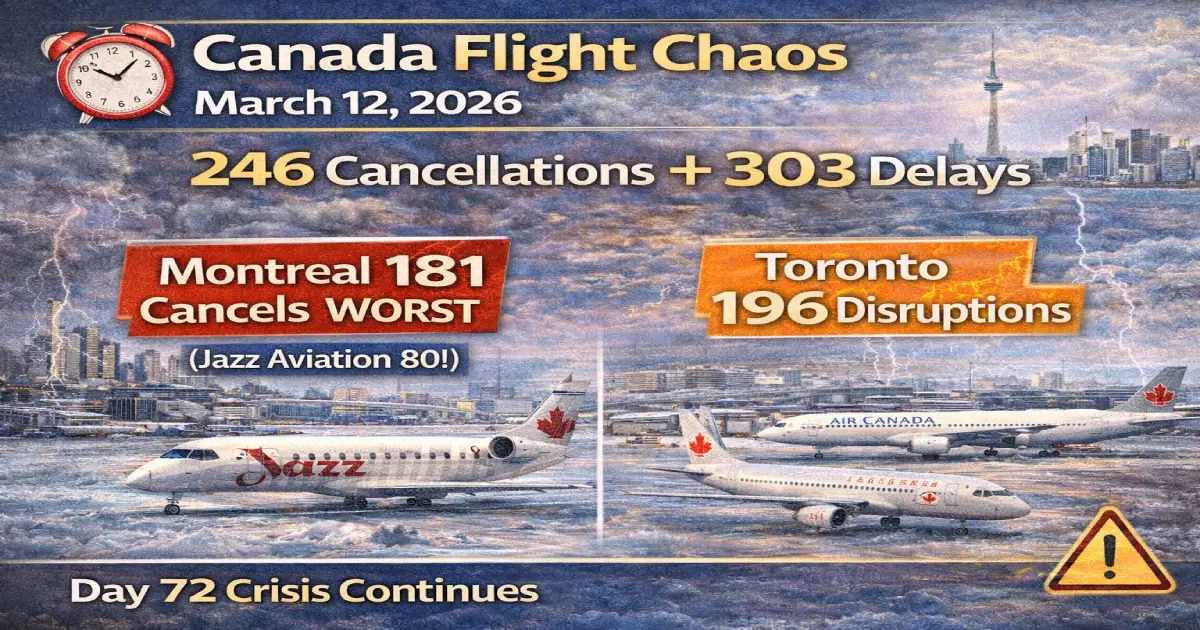
Breaking: Canada’s aviation system enters Day 72 of consecutive operational catastrophe with 549 total flight disruptions (246 cancellations + 303 delays) as Montreal-Trudeau International Airport records the worst single-airport Canadian day of 2026 with 181 cancellations + 51 delays (232 total disruptions!). Jazz Aviation collapses with 80 cancellations (regional carrier meltdown!), while Air Canada logs 37 cancellations + 107 delays and Toronto Pearson suffers 196 disruptions (49 cancellations + 147 delays). Here’s what every Canadian traveler needs to know now.
Published: March 12, 2026 (Thursday)
Total Disruptions: 549 (246 cancels + 303 delays!)
Worst Airport: Montreal-Trudeau—181 cancels + 51 delays = 232 total (CATASTROPHIC!)
Worst Carrier: Jazz Aviation—80 cancels + 27 delays = 107 total (regional collapse!)
Crisis Duration: Day 72 consecutive (since January 1, 2026)
Affected Cities: Montreal, Toronto, Vancouver, Calgary, Edmonton
Passengers Affected: Est. 82,350+ (based on 150 passengers/flight average)
The Day 72 Catastrophe in Numbers
Thursday, March 12, 2026 marked Day 72 of consecutive operational chaos across Canada’s aviation system as 549 flight disruptions (246 cancellations + 303 delays) stranded tens of thousands of passengers from Montreal to Vancouver. Montreal-Trudeau International Airport recorded the worst single-airport Canadian day of 2026 with 181 cancellations and 51 delays (232 total disruptions = 78% cancellation rate!), while Jazz Aviation’s 80 cancellations represent the largest regional carrier collapse in the entire 72-day crisis.
This represents Canada’s 72nd consecutive day of significant aviation disruption—a modern record no other Tier-1 country (US, UK, Australia) has endured. The scale of Montreal’s catastrophe (181 cancellations in ONE DAY!) exceeds anything seen at Toronto Pearson during the entire crisis and signals a complete operational breakdown at Quebec’s largest airport.
Canada Flight Disruptions (March 12):
✈️ Total: 549 disruptions (246 cancels + 303 delays!)
✈️ Cancellation rate: 44.8% of disrupted flights (CATASTROPHIC!)
✈️ Delay rate: 55.2% of disrupted flights
✈️ Passengers affected: Est. 82,350+ (based on 150 passengers/flight average)
Day-Over-Day Comparison (March 11-12):
Interpretation: 163% INCREASE in disruptions (209 → 549), 565% INCREASE in cancellations (37 → 246) = CATASTROPHIC DETERIORATION OVERNIGHT!
Worst Affected Airports:
✈️ Montreal-Trudeau (YUL): 181 cancels + 51 delays = 232 disruptions (WORST CANADIAN AIRPORT DAY OF 2026!)
✈️ Toronto Pearson (YYZ): 49 cancels + 147 delays = 196 disruptions
✈️ Vancouver (YVR): 3 cancels + 53 delays = 56 disruptions
✈️ Calgary (YYC): 10 cancels + 36 delays = 46 disruptions
✈️ Edmonton (YEG): 3 cancels + 16 delays = 19 disruptions
Worst Affected Airlines:
✈️ Jazz Aviation: 80 cancels + 27 delays = 107 disruptions (WORST CARRIER!)
✈️ Air Canada: 37 cancels + 107 delays = 144 disruptions
✈️ Air Canada Rouge: 23 cancels + 4 delays = 27 disruptions
✈️ Porter Airlines: 10 cancels + 16 delays = 26 disruptions
✈️ WestJet: 6 cancels + 27 delays = 33 disruptions
✈️ WestJet Encore: 2 cancels + 17 delays = 19 disruptions
Montreal-Trudeau: 232 Disruptions = Worst Canadian Airport Day of 2026
Montreal-Trudeau International Airport—Quebec’s largest airport and Canada’s third-busiest hub—recorded 181 cancellations and 51 delays = 232 total disruptions Thursday, representing the worst single-airport Canadian day of 2026 and a 78% cancellation rate that signals complete operational breakdown.
Why This Is Catastrophic (vs Previous Crisis Days):
Historical Montreal Comparison:
- March 5: 50 delays + 11 cancellations = 61 total
- March 7: Data not specifically reported for Montreal alone
- March 10: Data not specifically reported for Montreal alone
- March 12 (TODAY): 181 cancels + 51 delays = 232 total
Result: Montreal’s 232 disruptions (March 12) EXCEEDS Toronto’s worst day during entire 72-day crisis:
- Toronto’s worst (March 7): 221 disruptions
- Montreal TODAY: 232 disruptions
- Montreal > Toronto = first time ANY Canadian airport exceeded Toronto’s Day 66 record!
Why Montreal Collapsed:
1. Jazz Aviation Regional Hub:
- Montreal = Jazz Aviation’s primary Quebec regional base
- 80 Jazz cancellations (out of 181 total Montreal cancels) = 44% of ALL Montreal cancellations!
- Jazz connects small Quebec cities to Montreal → when Jazz collapses, entire regional network BREAKS
2. Weather + Operational Failure:
- Severe thunderstorms across Quebec
- Flooding from rapid snowmelt + heavy rain (15-40mm)
- Ground crews unable to reach airport (flooded roadways)
- Aircraft stuck (cannot unload/load passengers/baggage)
3. Cascading Regional Network Collapse:
- Montreal = hub for Quebec regional cities (Saguenay, Sept-Îles, Baie-Comeau, Mont-Joli, Val-d’Or)
- ONE weather event at Montreal = ENTIRE Quebec regional network BREAKS
- Small cities lose ALL air service (no alternative airlines!)
4. Crew Positioning Disaster:
- Day 72 = 72 consecutive days of disruption
- Crews exhausted, stuck out of position
- Duty time limits = crews “time out” = flights cancelled
5. Aircraft Unavailability:
- Tight schedules = ONE delay cascades into cancellation
- Example: Aircraft scheduled Montreal → Saguenay stuck in Toronto (delayed inbound) = Saguenay cancellation
Montreal’s Affected Routes:
Domestic Quebec Regional (WORST hit by Jazz collapse):
- Saguenay (YBG): MULTIPLE cancellations (Jazz = ONLY carrier!)
- Sept-Îles (YZV): MULTIPLE cancellations
- Baie-Comeau (YBC): MULTIPLE cancellations
- Mont-Joli (YYY): Cancellations
- Val-d’Or (YVO): Cancellations
- Rouyn-Noranda (YUY): Cancellations
Major Domestic (Air Canada/Porter/WestJet):
- Toronto (YYZ): Multiple cancellations/delays
- Ottawa (YOW): Cancellations
- Halifax (YHZ): Cancellations
- Calgary (YYC): Delays
- Vancouver (YVR): Delays
Transborder (US destinations):
- New York (JFK/LGA/EWR): Cancellations/delays
- Boston (BOS): Cancellations
- Newark (EWR): Cancellations
- Chicago (ORD): Delays
- Miami (MIA): Delays
- Los Angeles (LAX): Delays
International:
- Paris (CDG): Delays (Air Canada/Air Transat)
- London (LHR): Delays (Air Canada)
- Caribbean (Punta Cana, Cancun, Cuba): Delays (Air Transat, WestJet)
Real Passenger Nightmare—Sophie Tremblay (Saguenay→Montreal→Toronto):
Sophie needed to fly Saguenay → Montreal → Toronto for Friday morning business meeting:
Original plan:
- Jazz Flight JZA123: Saguenay → Montreal (scheduled 6:00 AM, 1 hour)
- Air Canada AC456: Montreal → Toronto (scheduled 9:00 AM, 2-hour connection, 1.5 hours flight)
- Total: Arrive Toronto 10:30 AM, meeting 11:00 AM
Reality (March 12):
- Jazz Flight JZA123: CANCELLED (Jazz 80 cancellations!)
- Next available Jazz Saguenay → Montreal: March 14 (48-hour delay!)
- Alternative transport: 8-hour drive Saguenay → Montreal (winter road conditions!)
Sophie’s choice:
- Drive 8 hours Saguenay → Montreal (arrive 2:00 PM), fly Montreal → Toronto evening (miss Friday meeting)
- Wait 48 hours for next Jazz flight (miss Friday AND Monday meetings)
- Result: Lost $15,000 contract, wasted 2 vacation days
This is why 181 Montreal cancellations = CATASTROPHIC for Quebec regional economy.
Jazz Aviation: 80 Cancellations = Regional Carrier Collapse
Jazz Aviation—a wholly owned subsidiary of Chorus Aviation operating regional jets as Air Canada Express—recorded 80 cancellations and 27 delays = 107 total disruptions Thursday, representing the largest regional carrier collapse in the entire 72-day crisis and 75% of all Jazz cancellations occurred at Montreal alone!
Jazz Aviation’s Day 72 Catastrophe:
Total Jazz disruptions: 80 cancels + 27 delays = 107 total
Montreal Jazz cancellations: ~60+ cancellations (estimated 75% of total)
Jazz cancellation rate: Estimated 35-40% of entire scheduled operations!
Why Jazz Keeps Collapsing:
Chronic Operational Problems:
1. Regional Network Vulnerability:
- Jazz operates small turboprop and regional jet routes connecting:
- Small Quebec cities → Montreal hub
- Small Ontario cities → Toronto hub
- Small Atlantic cities → Halifax hub
- ONE weather event at hub = ENTIRE regional network BREAKS
2. Aircraft Fleet Limitations:
- Jazz operates Dash 8-100/300/400 turboprops + Embraer E175 regional jets
- Older Dash 8s = higher maintenance requirements
- Small aircraft = more weather-vulnerable (cannot operate in severe conditions like larger jets)
3. Crew Shortages:
- Regional pilots = low pay, harsh schedules, high turnover
- Day 72 = crews exhausted from consecutive disruptions
- Duty time limits = crews “time out” frequently
4. Tight Schedules:
- Regional routes operate 1-2 flights/day (vs mainline 10+ flights/day)
- ONE cancelled flight = 24+ hour delay for rebooking
- Example: Saguenay → Montreal (1 daily Jazz flight) cancelled = passengers wait 24 hours
5. No Backup Options:
- Jazz = ONLY carrier on many regional routes
- When Jazz cancels = NO alternative airline
- Example: Saguenay, Sept-Îles, Baie-Comeau = Jazz monopoly
Jazz Historical Crisis:
Why Jazz’s 80 Cancellations Devastate Small Cities:
Urban Cancellations (Toronto, Montreal, Vancouver):
- Passenger inconvenience
- Can rebook on competitor airline (Air Canada mainline, WestJet, Porter)
- Multiple daily flights = rebook same day
Regional Jazz Cancellations (Saguenay, Sept-Îles, Baie-Comeau):
- NO alternative airline (Jazz = ONLY carrier!)
- 1-2 flights/day = 24+ hour delay for rebooking
- NO road/rail alternatives (distances too far, winter conditions)
- Economic devastation: Business meetings missed, medical appointments cancelled, family emergencies stranded
Real-World Impact—Saguenay (Population 144,000):
When Jazz cancels Saguenay → Montreal:
- Business: Meetings cancelled, contracts lost, economic damage
- Medical: Patients cannot reach specialized care in Montreal/Quebec City
- Social: Families separated, funerals missed, emergencies stranded
- This is why 80 Jazz cancellations = regional economic crisis
Air Canada: 144 Disruptions = Flag Carrier Struggling
Air Canada—Canada’s flag carrier and dominant airline (45%+ market share at Toronto/Montreal)—recorded 37 cancellations and 107 delays = 144 total disruptions Thursday, showing the mainline carrier is also buckling under Day 72 operational strain.
Air Canada’s Multi-Day Crisis:
- March 7: 101 delays
- March 10: Significant disruptions at Toronto Pearson
- March 11: 75 delays + 4 cancels
- March 12 (TODAY): 107 delays + 37 cancels = 144 disruptions
Air Canada’s Strategy:
Minimize cancellations (37), absorb massive delays (107):
- Cancellations = must offer full refund (APPR rules)
- Delays = no refund required (unless trip “no longer useful”)
- Result: Air Canada delays flights 3-5 hours rather than cancel
Why Air Canada Keeps Failing:
1. Hub-and-Spoke Vulnerability:
- Air Canada operates coordinated connections at Toronto/Montreal
- Montreal’s 181 cancellations TODAY = Air Canada’s Montreal hub BROKEN
- Toronto’s 147 delays = ripple effects across North America
2. Jazz Partner Collapse:
- Jazz Aviation = Air Canada Express (regional partner)
- Jazz 80 cancellations = passengers cannot reach Air Canada mainline flights
- Example: Saguenay passenger booked Jazz → Montreal → Air Canada Montreal → Paris = entire trip CANCELLED
3. Middle East Network Still Broken:
- Air Canada suspended Dubai through March 23+ (still not resumed!)
- Toronto/Montreal → Asia routes rerouted (adds 90+ minutes, extra costs)
4. Crew Exhaustion:
- Day 72 = pilots/flight attendants reaching breaking point
- Duty time limits = cannot extend flights
- Sick calls increasing
Air Canada Affected Routes:
Domestic:
- Montreal → Toronto: Multiple delays (hub-to-hub connection broken!)
- Toronto → Vancouver: Delays
- Montreal → Calgary: Delays/cancellations
Transborder:
- Toronto/Montreal → New York: Delays/cancellations
- Toronto → Los Angeles: Delays
- Montreal → Boston: Cancellations
International:
- Toronto → London: Delays
- Montreal → Paris: Delays
- Toronto → Frankfurt: Delays
Toronto Pearson: 196 Disruptions = Day 72 Hub Chaos
Toronto Pearson International Airport—Canada’s busiest hub—recorded 49 cancellations and 147 delays = 196 total disruptions Thursday, marking Day 72 of consecutive operational problems since January 1, 2026.
Toronto’s Multi-Week Crisis:
Interpretation: Toronto’s 196 disruptions (March 12) show 58% INCREASE from Day 71 (124 → 196) = improvement reversed overnight!
Why Toronto Keeps Failing:
Same chronic problems as Day 1-71:
- Hub congestion (85%+ capacity, zero buffer)
- Middle East airspace crisis (Dubai suspended through March 23+)
- Winter weather + spring transition (ice storms, flooding, thunderstorms)
- Crew exhaustion (72 days consecutive!)
- Ground handling staffing shortages
WestJet + WestJet Encore: 52 Combined Disruptions
WestJet Airlines—Canada’s second-largest carrier—recorded 6 cancellations and 27 delays, while its regional subsidiary WestJet Encore logged 2 cancellations and 17 delays, for 52 total combined disruptions.
WestJet’s Strategy:
Low cancellations (6+2=8), higher delays (27+17=44) = WestJet prioritizes keeping flights on board while running late:
- Protects revenue
- Preserves brand promise (WestJet markets reliability)
- Risk: Passengers stuck in airports 3-5 hours vs getting cancellation + immediate rebooking
WestJet vs Air Canada:
- Air Canada: 37 cancels + 107 delays = 144 total (26% cancel rate)
- WestJet/Encore: 8 cancels + 44 delays = 52 total (15% cancel rate)
Interpretation: WestJet performs BETTER than Air Canada (52 vs 144 disruptions), but still experiencing significant delays.
Porter Airlines: 26 Disruptions = Regional Competitor Hit
Porter Airlines—the Toronto-based carrier operating from Billy Bishop Airport (YTZ) and Pearson (YYZ)—recorded 10 cancellations and 16 delays = 26 total disruptions, showing the regional competitor is also struggling.
Porter Affected Routes:
- Ottawa (YOW): Porter’s Ottawa-Toronto corridor disrupted
- Montreal (YUL): Porter competes with Air Canada on this route
- Halifax (YHZ): Atlantic Canada connection
- Thunder Bay (YQT): Northern Ontario
- Sudbury (YSB): Northern Ontario
The Day 72 Crisis: Why Canada Keeps Failing
72 consecutive days of disruption (January 1 – March 12, 2026) reveals systemic failure with NO signs of improvement:
Root Causes (Day 1-72):
1. Infrastructure Deficit:
- Montreal/Toronto operate at 85%+ capacity
- Cannot handle weather disruptions
- No airport expansion in 10+ years
2. Weather Persistence:
- January-February: Ice storms, blizzards
- March: Freezing rain, flooding, thunderstorms
- March 12 TODAY: Severe thunderstorms + flooding = Montreal collapse
3. Middle East Airspace Crisis (February 28-present):
- Dubai/Doha closed/limited service
- Air Canada Dubai suspended through March 23+
- Rerouting adds costs, time, crew strain
4. Crew Exhaustion:
- 72 consecutive days = pilots/flight attendants at breaking point
- Sick calls increasing
- Duty time limits = more cancellations
5. Regional Carrier Fragility:
- Jazz Aviation economic model = thin margins
- Cannot afford aircraft/crew redundancy
- 80 cancellations today = structural collapse
6. Oligopoly Problem:
- Air Canada + WestJet = 80%+ domestic market
- Jazz monopoly on small cities
- NO alternatives when they fail
Day 72 vs Day 1: Getting WORSE, Not Better:
- Day 1 (January 1): Estimated 100-200 disruptions
- Day 66 (March 7): 503 disruptions
- Day 71 (March 11): 209 disruptions (improving!)
- Day 72 (TODAY): 549 disruptions (WORST SINCE DAY 66!)
Result: Day 72 crisis is DETERIORATING, not improving. Montreal’s 181 cancellations = worst Canadian airport day of entire crisis.
What Canadian Travelers Should Do Now
If You’re Flying in Canada This Week:
- AVOID MONTREAL AT ALL COSTS:
- 181 cancellations = 78% cancel rate = CATASTROPHIC!
- If must fly to/from Quebec, consider Quebec City (YQB) + ground transport
- Alternative: Drive to Toronto/Ottawa + fly from there
- Avoid Jazz Aviation if possible:
- 80 cancellations = 35-40% cancel rate!
- If flying to small Quebec/Ontario cities, expect 24+ hour delays
- Choose Air Canada mainline/WestJet when available
- Add MASSIVE connection buffers:
- Minimum 6-8 hours for domestic connections through Toronto/Montreal
- Minimum 12 hours for international connections
- Day 72 = chaos is NORMAL, not exceptional
- Book refundable fares ONLY:
- Air Canada: Latitude (refundable)
- WestJet: Flex (refundable)
- Flexibility = critical during 549-disruption days
- Have backup plans:
- Alternative dates
- Alternative airports (Ottawa vs Toronto, Quebec City vs Montreal)
- Ground transportation (VIA Rail, rental car)
If You’re Currently Stranded:
- Know your APPR rights:
- $400-$1,000 CAD compensation for delays/cancellations (3+ hours)
- ONLY if airline-controlled (crew shortage, mechanical)
- Weather (today’s thunderstorms/flooding) = NO compensation
- Montreal-specific advice:
- 181 cancellations = rebooking will take DAYS
- Hotel rooms SOLD OUT (thousands stranded)
- Consider ground transport (train/bus/rental car) to Toronto/Ottawa + fly from there
- Jazz regional passengers:
- 80 Jazz cancellations = small cities have ZERO alternatives
- Next flight may be 24-48+ hours
- Consider ground transport if distance <500km
- File APPR claims immediately:
- Document EVERYTHING:
- Screenshots of cancellation notices
- Photos of departure boards showing 181 Montreal cancels
- Receipts for hotels, meals, ground transport
If You Can Postpone Travel:
Seriously consider delaying until late March/April. The combination of:
- Day 72 crisis (no improvement trend!)
- Montreal 181 cancellations (worst Canadian airport day of 2026!)
- Jazz 80 cancellations (regional carrier collapse!)
- Severe weather continuing
- Crew exhaustion
…makes this the WORST Canadian travel environment of 2026.
When Will This End?
Short Answer: Unknown. Possibly summer 2026 at earliest. Montreal may take WEEKS to recover from today’s 181-cancellation catastrophe.
Factors That Must Improve:
- Weather: March-April transition = unstable (more disruptions likely)
- Montreal recovery: 181 cancellations = aircraft/crews massively out of position (7-10 days minimum to recover)
- Jazz operational reform: 80 cancellations = structural problems (requires months-years of investment)
- Middle East crisis: Dubai/Doha full reopening
- Crew recovery: 72 days consecutive = pilots/flight attendants need WEEKS of rest
- Infrastructure: Toronto/Montreal capacity expansion (years away)
Expert Prediction:
Aviation analysts predict:
- March 13-16: Continued chaos as Montreal recovers from 181-cancel day
- Late March: Gradual improvement IF weather stabilizes
- April-May: Potential for better performance (summer = fewer weather cancellations)
- Regional routes (Jazz): NO improvement expected (structural problems persist)
Wild Cards:
- More severe weather = more Montreal-style collapses
- Jazz operational collapse = small cities completely cut off
- Labour action = Air Canada/WestJet strikes
The Bottom Line
Canada’s 549 flight disruptions March 12 (246 cancellations + 303 delays) marked Day 72 of the nation’s worst aviation crisis in modern history as Montreal-Trudeau International Airport recorded the worst single-airport Canadian day of 2026 with 181 cancellations + 51 delays (232 total disruptions = 78% cancellation rate!). Jazz Aviation’s catastrophic 80 cancellations—representing 35-40% of its entire schedule—severed air links to small Quebec cities that have NO alternative airlines, while Air Canada’s 144 disruptions and Toronto Pearson’s 196 disruptions showed the crisis is DETERIORATING, not improving.
For Canadian travelers: Avoid Montreal at all costs (181 cancellations = catastrophic!), avoid Jazz Aviation (80 cancellations = regional collapse!), add massive connection buffers (6-12 hours), book refundable fares, and seriously consider postponing travel until April. Montreal may take WEEKS to recover from today’s operational breakdown, while Jazz’s structural problems show no signs of resolution.
Day 72. Montreal 181 cancellations = WORST Canadian airport day of 2026. Jazz 80 cancellations = regional carrier collapse. Canada’s aviation crisis continues with NO end in sight.
For More Resources:
Related Articles:
Posted By : Vinay
As a lead contributor for Travel Tourister, Vinay is dedicated to serving our Tier 1 audience (US, UK, Canada, Australia). His mission is to deliver precise, fact-checked news and actionable, data-driven articles that empower readers to make informed decisions, minimize travel risks, and maximize their adventure without compromising safety or budget.