Published on : 25 Jan 2026
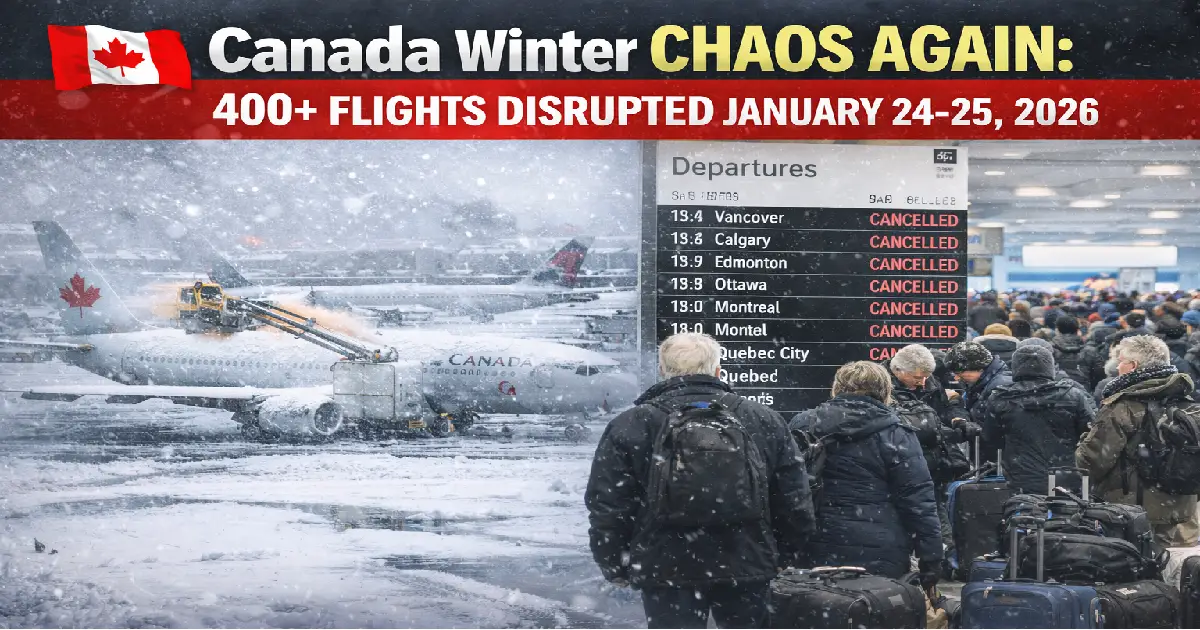
Toronto Pearson hit hardest with 40% disruption rate (360-400 cancellations + delays) as bone-chilling -55°C wind chill paralyzes Canada from Atlantic to Prairies—Air Canada & WestJet issue free rebooking waivers while Sunday snow threatens MORE chaos
Breaking: Canada’s relentless winter nightmare strikes AGAIN with 400+ flight disruptions January 24-25 as bone-chilling Arctic cold (-55°C wind chill) paralyzes Toronto Pearson, Montreal, and major hubs nationwide. 20% of Toronto’s 900+ flights cancelled, another 20% delayed—stranding thousands in the latest assault of 2026’s brutal winter crisis. Here’s everything travelers need to know about this weekend’s chaos and why Canadian aviation can’t catch a break.
Published: January 25, 2026 Crisis Dates: Friday January 24 – Sunday January 26 Toronto Pearson Impact: 360-400 disruptions (20% cancelled, 20% delayed) Nationwide Estimate: 400-500+ total disruptions Airlines Affected: Air Canada, WestJet, Porter, Jazz, regional carriers Airports Hit: Toronto, Montreal, Halifax, Moncton, Quebec City, Calgary, Vancouver Weather Cause: Extreme cold (-30°C to -55°C wind chill), snow forecast Sunday Winter 2026 Crisis Total: 2,200+ disruptions since January 2 Pattern: 5th major weather event in 24 days
Toronto Pearson International Airport—Canada’s busiest hub—is experiencing catastrophic disruptions this weekend as Arctic cold and approaching snow create a perfect storm of operational chaos.
Friday-Saturday Numbers (Per Airport Data):
✈️ 20%+ of 900+ flights CANCELLED = 180-200 cancellations ✈️ Another 20% DELAYED = 180-200 delays ✈️ Total: 360-400 disruptions at Pearson alone ✈️ 40% overall disruption rate (unprecedented for non-blizzard conditions) ✈️ Passengers affected: 50,000-60,000 travelers stranded or delayed ✈️ Sunday snow threat: 15-30cm forecast, could trigger MORE cancellations
This represents one of Toronto Pearson’s worst disruption rates of the winter—40% of all flights either cancelled or delayed, and the crisis isn’t over. Environment Canada is forecasting 15-30 centimeters of snow for Toronto and southern Ontario starting Sunday morning, virtually guaranteeing continued chaos through the weekend.
The Human Toll:
Guilherme Holtz and his family flew 11 hours from Rio de Janeiro to Toronto, expecting to catch an 8:00 AM Saturday connection to Quebec City. Cancelled. Rebooked for 6:00 PM—an additional 10-hour airport wait after an exhausting overnight flight.
“I’m hoping that it stays like that there’s no more cancellations, and we can go home,” Holtz told reporters at Pearson Saturday morning. “(I am) very tired and we just want to get home, but it’s 10 hours more to do all this whole trip. It’s very long.”
His story is playing out thousands of times across Canadian airports this weekend.
This isn’t your typical Canadian cold. This is life-threatening Arctic air sweeping from the Prairies to the Atlantic, bringing wind chills that can cause frostbite in minutes.
Temperature Breakdown by Region:
Impact: Warming centers in Hamilton extended hours or opened new spaces due to overwhelming demand. Toronto Pearson activated full winter storm protocols.
Impact: Montréal-Trudeau International Airport experiencing parallel disruptions to Toronto, with Air Canada’s two largest hubs simultaneously crippled.
Impact: Regional carriers like PAL Airlines and Jazz Aviation hit hard, stranding passengers in remote locations with limited rebooking options.
Impact: WestJet operations centered in Calgary facing severe delays. Extreme cold causes mechanical issues, de-icing challenges, and crew duty time complications.
Critical Context: These temperatures are dangerous. Environment Canada warns that wind chills below -40°C can cause frostbite on exposed skin in under 5 minutes. At -55°C (Manitoba/Saskatchewan), frostbite occurs in 2-3 minutes. This forces airlines to limit ground crew exposure, slowing all operations.
Both of Canada’s major airlines activated travel waivers Friday-Saturday as the crisis unfolded.
Affected Airports:
Waiver Terms:
Air Canada’s Statement: “Extreme cold at airports in Toronto and Montreal is causing delays. Customers can rebook at no cost.”
Affected Airports:
Waiver Scope:
WestJet’s advisory is notably broader than Air Canada’s, including US cross-border flights affected by Winter Storm Fern (which is simultaneously hitting the southern and eastern United States). This creates a double-disruption scenario: Canadian passengers trying to fly south are hit by BOTH Canadian cold AND US storm cancellations.
Example: Scott Lang and his wife had their Air Canada direct flight to Cancun cancelled THREE days ago, then rescheduled with a Houston layover for Saturday morning. Now the Houston connection is threatened by Winter Storm Fern’s ice and snow.
Most people think snow causes the worst airport disruptions. Wrong. Extreme cold is often WORSE because it’s harder to combat and lasts longer.
1. Aircraft De-Icing Becomes Critical
At -30°C, even without precipitation, frost and ice form on aircraft surfaces overnight and during ground operations. Every plane requires de-icing treatment before takeoff, creating massive bottlenecks.
Process time: 15-30 minutes per aircraft Toronto Pearson capacity: ~20-30 de-icing trucks Saturday morning backlog: 180+ flights needing treatment Math: Doesn’t work. Physically impossible to process that many planes quickly enough.
2. Mechanical Failures Skyrocket
Aircraft systems are rated for cold weather operation, but -40°C to -55°C pushes equipment to its limits:
Result: Planes that were airworthy at -20°C need extensive checks at -40°C, adding delays.
3. Ground Crew Safety Limits
Canadian labor laws and airline policies restrict outdoor work in extreme cold:
Result: Operations that normally take 30 minutes now take 60-90 minutes because crews cycle in/out for safety.
4. Fuel Temperature Management
Jet fuel can gel or freeze at extreme temperatures (typically below -40°C for Jet A). Airlines must:
Challenge: Planes sitting on the tarmac for hours risk fuel issues, forcing returns to gate.
5. Runway and Taxiway Ice
Even without snow, moisture in the air freezes onto pavement at -30°C, creating invisible ice. Runways require continuous:
Toronto’s runways: Reduced operational capacity by 30-40% due to ice/friction concerns.
Just when airlines thought the worst was over, Environment Canada dropped a bomb Friday evening:
Sunday Snow Forecast for Southern Ontario:
This is a worst-case scenario. Airports are already operating at 40% disruption rates from extreme cold. Now add half a foot of snow Sunday morning—peak departure time—and you’re looking at potential 60-80% disruption rates Sunday.
Toronto Pearson’s Sunday Preparations:
The airport posted on social media Saturday: “We are closely monitoring the impact of the winter storm on our operations as we prepare to respond to snowfall starting Sunday morning.”
Translation: Expect mass cancellations Sunday. Airlines are likely pre-cancelling flights Saturday evening for Sunday morning to avoid stranding passengers overnight at the airport.
Canadian travelers aren’t just dealing with domestic cold—they’re also caught in Winter Storm Fern’s US rampage.
US Airports Affecting Canadian Passengers:
The Double-Whammy Effect:
This scenario is playing out HUNDREDS of times this weekend, with Canadians stuck in US airports far from home during an ice storm.
January 24-25’s disruptions aren’t an isolated incident. This is the FIFTH major weather event hammering Canadian aviation in 24 days:
Canada’s Winter 2026 Crisis Timeline:
24-Day Total: ~2,200+ disruptions (1,000+ cancellations, 1,200+ major delays)
Average: One major disruption event every 5 days since January 1.
The pattern is clear: Canada’s aviation system is operating with ZERO operational slack, and winter weather keeps exploiting every weakness.
1. Infrastructure Deficit
Canadian airports invested heavily in terminal expansions (shiny new gates, food courts, shopping) but underfunded operational infrastructure:
2. Airline Crew Shortages
Post-pandemic staffing hasn’t recovered. When weather strikes:
3. Geographic Vulnerability
Unlike US hub-and-spoke systems with geographic diversity, Canada’s three main hubs (Toronto, Montreal, Vancouver) are ALL in weather-vulnerable zones:
When ONE gets hit, 33% of national capacity disappears. When TWO get hit simultaneously (like this weekend), the entire country grinds to a halt.
4. Climate Change Amplification
Polar vortex instability is pushing Arctic air further south more frequently. Canada is seeing:
The Result: What used to be “once per winter” crisis events are now happening every 5 days.
Saturday (TODAY):
Sunday:
Step 1: Rebook Immediately
Step 2: Know Your Rights
Canadian Passenger Rights (APPR):
Hotels/Meals:
Step 3: File Waiver Claim
If you purchased before January 21:
Good News: Arctic blast should weaken by Tuesday-Wednesday. Bad News: Recovery chaos lasts 2-3 days after weather clears.
Monday-Tuesday (Jan 27-28):
Wednesday+ (Jan 29+):
Saturday Disruptions: 360-400 (40% of flights) Sunday Forecast: 60-80% disruptions likely Why: Canada’s busiest airport (50+ million passengers annually), limited de-icing capacity, snow forecast Airlines Affected: Air Canada (largest hub), WestJet, Porter, all international carriers
Traveler Strategy: Avoid Pearson this weekend if possible. Rebook through Montreal, Ottawa, or even US hubs.
Saturday Disruptions: Estimated 150-200 Sunday Forecast: Freezing rain + snow mix Why: Air Canada’s second-largest hub, simultaneous hit with Toronto creates network collapse Airlines Affected: Air Canada, Porter, Air Transat, international carriers
Traveler Strategy: Similar to Toronto—avoid if possible, expect cascading delays through Tuesday.
Saturday Disruptions: Estimated 80-120 Sunday Forecast: Continued extreme cold (-40°C) Why: WestJet’s main hub, Prairies Arctic blasts, mechanical issues in extreme cold Airlines Affected: WestJet, WestJet Encore, Air Canada
Traveler Strategy: Morning flights better than afternoon (temperatures warmest 12-2 PM). Dress warmly—if flight delays, you may be outside briefly during boarding.
Saturday Disruptions: Estimated 60-100 Sunday Forecast: Rain/fog (milder than east) Why: Pacific moisture creates fog, less severe than eastern Canada Airlines Affected: Air Canada, WestJet, international carriers
Traveler Strategy: Vancouver is your BEST BET for Canadian travel this weekend (relatively speaking). Still expect delays, but cancellations less likely.
Saturday Disruptions: 30-50 each Sunday Forecast: Continued cold, residual snow Why: Smaller airports with regional carrier dependence (Jazz, PAL Airlines) Impact: Limited rebooking options—if your flight cancels, next seat might be Tuesday-Wednesday
Traveler Strategy: Regional airports always struggle more in weather. Budget extra time, have contingency plans.
Airlines:
Airports:
Passengers:
Total Estimated Cost (24 days): $300-500 million across all stakeholders
Example: Elderly passenger needs urgent medical care in Vancouver, flying from Halifax. Flight cancels Saturday, next available seat Wednesday. Family scrambles to arrange local care.
1. Double De-Icing Capacity
2. Runway Heating Systems
3. Cold Weather Hangars
1. Proactive Cancellations
2. Weather Reserve Crews
3. Passenger Communication
1. Mandatory Weather Preparedness Standards
2. Extended APPR Coverage
3. Hub Diversification Incentives
Canada’s winter aviation crisis isn’t getting better—it’s getting WORSE. Five major disruption events in 24 days. Over 2,200 flights cancelled or severely delayed. Hundreds of millions in economic damage. Hundreds of thousands of passengers affected.
This weekend’s chaos (January 24-25) is the latest chapter in a relentless saga: bone-chilling -55°C wind chills, 40% disruption rates at Toronto Pearson, cross-border complications with US Winter Storm Fern, and Sunday snow threatening to push disruption rates to 60-80%.
What you should do RIGHT NOW:
Longer-term:
Demand infrastructure investment. Write MPs. Push Transport Canada for action. Canada’s airports weren’t built for this new climate reality, and until billions are invested in cold-weather infrastructure, winter chaos will remain the new normal.
The Arctic blast will end by Tuesday. But another weather system is already forming over the Pacific. And when it hits next week, Canada’s overstretched aviation system will buckle again. Because it always does.
Winter in Canada is far from over. And neither is the travel chaos.
Title (68 chars): Canada Winter Chaos AGAIN: 400+ Flights Disrupted January 24-25, 2026
Meta Description (158 chars): Canada winter crisis strikes again January 24-25: 400+ flight disruptions, -55°C cold, 20% Toronto Pearson cancellations. Air Canada/WestJet waivers active NOW.
URL Slug: canada-winter-chaos-strikes-again-400-flights-disrupted-january-24-25-2026-toronto-pearson-extreme-cold-minus-55-wind-chill
Focus Keyword: Canada flight cancellations January 25 2026
Secondary Keywords:
Image Alt Text: Canada winter chaos January 24-25 2026 Toronto Pearson 400 flight disruptions extreme cold minus 55 wind chill Air Canada WestJet cancellations map airports affected
Image Filename: canada-winter-chaos-january-24-25-2026-toronto-pearson-400-flight-disruptions-extreme-cold-minus-55-wind-chill-air-canada-westjet-cancellations-airports-map.webp
Related Articles:
For More Resources:
Posted By : Vinay
Lastest News
2nd Floor, 39, Above Kirti Club, DLF Industrial Area, Kirti Nagar, New Delhi, Delhi 110015



Travel Tourister is a leading Travel portal where we introduce travellers to trusted travel agents to make their journey hasselfree, memorable And happy. Travel Tourister is a platform where travellers get Tour packages ,Hotel packages deals through trusted travel companies And hoteliers who are working with us across the world. We always try to find new and more travel agents and hoteliers from every nook and corners across the world so that you could compare the deals with different travel agents and hoteliers and book your tour or hotel with the one you have chosen according to your taste and budget.
Copyright © Travel Tourister, India. All Rights Reserved

 Call
Call Enquiry