Published on : 02 Jan 2026
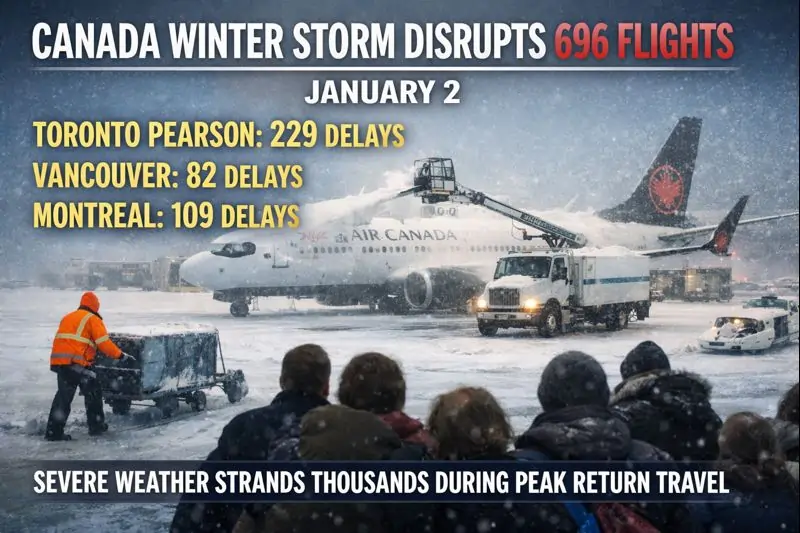
TRENDING: Winter storm paralyzes Canadian air travel January 2, 2026 with 598 flight delays + 98 cancellations—Toronto Pearson (229 delays, 34 cancellations), Vancouver (82/23), Montreal (109/15), Calgary (112/7) hardest hit as Air Canada, WestJet, Jazz scramble amid blizzards, 90 km/h winds, -50°C wind chills, dense fog across provinces during peak return travel period when thousands attempt reaching home after New Year holidays
Published: January 2, 2026 Source: FlightAware, Environment Canada, Airport Reports, Multiple Sources Key Finding: 696 total flight disruptions (598 delays + 98 cancellations) January 2, 2026 Hardest Hit: Toronto Pearson (263 disruptions), Montreal (124), Vancouver (105), Calgary (119) Airlines Affected: Air Canada (46% flights delayed), WestJet, Jazz (34% cancelled, 36% delayed) ANZ Impact: Australian/NZ travelers connecting through Canada to USA/Europe face major disruptions
Thousands of air passengers found themselves stranded across Canada on January 2, 2026 after severe winter weather triggered at least 598 flight delays and 98 cancellations at major hubs including Toronto Pearson, Vancouver International, Montreal Trudeau, and Calgary International—creating cascade effects that rippled through North American air networks as Air Canada, WestJet, regional carrier Jazz, and US operator Republic Airways scrambled to manage fallout from blizzards, snow squalls, 90 km/h winds, and dense fog that disrupted schedules and snarled ground operations from Pacific Coast to Atlantic Canada during peak return travel period when families and business travelers attempted reaching home after New Year celebrations.
The disruptions struck as powerful winter system swept across large parts of the country, compounding an already difficult holiday and early winter travel season. Environment Canada advisories pointed to volatile mix of heavy snow, freezing rain, high winds, and extreme cold affecting multiple provinces simultaneously—making safe takeoffs and landings increasingly difficult as the day progressed while reducing visibility, slowing de-icing and runway clearing operations, and forcing air-traffic controllers to cut back the number of takeoffs and landings for safety considerations that created bottlenecks at airports operating near capacity.
“Thousands of travelers are stranded across Canada as Air Canada, WestJet, Jazz, Republic, and several other airlines face 598 delays and 98 cancellations due to severe weather conditions,” confirms Travel and Tour World reporting from affected airports. “The storms, which include snow, strong winds, and extreme cold, have heavily impacted major airports in cities like Toronto, Vancouver, Montreal, Calgary, and more. Passengers are grappling with long delays and unexpected cancellations, causing frustration and confusion.”
For Australian and New Zealand travelers—who frequently transit through Toronto, Vancouver, or Montreal when flying to/from Europe, United States, or connecting between Pacific and Atlantic destinations—the disruptions create particular challenges as long-haul international flights from Sydney, Melbourne, Auckland arrive into chaos where domestic connections disappeared, rebooking queues stretched hours, and limited hotel availability forces airport overnight stays during one of busiest travel periods annually when accommodation near major hubs sells out weeks in advance.
Toronto Pearson—Canada’s largest and busiest airport handling 50+ million passengers annually—bore the brunt of January 2 disruptions with 229 flight delays and 34 cancellations as freezing rain combined with strong winds reaching 70-90 km/h gusts and low visibility moved through the region, forcing repeated runway closures for snow clearing, creating de-icing backlogs that stretched aircraft processing times to 45+ minutes, and overwhelming ground crews already stretched thin from December’s succession of winter storms.
Toronto Pearson impacts:
Environment Canada issued wind warnings for Toronto with gusts between 70-90 km/h, while fog and mixed precipitation added to challenging travel conditions—creating perfect storm of weather factors that individually cause moderate delays but collectively paralyze operations at airport where schedule depends on precise coordination of arrivals, departures, gate assignments, crew rotations, and aircraft turnarounds operating with minimal slack during peak periods.
“Toronto Pearson was reporting ongoing delays and cancellations as freezing rain, strong winds, and low visibility moved through the region,” confirms TravelPulse Canada. “Airport officials cautioned travellers to expect delays and to allow extra time for check-in, security screening, and boarding” as conditions deteriorated through morning and early afternoon before gradual improvement began evening as weather system moved eastward toward Atlantic provinces.
Passenger experiences at Pearson:
Vancouver International faced substantial disruptions with 82 delays and 23 cancellations despite typically milder winter weather compared to eastern Canada—as dense fog reducing visibility to near-zero combined with snow and rain in region affecting both incoming and outgoing flights while mountain operations at Whistler and interior British Columbia ski destinations created additional complexities for carriers serving leisure travelers during peak winter sports season.
Vancouver-specific challenges:
British Columbia weather warnings covered multiple regions including North and South Peace River areas where snowfall and fog warnings remained in effect, while areas like Vancouver Island’s Nanaimo also experienced disruptions affecting both Vancouver International and regional airports serving tourism destinations popular with international visitors seeking winter sports, whale watching, and coastal experiences.
Montreal-Trudeau International experienced 109 delays and 15 cancellations as freezing rain and ice pellets created hazardous conditions across Quebec, with average departure delays approaching one hour and operational impacts continuing through the day as weather system persisted longer than initially forecast—creating cascading delays that affected not just Montreal-origin flights but connections throughout Air Canada and WestJet networks where aircraft and crew rotations depend on Montreal hub performing on schedule.
Quebec weather severity:
“Montreal faced similar challenges as freezing rain and ice pellets created hazardous conditions across the region,” reports TravelPulse Canada. “Montréal–Trudeau was experiencing operational impacts, with average departure delays approaching an hour and dozens of cancellations recorded over the past 24 hours. Airport authorities warned that conditions could continue to affect flight schedules as the day progressed.”
For international travelers—including Australians and New Zealanders routing through Montreal to/from Paris, London, or eastern United States destinations—the disruptions prove particularly frustrating as Montreal serves as Air Canada’s primary transatlantic hub where long-haul widebody aircraft connect with regional jets and narrow-body domestic flights in coordinated banks that collapse when weather delays throw timing off schedule.
Calgary International—Western Canada’s second-busiest airport and major hub for WestJet—recorded 112 delays and 7 cancellations as dense fog disrupted flight operations throughout the day, with visibility dropping to near zero forcing airlines to shift to low-visibility operating procedures that reduce arrival and departure rates from normal 44 aircraft per hour to as low as 16 during worst conditions, creating inevitable backlogs that took hours to clear even after fog began lifting.
Calgary challenges:
“Calgary International Airport experienced dense fog disrupting flight operations from Thursday, Jan. 1,” confirms Travel Radar Aviation News. “As a result, dozens of flights were delayed or cancelled as visibility dropped to near zero and airlines shifted to low-visibility operating procedures. Environment and Climate Change Canada stated that while conditions eased Thursday afternoon, fog patches lingered into Friday morning” continuing operational challenges into January 2.
Ottawa Macdonald-Cartier International (YOW): Freezing rain and blizzard conditions resulted in dozens of delays and cancellations, with wind chills around -31°C creating extreme cold challenges for ground crews, passengers connecting to flights, and aircraft systems requiring special cold-weather procedures.
Quebec City Jean Lesage International (YQB): Winter storm warnings with 15-40 cm snow forecast created operational challenges at regional airport serving provincial capital.
Halifax International (YHZ): Atlantic Canada weather affected Maritime provinces with mix of snow, ice pellets, rain adding to flight disruption challenges.
Winnipeg Richardson International (YWG): Manitoba experiencing blizzard conditions with wind chills as low as -50°C in northern regions affecting flights to/from Churchill, Thompson, and regional communities.
Regional airports: Victoria, Nanaimo (BC), Thunder Bay (Ontario), Moncton (New Brunswick), St. John’s (Newfoundland) all reported clusters of delays and cancellations magnifying pressure on national network.
Air Canada—operating Canada’s most extensive domestic and international network with hubs at Toronto, Montreal, and Vancouver—faced severe operational challenges with 46% of flights delayed at affected airports, forcing the airline to activate “winter-hold” protocols that reduce scheduled operations, introduce flexible rebooking options, and prioritize safety over schedule adherence during severe weather events.
Air Canada response measures:
“Air Canada, which operates major hubs in both Toronto and Montreal, confirmed it was making further operational changes in response to the storm,” reports TravelPulse Canada. “The airline introduced flexible rebooking options for passengers travelling on affected flights, allowing changes without penalty, subject to availability. Customers were advised to check their flight status regularly and monitor airline communications throughout the day.”
WestJet—Canada’s second-largest carrier with primary hubs in Calgary and Toronto—similarly struggled with weather-related disruptions affecting its domestic network, transborder US flights, and Caribbean/Mexico leisure routes popular during Canadian winter when travelers escape harsh weather for beach destinations.
WestJet measures:
Jazz Aviation (operating Air Canada Express regional flights) faced particularly severe impacts with 34% of flights cancelled and 36% delayed—reflecting regional jets’ greater vulnerability to winter weather conditions compared to larger narrow-body and widebody aircraft, as smaller planes more affected by wind, icing, and visibility restrictions that ground regional operations while mainline jets continue flying.
Canada’s Air Passenger Protection Regulations establish minimum compensation and assistance requirements for flight disruptions—though weather-related delays and cancellations typically classified as “outside airline control” exempt carriers from monetary compensation obligations while still requiring reasonable assistance with rebooking, meals, and accommodations.
What passengers are entitled to:
What passengers are NOT entitled to during weather delays:
Passenger action steps:
For Australian and New Zealand travelers—whose long-haul flights from Sydney, Melbourne, Auckland to North America and Europe frequently connect through Toronto, Vancouver, or Montreal—winter weather disruptions create compounding challenges where 14-16 hour Pacific crossings arrive into chaos, domestic connections vanish, and rebooking options limited by aircraft capacity constraints during peak holiday period when flights operate near 100% load factors.
Typical ANZ-Canada routing patterns:
When Vancouver experiences 82 delays and 23 cancellations while Toronto faces 229 delays and 34 cancellations simultaneously, the compounding effects devastate connection reliability—where passenger arriving from 14-hour overnight Sydney-Vancouver flight discovers their Vancouver-Toronto connection cancelled, next available seat not until following day, Vancouver hotels fully booked, and airline offering only airport hotel voucher (if available) or suggesting passengers return following day once rebooking confirmed.
“Airports are experiencing delays in rebooking flights and providing alternative routes for affected passengers,” confirms Travel and Tour World analysis, noting that computer systems overwhelmed by simultaneous rebooking requests, agent availability limited, and seat inventory constrained create perfect storm of factors that leave passengers stranded without clear resolution timeline or guaranteed accommodation.
Similarly, European travelers using Canada as connection point to/from US destinations, Latin America, or Pacific routes face disruptions—as Toronto and Montreal serve as major Air Canada transatlantic hubs where widebody aircraft from London, Paris, Frankfurt, Amsterdam arrive multiple times daily connecting with North American domestic networks.
Europe-Canada-US routing:
When Montreal reports average departure delays approaching one hour and Toronto faces 229 delays, the transatlantic-arriving passengers discover domestic US connections missed, rebooking queues lengthy, and alternative routing through US hubs (connecting Europe-NYC-final destination) fully booked or significantly more expensive than original Canada-connection itinerary.
Check flight status obsessively: Monitor airline app, website, FlightAware, or airport websites continuously in hours before departure. Airlines proactively cancel flights giving advance notice rather than stranding passengers at airport—but notifications sometimes delayed or fail reaching passengers if contact information outdated.
Contact airline proactively: If flight shows delays or cancellations, call airline immediately (despite long wait times) or use social media channels (Twitter/X often faster response than phone) to begin rebooking process before arriving at airport where in-person queues stretch hours.
Consider delaying airport trip: If severe delays likely, postpone airport departure until flight status clarifies—avoiding hours sitting in terminal when flight eventually cancels, forcing return home or hotel stay that could have been arranged more comfortably from home.
Pack essential medications, valuables in carry-on: Never check items you cannot survive without for 24-48 hours, as weather delays often separate passengers from checked baggage when rerouting through different cities or airlines.
Get in multiple rebooking lines simultaneously: Physical airport line, call airline from phone while waiting, use airline app/website, contact airline via social media—first successful rebooking wins, others can be cancelled.
Be flexible with routing and timing: Accepting next-day departure, connection through different city, or alternative airline may get you home faster than insisting on original routing that might not restore for days.
Inquire about partner airlines: If your airline fully booked, ask about rebooking on partner carriers (Star Alliance, SkyTeam, Oneworld members) or interline agreements where airlines coordinate during irregular operations.
Document everything: Photograph departure boards showing cancellations, save airline communications, keep receipts for meals/hotels/transport—essential for insurance claims or later airline reimbursement requests.
Investigate alternative cities: If Toronto completely disrupted, consider rebooking through Ottawa, Montreal, Buffalo (NY), or Detroit as alternative gateways that might offer faster resolution than waiting for Toronto operations normalizing.
Secure accommodation early: Hotels near major airports sell out within hours during major disruptions—book immediately when overnight delay confirmed rather than waiting until evening when everything fully booked.
Trip interruption coverage: Quality travel insurance policies cover additional accommodation, meals, transportation costs when trips interrupted by weather delays—reimbursing expenses airlines refuse covering since weather classified as outside their control.
Cancel For Any Reason (CFAR) policies: Most comprehensive coverage allowing trip cancellation for any reason including “I don’t want to deal with weather chaos”—though typically refund only 50-75% of non-refundable costs vs 100% for covered reasons.
Medical coverage abroad: Travel insurance essential for medical emergencies during weather-delayed trips—especially for Australians and New Zealanders whose domestic health coverage doesn’t extend to Canada, requiring out-of-pocket payment or insurance coverage for Canadian medical care.
Credit card benefits: Premium travel credit cards (Chase Sapphire Reserve, Amex Platinum) include trip delay/interruption coverage typically covering $500-1000 per person for delays exceeding 6-12 hours depending on card terms—though coverage less comprehensive than dedicated travel insurance policies.
The 696 total flight disruptions across Canada on January 2, 2026—comprising 598 delays and 98 cancellations concentrated at Toronto Pearson (229 delays, 34 cancellations), Vancouver (82/23), Montreal (109/15), and Calgary (112/7)—demonstrate how quickly winter weather systems paralyze air travel infrastructure designed for efficiency during normal operations but lacking redundancy to absorb shocks when multiple airports experience simultaneous severe weather affecting visibility, runway conditions, aircraft de-icing, and ground operations that collectively reduce capacity below demand levels during peak travel periods.
For the thousands of passengers stranded—including international travelers from Australia, New Zealand, Europe, and Asia whose long-haul flights arrived into chaos where domestic connections disappeared—the experience highlights vulnerability of hub-and-spoke airline networks where weather disrupting a single major hub cascades through entire system affecting passengers whose origins and destinations experience perfect weather but suffer delays because their connections route through Toronto, Vancouver, or Montreal experiencing blizzards, fog, or freezing rain.
Key takeaways for travelers navigating winter weather disruptions:
✓ Monitor weather forecasts for connection cities even if origin and destination clear ✓ Check flight status continuously before airport departure (airlines cancel proactively when possible) ✓ Travel insurance essential for weather-related trip interruption coverage airlines won’t provide ✓ Build connection buffers (minimum 3-4 hours connecting through Canadian hubs during winter) ✓ Pack medications, valuables in carry-on (weather delays often separate passengers from checked bags) ✓ Proactive rebooking (contact airline immediately when disruption appears likely vs waiting at airport) ✓ Flexible routing (accepting alternative cities, next-day departure may resolve faster than original plan) ✓ Document expenses (photograph boards, save receipts for insurance/reimbursement claims) ✓ Join airline loyalty programs (elite status provides priority rebooking during irregular operations) ✓ Premium credit cards (include trip delay coverage offsetting some weather-disruption costs)
“The ongoing pattern of severe winter weather has led to repeated schedule adjustments at two of the country’s busiest air hubs,” notes TravelPulse Canada, referring to Toronto and Montreal’s succession of weather challenges through December 2025 and early January 2026. “Both Toronto Pearson and Montréal–Trudeau urged travellers to remain flexible with their plans, particularly during peak travel periods, and to verify flight information before heading to the airport.”
The January 2 disruptions follow December’s severe winter storms that affected Canadian air travel repeatedly, creating operational recovery challenges where airlines struggle repositioning aircraft and crew to resume normal schedules even after weather clears—as planes and pilots end up in wrong cities, maintenance backlogs develop, and crews exceed maximum duty hours requiring rest before flying again, extending disruption impacts days beyond actual weather events that triggered initial delays and cancellations.
For More Resources:
Related Travel Guides:
Final Reflection: January 2, 2026 winter storm disruptions affecting 696 flights across Canada—stranding thousands including Australian and New Zealand travelers connecting through Toronto, Vancouver, Montreal—remind us that modern air travel’s remarkable efficiency and interconnectedness become profound vulnerabilities when weather, the ultimate uncontrollable variable, strikes simultaneously across multiple hubs where hub-and-spoke networks concentrate operations. For international travelers whose 14-hour Pacific crossings or 7-hour transatlantic flights represent significant investments of time, money, and energy, arriving into chaos where domestic connections vanish creates frustrations that comprehensive travel insurance, flexible booking, and realistic expectations about winter travel risks can mitigate but never eliminate entirely. The lesson: winter travel through Canadian hubs requires acknowledging that severe weather isn’t possibility but probability, planning accordingly with connection buffers, backup routing options, and financial protection through insurance transforms inevitable disruptions from travel disasters into manageable inconveniences.
Posted By : Vinay
Lastest News
2nd Floor, 39, Above Kirti Club, DLF Industrial Area, Kirti Nagar, New Delhi, Delhi 110015



Travel Tourister is a leading Travel portal where we introduce travellers to trusted travel agents to make their journey hasselfree, memorable And happy. Travel Tourister is a platform where travellers get Tour packages ,Hotel packages deals through trusted travel companies And hoteliers who are working with us across the world. We always try to find new and more travel agents and hoteliers from every nook and corners across the world so that you could compare the deals with different travel agents and hoteliers and book your tour or hotel with the one you have chosen according to your taste and budget.
Copyright © Travel Tourister, India. All Rights Reserved

 Call
Call Enquiry