Published on : 26 Feb 2026
🔴 MEXICO TRAVEL ALERT | Published: February 26, 2026 | Last Updated: February 26, 2026, 9:00 AM EST
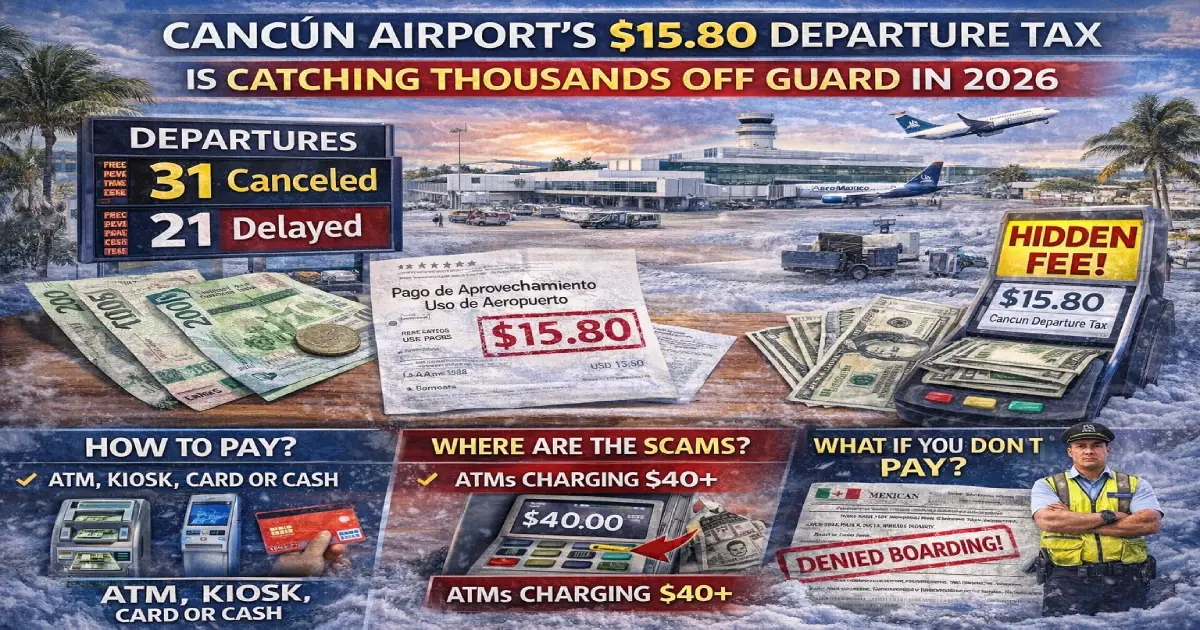
The Tax: VISITAX — Quintana Roo State Tourism Tax Amount: 283 Mexican pesos = $15.80 USD per person (ages 4+) Who Pays: Every foreign tourist departing Quintana Roo state — Cancún, Playa del Carmen, Tulum, Cozumel, Holbox, Isla Mujeres, Bacalar, and all surrounding areas Who Is Exempt: Mexican nationals, children under 4, transit passengers not clearing immigration Enforcement Status: 🔴 HEIGHTENED — checkpoints active at Terminals 3 and 4 in 2026 Where They Stop You: Right before the final escalators to security screening What Happens If Caught Without It: Pulled from line, forced to pay on the spot — possible missed flight Hotel Pays For You: ❌ NO — officially rejected by government in January 2026 Bundled Into Your Flight Ticket: ❌ NO — must be paid separately, online Official Payment Portal: visitax.gob.mx — ONLY use this site Google’s Top Results: ⚠️ SCAM SITES charging $30–$40 for a $15 tax Cancún Airport Terminal 1 Expansion: Underway — completing mid-2026 for FIFA World Cup Spring Break Risk: 500,000+ Americans expected in Quintana Roo March 8–22 — most unaware of the fee For a Family of 4 (all ages 4+): $63.20 total — easy to forget, easy to pay
You have spent $3,000, $5,000, or $8,000 on your Cancún vacation. You have packed your bags, tipped the resort staff, posted your last beach photo, and arrived at Cancún International Airport three hours early like a responsible traveler. You are standing in line, luggage checked, sunburned and happy, when an official in a high-visibility vest steps in front of you and asks for your VISITAX receipt.
You have no idea what they are talking about.
This is the moment that is catching thousands of American, Canadian, British, and Australian travelers completely off guard at Cancún Airport in 2026 — and it is happening with sharply increased frequency this year following two major enforcement changes: the deployment of dedicated VISITAX checkpoint teams at Terminals 3 and 4, and the official rejection of a proposal that would have had hotels collect the tax at check-in.
The tax is real. The enforcement is real. The $15.80 fee is trivially small. But the stress of being pulled from the security line with a flight boarding in 45 minutes is not trivial — and the scam websites that appear at the top of Google when you frantically search “pay Visitax” can turn a $15 fee into a $40 problem and leave you with an invalid QR code.
Here is everything you need to know, verified as of this morning: what the tax is, who pays it, the only safe way to pay it, where the checkpoints are, what happens if you get caught, and the complete guide to all three fees that travelers must navigate at Cancún Airport in 2026.
VISITAX is a state-level tourist fee implemented by the government of Quintana Roo, the region home to world-famous destinations like Cancún, Tulum, Playa del Carmen, Cozumel, Bacalar, and Isla Mujeres. Unlike federal taxes that apply throughout Mexico, this one specifically covers entry into Quintana Roo and focuses on foreign visitors who arrive for tourism, business, or health-related travel.
The legal basis is Article 51-octies of the Law of Rights of the State of Quintana Roo. The government’s official stance leaves absolutely zero room for interpretation. As stated explicitly on the official government portal under their FAQ: “This tax is mandatory and must be paid by all foreign tourists.” It is not a tip. It is not a donation. It is not voluntary. It is state law.
This revenue directly funds the infrastructure and environmental upkeep required to sustain the massive volume of tourism the region handles. Quintana Roo receives over 30 million tourist arrivals annually — the most of any Mexican state — and the VISITAX is designed to offset the environmental and infrastructure cost of that volume.
Every foreign tourist over the age of four departing the state of Quintana Roo — which includes Cancún, Playa del Carmen, and Tulum — owes the state 283 Mexican pesos, roughly $15.80 USD.
Who is included: Every non-Mexican national who visited Quintana Roo for tourism, business, or leisure — regardless of how long they stayed, where they stayed, or whether they stayed in a hotel, Airbnb, or a friend’s house.
Who is exempt:
For a family of four adults: $63.20. For a couple: $31.60. These are not significant sums — but they are mandatory, and they are entirely your responsibility to handle.
For years, online travel forums were full of travelers claiming they had visited Cancún 10 times and never been asked to show a VISITAX receipt. That era is ending.
Two specific changes in 2026 have made VISITAX the most common source of airport stress for Cancún-bound travelers:
In 2026, authorities have implemented a “Checkpoint Strategy” at Cancún International Airport (CUN). Inspectors are now stationed at the bottlenecks before the security escalators in Terminal 3 and 4. They are randomly selecting passengers to show their QR code.
Authorities have set up more spot checks before the security screening area. Agents are actively stopping passengers to scan their Visitax QR codes. Travelers who had their codes ready were waved through in seconds. Those who didn’t were pulled out of line and directed to pay on the spot, creating significant stress right before their flight. This aligns with earlier reports of Visitax enforcement teams deploying iPads and card readers to terminals 2, 3, and 4 to catch non-compliant travelers.
Authorities are not stopping every single passenger — doing so would grind the airport’s infrastructure to an absolute halt. Instead, they are utilizing targeted checkpoints, typically positioned right before the final escalators leading up to the security screening area. Travelers report being flagged down by officials in high-visibility vests who demand immediate proof of payment. If you do not have the receipt, you will be pulled out of line.
The targeting appears to focus on passengers who look uncertain, are moving slowly, or are travelling in groups — patterns consistent with first-time visitors who are more likely to be unaware of the requirement.
In late 2025, a government proposal circulated to simplify VISITAX by having hotels and resorts collect it at check-in — eliminating the airport checkpoint problem entirely. Hoteliers pushed back against the proposal, arguing they were already burdened with collecting multiple taxes. The government agreed. For the foreseeable future, specifically heading into 2026, the responsibility to pay this tax falls 100% on you, the traveler.
A proposal was floated to simplify the process by having hotels collect the fee at check-in. This was officially rejected. Your resort will not pay this for you, and it will not be bundled into your Expedia or airline receipt. You are entirely responsible for paying it yourself.
This decision means there is no passive pathway to VISITAX compliance. There is no moment when your resort reminds you, charges you, or generates a receipt on your behalf. If you do not actively go to visitax.gob.mx before you leave home — or before you leave your resort for the airport — you will arrive at the checkpoint without proof of payment.
The VISITAX confusion is compounded by the fact that Cancún travelers actually encounter three separate fees — two of which are already bundled invisibly into their flight tickets, and one (VISITAX) which is entirely separate. Understanding all three eliminates the mystery of why a $200 base fare to Cancún becomes a $450 ticket at checkout.
The DNR is the Federal Right of Visitor fee — formerly known as the FMM tourist card that travelers used to fill out on paper on the plane. The DNR rate for 2026 is $983 pesos (US $53), being mandatory for each person who enters the country, including minors from 2 years of age.
Your action required: Nothing. If you flew on a major US, Canadian, British, or Australian carrier (AA, United, Delta, Air Canada, WestJet, British Airways, Virgin Atlantic, Qantas, etc.), the DNR was bundled into your ticket price at checkout. You paid it without knowing it. You do not owe anything additional at the airport for the DNR.
The TUA is the Mexican international airport departure tax — a fee all visitors pay for use of the airport facilities when departing internationally. On your airline ticket receipt, it appears as a separate line item with the code “TUA.”
Your action required: Nothing. Airlines collect the TUA as part of every international ticket price. It is pre-paid. You owe nothing additional at the airport.
Your action required: Pay online at visitax.gob.mx before your departure. 283 pesos per person aged 4+. You will receive a QR code. Screenshot it. Print it as backup. Show it at the checkpoint before the security escalators.
The Environmental/Sanitation Tax (hotel fee): A fourth, separate fee applies in some Quintana Roo municipalities — a per-room-per-night environmental tax collected by your hotel at check-in. For example, in 2026 this tax in Cancún is $76 pesos per night per room, but in Playa del Carmen, this tax is calculated differently as the amount to pay is $54 pesos per couple in a room. This is NOT the VISITAX — it is a separate local charge collected by the hotel, not at the airport.
| Fee | Amount (2026) | Who Collects | Paid Where | Your Action |
|---|---|---|---|---|
| DNR (Federal visitor fee) | $983 pesos / ~$53 | Airline | In your ticket | ✅ Nothing — already paid |
| TUA (Airport use fee) | Varies by airport | Airline | In your ticket | ✅ Nothing — already paid |
| VISITAX (State tourism tax) | 283 pesos / ~$15.80 | You, online | visitax.gob.mx | ⚠️ PAY BEFORE YOUR TRIP |
| Environmental Tax | 76 pesos/room/night (Cancún) | Hotel at check-in | Resort front desk | 🏨 Hotel collects on site |
Only use the official site: visitax.gob.mx. Do not use third-party sites that appear at the top of Google search results — they are “scam” agencies charging $40+ for a $15 tax.
This is not a minor warning. This has birthed a cottage industry of “scam” websites that look official but charge double the price. If you Google “Pay Visitax,” the first five results are often third-party brokers charging $30 or $40 USD — adding a massive “service fee” for something that is legally set at roughly $15.80. These sites issue receipts that may look valid but can fail to scan at the checkpoint. Pay the $15.80 directly to the government. Do not pay $40 to a middleman.
The official VISITAX payment process:
Step 1: Go directly to visitax.gob.mx in your browser. Do not Google “pay visitax” — type the URL directly.
Step 2: Click the “Pay” or “Pagar” button on the homepage.
Step 3: Complete the form with:
Step 4: Pay by credit or debit card. The charge is 283 pesos — your card will convert this at the current exchange rate, typically $15.50–$16.00 USD.
Step 5: Immediately upon payment confirmation, screenshot your QR code. Save it to your phone’s camera roll. Do not rely solely on the email confirmation — email delivery can fail.
Step 6: Optional but recommended — print a paper copy of the QR code. If your phone battery dies, screen is cracked, or airport Wi-Fi is needed to access your email, a paper printout is your guaranteed backup.
When to pay: Pay before you leave home — not at the airport. Paying early ensures you have the correct documentation stored on your device or printed out before reaching the airport. There is no time restriction. You can pay it weeks in advance.
If you lose your receipt: Select “recover your receipt” on the website and use your passport number to retrieve it.
If you need to pay at the airport: You can pay at official VISITAX modules inside the airport terminals, but consider arriving well in advance since there may be many people to fill out a VISITAX form for each person and then make another line to pay, which could be a risk of delays and fatigue with the bureaucratic process. Airport Wi-Fi is congested during peak hours — do not rely on it.
The consequence: If you are flagged and haven’t paid, you are pulled out of line. You will have to stand to the side, connect to the notoriously congested airport Wi-Fi, navigate the government website, and pay on the spot while your boarding time ticks away.
You will not be arrested. You will not be fined beyond the original $15.80. But the practical reality is deeply stressful:
Technically speaking, if you refuse to pay, you are violating state tax law. While they aren’t arresting or fining tourists at the departure gate, they are stopping them, delaying them, and forcing payment on the spot. Why risk the legal gray area (and a missed flight) over $15?
The answer, of course, is that no rational traveler would risk it. The entire problem exists because travelers don’t know the fee exists — not because they are refusing to pay it. That is exactly why this article is critical: the VISITAX is almost never mentioned by airlines, OTAs, resort booking platforms, or travel agents. It appears on no itinerary. It arrives in no confirmation email. The only way to know it exists is to research it specifically — or to get stopped at the checkpoint.
The single most dangerous aspect of VISITAX is what happens when an unprepared traveler googles the fee at the airport under time pressure. The first five organic results on Google for “pay visitax” are frequently third-party broker websites that charge $30–$40 USD. These sites look official. They use similar color schemes and logos to the government portal. They complete a transaction and issue a QR code.
The problems:
The only legitimate third-party services are those officially listed by SATQ (Quintana Roo tax authority). There are very few, and they still charge a premium. There is no reason to use them — visitax.gob.mx works perfectly, is available in English, and charges the legally mandated amount.
Simple rule: If the URL is not visitax.gob.mx — do not enter your payment information.
Cancún and the Quintana Roo riviera are the single most popular international spring break destination for American college students and families. In the two weeks of peak spring break (March 8–22, 2026), an estimated 500,000+ American travelers will pass through Cancún International Airport’s departures hall.
The overwhelming majority of them will not know the VISITAX exists until they reach Terminal 3 or 4’s checkpoint.
This is the precise scenario that turns a $15.80 tax into a major airport disruption. When five American spring break groups are simultaneously stopped at the security escalator in Terminal 4, all trying to pay on congested Wi-Fi while their boarding gate calls are playing overhead, the bottleneck compounds quickly. Each group held for 10 minutes is 10 minutes of queue disruption for the passengers behind them.
Stricter verification of the mandatory tourist departure tax has added extra processing time at certain checkpoints, contributing to congestion in the terminal.
The practical advice: if you are planning a Cancún, Playa del Carmen, Tulum, or any Quintana Roo trip this spring — pay your VISITAX tonight. It takes four minutes online. Your QR code will be in your camera roll before you pack your bag. When you walk past the checkpoint at Terminal 3 or 4, you scan your code and keep walking. Total time: three seconds.
While the VISITAX checkpoint is the most immediate traveler concern, there is a larger Cancún Airport story that contextualizes the congestion you will encounter there in 2026.
A major expansion at Cancún International Airport is centered on Terminal 1 and Terminal 4, with the goal of increasing capacity and smoothing passenger flow. The Terminal 1 reconstruction is estimated to be completed around mid-2026, timed to align with the FIFA World Cup.
Cancún airport recorded a 16% increase in airport traffic through September 2025. That growth trajectory, combined with the World Cup in June and July, means CUN is operating at or near capacity at its existing terminals. Terminal 1 construction means some processing and circulation areas are temporarily constrained.
The World Cup implications: Guadalajara and Mexico City are the Mexican host cities for the 2026 FIFA World Cup — but hundreds of thousands of World Cup visitors will use Cancún as their Mexican entry/exit point, arriving to extend their trip with a beach stay before or after matches. The combination of construction, increased traffic, and VISITAX checkpoints means CUN’s departures process will be slower than normal throughout the World Cup period. Plan accordingly — allow extra time at the airport.
One of the most common misconceptions is that VISITAX applies only to Cancún. It applies to the entire state of Quintana Roo — one of Mexico’s most diverse tourism states.
| Destination | In Quintana Roo? | VISITAX Applies? |
|---|---|---|
| Cancún (CUN) | ✅ Yes | ✅ Yes |
| Playa del Carmen | ✅ Yes | ✅ Yes |
| Tulum | ✅ Yes | ✅ Yes |
| Cozumel | ✅ Yes | ✅ Yes |
| Isla Mujeres | ✅ Yes | ✅ Yes |
| Holbox | ✅ Yes | ✅ Yes |
| Bacalar | ✅ Yes | ✅ Yes |
| Riviera Maya (all resorts) | ✅ Yes | ✅ Yes |
| Mayan Train destinations in QR | ✅ Yes | ✅ Yes |
| Puerto Vallarta (Jalisco) | ❌ No | ❌ No |
| Cabo San Lucas (Baja California Sur) | ❌ No | ❌ No |
| Mexico City (CDMX) | ❌ No | ❌ No |
| Oaxaca | ❌ No | ❌ No |
VISITAX is a Quintana Roo state tax. If you depart from Puerto Vallarta, Cabo San Lucas, Mexico City, or any other Mexican state, VISITAX does not apply. You may still owe the DNR and TUA (bundled in your ticket) — but there is no separate VISITAX for non-Quintana Roo destinations.
| Task | Timing | Status |
|---|---|---|
| Pay VISITAX at visitax.gob.mx ($15.80/person ages 4+) | Before you leave home | ☐ |
| Screenshot QR code to camera roll | Immediately after paying | ☐ |
| Print paper backup QR code | Night before travel | ☐ |
| Confirm all family members paid (ages 4+) | Night before travel | ☐ |
| Recover lost receipt at visitax.gob.mx with passport number | If needed | ☐ |
| Arrive at CUN 3 hours before international departure | Day of travel | ☐ |
| Allow 15–20 extra minutes for checkpoint in Terminals 3/4 | Day of travel | ☐ |
| Do NOT use any website other than visitax.gob.mx | Before paying | ☐ |
The Cancún VISITAX is not a scam. It is not optional. It is not something your hotel, airline, Expedia, or travel agent will remind you about. It is $15.80 per person, it funds the infrastructure of one of the world’s most visited coastlines, and it takes four minutes to pay online.
If you want to travel like a professional and bypass the airport checkpoints without breaking stride, you must handle this before you ever leave your hotel room.
Go to visitax.gob.mx tonight. Pay for every member of your group aged 4 and over. Screenshot the QR code. Put it in a folder labeled “VISITAX” in your phone’s camera roll. On departure day, you will walk past the checkpoint in Terminal 3 or 4 in three seconds while the traveler next to you gets pulled from the line to spend the next 15 minutes wrestling with airport Wi-Fi.
For your 2026 trips, the protocol is simple: Don’t ignore it. Don’t listen to the forum warriors who say “it’s a scam.” Spend the $15, get the QR code, and walk through the airport with the confidence of a trusted insider.
Published: February 26, 2026. Information sourced from Cancún Sun (published 4 days ago — February 22, 2026, and December 18, 2025), Travel Off Path (December 19, 2025), FilmoGaz Cancún Travel Update (February 25, 2026 — 1 day ago), Backroad Planet (November 21, 2025), Traveliere Mexican Taxes Guide (last updated February 17, 2026), Tim’s Ocean Condos Cancún (December 7, 2024), TripAdvisor Cancún Forum (2026 update), cancuniairport.com official VISITAX guide, and Article 51-octies of the Law of Rights of the State of Quintana Roo. The official payment portal is visitax.gob.mx — the only legitimate direct payment channel. All fees accurate as of February 26, 2026.
For More Resources:
Related Articles:
Posted By : Vinay
Lastest News
2nd Floor, 39, Above Kirti Club, DLF Industrial Area, Kirti Nagar, New Delhi, Delhi 110015



Travel Tourister is a leading Travel portal where we introduce travellers to trusted travel agents to make their journey hasselfree, memorable And happy. Travel Tourister is a platform where travellers get Tour packages ,Hotel packages deals through trusted travel companies And hoteliers who are working with us across the world. We always try to find new and more travel agents and hoteliers from every nook and corners across the world so that you could compare the deals with different travel agents and hoteliers and book your tour or hotel with the one you have chosen according to your taste and budget.
Copyright © Travel Tourister, India. All Rights Reserved

 Call
Call Enquiry