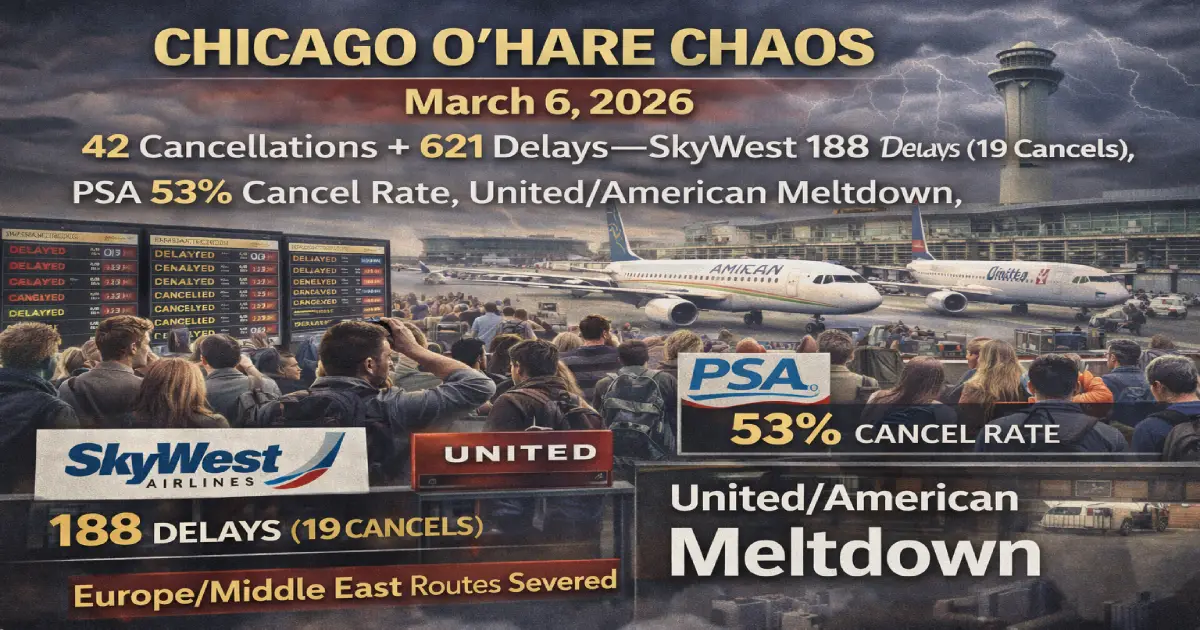
March 6, 2026 — Chicago O’Hare International Airport is experiencing a massive operational breakdown today, with 42 flight cancellations and 621 delays (663 total disruptions) paralyzing one of the world’s busiest aviation hubs. Regional carriers SkyWest and PSA Airlines are bearing the brunt of the chaos, while United and American Airlines struggle to maintain their connection banks as federal regulators issue dire warnings about summer 2026 schedule overload. International routes to London, Doha, Tel Aviv, and Brussels have been severed, stranding thousands of passengers as O’Hare’s systemic capacity crisis explodes into a full-blown network meltdown.
The Crisis in Numbers
Chicago O’Hare International Airport (ORD) recorded catastrophic disruption levels today:
- 42 flight cancellations (affecting domestic and international routes)
- 621 flight delays (cascading throughout the day)
- 663 total disruptions in a single day
- Thousands of passengers affected, with many missing connections to Europe, Middle East, and transcontinental destinations
The operational strain quickly spilled beyond Illinois, triggering schedule knock-ons for passengers originating in or transiting through the hub. Short-haul domestic feeders operated by regional partners bore the brunt of early disruption, with multiple departures to Midwestern and Southern cities pushed back or scrubbed from departure boards.
Regional Carrier Collapse: SkyWest & PSA Airlines
SkyWest Airlines — operating flights on behalf of United and American under the SkyWest brand:
- 19 cancellations (regional routes grounded)
- 188 delays (WORST delay count of any carrier at ORD today!)
- 207 total disruptions from a single regional operator
- 12% delay rate (statistical anomaly caused by cascading delays where a single aircraft/crew accumulates multiple delay markers throughout the day)
- Routes affected: Des Moines, Colorado Springs, Cincinnati, St. Louis, Oklahoma City, Flint, and dozens of smaller Midwestern cities
PSA Airlines (operating as American Eagle under American Airlines):
- 53% cancellation rate (CATASTROPHIC operational collapse!)
- Multiple cancellations across Chicago O’Hare hub
- 31% delay rate on remaining flights
- Short-haul feeders to Charlotte, Philadelphia, Dallas, and Miami completely disrupted
- Regional passengers stranded with limited rebooking options (small aircraft = fewer available seats)
The Regional Carrier Crisis Explained: SkyWest and PSA operate short-haul services that feed passengers into O’Hare’s connection banks. When an early cluster of delays or a handful of cancellations break the rhythm, the entire operation unravels:
- Morning delays cascade: Aircraft/crews out of position for afternoon/evening rotations
- Tight turnaround times: Regional jets often have 30-45 min turns (any delay = missed next departure)
- Limited spare aircraft: Regional carriers operate with minimal slack capacity
- Crew timing limits: FAA duty hour restrictions mean delayed crews cannot operate later flights
- Connection bank collapse: Passengers from 20+ regional flights miss their 1-2 connecting widebody departures
Result: An early morning SkyWest delay from Des Moines can strand a passenger who was supposed to connect to London Heathrow six hours later — and with United/American overbooking, rebooking can take 24-48 hours.
Major Carrier Struggles: United & American
United Airlines:
- Significant delays on routes heavily relying on regional feed
- Customers connecting from smaller US and Canadian cities rebooked onto later services to Europe/Middle East
- Some itineraries pushed to following day when minimum connection times could no longer be met
- Key affected routes: New York (LaGuardia, JFK, Newark), Washington DC (Reagan National, Dulles), Boston, Nashville
- International impact: London, Doha, Tel Aviv connections missed
American Airlines:
- Delays across hub operations as regional partner PSA collapsed
- Charlotte, Dallas, Philadelphia spokes affected
- Corporate criticism: American executives have publicly criticized what they describe as “overly dense scheduling” by United
- Internal warnings to staff: Without FAA intervention, O’Hare could face extended taxi times, persistent gate holds, and cascading network disruptions
What Happened: As delays mounted through the morning and early afternoon, long-haul services to Europe and the Middle East became increasingly vulnerable to missed connections and crew timing limits. A typical scenario:
- Passenger books ORD-LHR (Chicago-London) departing 5 PM
- Arrives ORD on SkyWest feeder from Des Moines at 2 PM (3-hour connection buffer)
- SkyWest flight delayed 4 hours → arrives ORD at 6 PM
- ORD-LHR flight already departed at 5 PM
- Next available United ORD-LHR flight: Tomorrow 5 PM (24-hour delay)
- Hotel, meals, rebooking chaos
Multiply this by 621 delays and 42 cancellations, and you have thousands of passengers stranded across O’Hare’s terminals.
International Routes Severed
Major International Hubs Affected:
London (LHR – Heathrow):
- Multiple United/American delays to London
- British Airways connections missed for passengers arriving on regional feeders
- European passengers transiting through London to US stranded (reverse flow also affected)
Doha (DOH – Hamad International):
- Qatar Airways flights delayed/cancelled at ORD
- Qatar Airways already operating at reduced capacity due to Middle East crisis (Doha airport closed for 8 days, limited reopening March 5)
- Passengers connecting to Asia/Middle East/Africa via Doha stranded
- Note: This compounds the existing Middle East aviation crisis (12,300+ flights cancelled Feb 28-March 3)
Tel Aviv (TLV – Ben Gurion International):
- Delays affecting Israeli passengers and US-Israel business travel corridor
- Religious tourism impacted (Passover season approaching)
Brussels (BRU – Brussels Airport):
- United delays to Brussels
- European Union connections severed (Brussels = key EU hub for NATO, European Commission)
Other Affected International Cities:
- Toronto (YYZ), Montreal (YUL), Vancouver (YVR) — Canadian connections disrupted
- Grand Cayman (GCM) — 100% delay rate (Caribbean routes completely paralyzed!)
- Punta Cana (PUJ) — 50% delay rate
- Palm Beach (PBI) — 50% delay rate (Florida routes affected)
Total International Impact: The disruption creates a network-wide chokepoint because O’Hare is a critical gateway hub. When ORD delays cascade, passengers miss connections not just in Chicago, but across the entire United/American global network.
Domestic Routes Also Paralyzed
Worst-Affected US Cities:
New York Metro Area:
- LaGuardia (LGA): Multiple delays/cancellations
- JFK: Transcontinental delays
- Newark (EWR): United hub affected (ORD-EWR route = key United corridor)
Washington DC:
- Reagan National (DCA): Major delays
- Dulles (IAD): United operations disrupted
Boston Logan (BOS):
- Multiple ORD-BOS delays (high-frequency business route)
Nashville (BNA):
- Regional feeder disruptions (SkyWest/PSA affected)
Other Major Cities:
- Milwaukee (MKE): 37% cancellation rate (close proximity to ORD = absorbs overflow, but overwhelmed)
- St. Louis (STL): 50% delay rate
- Des Moines (DSM): Highest cancellation rate among smaller airports (regional carrier reliance)
- Charlotte (CLT), Dallas (DFW), Philadelphia (PHL), Miami (MIA): American Airlines spoke disruptions
Midwest Regional Chaos: Smaller cities relying entirely on SkyWest/PSA feeders experienced near-total service collapse:
- Colorado Springs, Cincinnati, Oklahoma City, Flint: Multiple cancellations
- Passengers in these cities have NO alternative carriers (SkyWest/PSA = only option)
- Rebooking requires routing through Dallas, Denver, or Minneapolis (adding 6-12 hours)
The FAA Intervention: Summer 2026 Schedule Cap
Breaking Development: The Federal Aviation Administration (FAA) announced today that Chicago O’Hare’s planned summer 2026 schedules significantly exceed the airport’s practical capacity, prompting unprecedented federal intervention.
FAA Summer 2026 Schedule Reduction Order:
- Current planned capacity: 3,080 daily operations (flights)
- FAA-mandated cap: 2,800 daily operations
- Total reduction required: 280 flights per day must be cut
- Affected period: March 29 – October 25, 2026 (Summer 2026 scheduling season)
- Total seasonal impact: 50,400+ flights must be cancelled preemptively
Why the Cap is Necessary: Federal regulators determined that overscheduling has resulted in:
- Severe congestion during peak hours
- Frequent delays (like today’s 621 delays!)
- Increased cancellations
- Risk to passenger safety (runway/taxiway system cannot handle volume)
FAA Administrator Statement (March 3, 2026):
“The meeting is being called because the Secretary of Transportation has determined, pursuant to 49 U.S.C. 41722, that the meeting is necessary to address severe congestion at ORD and reduce flight delays during peak hours of operation. We also understand that the meeting is important to meet the serious and unusual situation occurring at ORD right now.”
Scheduling Reduction Meeting:
- FAA Administrator opening remarks: March 3, 2026, 3:00 PM
- Main meeting: March 4, 2026, 9:00 AM
- Attendees: All scheduled air carriers (regardless of current ORD service), Chicago Department of Aviation
- Purpose: Evaluate how to reduce flights without undermining competition or passenger access
- Final order: Expected to be published in Federal Register, effective through Summer 2026 season
Which Flights Will Be Cut? The FAA has indicated that regional feeder flights are at highest risk:
- SkyWest, PSA, Envoy Air, Republic Airways, GoJet = primary targets
- Short-haul routes (under 500 miles) most vulnerable
- Peak hour operations (7-9 AM, 5-7 PM) will see heaviest cuts
- United and American will be forced to trim schedules (competing for market share = overscheduling)
Passenger Impact:
- 50,400 preemptive cancellations Summer 2026 (May-September)
- Ticket prices expected to surge 15-30% after cuts take effect (reduced capacity = higher fares)
- Peak summer travel (July 4, Labor Day) = worst availability
- Alternative airports: Milwaukee (MKE, 90 mi), Indianapolis (IND, 185 mi), Detroit (DTW), Minneapolis (MSP)
American Airlines’ Public Criticism: American executives have publicly criticized United’s aggressive scheduling, warning that:
- Without intervention, ORD could face extended taxi times
- Persistent gate holds (aircraft waiting 30+ min for gates)
- Cascading network disruptions when irregular operations strike (like today!)
- “Essential and fragile hub” = one delay triggers system-wide collapse
United Airlines’ Response: United, as ORD’s largest hub operator (55% of total flights), faces the most pressure to cut schedules. The airline has acknowledged:
- Need to balance growth ambitions with safe/efficient operations
- Willingness to engage collaboratively with FAA regulators
- Ongoing investments in ground handling, gate capacity improvements
Chicago Department of Aviation Statement:
- Highlighted ongoing investments in airfield modernization and capacity expansion
- Reinforced city’s commitment to maintaining ORD’s status as critical aviation hub
- Acknowledged that current runway/taxiway system cannot handle 3,080 daily ops during peak summer
Long-Term Implications: Today’s 663 disruptions are a preview of what summer 2026 could look like without the FAA cap. Industry experts warn:
- Even with 280 flights/day cut, residual delays will persist
- Construction projects (runway resurfacing, terminal expansions) will further constrain capacity
- O’Hare’s hub-and-spoke model = vulnerable to cascading failures
- Alternative hubs (Denver, Dallas, Atlanta) may absorb ORD overflow traffic
Systemic Crisis: Construction, Runways, Aggressive Schedules
Root Causes of Today’s Breakdown:
1. Construction Projects:
- Runway resurfacing ongoing (reduces available runway capacity during peak hours)
- Terminal expansion = gate constraints (fewer gates available for widebody aircraft)
- Taxiway improvements = longer taxi times (aircraft spend 15-20 min taxiing vs. normal 8-12 min)
2. Tight Runway & Gate Utilization:
- 8 runways serving 3,080 daily operations = 385 ops per runway per day
- During peak hours (7-9 AM, 5-7 PM), runways operate at 95-100% capacity
- Weather (wind, visibility) forces runway closures → immediate gridlock
- Gate utilization at 90%+ during peak banks → aircraft waiting for gates
3. Aggressive Scheduling by Hub Carriers:
- United Airlines: 55% of ORD flights, aggressive expansion into new markets
- American Airlines: 35% of ORD flights, competing with United for market share
- “Schedule creep”: Airlines gradually add flights season-over-season without FAA scrutiny
- Connection banks: United/American schedule 100+ arrivals in 90-min windows to maximize connections → creates “peaks” that exceed runway capacity
4. Regional Carrier Dependency:
- 40% of ORD flights operated by regional carriers (SkyWest, PSA, Envoy, Republic, GoJet)
- Regional jets = smaller aircraft (50-76 seats) → more flights needed for same passenger volume
- Regional carriers have fewer spare aircraft/crews → delays cascade faster
- FAA duty hour limits = crews “time out” easily (cannot work extended shifts)
5. Weather Vulnerability:
- Chicago weather = unpredictable (thunderstorms, snow, high winds, low visibility common)
- Today’s disruptions occurred WITHOUT major weather event (imagine with a storm!)
- Even minor weather = runways reduced from 8 to 4-6 → immediate congestion
The “Essential and Fragile Hub” Problem: O’Hare is described by industry analysts as “essential and fragile”:
- Essential: Critical to United/American networks, serves 83 million passengers/year
- Fragile: One delay triggers system-wide collapse (like dominoes falling)
Expert Analysis:
“Chicago O’Hare is operating at the edge of its physical capacity. The airport was built for 2,500 daily operations, but we’re trying to squeeze in 3,080. Today’s 663 disruptions are the inevitable result — and it’s only going to get worse unless the FAA steps in.” — Aviation industry analyst
Passenger Nightmare: Real Stories
Jessica Martinez, 34, connecting ORD-LHR (Chicago-London):
“I flew in from Des Moines this morning on SkyWest. Flight was supposed to land at 2 PM, giving me 3 hours to connect to my 5 PM London flight. SkyWest delayed 4 hours — we landed at 6 PM. My London flight left at 5. United rebooked me on tomorrow’s 5 PM flight. I’ve already spent $380 on a hotel and meals, and I’m missing my business meeting in London. This is unacceptable.”
David Chen, 29, regional traveler from Oklahoma City:
“This is the third time this month my SkyWest flight from OKC to Chicago has been cancelled. There’s literally NO other option — SkyWest is the only carrier on this route. I had to rent a car and drive 9 hours to Dallas to catch my connecting flight. $600 car rental, $200 gas, full day lost. I’m seriously considering flying through Denver or Dallas instead of Chicago from now on.”
Typical Passenger Challenges:
- Missed connections: 621 delays = thousands of missed Europe/Middle East connections
- Rebooking delays: United/American hubs oversold → next available flight often 24-48 hours
- Hotel costs: $150-300/night unplanned (airlines not obligated to pay for operational delays)
- Lost productivity: Business travelers missing meetings, conferences, deals
- International visa complications: Passengers stranded in US beyond visa validity periods
- Limited compensation: US airlines not required to pay EU261-style compensation for delays
Average Total Losses Per Passenger: $800-2,000 (hotels, meals, lost wages, rebooking fees for non-refundable tickets)
Estimated ORD Economic Impact Today: 663 disruptions × 150 passengers/flight average = 99,450 passengers affected × $1,200 average loss = $119.3 million in passenger losses (conservative estimate).
What Travelers Should Do Now
If You’re Booked Through O’Hare (Next 7 Days):
- Expect delays and plan accordingly:
- Add 3-4 hour connection buffers (minimum 2 hours domestic, 4 hours international)
- Book first flight of the day (fewer cascading delays early morning)
- Avoid peak hours (7-9 AM, 5-7 PM departures)
- Monitor flight status obsessively:
- United/American mobile apps (push notifications enabled)
- FlightAware real-time tracking
- Sign up for SMS/email alerts from airlines
- Book flexible fares:
- Avoid basic economy (no rebooking flexibility)
- Refundable tickets worth extra cost if traveling during peak times
- Travel insurance with “cancel for any reason” coverage
- Know your rights:
- US domestic: Airlines must rebook you on next available flight at no charge (but no compensation for delays)
- EU261 (if flying to/from Europe on EU carrier): Up to €600 compensation for long delays/cancellations (not applicable to weather, but applicable to airline operational issues!)
- Document everything: Screenshots, photos of departure boards, receipts
- Consider alternative airports:
- Milwaukee (MKE): 90 miles north, smaller but less congested
- Indianapolis (IND): 185 miles south, American hub
- Detroit (DTW): Delta hub, avoids ORD entirely
- Minneapolis (MSP): Delta hub, alternative Midwest gateway
If You’re Currently Stranded at O’Hare:
- Don’t wait in line — use apps:
- United/American apps for rebooking (faster than airport desk)
- Call airline customer service while simultaneously using app
- Explore alternative routing:
- Ask to be rerouted through Dallas, Denver, Atlanta, Detroit
- Sometimes faster than waiting for next ORD-destination direct flight
- Demand meal/hotel vouchers:
- Airlines not required to provide, but often will if you ask
- Elite status holders have better leverage
- File compensation claims (if eligible):
- EU261 applies if flying to/from Europe on EU carrier (British Airways, Lufthansa, etc.)
- AirHelp, ClaimCompass = third-party services that file claims for you (take 25-35% fee)
If You’re Booking Summer 2026 Travel Through O’Hare:
- Wait until FAA order published (late March 2026):
- Airlines will preemptively cancel 280 flights/day
- Your ticket might be cancelled even if you book now
- Book EARLY (once FAA order published):
- Reduced capacity = higher fares (expect 15-30% increase)
- Peak summer (July 4, Labor Day) will sell out faster
- Avoid regional carriers through ORD:
- SkyWest, PSA, Envoy, Republic = highest cancellation risk
- Book United/American mainline if possible (larger aircraft, more backup options)
- Choose alternative hubs:
- Denver (DEN), Dallas (DFW), Atlanta (ATL) = more reliable summer 2026
The Bigger Picture: Nationwide Implications
O’Hare’s Crisis Ripples Across US Aviation Network:
Today’s 663 disruptions at ORD triggered knock-on effects nationwide:
- New York (LGA, JFK, EWR): ORD connections missed → passengers stranded at NYC airports
- Dallas (DFW): American Airlines spoke disrupted
- Charlotte (CLT): American Airlines spoke disrupted
- Los Angeles (LAX): Transcontinental connections missed
- San Francisco (SFO): United spoke disrupted
- Miami (MIA): American Airlines spoke disrupted
Total US Impact (Estimated):
- 2,222 total US disruptions today (303 cancels + 1,919 delays across all US airports)
- ORD contributed 663 disruptions (30% of national total!)
- Southwest Airlines: 134 cancellations + 285 delays = 419 disruptions (WORST US carrier today, separate from ORD issues)
Other Affected Hubs:
- Dallas DFW: 55 cancels + 164 delays (severe storms)
- Chicago Midway (MDW): Southwest hub, also experiencing delays
- Miami (MIA): 11 cancels + 57 delays
The “Hub-and-Spoke Fragility” Problem: US airlines operate hub-and-spoke networks where:
- 90% of passengers connect through hubs (not origin-destination)
- When ONE hub fails (like ORD today), the ENTIRE network collapses
- Alternative: Point-to-point networks (Southwest model) more resilient but less efficient
Congressional Scrutiny Expected:
- Today’s ORD chaos + FAA summer cap announcement = congressional hearings likely
- Senate Commerce Committee oversight of FAA’s role in preventing airline overscheduling
- Potential legislation requiring pre-approval of airline schedules at congested airports
Expert Analysis: “This Was Predictable”
Dr. Michael Henderson, Northwestern University Aviation Economics:
“Chicago O’Hare’s meltdown today was entirely predictable. The FAA has been warning airlines for months that 3,080 daily operations exceeds the airport’s physical capacity. United and American ignored those warnings, aggressively adding flights to compete for market share. Now passengers are paying the price — 663 disruptions in a single day, with thousands stranded. The summer 2026 cap is overdue.”
Captain Sarah Johnson, Retired United Airlines Pilot:
“I flew out of O’Hare for 25 years. The airport’s runway/taxiway system was designed for 2,500 daily ops, not 3,080. When you add construction projects, weather, and aggressive scheduling, you get what we saw today — a complete operational breakdown. Even without a major storm, minor delays cascade because there’s zero slack in the system. Pilots call it ‘flying on the edge.’ One delay and the whole thing unravels.”
Industry Warnings:
- Residual delays expected tomorrow: Aircraft and crews out of position → Friday March 7 will see continued disruptions
- Peak morning/evening banks vulnerable: 7-9 AM and 5-7 PM = highest risk periods
- Summer 2026 concerns: Even with 280 flights/day cut, experts predict continued delays during peak travel season
Official Responses
Chicago Department of Aviation:
- Established airport command center to monitor operations
- Coordinating with airlines to expedite rebooking
- Highlighted $8.5 billion “O’Hare 21” modernization program (runway/terminal/gate expansions)
- Acknowledged current capacity constraints
- Committed to working with FAA to ensure safe, efficient operations
United Airlines Statement:
- Apologized for disruptions
- Offered fee waivers for rebooking
- Committed to working with FAA on summer schedule reductions
- Emphasized investments in ground handling, de-icing equipment, gate capacity
American Airlines Statement:
- Apologized for delays and cancellations
- Reiterated criticism of “overscheduling” at ORD
- Called for FAA enforcement of capacity limits
- Offered travel waivers for affected passengers
FAA Statement:
- Reiterated commitment to safety
- Confirmed summer 2026 schedule reduction meeting held March 4
- Final order expected late March 2026
- “Operational caps necessary to protect passenger safety and reduce delays”
Passenger Advocacy Groups:
- FlyersRights.org called for mandatory compensation for operational delays (like EU261)
- Called for Congressional investigation into airline overscheduling
- Demanded stricter FAA oversight of hub capacity
Conclusion
Chicago O’Hare’s 663 disruptions today — 42 cancellations and 621 delays — represent a catastrophic operational breakdown driven by systemic overscheduling, regional carrier collapse, and infrastructure constraints that federal regulators have been warning about for months. SkyWest’s 188 delays and PSA’s 53% cancellation rate paralyzed the hub’s critical feeder network, stranding thousands of passengers and severing international connections to London, Doha, Tel Aviv, and Brussels.
The FAA’s intervention — capping summer 2026 schedules at 2,800 daily operations (down from 3,080, a cut of 280 flights/day) — signals unprecedented federal recognition that Chicago O’Hare is operating beyond its physical capacity. With 50,400 preemptive cancellations expected across the summer season and ticket prices projected to surge 15-30%, travelers face a harsh reality: one of America’s most critical aviation hubs is “essential and fragile,” and today’s chaos is just a preview of what summer 2026 could bring without aggressive capacity management.
For the 99,450 passengers affected today, the message is clear: avoid O’Hare during peak hours, add massive connection buffers (3-4 hours minimum), book flexible fares, and seriously consider alternative hubs like Milwaukee, Indianapolis, Denver, or Detroit. As one stranded passenger put it: “I’m never connecting through Chicago again.”
Last Updated: March 6, 2026, 7:30 PM CST (Chicago Time) Sources: FlightAware, The Traveler, Federal Aviation Administration Federal Register (Docket FAA-2004-16944), Chicago Department of Aviation, United Airlines, American Airlines, SkyWest, PSA Airlines, AirHelp, passenger reports
For More Resources
Related Articles
- US Flight Chaos March 3, 2026: 2,934 Disruptions — DHS Shutdown Day 18, TSA Reduced Paycheck Today, Spring Break 11 Days Away
- Italy ATC Strike TOMORROW March 7 — Final 24-Hour Warning, 1,500 Flights, Zero EU261, No Salvini Injunction
- Brussels Airport: ALL Departing Flights OFFICIALLY CONFIRMED Cancelled March 12 — 65,000 Passengers Grounded, Last Weekend to Rebook
- DHS Shutdown Day 13: TSA Partial Paycheck — First Full Missed Check March 14, Spring Break in 9 Days
For live updates on Chicago O’Hare disruptions, monitor FlightAware real-time tracking and airline mobile apps. The FAA’s final order on summer 2026 schedule reductions is expected to be published in the Federal Register in late March 2026. Travelers are urged to delay booking summer 2026 O’Hare connections until after the FAA order is published to avoid preemptive cancellations.
Posted By : Vinay
As a lead contributor for Travel Tourister, Vinay is dedicated to serving our Tier 1 audience (US, UK, Canada, Australia). His mission is to deliver precise, fact-checked news and actionable, data-driven articles that empower readers to make informed decisions, minimize travel risks, and maximize their adventure without compromising safety or budget.




 Call
Call Enquiry