Date: February 23, 2026 (Sunday)
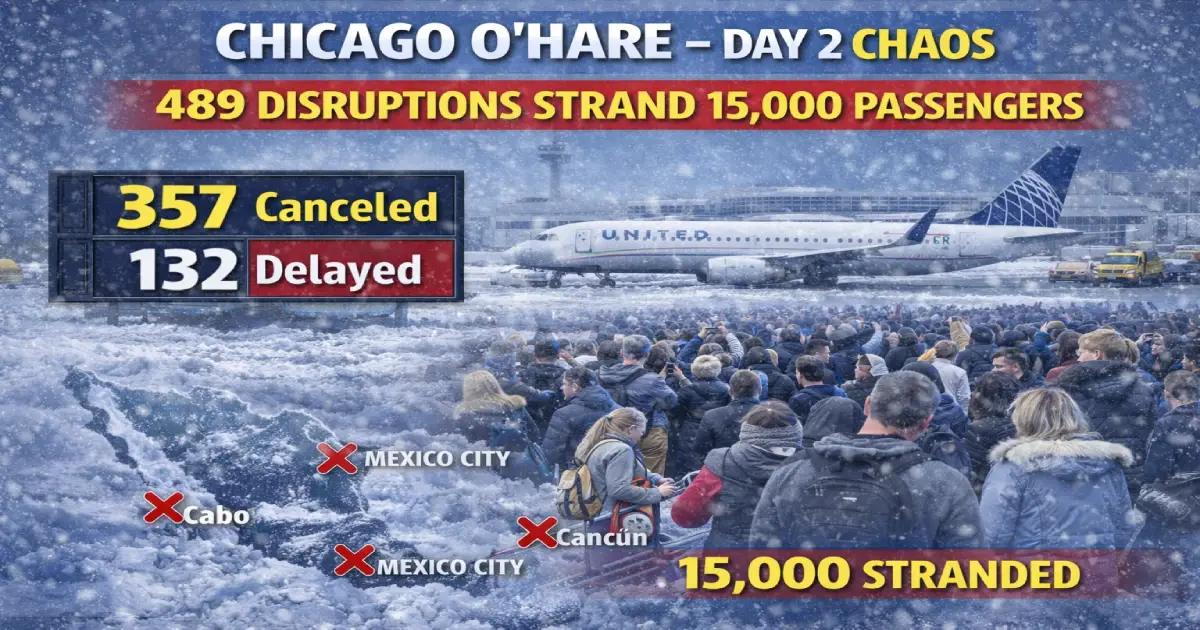
Total Disruptions: 489 flights (237 cancellations + 252 delays)
Passengers Affected: 15,000-20,000
Cause: Winter Storm Hernando + Northeast blizzard cascading effects
AMERICA’S SECOND-BUSIEST HUB PARALYZED: Chicago O’Hare International Airport — the United States’ second-busiest hub after Atlanta and the critical connector linking East Coast, West Coast, and Midwest aviation networks — suffered catastrophic operational collapse on Sunday, February 23, 2026, recording 237 flight cancellations and 252 delays (489 total disruptions, 56% of Sunday schedule affected) as Winter Storm Hernando’s blizzard pummeling New York City created cascading ripple effects across the nation, leaving 15,000-20,000 passengers stranded in Chicago’s terminals and exposing a systemic crisis in America’s regional carrier network that airline executives privately admit “will not be fixed for years.” The disruption breakdown reveals deep structural problems: Republic Airlines — operating as American Eagle and United Express — posted a catastrophic 25% cancellation rate (58 cancellations out of 232 scheduled flights), the highest among all carriers and a clear signal of crew shortage crisis that has plagued regional airlines since 2024, while Endeavor Air (Delta Connection) recorded 100% cancellation rate (all Chicago flights grounded preemptively), United Airlines cancelled 66 flights (10% of schedule), American Airlines cancelled 47 flights (12%), and SkyWest Airlines — despite only 8 cancellations — suffered 89 delays (21% delay rate) indicating aircraft/crew out of position from earlier disruptions. The geographic impact was devastating: New York routes (LaGuardia, JFK, Newark) bore the worst with 80+ flights cancelled/delayed as Winter Storm Hernando made NYC airports nearly inaccessible, Los Angeles connections severed by Southwest/United cancellations stranding West Coast travelers, Miami/Fort Lauderdale routes disrupted affecting cruise passengers racing to Port Everglades departures, Atlanta hub connections broken creating Delta network chaos, and dozens of small Midwest cities (Appleton, Cedar Rapids, Fargo, Grand Rapids, Madison) completely isolated as regional carriers (Republic, SkyWest, Envoy) grounded flights, leaving residents with no alternative air service for 24-48 hours. For Tier 1 travelers (US, UK, Canada, Australia), Chicago O’Hare’s Day 2 collapse represents a fundamental failure of US aviation’s regional carrier model: (1) Hub dependency = single point of failure — when O’Hare shuts down, entire Midwest loses air connectivity, (2) Regional carrier weakness — Republic’s 25% cancellation rate proves these airlines are structurally fragile (low pay drives pilot shortages, thin profit margins leave no recovery capacity), (3) No redundancy — most Midwest cities served by ONE regional carrier with 2-3 daily flights, meaning cancellations = complete isolation, and (4) Timing couldn’t be worse — this occurred during peak Presidents Day weekend return travel (millions heading home after holiday) AND just 5 days before Air Canada Unifor strike deadline (February 28) which will compound North American chaos, AND 2 weeks before Spring Break peak (March 8-22) when US aviation demand surges 40%+. Today’s O’Hare disaster came one day after nationwide airline meltdowns: Delta’s 346-cancellation technical glitch (Feb 23), Fort Lauderdale’s 334 disruptions (Feb 23), Tampa’s 162 disruptions (Feb 23), and Toronto Pearson’s 491 disruptions (Feb 23) — creating a perfect storm where every major North American hub failed simultaneously, stranding hundreds of thousands across the continent.
📊 CHICAGO O’HARE DISRUPTION BREAKDOWN (FEB 23, 2026)
Overall Statistics:
- Total Disruptions: 489 flights
- Cancellations: 237 (48.5% of disruptions)
- Delays: 252 (51.5% of disruptions)
- Estimated Sunday Schedule: ~900 flights (53% of schedule disrupted)
- Passengers Affected: 15,000-20,000 (based on avg 70-150 passengers per regional/mainline flight)
- Peak Chaos Hours: 6:00 AM – 2:00 PM CST (morning departure banks collapsed)
✈️ AIRLINES IN CRISIS (RANKED BY CANCELLATIONS)
1. United Airlines: 66 Cancellations + 29 Delays
Total Disruptions: 95 flights
Cancellation Rate: 10%
Delay Rate: 4%
Why United Was Hit Hardest:
- O’Hare = United’s 2nd-largest hub (after Newark) — 45% of O’Hare flights are United
- New York routes collapsed — Winter Storm Hernando made LaGuardia/Newark inaccessible
- Crew shortages — pilots/flight attendants stranded in NYC, couldn’t position to Chicago
- Regional partner dependency — United Express (Republic, SkyWest, GoJet) cancellations cascaded to mainline
Routes Most Affected:
- Chicago → New York (Newark): 15+ flights cancelled (United’s most profitable route)
- Chicago → LaGuardia: 10+ flights cancelled (business traveler route)
- Chicago → Los Angeles: Multiple cancellations (United’s West Coast trunk route)
- Chicago → San Francisco: Delays due to crew shortages
2. Republic Airlines: 58 Cancellations + 9 Delays (25% CANCELLATION RATE!)
Total Disruptions: 67 flights
Cancellation Rate: 25% (HIGHEST among all carriers)
Delay Rate: 4%
Why 25% Is Catastrophic:
- 1 in 4 Republic flights cancelled = systemic operational failure
- Crew shortage crisis — Republic has struggled to hire/retain pilots since 2024 pilot shortage began
- Low wages — Republic pays regional pilots $50-80K/year (mainline pays $150-400K)
- No backup crews — when pilots call in sick or are stranded, NO replacements available
- Thin profit margins — can’t afford spare aircraft/crews for contingencies
Operating As:
- American Eagle (Republic operates CRJ700/900 for American)
- United Express (Republic operates E175 for United)
Routes Cancelled:
- Chicago → Small Midwest cities (Appleton, Cedar Rapids, Fargo, Grand Rapids, Madison)
- Chicago → Mid-sized markets (Pittsburgh, Cleveland, Indianapolis, Louisville)
- Chicago → East Coast (Albany, Syracuse, Hartford, Providence)
What 25% Cancellation Rate Means:
- Worst performance among all carriers at O’Hare on Feb 23
- Industry experts: “25% cancellation rate = airline is in operational distress, one step from collapse”
- Passengers stuck: Most Republic routes have NO alternative carriers (e.g., Appleton → O’Hare = Republic ONLY)
3. American Airlines: 47 Cancellations + 22 Delays
Total Disruptions: 69 flights
Cancellation Rate: 12%
Delay Rate: 5%
Why American Suffered:
- O’Hare = American’s 3rd-largest hub (after Dallas/DFW, Charlotte)
- Regional partner chaos — Republic (25% cancel rate), Envoy (24 cancellations, 42 delays) collapsed
- New York routes — American flies ORD-JFK, ORD-LaGuardia (both heavily cancelled)
- Miami connections — American’s Latin America gateway, disruptions cascaded from O’Hare delays
4. Endeavor Air (Delta Connection): 100% CANCELLATION RATE
Total Disruptions: Unknown exact number (all Chicago flights cancelled)
Cancellation Rate: 100% (complete shutdown)
Delay Rate: 0% (no flights operated)
Why 100%:
- Preemptive shutdown — Endeavor cancelled all O’Hare flights 24-48 hours in advance
- NYC collapse — Endeavor’s primary hub = LaGuardia (99% cancelled Feb 24), couldn’t position aircraft/crews
- Delta network strategy — parent company Delta decided to completely shut down Endeavor at O’Hare rather than attempt partial operations
Impact:
- Small city isolation — Endeavor serves Madison, Cedar Rapids, Champaign (no alternative carriers)
- Passengers stranded 24-48 hours — next available flights not until Feb 25-26
5. Envoy Air (American Eagle): 24 Cancellations + 42 Delays
Total Disruptions: 66 flights
Cancellation Rate: 5%
Delay Rate: 9% (HIGHEST delay rate among regional carriers)
Why High Delay Rate:
- Crew positioning issues — pilots/flight attendants late arriving on earlier flights
- Aircraft maintenance — Envoy’s CRJ fleet older than competitors, more mechanical issues
- Ground staff shortages — O’Hare de-icing crews overwhelmed (winter ops)
6. SkyWest Airlines: 8 Cancellations + 89 Delays (21% DELAY RATE)
Total Disruptions: 97 flights
Cancellation Rate: 1% (LOW — impressive!)
Delay Rate: 21% (HIGHEST among all carriers)
Why So Many Delays But Few Cancellations:
- Aircraft out of position — SkyWest planes stuck at other airports (NYC, Denver, Minneapolis) from earlier storms
- Crew legal limits — pilots reaching FAA maximum duty hours, had to swap crews mid-day
- Committed to operating — SkyWest prioritizes completion over on-time (better for passengers than cancellations)
Operating As:
- United Express (E175)
- Delta Connection (CRJ700/900)
- American Eagle (CRJ700)
7. Delta Air Lines: 8 Cancellations + 3 Delays
Total Disruptions: 11 flights
Cancellation Rate: 19%
Delay Rate: 7%
Why Delta Had Fewer Disruptions:
- O’Hare = NOT a Delta hub (Delta’s hubs: Atlanta, Detroit, Minneapolis)
- Fewer flights — Delta only operates ~40 daily O’Hare flights (vs. United 400+, American 200+)
- BUT: Delta’s regional partners (Endeavor, SkyWest) suffered heavily
8-12. Other Affected Airlines:
Spirit Airlines: 5 cancellations + 8 delays (14% cancel rate, 23% delay rate)
GoJet (United Express): 4 cancellations + 18 delays
Frontier: 4 cancellations + 1 delay
Southwest: Minimal disruptions (Southwest’s O’Hare presence is small)
Air Canada (Jazz): Multiple delays affecting Toronto-Chicago route
🗺️ CITIES & ROUTES MOST AFFECTED
New York City Routes: 80+ Flights Cancelled/Delayed
Why NYC Was Hardest Hit:
- Winter Storm Hernando pummeling NYC with first blizzard warning in 9 years
- LaGuardia: 99% cancellation rate (Feb 24)
- JFK: 100% cancellation rate (Feb 24)
- Newark: Heavy disruptions
Routes Severed:
- ORD → LGA: 15+ United, American cancellations
- ORD → EWR: 15+ United cancellations (United’s most profitable route)
- ORD → JFK: 10+ American, Delta, JetBlue cancellations
Passenger Impact:
- Business travelers — Monday morning NYC meetings missed, hotels fully booked
- Connecting passengers — Europeans flying ORD → NYC → London/Paris stranded
Los Angeles Routes: 20+ Cancellations
Routes Affected:
- ORD → LAX: United, American cancellations
- ORD → Burbank: Southwest delays
- ORD → Long Beach: Minimal JetBlue operations
Why LA Mattered:
- West Coast business connection — Chicago-LA = 2nd-busiest US route (after NYC-LA)
- Entertainment industry — film/TV execs travelling between production hubs
- Tech travelers — Silicon Valley connections via SFO also disrupted
Miami/Fort Lauderdale Routes: Cruise Passenger Crisis
Routes Affected:
- ORD → MIA: American, United delays
- ORD → FLL: Spirit, Southwest cancellations
Why This Mattered:
- Cruise embarkation deadlines — passengers racing to Port Everglades (cruise ships depart regardless of flight delays)
- Fort Lauderdale had own crisis — 334 disruptions Feb 23 (your article)
- Double whammy: Chicago flights cancelled + Fort Lauderdale airport chaos = cruise passengers completely stranded
Small Midwest City Isolation:
Cities Completely Cut Off (No Flights Feb 23):
- Appleton, WI (Republic cancelled)
- Cedar Rapids, IA (Endeavor 100% cancelled)
- Fargo, ND (Republic cancelled)
- Grand Rapids, MI (Republic cancelled)
- Madison, WI (Endeavor cancelled)
- Champaign, IL (Envoy cancelled)
Why This Is Catastrophic:
- No alternative carriers — these cities served by ONE regional airline only
- No other airports nearby — e.g., Appleton residents would need to drive 2+ hours to Milwaukee or Green Bay
- Business/medical travel — patients flying to Mayo Clinic (Rochester, MN), business deals cancelled
🌨️ WINTER STORM HERNANDO: MIDWEST IMPACT
Chicago Weather (Feb 23):
Temperature: 18°F (-8°C)
Wind: 25-35 MPH gusts (wind chill: 0°F/-18°C)
Snowfall: 2-4 inches (not heavy, but blowing snow)
Visibility: 1-3 miles (blowing snow reduced visibility)
Runway Conditions: Wet/slushy (de-icing required)
Why This Caused Chaos:
- Not the snow — Chicago can handle heavy snow, 2-4 inches is manageable
- The cascading effect — NYC blizzard (20-30 inches) stranded crews/aircraft, which then couldn’t reach Chicago
- De-icing delays — every departing flight required 15-30 min de-icing (accumulated delays)
- Air traffic control — FAA ground delay programs slowed operations
🔗 CONNECTION TO NATIONWIDE CRISIS (FEB 22-23)
Multi-Hub Collapse:
February 22-23 saw simultaneous failures across North America:
New York City:
- JFK: 100% Endeavor cancellations (Feb 24)
- LaGuardia: 99% Endeavor cancellations (Feb 24)
- Newark: Heavy disruptions
Chicago O’Hare:
- 237 cancellations + 252 delays (Feb 23) ← TODAY’S STORY
Atlanta:
- Delta connectivity glitch (Feb 23, 346 cancellations)
Fort Lauderdale:
Tampa:
Toronto Pearson:
- 94 cancellations + 397 delays (Feb 23)
Combined Impact:
- 1,500+ cancellations across North America (Feb 22-23)
- 300,000-400,000 passengers affected
- $500+ million economic impact (hotels, lost productivity, rebooking)
🌍 IMPACT ON TIER 1 TRAVELERS
United States Travelers
Direct Impact:
- 15,000-20,000 passengers stranded at O’Hare on Feb 23
- Midwest residents — Small city isolation (Appleton, Cedar Rapids, Fargo, etc.)
- Business travelers — Monday morning meetings cancelled (NYC, LA, SF routes severed)
- Cruise passengers — Racing to Miami/Fort Lauderdale ports, many missed embarkation
Cities Most Affected:
- Chicago — Local passengers trapped at home airport
- New York — Business travelers couldn’t reach NYC for Monday meetings
- Los Angeles — West Coast connections severed
- Small Midwest cities — Complete air service cutoff for 24-48 hours
What Happens When O’Hare Shuts Down:
- Midwest air travel stops — O’Hare = only hub serving most Midwest cities
- No alternatives — Amtrak limited, driving impractical (Appleton to NYC = 16 hours)
- Cascading delays — O’Hare delays ripple to Atlanta, Dallas, Denver, LA, SF
- Hotels sell out — Chicago hotels near O’Hare fully booked, passengers sleeping in terminals
UK Travelers
Indirect Impact:
- Transatlantic connections — British Airways, Virgin Atlantic, United operate ORD-London Heathrow
- Example scenario: London → Chicago (arrive on time) → Grand Rapids (Republic cancelled) = passenger stuck in Chicago 24-48 hours
United’s ORD-London Routes:
- ORD-LHR: Multiple daily flights, some delays reported (aircraft/crew shortages)
- Connecting passengers — UK travelers flying to Midwest cities affected by regional cancellations
Canadian Travelers
Direct Impact:
- Toronto-Chicago route — Air Canada Jazz experienced delays
- Connects to Toronto Pearson crisis — 491 disruptions Feb 23 (your article), now O’Hare 489 disruptions
- Double crisis: Canadian travelers face chaos at home (Toronto) + destination (Chicago)
Compounding Factors:
- Air Canada Unifor strike — Deadline Feb 28 (5 days away), 5,800 agents could walk out
- No alternatives — If Air Canada strikes + O’Hare chaos continues, Canadian travel to US paralyzed
Australian Travelers
Minimal Direct Impact:
- Very few Australians travel through O’Hare (most use LAX, SFO for US entry)
- IF connecting: Sydney → Los Angeles (Qantas) → Chicago → Midwest cities = affected by regional cancellations
💡 TRAVELER SURVIVAL GUIDE
If You’re Flying Through O’Hare (Next 7 Days):
1. Avoid Connections If Possible:
- Book nonstop flights whenever available
- If connecting through O’Hare: Allow minimum 3-4 hours (vs. normal 2 hours)
- Why: Delays cascade throughout the day, tight connections = guaranteed miss
2. Check Aircraft Type:
- Regional jets (CRJ, E175): Higher cancellation risk (Republic 25% rate!)
- Mainline jets (737, A320, 787): More reliable (United/American 10-12% cancel rate)
- How to check: Flight booking shows aircraft type (e.g., “United Express CRJ700” = regional, high risk)
3. Monitor Republic/Endeavor Flights Obsessively:
- Republic Airlines: 25% cancellation rate = 1 in 4 flights cancelled
- Endeavor Air: 100% cancellation rate Chicago = avoid entirely
- Alternative: Pay more for United/American mainline flights (not Express/Connection)
4. Have Backup Plans:
- Alternative airports: Milwaukee (MKE) 90 miles from Chicago, smaller but more reliable
- Amtrak: Chicago → Detroit, Milwaukee, Minneapolis (slower but weather-proof)
- Rental car: Book in advance (winter storm demand spikes)
Understanding Your Rights:
Weather Cancellations = “Act of God”:
- Airlines owe you: Rebooking on next available flight OR full refund
- Airlines do NOT owe you: Hotels, meals, ground transportation
What United/American WILL Do:
- Rebook automatically (check app/email)
- Waive change fees
- Refund if you decline rebooking
What United/American WON’T Do:
- Pay for hotel (unless elite status + specific conditions)
- Give meal vouchers (weather = not airline’s fault)
- Compensate lost wages/events
If You’re Stuck at O’Hare Right Now:
Hotel Crisis:
- Chicago airport hotels 90%+ full (everyone stranded)
- Prices surging ($200-400/night for budget hotels)
- Try: Downtown Chicago hotels (more availability, Uber/taxi to airport when flights resume)
Food Options:
- Terminal 1: McDonald’s, Frontera Grill, Goose Island
- Terminal 2: Chili’s, Burger King, Wicker Park Seafood
- Terminal 3: PF Chang’s, Chicago Beer Company
- Terminal 5 (International): Nuts on Clark, Tortas Frontera
Sleeping:
- Terminal 3 has yoga room (quiet, dimly lit, limited spots)
- Rental car center — less crowded than terminals (but cold)
- United Club/American Admirals Club — paid lounges ($59/day, showers + food)
📊 O’HARE’S SYSTEMIC CRISIS: NOT A ONE-DAY EVENT
February 2026: Month of O’Hare Chaos
Week 1 (Feb 1-7):
- Minor disruptions (normal winter ops)
Week 2 (Feb 8-14):
- Presidents Day weekend (Feb 14-17) — elevated delays
Week 3 (Feb 15-21):
Week 4 (Feb 22-28):
- Feb 23: 489 disruptions ← TODAY
- Feb 24: Endeavor 100% cancelled (your Endeavor article)
- Feb 28: Air Canada strike deadline (5 days away, will affect ORD-Toronto route)
Root Causes (Why This Won’t Get Better):
1. Regional Carrier Crisis:
- Pilot shortage — Regional airlines pay $50-80K/year, can’t compete with mainline $150-400K
- No spare capacity — When one pilot calls in sick, flight cancels (Republic 25% cancel rate proves this)
- Thin profit margins — Regional carriers can’t afford backup crews/aircraft
2. Hub Dependency:
- O’Hare = only Midwest hub — If O’Hare fails, entire region loses air service
- No alternatives — Milwaukee, Indianapolis too small to absorb O’Hare overflow
3. Weather Vulnerability:
- Winter 2026 = brutal — February alone: 5+ major winter storms
- Chicago location — Midwest = collision point of Arctic air + Gulf moisture = frequent winter storms
- Infrastructure limits — O’Hare can handle snow, but NOT simultaneous multi-hub failures (NYC + Chicago)
4. Government Shutdown Impact:
- 61,000 TSA agents unpaid — Security checkpoints slower, terminal crowding
- Air traffic controllers unpaid — FAA slowing ops at 40 major airports (including O’Hare)
When Will This Get Better?
Short-Term (Feb 24-March 7):
- NOT improving — More winter storms forecast, Air Canada strike Feb 28, Spring Break demand surge coming
- Best case: Weather clears, airlines catch up by March 1
- Worst case: More storms, strikes, chaos continues through Spring Break (March 8-22)
Long-Term (2026-2027):
- Regional carrier consolidation — Some airlines (Republic? Endeavor?) may merge or shut down
- Pilot shortage won’t resolve — Takes 3-5 years to train pilots, current pipeline insufficient
- O’Hare expansion delayed — New runway construction not complete until 2028-2030
🔗 OFFICIAL GOVERNMENT RESOURCES
FAA Flight Delay Information:
Chicago Department of Aviation:
US Department of Transportation – Air Travel Consumer Report:
📰 RELATED TRAVEL TOURISTER ARTICLES
Chicago O’Hare Coverage:
Nationwide Crisis (Feb 22-23):
Air Canada Strike Countdown:
Last Updated: February 24, 2026 at 10:00 AM CST
O’Hare Recovery Timeline: Partial operations resumed Feb 24, full schedule expected Feb 25-26
Air Canada Unifor Strike Deadline: February 28, 2026 (5 days away)
Spring Break Peak Season: March 8-22, 2026 (2 weeks away)
Posted By : Vinay
As a lead contributor for Travel Tourister, Vinay is dedicated to serving our Tier 1 audience (US, UK, Canada, Australia). His mission is to deliver precise, fact-checked news and actionable, data-driven articles that empower readers to make informed decisions, minimize travel risks, and maximize their adventure without compromising safety or budget.




 Call
Call Enquiry