Published on : 05 Mar 2026
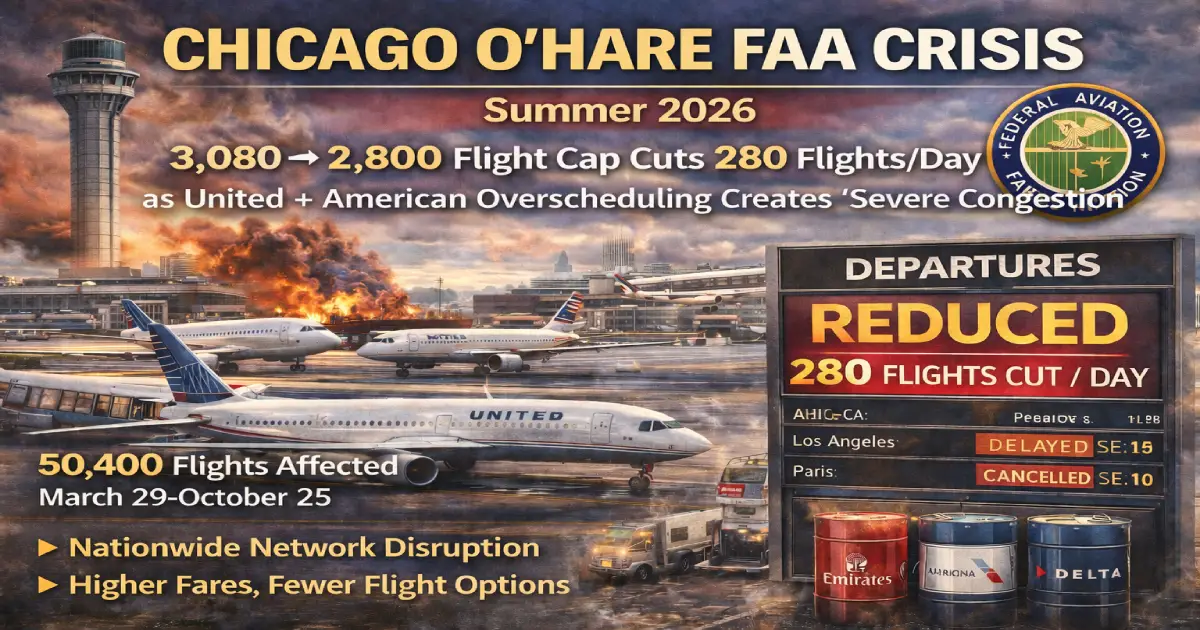
Breaking — Summer 2026 Shake-Up: The Federal Aviation Administration has ordered massive mandatory flight reductions at Chicago O’Hare International Airport for Summer 2026 season (March 29-October 25) after carriers scheduled more than 3,080 daily peak-day operations — including take-offs and landings with FAA signalling that this level of flights could overwhelm runways, taxiways, terminals and air traffic control capacity as United Airlines and American Airlines engaged in aggressive hub expansion battle scheduling roughly 15% more flights than last summer’s 2,680 peak prompting FAA to impose cap of around 2,800 daily operations at ORD meaning 280 flights/day must be cut (9% reduction) = 50,400 total flights over 180-day summer season affecting millions of passengers as overscheduling has resulted in severe congestion, frequent delays while meetings started early March between FAA, airlines, Chicago Department of Aviation to negotiate voluntary cuts before formal enforcement order, with regulators warning unchecked schedules would create “large-scale operational disruption” as infrastructure modernization projects, air traffic controller shortages, gate competition strain nation’s second-busiest airport beyond breaking point. Here is the complete breakdown every Chicago summer traveler needs today.
Published: March 5, 2026 (Wednesday) FAA Action: Mandatory flight cap Summer 2026 (IATA summer season) Season Dates: March 29-October 25, 2026 (210 days / ~180 peak operational days) Current Schedules: 3,080 daily peak operations (takeoffs + landings) Last Summer 2025: 2,680 daily peak operations Increase: +400 operations (+15% year-over-year) FAA Cap: 2,800 daily operations maximum Required Cuts: 280 operations/day (9% reduction from current schedules) Total Summer Impact: 50,400 flights affected (280/day × 180 peak days) Passengers Affected: 7-10 million (estimate 140-200 passengers/flight) Primary Culprits: United Airlines + American Airlines aggressive hub expansion Meetings: Started March 3-4, ongoing (voluntary negotiation phase) Deadline: March 11, 2026 for airline proposals to FAA Enforcement: Formal FAA order to follow if voluntary cuts insufficient
Official filings published in Federal Register show that carriers have scheduled more than 3,080 daily peak-day operations — including take-offs and landings — for 2026 summer season, which runs from 29 March to 25 October 2026 according to Travel and Tour World.
Breaking down the math:
Current airline schedules (published):
FAA proposed cap:
Required cuts:
FAA’s publication clearly states that overscheduling has resulted in severe congestion, frequent delays because Chicago O’Hare’s infrastructure cannot handle 3,080+ daily operations without catastrophic breakdown.
The capacity bottlenecks:
O’Hare operates 8 runways (most of any US airport), but:
Result: FAA will review each 30-minute period between 06:00 and 21:59 local time with carriers to meet overall hourly proposed scheduling limit , with FAA Administrator Bryan Bedford identifying any of those 30-minute periods he considers severely congested, as well as general targets for flight reductions during those periods .
Chicago O’Hare infamous for taxiway gridlock:
Passenger experience: “We pushed back from gate on time, then sat on taxiway 45 minutes. Pilot said ‘traffic jam.’ Missed my connection.”
O’Hare undergoing $8.5 billion Terminal Area Plan expansion, but:
FAA faces nationwide ATC staffing crisis:
Until staffing levels improve, adjusting airline schedules remains one of FAA’s most immediate and practical levers to ease congestion .
United Airlines fueled the crisis with unprecedented Summer 2026 expansion:
United announced its largest-ever summer schedule in Chicago. Carrier plans to serve 222 destinations, including 175 domestic and 47 international routes, with up to 750 daily departures according to Aviation A2Z.
United’s 2026 vs 2025:
Why United overscheduled:
United’s small aircraft problem:
UA flies smallest gauge aircraft in/out of ORD; just as in EWR they can grow capacity by upgauging but many of these flights they have added won’t work with more capacity according to One Mile at a Time analysis.
United’s expansion relies heavily on:
Problem: Each takeoff/landing counts equally toward 2,800 cap — whether 50-seat CRJ or 300-seat 777. United’s small-aircraft strategy = inefficient capacity per operation.
Expected impact on United:
United likely absorbing majority of 280 daily cuts because:
American Airlines took more moderate approach:
American is targeting service to more than 180 destinations from Chicago, reaching approximately 183 markets. Airline operates just over 500 daily flights, placing it near pre-pandemic levels rather than significantly above them .
American’s 2026 vs 2025:
Why American restrained:
American lost gates in 2023-2024 after failing to restore capacity quickly post-pandemic per lease terms. To secure footprint:
American’s public statement:
American Airlines commended FAA “for taking proactive action to ensure operational integrity of airfield and airspace in Chicago.” “FAA now has the opportunity to achieve improved customer experience for passengers traveling from, to, and through Chicago this summer” .
Translation: “Thank you FAA for stopping United’s insanity. Now United has to cut flights while we keep ours.”
AA has killed all credibility it had by cutting flights out of ORD over last 5+ years. Just making O’Hare a connection airport made them bad airline they are today according to industry observers, but in this case, American’s strategic retreat positioned them advantageously when FAA imposed cuts.
280 operations/day × 180 peak summer days = 50,400 total flights affected.
How will airlines decide which flights to cut?
Airlines typically decide where to absorb reductions based on revenue, connectivity, and operational flexibility. Regional feeder flying, which can add many movements for fewer passengers per flight, often becomes first place carriers look when movement limits tighten according to VisaVerge.
Likely cut priorities:
Small-city connections using 50-76 seat regional jets:
Example routes at risk:
Why regional flights vulnerable:
Passenger impact: Small-city residents lose convenient connections, forced to drive 2-4 hours to Chicago or connect through other hubs.
Routes with 8-12+ daily flights where reducing to 6-8 maintains connectivity:
Strategy: Cut 1-2 frequencies per route (e.g., 10 daily → 8 daily) spreads pain across network without eliminating service.
FAA will review each 30-minute period between 06:00 and 21:59 local time with carriers to meet overall hourly proposed scheduling limit .
Most congested windows:
Airlines will shift flights to off-peak windows (10 AM-3 PM, after 8 PM) where capacity exists.
If you’re flying through O’Hare Summer 2026, here’s what to expect:
280 fewer daily flights = 50,400 fewer seats over summer (assuming 180-seat average).
Example impacts:
For passengers, schedule cuts may result in fewer available flights on popular routes. This, in turn, could lead to higher prices as demand outstrips supply, particularly during busy summer travel period Travel Tourister.
Price surge estimates:
Fewer connecting banks = tighter connection windows:
If you’re booking ORD travel for summer 2026, choose fares with no-change or low-change fees when possible, and set flight alerts for schedule updates. When schedule change hits, compare nonstop options and earlier departures before accepting automatic rebooking Travel Tourister.
Timeline for changes:
Action: If you booked O’Hare travel April-October 2026, check your itinerary weekly for schedule changes.
FAA’s scheduling reduction meeting framework provides airlines and interested parties opportunity to submit written data and operational proposals until 11 March 2026. After reviewing all inputs and considering operational realities at O’Hare, FAA will issue final order that could formalise flight limits .
Phase 1 — Voluntary Negotiation (Now-March 11):
Phase 2 — FAA Review (March 11-20):
Phase 3 — Formal Order (March 20-29):
Phase 4 — Summer Implementation (March 29-October 25):
In mid-2025, FAA implemented scheduling limits at Newark Liberty International Airport (EWR) to reduce delays and manage congestion. Newark, much like O’Hare, had experienced significant flight overscheduling, and FAA took regulatory action to curb number of operations .
Newark 2025 crisis mirrors O’Hare 2026:
Newark situation:
Key lessons for O’Hare:
If traveling O’Hare April-October 2026:
Avoid O’Hare connections if possible:
Chicago-area alternatives:
If airline changes your schedule >2 hours:
The Federal Aviation Administration ordered massive mandatory flight reductions at Chicago O’Hare International Airport for Summer 2026 (March 29-October 25) after carriers scheduled 3,080 daily peak operations — 15% above last summer’s 2,680 — with FAA imposing 2,800 cap meaning 280 flights/day must be cut (9% reduction) = 50,400 total flights affected as United Airlines’ unprecedented expansion (+200 flights/day, +36%) and American Airlines’ moderate growth (+20-40 flights/day) created “severe congestion, frequent delays” overwhelming runways, taxiways, terminals, air traffic control capacity while infrastructure modernization, ATC staffing shortages strain nation’s second-busiest airport beyond breaking point — with meetings started March 3-4 between FAA, airlines, Chicago Department of Aviation to negotiate voluntary cuts by March 11 deadline before formal enforcement order, affecting millions of passengers through fewer flight options, higher fares (+15-40%), missed connections, schedule changes as regional feeder flights face highest cut risk while peak-hour congestion windows (6-10 AM, 4-8 PM) targeted for reductions.
Your O’Hare Summer 2026 Survival Checklist:
✅ Booked O’Hare travel April-Oct? Check itinerary weekly for schedule changes, airlines notifying passengers March 20-29 ✅ Small-city connection? Regional feeder flights highest cut risk — book alternative routing NOW ✅ Book flexible fares: Schedule changes likely, refundable/changeable tickets essential ✅ Peak summer travel (July 4, Labor Day)? Prices will surge +15-30% after cuts take effect ✅ Consider alternatives: Milwaukee (90 mi), Indianapolis (185 mi), Detroit, Minneapolis hubs avoid O’Hare congestion
Track O’Hare crisis:
Related Articles:
Posted By : Vinay
Lastest News
2nd Floor, 39, Above Kirti Club, DLF Industrial Area, Kirti Nagar, New Delhi, Delhi 110015



Travel Tourister is a leading Travel portal where we introduce travellers to trusted travel agents to make their journey hasselfree, memorable And happy. Travel Tourister is a platform where travellers get Tour packages ,Hotel packages deals through trusted travel companies And hoteliers who are working with us across the world. We always try to find new and more travel agents and hoteliers from every nook and corners across the world so that you could compare the deals with different travel agents and hoteliers and book your tour or hotel with the one you have chosen according to your taste and budget.
Copyright © Travel Tourister, India. All Rights Reserved

 Call
Call Enquiry