Published on : 18 Feb 2026
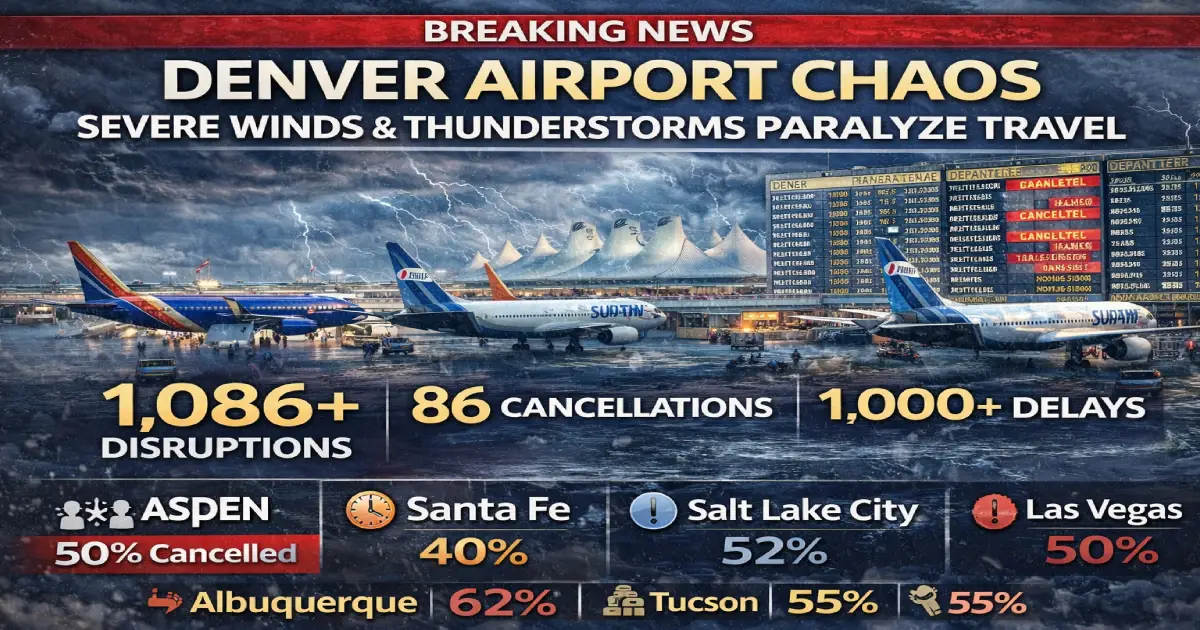
MOUNTAIN WEST CRISIS: Denver International Airport descended into operational chaos Tuesday, February 18, 2026, as severe winds, fast-building thunderstorms, and cascading operational failures triggered 86 flight cancellations and more than 1,000 delays — stranding thousands of passengers and paralyzing the Mountain West’s primary aviation hub — with SkyWest Airlines recording 60 cancellations (14% of its entire fleet) plus 203 delays, Southwest Airlines suffering 24 cancellations and 315 delays, and United Airlines experiencing 2 cancellations but a staggering 392 delays (66% of its Denver schedule) as Federal Aviation Administration ground delay programs, lightning-induced ramp shutdowns, and crew duty-time violations cascaded across the network, leaving Aspen-Pitkin County Airport with 50% cancellations (33 flights grounded, devastating Colorado’s premier ski resort), Santa Fe Regional at 40% cancellations and 40% delays (New Mexico tourism shattered), Salt Lake City International suffering 52% delays, Las Vegas Harry Reid recording 50% delays, Albuquerque International Sunport experiencing 62% delays, Tucson International facing 55% delays, and dozens of smaller Mountain West communities completely cut off from same-day connections as Denver’s role as the region’s sole major hub exposed the fragility of America’s centralized aviation network — making this the worst single-day Denver disruption event of 2026 and a catastrophic blow to the region’s winter tourism economy just as ski season peaks.
Published: February 18, 2026 (Tuesday) Total Denver Disruptions: 1,086+ flights (86 cancellations + 1,000+ delays) Denver Delay Percentage: 47% of all Denver flights delayed Denver Cancellation Percentage: 4% of all Denver flights cancelled Worst Airline (Cancellations): SkyWest — 60 cancellations (14% of fleet) Worst Airline (Delays): United — 392 delays (66% of Denver schedule) Weather Cause: Severe winds (high gusts), thunderstorms, lightning, heavy rain FAA Ground Stops: Multiple ground delay programs issued Regional Impact: 15+ airports affected (Mountain West + Southwest + Upper Midwest) Passengers Affected: Estimated 80,000-100,000 Ski Resort Impact: Aspen 50% cancelled, Vail/Breckenridge connections severed Tourism Economic Loss: $15-20 million (estimated single-day impact)
Confirmed data (Tuesday, February 18, 2026):
Context:
Multiple weather systems converging:
1. Severe Winds (Primary Cause):
2. Thunderstorms + Lightning:
3. Multiple Ground Delay Programs: Federal air-traffic managers issued a series of ground delay programs to space out arrivals and regulate departures, forcing airlines to hold aircraft at gates and on taxiways while storms moved through critical approach paths.
Result: Denver operations slowed to a crawl. Aircraft sat idle awaiting clearance. By late afternoon: 1,000+ delays, 86 cancellations.
Confirmed data:
Why SkyWest was devastated:
SkyWest’s specific cancellations: SkyWest, which operates regional flights for several major carriers including United and Delta, emerged as one of the hardest-hit operators in Denver’s latest bout of disruption. Its regional jets form the backbone of service to smaller airports in the Mountain West, and delays to those flights quickly multiplied as crews and aircraft fell out of position.
Confirmed data:
Why Southwest struggled: Southwest Airlines, a dominant presence at Denver and a popular choice for leisure travelers, also reported hundreds of delays. The carrier’s point-to-point network can be especially vulnerable when a major station like Denver experiences weather-related ground stops. Aircraft that should be turning quickly between cities instead sat idle, awaiting clearance from air-traffic control or ground crews as lightning and heavy rain slowed ramp operations.
Southwest’s operational model vulnerability:
Confirmed data:
Why United had massive delays but few cancellations: United Airlines, Denver’s largest tenant and a primary hub carrier, wrestled with the dual challenge of protecting a dense bank of connecting flights while maintaining long-haul departures.
United’s strategic choice:
But passengers suffered more:
Confirmed data:
Why Aspen was worst: SkyWest has triggered significant travel turmoil at Aspen-Pitkin County Airport, with 33 cancellations and 21 delays. These disruptions, caused by WestJet, are severely affecting passengers traveling from major U.S. cities like Denver, Los Angeles, Chicago, Dallas, Houston, and other destinations.
Aspen-specific route failures:
| Route | Cancellations | Delays |
|---|---|---|
| Denver → Aspen | 5 cancels (50%) | 5 delays (50%) |
| Dallas-Fort Worth → Aspen | 3 cancels (60%) | 2 delays (40%) |
| Los Angeles → Aspen | Multiple disruptions | |
| Chicago → Aspen | Multiple disruptions | |
| Houston → Aspen | Multiple disruptions | |
| Atlanta → Aspen | Multiple disruptions |
Aspen’s unique vulnerability:
Economic impact on Aspen:
Confirmed data:
Routes affected: Flights between Denver and Santa Fe, often operated by regional partners like SkyWest, saw mounting delays as aircraft arriving late from other cities failed to turn on time. Travelers headed to northern New Mexico for work trips, ski vacations and cultural tourism faced hours-long waits and, in some cases, overnight stays in Denver.
Why Santa Fe hit hard:
Confirmed data:
Why Salt Lake City affected: In Salt Lake City, another key western hub, Denver-linked flights experienced knock-on effects as crews and aircraft arriving from Colorado were delayed.
Delta’s SLC hub:
Confirmed data:
Impact:
Confirmed data:
Why Albuquerque worst for delays:
Confirmed data:
Southbound routes to Tucson were also affected, with both Southwest and United adjusting schedules as storms moved through Denver and connecting banks began to unravel. Passengers reported missed onward connections to Mexico and other Southwest destinations as late-arriving flights from the East Coast could no longer feed tightly timed departures.
Mountain West:
Upper Midwest:
Southwest US:
Denver’s unique role in US aviation:
1. Geographic centrality:
2. Regional monopoly: When one bank of flights into Denver is delayed or canceled, passengers in cities such as Santa Fe, Cheyenne and smaller Upper Midwest markets can lose same day connections to the rest of the country.
3. Hub concentration risk: As a major connecting hub, disruption there affects airline operations across the United States as aircraft, crews and passengers fail to reach their next scheduled legs. An aircraft arriving late into Denver from the East Coast, for example, may have been slated to continue on to cities as far flung as Boise, Omaha or Ontario, California, creating a daisy chain of delays.
Real cascade examples from today:
Aspen ski resorts:
Santa Fe cultural tourism:
Las Vegas casinos:
Denver hotels (paradoxically gained):
Total estimated economic impact (conservative): $15-20 million for single day
If stuck at Denver TODAY:
1. Check rebooking options:
2. Know your rights:
US DOT Passenger Rights:
3. Alternative transportation:
Driving options (if destination within 200 miles):
Rental cars:
Amtrak (limited):
4. Hotel options:
Denver airport hotels (all likely fully booked):
Downtown Denver (15 miles, $40-60 Uber):
1. Weather exposure:
2. Infrastructure constraints:
3. Regional hub monopoly:
Q: Will Wednesday (February 19) be better? A: Likely yes. Weather forecast shows storms clearing overnight. Expect residual delays Wednesday morning as aircraft/crews reposition, but near-normal by afternoon.
Q: Can I get compensation for weather delays? A: No. Weather = “extraordinary circumstances.” Only entitled to free rebooking or refund. No cash compensation, hotels, meals required.
Q: Why doesn’t Denver invest in better weather resilience? A: Denver’s infrastructure is world-class (6 runways, extensive de-icing). But you cannot control weather. Thunderstorms + lightning = mandatory ground stops (safety, not capacity issue).
Q: Is SkyWest safe if they cancelled 14% of their fleet? A: Yes. SkyWest cancelled proactively due to weather + operational constraints (crew duty times, aircraft positioning). Safety is not compromised. But reliability is poor.
Q: Should I avoid connecting through Denver in future? A: February-August = thunderstorm season (higher disruption risk). November-March = winter weather risk. Consider Phoenix or Salt Lake City for Mountain West connections if flexibility exists.
Denver International Airport’s February 18, 2026 chaos — 1,086+ disruptions (86 cancellations + 1,000+ delays) triggered by severe winds and thunderstorms — exposed the fragility of America’s centralized Mountain West aviation network as SkyWest’s 60 cancellations (14% of its fleet), Southwest’s 24 cancellations and 315 delays, and United’s staggering 392 delays (66% of Denver schedule) cascaded across the region, leaving Aspen with 50% flights cancelled (devastating Colorado’s premier ski resort), Santa Fe at 40% cancellations, Albuquerque suffering 62% delays, Salt Lake City recording 52% delays, Las Vegas experiencing 50% delays, and dozens of smaller Mountain West communities completely cut off from same-day connections — stranding an estimated 80,000-100,000 passengers and inflicting $15-20 million in single-day tourism economic losses while demonstrating that America’s hub-concentration model remains catastrophically vulnerable to weather events at critical nodes.
For Mountain West travelers:
For More Information:
Related Articles:
Posted By : Vinay
Lastest News
2nd Floor, 39, Above Kirti Club, DLF Industrial Area, Kirti Nagar, New Delhi, Delhi 110015



Travel Tourister is a leading Travel portal where we introduce travellers to trusted travel agents to make their journey hasselfree, memorable And happy. Travel Tourister is a platform where travellers get Tour packages ,Hotel packages deals through trusted travel companies And hoteliers who are working with us across the world. We always try to find new and more travel agents and hoteliers from every nook and corners across the world so that you could compare the deals with different travel agents and hoteliers and book your tour or hotel with the one you have chosen according to your taste and budget.
Copyright © Travel Tourister, India. All Rights Reserved

 Call
Call Enquiry