DHS Shutdown Airport Chaos February 2026: 61,000 TSA Agents Work Unpaid as $6 Billion Economic Crisis Looms

Published on : 19 Feb 2026
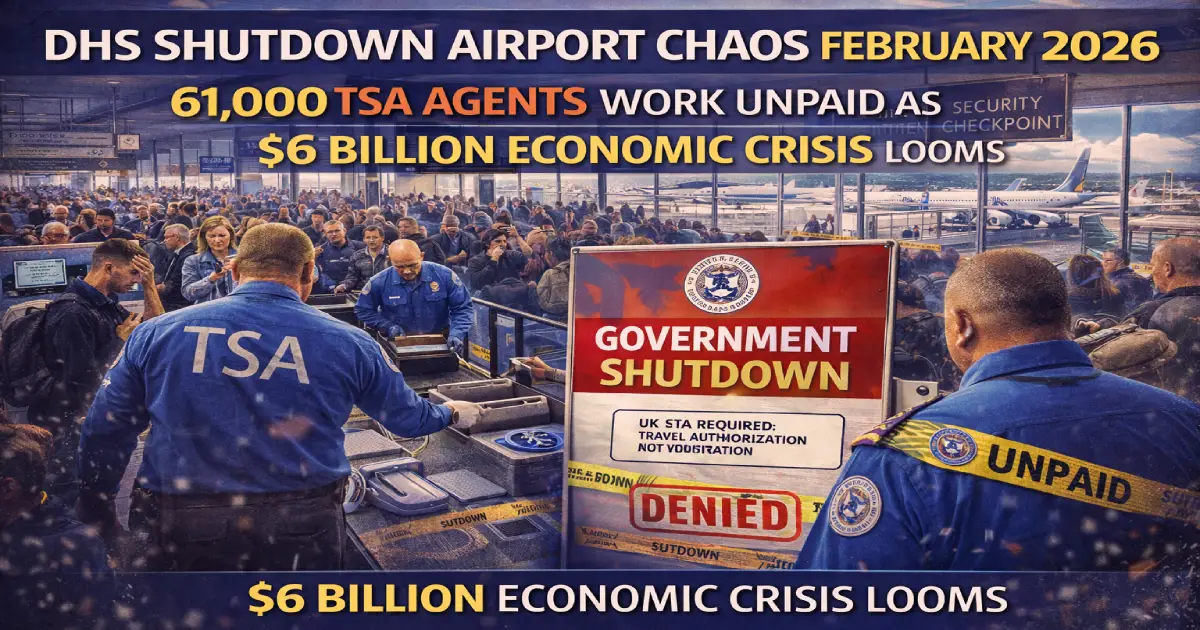
DHS shutdown February 2026, TSA security checkpoint delays, 61,000 agents working unpaid, airport lines, spring break travel crisis, government funding lapse

Breaking: The United States faces its THIRD government shutdown in four months as 61,000 TSA agents work without pay starting February 14, 2026. The Department of Homeland Security funding lapse threatens $6 billion in economic damage, affects 6 million travelers, and creates a looming spring break catastrophe. Here’s everything you need to know NOW.


Published: February 19, 2026, 10:00 AM EST
Shutdown Start: February 14, 2026, 12:01 AM
Duration: 6 days and counting (NO end in sight)
TSA Agents Unpaid: 61,000 (95% of workforce)
Economic Impact: $6 billion estimated (based on previous shutdown)
Travelers Affected: 6+ million already
Spring Break Timing: March 1-April 15 (crisis period ahead)
Status: Congress remains deadlocked, no resolution expected this week


What’s Happening Right Now

For the THIRD time in just four months, the US government faces a partial shutdown—but this time it’s hitting travelers where it hurts most. The Department of Homeland Security lost funding at midnight on February 14, 2026, forcing 61,000 Transportation Security Administration agents to work without paychecks while screening 2.5 million daily passengers at 430+ airports nationwide.

The timing couldn’t be worse: Spring break travel begins in just 10 days, threatening to transform current inconveniences into a full-scale airport meltdown affecting millions of American families.

Current Crisis Statistics:


✈️ TSA Agents Unpaid: 61,000 (95% of 64,130 total workforce)
✈️ Furloughed Workers: 2,933 TSA employees sent home
✈️ Daily Passengers: 2.5 million screened at 430+ airports
✈️ Economic Impact Warning: $6 billion (industry estimate from last shutdown)
✈️ Previous Travelers Disrupted: 6 million during 43-day shutdown
✈️ Shutdown Duration: Day 6 with NO resolution in sight
✈️ Spring Break Risk: 10 days until peak travel (March 1-April 15)
✈️ Recent Flight Disruptions: 5,100+ delays Saturday, 6,500+ delays Sunday

Why This Shutdown Is Different (and Worse)

This isn’t a full government shutdown—just DHS. But for air travelers, it’s potentially MORE damaging than the record 43-day shutdown that ended November 2025.

The Triple Threat:

1. Timing Is Catastrophic

Spring break 2026 begins March 1—just 10 days away. Peak travel runs March 1 through April 15, affecting:

  • College students: 20+ million nationwide
  • Families: 50+ million with school-age children
  • International travelers: Millions arriving for World Cup events
  • Spring breakers: Florida, Texas, Arizona destinations

2. Workers Are Already Exhausted

TSA agents endured TWO shutdowns in the past four months:

  • October-November 2025: 43 days without pay (record-breaking)
  • Early February 2026: 4-day partial shutdown
  • Now: Third shutdown starting February 14

Acting TSA Administrator Ha Nguyen McNeill testified: “TSA workers are still reeling from the 43-day shutdown. Many sold blood plasma, slept in cars at airports, and took second jobs just to survive.”

3. Political Deadlock Looks Unbreakable

Unlike previous shutdowns over budget numbers, this fight centers on immigration policy—a deeply partisan issue with no compromise in sight. Democrats and Republicans remain completely deadlocked over ICE enforcement reforms.

The 61,000 TSA Agents Working Without Pay

Transportation Security Administration officers face impossible choices: work without pay or face termination for job abandonment.

Who’s Affected:

Essential Employees (61,000 – 95% of TSA):

  • Security screening officers
  • Behavior detection specialists
  • K-9 explosive detection teams
  • Federal Air Marshals
  • Security operations center staff
  • Checkpoint supervisors and managers

Furloughed Workers (2,933 – 5% of TSA):

  • Administrative staff
  • IT support personnel
  • Training coordinators
  • Policy analysts
  • Public affairs officers

Financial Impact on TSA Families:

Average TSA Officer Salary: $46,000/year ($1,769 biweekly) Missed Paychecks So Far: 0 (first paycheck affected March 1) Next Paycheck Risk: March 15 if shutdown continues

What TSA Agents Are Reporting:

  • “I’m donating blood plasma twice weekly to pay rent” – TSA officer, Atlanta
  • “Sleeping in my car between shifts to save gas money” – TSA supervisor, Chicago
  • “Took a night shift at Walmart to survive” – TSA agent, Dallas
  • “Can’t afford daycare, my kids stay with neighbors” – TSA mother, Miami
  • “Sold my wedding ring last shutdown, nothing left to sell now” – TSA officer, Phoenix

These aren’t hypothetical scenarios—TSA Administrator McNeill presented these testimonies to Congress during hearings before the shutdown.

Historical Pattern: Sick Calls WILL Spike

During the 43-day shutdown (Oct-Nov 2025), TSA sick calls increased dramatically:

  • Week 1: Normal 3-5% absence rate
  • Week 2-3: 8-10% absent
  • Week 4-5: 12-15% absent
  • Week 6+: 15-20% absent (some airports hit 25%)

With paychecks stopping March 1, expect similar patterns starting early March—right as spring break peaks.

Airport Impact: Where Delays Are Hitting Hardest

While delays haven’t reached crisis levels YET (we’re only on Day 6), the data shows clear warning signs:

Weekend Disruption Data (Feb 15-17, 2026):

Saturday, February 15:

  • Delays: 5,100 flights nationwide
  • Cancellations: 460 flights
  • Worst airports: Atlanta (ATL), JFK, LAX, Philadelphia (PHL)

Sunday, February 16:

  • Delays: 6,500 flights nationwide
  • Cancellations: 330 flights
  • Pattern: Increasing delays, decreasing cancellations (airlines adapting)

Monday, February 17:

  • Delays: 600+ flights (by morning only)
  • Status: Continuing pattern
  • TSA checkpoint wait times: Up 15-25% at major hubs

Airports Most Vulnerable:

Tier 1 – Major Hubs (Highest Risk):

  1. Hartsfield-Jackson Atlanta (ATL)
    • Daily passengers: 275,000+
    • TSA checkpoints: 9
    • Risk: Highest volume in US
  2. Los Angeles (LAX)
    • Daily passengers: 230,000+
    • TSA checkpoints: 8
    • Risk: International gateway congestion
  3. Chicago O’Hare (ORD)
    • Daily passengers: 220,000+
    • TSA checkpoints: 7
    • Risk: Midwest hub bottleneck
  4. Dallas-Fort Worth (DFW)
    • Daily passengers: 200,000+
    • TSA checkpoints: 8
    • Risk: Southwest/American hub concentration
  5. Denver International (DEN)
    • Daily passengers: 190,000+
    • TSA checkpoints: 6
    • Risk: Already struggling from weather issues

Tier 2 – Regional Airports (Acute Vulnerability):

Small regional airports with single TSA checkpoints face the HIGHEST risk. A few sick calls can shut down entire checkpoints:

  • Appleton (ATW) – Wisconsin
  • Pensacola (PNS) – Florida
  • Sioux Falls (FSD) – South Dakota
  • Eugene (EUG) – Oregon
  • Bozeman (BZN) – Montana

One regional TSA manager told CNN: “We have 12 officers. If three call in sick, we can’t open the checkpoint. Passengers miss flights. The airport shuts down.”

Spring Break 2026: The Looming Catastrophe

Spring break threatens to transform current delays into a full-scale crisis affecting tens of millions of American travelers.

Spring Break Travel Statistics:

Peak Travel Dates:

  • March 1-15: Primary college spring break
  • March 15-April 1: Peak family travel
  • April 1-15: Extended spring break/Easter travel

Expected Traveler Volume:

  • Daily passengers: Up to 3 million (vs. normal 2.5 million)
  • Total spring break travelers: 65-70 million Americans
  • International arrivals: 8-10 million (includes World Cup fans)

Top 10 Spring Break Destinations 2026:

  1. Key West, Florida (#1 searched – 17 states)
  2. Destin, Florida (#2 – 15 states)
  3. South Padre Island, Texas (#3 – growing fast)
  4. Panama City Beach, Florida
  5. Sarasota, Florida
  6. Lake Havasu, Arizona
  7. Hilo, Hawaii
  8. Cancun, Mexico (via US airports)
  9. Cabo San Lucas, Mexico
  10. Miami, Florida

Why Spring Break + Shutdown = Disaster:

Volume Overload:

Normal TSA capacity struggles during spring break even WITH full staffing and pay. Add unpaid workers calling in sick, and checkpoints will collapse.

Family Travel Stress:

Families with young children are least equipped to handle 3-4 hour security waits. Missed flights cascade into hotel cancellations, rental car problems, and ruined vacations.

Regional Airport Failure:

Small airports serving Florida/Texas beach destinations will face the worst impact. Think: Panama City Beach, Fort Myers, Pensacola—airports with minimal TSA staff serving massive spring break crowds.

Economic Multiplier Effect:

When travelers miss flights, they don’t just lose airfare. They lose:

  • Hotel reservations (often non-refundable)
  • Rental car bookings
  • Cruise ship departures
  • Theme park tickets
  • Restaurant reservations
  • Spring break group packages

The $6 Billion Economic Warning

Travel industry groups (U.S. Travel, Airlines for America, American Hotel Association) issued a joint statement citing the previous shutdown’s massive economic damage:

October-November 2025 Shutdown Impact:

Economic Losses:

  • Total economic impact: $6 billion
  • Travelers disrupted: 6+ million
  • Flights affected: 20,000+ cancellations
  • LaGuardia Airport: Ground stops on peak days
  • Hotel occupancy: Dropped 15-20% nationwide
  • Restaurant revenue: Down 25% in tourist areas

Current Shutdown Projection (If Continues Through March):

  • Economic impact: $8-10 billion (spring break multiplier)
  • Travelers disrupted: 15-20 million
  • Flights affected: 50,000+ potential delays/cancellations
  • Spring break bookings: 30-40% cancellation risk
  • Tourism jobs: 100,000+ at risk

Travel industry groups warned: “Funding uncertainties create lasting damage to the entire travel ecosystem, especially the airlines, hotels and thousands of small businesses the travel industry supports. It also stifles recruitment, retention, preparedness and modernization efforts.”

What’s NOT Affected (Important Distinctions)

Understanding what’s still working helps travelers plan around the crisis:

Air Traffic Controllers: WORKING WITH PAY ✅

Good News: Air traffic controllers fall under the Department of Transportation (NOT DHS), so they’re fully funded and working normally.

  • All control towers: Operating normally
  • Flight routing: No impact
  • Air traffic delays: Only from TSA bottlenecks, not ATC issues

ICE/Border Patrol: FULLY FUNDED ✅

Ironic Note: The immigration enforcement agencies at the center of the political fight are FULLY funded through 2029 under the “One Big Beautiful Bill Act” passed in late 2025:

  • ICE funding: $75 billion through 2029
  • Border Patrol funding: $12 billion
  • Immigration enforcement: Completely unaffected by shutdown

The shutdown ONLY affects TSA, Coast Guard, FEMA, Secret Service, and other DHS divisions—not the immigration agencies causing the political deadlock.

Airlines: OPERATING NORMALLY ✅

Airlines are private companies unaffected by government shutdowns. All flights operate normally (subject only to TSA checkpoint delays).

Passenger Survival Guide: How to Navigate the Shutdown

Before Your Flight:

1. Add 2-3 Hours to Arrival Time

  • Normal TSA recommendation: 2 hours domestic, 3 hours international
  • During shutdown: 4 hours domestic, 5 hours international
  • Spring break peak: 5 hours domestic, 6 hours international

2. Enroll in TSA PreCheck Immediately

TSA PreCheck lines remain MUCH faster even during shutdowns:

  • Regular screening: 45-90 minute waits (and growing)
  • PreCheck: 10-20 minute waits (relatively stable)
  • Cost: $78-85 for 5 years
  • Enrollment: Some locations offering same-day service

WARNING: TSA PreCheck enrollment appointments are filling fast. Book NOW if you’re traveling in March.

3. Monitor TSA Wait Times (When Available)

The MyTSA app normally shows real-time wait times, BUT it doesn’t function during shutdowns when IT staff are furloughed. Alternatives:

  • Airport websites (some have live cameras)
  • Twitter/X: Search “[Airport Code] TSA wait” for real-time passenger reports
  • Airline apps: Some show security wait estimates

4. Pack Smart for Long Waits

  • Water bottle (fill after security)
  • Snacks (checkpoint lines can be 2-3 hours)
  • Phone chargers/portable batteries
  • Entertainment for children
  • Medications in carry-on
  • Patience and understanding

At the Airport:

1. Be KIND to TSA Agents

Remember: They’re working without pay to protect your safety. They didn’t cause this crisis. Many are:

  • Selling blood plasma to pay rent
  • Working second jobs overnight
  • Sleeping in cars to save gas
  • Skipping meals to afford daycare

A simple “thank you for working without pay” goes a long way.

2. Use Less-Crowded Checkpoints

Major airports have multiple TSA checkpoints:

  • International terminals: Often less crowded (if you have access)
  • Satellite terminals: Check if your airline has alternates
  • Off-peak checkpoints: Early morning/late night sometimes faster

3. Consider Alternate Airports

If your city has multiple airports, check alternatives:

  • New York: JFK vs. LaGuardia vs. Newark vs. White Plains
  • Los Angeles: LAX vs. Burbank vs. Long Beach vs. Ontario
  • Chicago: O’Hare vs. Midway
  • San Francisco: SFO vs. Oakland vs. San Jose

Smaller airports often have SHORTER TSA waits because they have fewer passengers—even with fewer TSA officers.

If You Miss Your Flight:

1. Airlines Must Accommodate You

If you arrived 2+ hours early (3+ international) but missed your flight due to TSA delays:

  • Airlines will rebook you on next available flight
  • Usually no change fees (but not guaranteed)
  • Document checkpoint wait times (photos, timestamps)

2. Travel Insurance Considerations

Most travel insurance DOES NOT cover government shutdowns because they’re “known events” once they begin. But:

  • “Cancel for Any Reason” policies may cover it
  • If shutdown causes you to cancel BEFORE it starts, some policies cover it
  • Credit card travel protections vary—check your card benefits

3. Document Everything

  • Photos of TSA checkpoint lines
  • Timestamps showing when you arrived
  • Screenshots of MyTSA app (if working)
  • Witness statements from other passengers
  • Airline rebooking confirmations

This documentation helps with airline customer service disputes and potential compensation claims.

Congressional Deadlock: Why There’s No End in Sight

Unlike previous shutdowns over budget numbers where compromise is possible, this shutdown centers on deeply partisan immigration policy with NO middle ground.

The Core Dispute:

Democrats Demand:

  • Ban on ICE agents wearing masks during arrests
  • Warrant requirements for individual arrests
  • Body cameras on all immigration enforcement officers
  • Independent oversight of ICE operations
  • Data transparency on enforcement activities

Republicans Refuse:

  • “Immigration enforcement is non-negotiable”
  • “Democrats are protecting criminals, not citizens”
  • “ICE needs operational flexibility to enforce law”
  • “This is political theater to handcuff border security”

Current Status (February 19, 2026):

  • Senate Democrats: Sent counteroffer Monday (1 day ago)
  • House Republicans: No response yet
  • White House: Supporting ICE, opposing restrictions
  • Timeline: NO votes scheduled, no meetings planned
  • Expectation: Shutdown continues “indefinitely”

Senate Majority Leader Chuck Schumer (D-NY) stated: “If the reason for this shutdown is ICE’s behavior, why punish TSA, Coast Guard, and FEMA workers?”

House Republicans countered that Democrats are “manufacturing a crisis over immigration enforcement to score political points.”

Historical Context Shows Long Duration Likely:

When government shutdowns involve core ideological disputes (not just budget math), they last MUCH longer:

  • 2018-2019 Border Wall Shutdown: 35 days
  • 2013 Obamacare Shutdown: 16 days
  • 2025 Immigration Shutdown: 43 days (record)

The current shutdown is Day 6. Based on historical patterns, expect it to last 2-4 weeks MINIMUM—right through peak spring break.

Long-Term Implications Beyond This Shutdown

Even after this shutdown ends, the damage compounds over time:

1. TSA Recruitment and Retention Crisis

TSA has lost 25% of its workforce since the October 2025 shutdown began. The agency can’t recruit fast enough to replace departing officers because:

  • Pay is too low: $46,000 average (vs. $65,000 for local police)
  • Shutdown risk: Who wants a job that doesn’t pay regularly?
  • Working conditions: Stressful, thankless work
  • Career prospects: Limited advancement opportunities

Acting Administrator McNeill testified: “Recruitment is suspended during shutdowns. We can’t make job offers when we don’t know if we can pay people.”

2. Technology Deployment Frozen

TSA planned to roll out Touchless ID technology (facial recognition screening) at 65 airports by spring 2026. The shutdown has:

  • Suspended installation at remaining 45 airports
  • Frozen training for TSA officers
  • Delayed modernization by 6+ months minimum
  • Created security gaps as old equipment ages

3. Morale Collapse

TSA officers report plummeting morale after three shutdowns in four months:

  • Trust in government: “They don’t care about us”
  • Financial stress: “We live paycheck to paycheck”
  • Family strain: “My spouse wants me to quit”
  • Career doubts: “Why did I take this job?”

One TSA supervisor in Atlanta told CNN: “I’ve been here 15 years. Three shutdowns in four months is the breaking point. I’m updating my resume.”

4. International Tourism Perception

The US already faces a tourism crisis with 8.2% fewer foreign visitors in 2025 compared to 2024. Add government shutdown chaos to:

  • $250 visa fees
  • Social media disclosure requirements
  • 39-country travel ban extensions
  • World Cup 2026 concerns

Result: Foreign tourists are choosing Europe, Asia, and Latin America over the United States.

Expert Analysis: A System Operating on Fumes

Aviation security experts warn the US air travel system is operating at breaking point:

The Zero-Margin Problem:

TSA operates with ZERO spare capacity:

  • Staffing: 64,000 officers for 430 airports = 149 per airport average
  • Coverage: 24/7/365 operations require 4-5 shifts
  • Effective staffing: ~30 officers per checkpoint, per shift
  • Sick call impact: 3 absences can close a checkpoint

Compare this to other countries:

  • UK airports: 15-20% staffing reserve
  • EU airports: 20-25% reserve capacity
  • Asian airports: 25-30% reserve capacity
  • US airports: 0-5% reserve capacity

Political Weaponization of Essential Services:

Using TSA workers as political leverage violates basic governance principles:

  • TSA didn’t cause the political fight: Immigration policy dispute
  • TSA can’t solve the political fight: No role in ICE policy
  • TSA workers suffer collateral damage: Unpaid for others’ fight
  • Travelers suffer collateral damage: Delayed for political theater

Aviation security analyst Mary Schiavo told CNN: “Congress is holding TSA hostage to fight over completely unrelated immigration policy. It’s unconscionable.”

The Coming Reckoning:

If spring break 2026 becomes the predicted disaster, Congress will face intense political pressure:

  • Angry voters: Millions of families with ruined vacations
  • Economic damage: Billions in lost tourism revenue
  • Job losses: Thousands in hospitality/travel industry
  • 2026 midterms: Campaign ads write themselves

But will it be enough to break the deadlock? History suggests partisan fights like this only end when political pain becomes unbearable for BOTH parties.

Looking Ahead: Timeline and Predictions

This Week (February 19-23):

Most Likely Scenario:

  • Shutdown continues through week
  • TSA operations remain relatively stable (still on Day 6)
  • Flight delays increase 10-15% but manageable
  • Spring break bookings start showing cancellations

Worst Case:

  • Shutdown continues indefinitely
  • First missed paychecks March 1
  • TSA sick calls begin spiking
  • Airlines start preemptive cancellations

Next Week (February 24-March 2):

Critical Week:

  • March 1: First missed TSA paychecks
  • March 1: Spring break travel begins
  • March 2-3: TSA sick calls likely spike
  • March 4-5: Airport chaos begins

This Is The Danger Zone.

Spring Break Peak (March 8-22):

Potential Disaster Window:

  • 15-20% TSA absence rate (based on previous shutdowns)
  • 3-5 hour checkpoint wait times at major hubs
  • Regional airport checkpoint closures
  • Tens of thousands of missed flights
  • $2-3 billion in lost travel spending

Congressional Response:

If this scenario plays out, expect emergency legislation—but the damage will already be done to millions of families.

Post-Spring Break (April 2026):

Recovery Period:

  • TSA workers get back pay (eventually)
  • Checkpoint operations normalize
  • Travel confidence slowly returns
  • But long-term damage to recruitment, morale, and international tourism persists

The Bottom Line

The Department of Homeland Security shutdown that began February 14, 2026, represents the THIRD government funding crisis in just four months—and the timing couldn’t be worse for American air travelers. With 61,000 TSA agents working without pay, spring break beginning in 10 days, and Congress showing no signs of compromise, the US faces a potential air travel catastrophe affecting tens of millions of passengers.

What Makes This Crisis Unique:

  • Timing: 10 days before spring break peak
  • Scope: 61,000 TSA workers unpaid
  • Duration: No end in sight (Day 6 with zero progress)
  • Economic risk: $6-10 billion potential damage
  • Political deadlock: Immigration policy fight with no middle ground

What Travelers Must Know:

  1. Arrive MUCH earlier: Add 2-3 hours to normal airport arrival time
  2. Delays will worsen: First missed paychecks hit March 1, TSA sick calls will spike
  3. Spring break is at risk: March 1-April 15 is danger zone
  4. Consider alternatives: Alternate airports, travel insurance, flexible booking
  5. Document everything: For airline disputes and compensation claims

Expert Recommendation:

If you’re traveling during spring break 2026 (March 1-April 15), treat this like severe weather planning:

  • Have flexible booking options
  • Arrive at airport 4-5 hours early
  • Prepare for long waits and potential delays
  • Consider trip cancellation insurance (if not too late)
  • Monitor situation daily as March 1 approaches

The TSA workforce is stretched to breaking point. When the first missed paychecks hit March 1, expect the situation to deteriorate rapidly. Your patience, preparation, and understanding will be essential to navigating what could become the worst air travel disruption in US history.

For travelers with spring break plans: This isn’t fear-mongering—it’s reality based on previous shutdown patterns. TSA workers WILL start calling in sick when paychecks stop. Checkpoints WILL experience longer waits. Flights WILL be missed. Plan accordingly, and remember: the TSA agents suffering through this didn’t create this crisis. They’re doing their best in impossible circumstances.


Last Updated: February 19, 2026, 10:00 AM EST Shutdown Status: Day 6, NO resolution in sight Next Critical Date: March 1 (first missed paychecks) Spring Break Peak: March 8-22 (highest risk period)

This is a developing situation. Check TSA.gov and your airline directly for real-time updates.


For More Resources:

Related Articles:

Posted By : Vinay

As a lead contributor for Travel Tourister, Vinay is dedicated to serving our Tier 1 audience (US, UK, Canada, Australia). His mission is to deliver precise, fact-checked news and actionable, data-driven articles that empower readers to make informed decisions, minimize travel risks, and maximize their adventure without compromising safety or budget.

Lastest News

How to reach

2nd Floor, 39, Above Kirti Club, DLF Industrial Area, Kirti Nagar, New Delhi, Delhi 110015

Payment Methods

card

Connect With Us

Travel Tourister is a leading Travel portal where we introduce travellers to trusted travel agents to make their journey hasselfree, memorable And happy. Travel Tourister is a platform where travellers get Tour packages ,Hotel packages deals through trusted travel companies And hoteliers who are working with us across the world. We always try to find new and more travel agents and hoteliers from every nook and corners across the world so that you could compare the deals with different travel agents and hoteliers and book your tour or hotel with the one you have chosen according to your taste and budget.

Your Tour Package Requirement

Copyright © Travel Tourister, India. All Rights Reserved

Travel Tourister Rated 4.6 / 5 based on 22924 reviews.