Published on : 06 Jan 2026
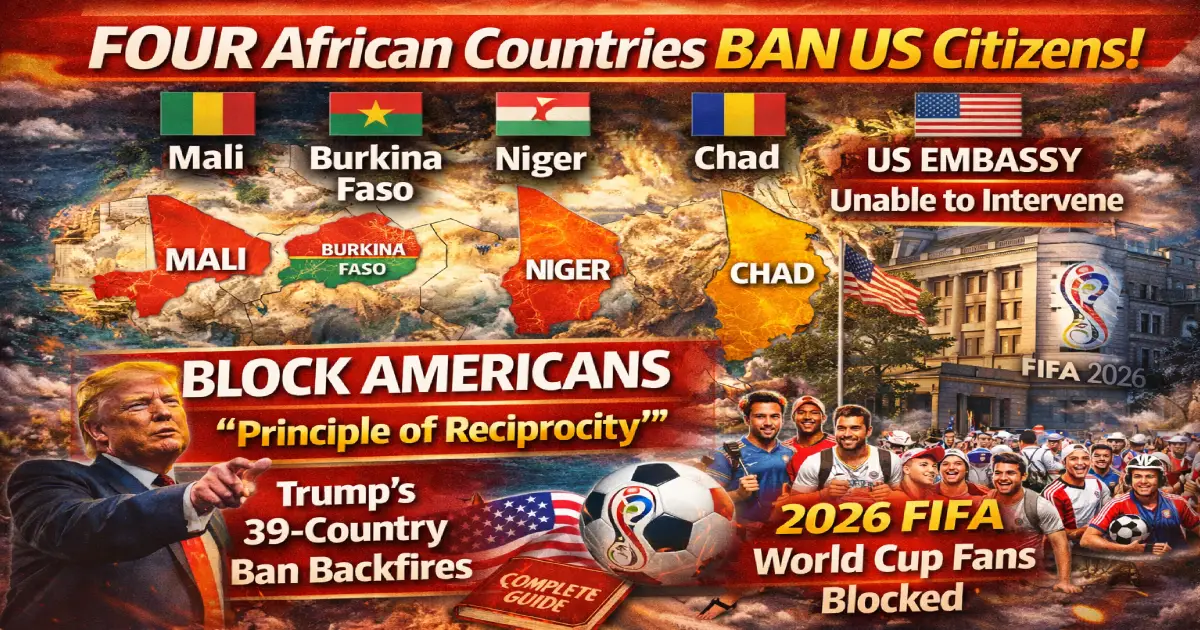
Breaking: Four African nations—Mali (January 1), Burkina Faso (January 1), Niger (December 25), Chad (June 6)—implemented TOTAL bans on US citizen entry as “reciprocal measures” retaliating against Trump’s December 16 Presidential Proclamation restricting 39 countries (effective January 1, 2026). Mali Foreign Ministry: “Apply same conditions to American nationals that US authorities impose on Malian citizens.” Burkina Faso echoed “principle of reciprocity” suspending all US visa issuance. Niger banned Americans December 25 (week before Trump ban even activated). Chad became FIRST June 6, 2025 responding to original Trump 12-country ban. ALL FOUR are Alliance of Sahel States members (military-led governments formed July 2024), coordinating response against “discriminatory” US policies targeting African/Muslim-majority nations despite terrorism concerns al-Qaeda/ISIL plaguing region. US citizens NOW BLOCKED from countries Americans rarely visit anyway—Mali (tourism minuscule), Burkina Faso (security threats), Niger (uranium mining), Chad (Lake Chad region instability)—but precedent terrifies: Could Nigeria (128K annual US visas), Senegal (World Cup qualified), or 16 OTHER African nations under partial Trump restrictions follow reciprocal ban playbook? US Embassy warnings: “We are unable to intervene to facilitate entry for private US citizens”—Americans stranded if attempt travel. 2026 FIFA World Cup implications: US hosting alongside Canada/Mexico June-July, but Senegal/Côte d’Ivoire qualified teams under partial Trump restrictions = fans may be blocked from attending games in US, while reciprocal bans could prevent Americans visiting African host cities future tournaments. Four-country ban affects estimated 5,000-10,000 annual US travelers (mostly military/NGO/mining workers vs tourists), but symbolic impact MASSIVE: First time in modern history multiple countries simultaneously banning Americans triggers “Will more follow?” panic as Trump’s travel restrictions affecting 200,000+ annual travelers potentially spark global backlash cascade where 39 banned countries + allies implement tit-for-tat measures, fundamentally reshaping US passport power.
Published: January 6, 2026 Countries Banning US Citizens: 4 (Mali, Burkina Faso, Niger, Chad) Effective Dates: Chad June 6, 2025 / Niger December 25, 2025 / Mali & Burkina Faso January 1, 2026 Reason: “Reciprocity” for Trump’s 39-country travel ban Americans Affected Annually: 5,000-10,000 direct travelers Geopolitical Impact: Alliance of Sahel States coordinated response
The Unprecedented Reality:
As of January 1, 2026, FOUR African nations have implemented complete bans on US citizen entry—marking the first time in modern history multiple countries simultaneously restricted Americans in coordinated retaliation for US immigration policy.
The Four Countries:
Why This Matters:
Americans rarely consider possibility of being BANNED from foreign countries—US passport historically one of world’s most powerful (visa-free access 186 countries). But Trump’s December 16 proclamation restricting 39 countries triggered backlash: African nations invoking “principle of reciprocity” treating Americans EXACTLY how Trump treats their citizens.
The Numbers:
Trump issues Proclamation 10949:
Chad becomes FIRST country to ban Americans:
Chadian President Mahamat Deby (via social media):
“In accordance with principles of reciprocity, Chad suspends visa issuance to American citizens. This is about national pride and dignity.”
Details:
Significance: Chad shocked everyone—first African nation fighting back Trump’s travel restrictions with mirror policy.
Presidential Proclamation 10998:
Rationale (per White House):
“Countries with demonstrated, persistent, severe deficiencies in screening, vetting, information-sharing to protect Nation from national security/public safety threats.”
Niger becomes SECOND country banning Americans:
Niger Government Statement (via state media):
“Niger has completely and indefinitely suspended issuance of all visas to citizens of United States of America and prohibited entry of US nationals into territory.”
Timing Significance:
Mali Foreign Ministry Statement:
“In accordance with principle of reciprocity, Ministry of Foreign Affairs informs national and international community that, with immediate effect, Government of Republic of Mali will apply same conditions and requirements to US nationals as those imposed on Malian citizens.”
Burkina Faso Foreign Minister Karamoko Jean-Marie Traore:
“Burkina Faso similarly cites reciprocity rule for visa ban.”
Coordinated Action:
What is Alliance of Sahel States (AES)?
Formation: July 2024 Members: Mali, Burkina Faso, Niger (all three NOW banning Americans) Leadership: Military-led governments (all three experienced coups 2020-2023) Purpose: Mutual defense, counterterrorism cooperation, economic integration
Why AES Matters:
Three countries acting in coordination = not coincidence. Alliance formed specifically to reduce dependence on Western powers (France, US) after years of failed counterterrorism efforts by foreign militaries.
Foreign Policy Shift:
Travel Ban as Geopolitical Statement:
Mali, Burkina Faso, Niger banning Americans simultaneously = message to US AND world: “We coordinate, we resist, we won’t be treated as inferior.”
Critical Warning to Americans:
US Embassy in Gabon (similar warnings issued for Mali, Burkina Faso, Niger, Chad):
“US Embassy is unable to intervene to facilitate entry for private US citizens.”
Translation: If you’re banned, you’re banned. Embassy can’t get you in. Don’t try.
State Department Travel Advisories:
Reality Check:
Most Americans weren’t traveling to these countries anyway (State Department advises DON’T GO). But NOW—even if you wanted to (work, family, emergency)—you CAN’T.
Typical US Travelers to Banned Countries:
Impact: Now require diplomatic visas (A/G category)—complicated, time-consuming, not guaranteed.
Impact: Humanitarian exceptions theoretically available—but “reciprocity” means US NGO workers face SAME barriers Malian/Burkinabe/Nigerien NGO workers face entering US (nearly impossible).
Impact: Corporate workers need specialized business visas—now subject to reciprocal restrictions = project delays, personnel shortages.
Impact: Press visas now nearly impossible—”reciprocity” means if Malian/Burkinabe journalists can’t easily get US visas, Americans can’t get theirs either.
Impact: US citizens with dual nationality CAN enter using Malian/Burkinabe/Nigerien/Chadian passports—but single-nationality Americans BLOCKED from family visits.
Chad’s President Deby (June 2025):
“This is about national pride and dignity.”
What Does This Mean?
African nations tired of being treated as second-class in international relations:
Symbolic Power vs Economic Power:
US Co-Hosting World Cup (June 11-July 19, 2026):
US, Canada, Mexico co-host largest World Cup ever—48 teams, 5 million expected international fans.
African Teams Qualified:
10 African nations qualified (most ever):
The Problem:
Reciprocal Threat:
20 Countries Under Trump’s Partial Ban:
Which Countries Likely to Retaliate Next?
NIGERIA:
IF Nigeria bans Americans:
SENEGAL:
IF Senegal bans Americans:
VENEZUELA:
CUBA:
TANZANIA, ZAMBIA, ZIMBABWE:
Can Countries Just Ban Americans Like This?
YES—Sovereignty:
But Rare Historically:
US Response Options:
US Passport Historically Among World’s Most Powerful:
Trump Ban + Reciprocal Bans = Erosion:
Comparison to Other Passports:
US LOSING ground: Trump’s immigration policies + reciprocal backlash = Americans now LESS welcome globally than citizens of other Western democracies.
MALI, BURKINA FASO, NIGER, CHAD:
✅ Dual nationals: Enter using Malian/Burkinabe/Nigerien/Chadian passport—reciprocal ban doesn’t apply to own citizens ✅ Diplomatic/official travel: A/G visas theoretically still available (but complicated, slow) ✅ Humanitarian exceptions: Theoretically possible—contact embassy, provide documentation, expect delays/denials ❌ Tourist/business travel: Essentially impossible—don’t attempt
US Embassy Warnings Clear:
“We are unable to intervene to facilitate entry for private US citizens.”
Translation: You’re on your own. Don’t expect US government help.
SAFE ALTERNATIVES (No Trump Ban, No Reciprocal Restrictions):
UNDER PARTIAL BAN (US Restricted Their Citizens, But They Haven’t Retaliated YET):
AVOID (Either US Banned OR Country Banned Americans):
Four African countries—Mali, Burkina Faso, Niger, Chad—implementing total bans on US citizen entry as “reciprocal measures” retaliating Trump’s December 16 Presidential Proclamation restricting 39 countries marks unprecedented moment in modern diplomacy: first time multiple nations simultaneously coordinate restrictions against Americans, fundamentally challenging assumption US passport grants universal access without consequence for US foreign policy.
Alliance of Sahel States (formed July 2024) demonstrated coordinated resistance capacity: Niger banning Americans December 25 (BEFORE Trump’s expanded ban even activated January 1), then Mali and Burkina Faso announcing simultaneous restrictions January 1 (exact moment Trump ban took effect), all invoking “principle of reciprocity” to mirror treatment US imposes on their citizens, sending geopolitical message beyond tourism implications—”We demand respect, we reject unilateral decisions, we won’t accept second-class treatment quietly.”
Immediate practical impact modest—5,000-10,000 annual US travelers affected (military contractors, NGO workers, mining industry, journalists, diaspora families) vs minuscule tourism numbers (State Department advises Level 4 “Do Not Travel” for Mali/Burkina/Niger due terrorism/kidnapping anyway)—but symbolic significance MASSIVE: Chad President Deby framing ban as “national pride and dignity” resonates across 20 additional African nations under Trump’s partial restrictions, raising terrifying question: Will Nigeria (128K annual US visas, most impacted), Senegal (World Cup qualified, fans blocked from US games), or others follow reciprocal ban playbook?
2026 FIFA World Cup complications foreshadow broader challenges: US co-hosting alongside Canada/Mexico June-July, but Senegal/Côte d’Ivoire fans under Trump’s partial ban cannot obtain B-2 tourist visas to attend games their teams play in US stadiums (athlete exemptions exist, general fan exemptions don’t), while reciprocal bans could eventually prevent Americans attending matches in African host cities future tournaments—geopolitical tensions literally invading sports, undermining US credibility as host welcoming “world” to World Cup while simultaneously restricting which parts of world allowed entry.
US Embassy warnings underscore reality: “We are unable to intervene to facilitate entry for private US citizens”—Americans accustomed to passport power, diplomatic protection, assumption they’re welcome everywhere now face blunt truth that sovereign nations CAN ban them, US government CAN’T override those decisions, and Trump’s immigration policies triggering backlash eroding US passport ranking (currently #6-7 globally at 186 countries access) as European/Canadian/Australian passports maintain superiority without reciprocal restrictions because their governments avoided antagonizing dozens of nations simultaneously.
Domino effect question looms: If 4 countries banned Americans in coordination within 6 months Trump ban timeline, how many of remaining 20 partially-banned countries (Angola, Benin, Côte d’Ivoire, Gabon, Gambia, Malawi, Mauritania, Nigeria, Senegal, Tanzania, Togo, Tonga, Venezuela, Zambia, Zimbabwe plus others) implement similar measures before Trump’s first 180-day review June 14, 2026? Each additional reciprocal ban compounds erosion US global standing, creates reciprocal spiral where Americans increasingly unwelcome abroad while simultaneously restricting who welcome in America—zero-sum game where EVERYONE loses: banned countries lose remittances/education/family reunification, America loses soft power/tourism revenue/diplomatic influence, travelers caught in crossfire suffer arbitrary restrictions based on nationality not individual merit.
For Americans with African connections—dual nationals entering using second passports sidestep reciprocal bans, diplomatic/NGO workers navigate complex visa processes with uncertain outcomes, mining/energy workers face project delays, diaspora families separated indefinitely—practical guidance: Alternative safe African destinations (Ghana, Rwanda, Botswana, South Africa) remain accessible, but avoid Mali/Burkina/Niger/Chad (reciprocal bans + State Department Level 4 warnings), monitor Nigeria/Senegal/Tanzania (under partial Trump restrictions, potential future reciprocal actions), expect US Embassy unhelpful (“unable to intervene”), understand passport power no longer absolute assumption—2026 marks year Americans learned hard lesson: other countries CAN say no to US citizens when US says no to theirs.
Related Travel Tourister Coverage:
Published: January 6, 2026 Last Updated: January 6, 2026 at 1:00 PM ET Reading Time: 45 minutes
Posted By : Vinay
Lastest News
2nd Floor, 39, Above Kirti Club, DLF Industrial Area, Kirti Nagar, New Delhi, Delhi 110015



Travel Tourister is a leading Travel portal where we introduce travellers to trusted travel agents to make their journey hasselfree, memorable And happy. Travel Tourister is a platform where travellers get Tour packages ,Hotel packages deals through trusted travel companies And hoteliers who are working with us across the world. We always try to find new and more travel agents and hoteliers from every nook and corners across the world so that you could compare the deals with different travel agents and hoteliers and book your tour or hotel with the one you have chosen according to your taste and budget.
Copyright © Travel Tourister, India. All Rights Reserved

 Call
Call Enquiry