Published on : 27 Feb 2026
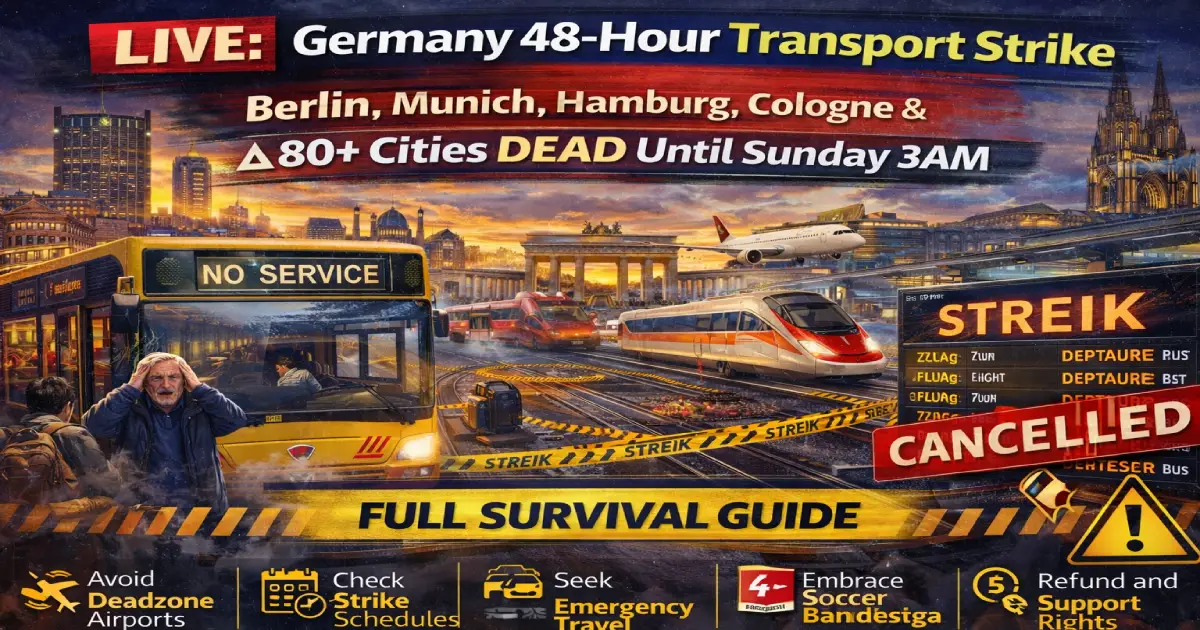
🔴 GERMANY TRAVEL EMERGENCY | Published: February 27, 2026 | Last Updated: February 27, 2026, 8:00 AM CET
Strike Status: ✅ ACTIVE — Started 03:00 AM CET today, runs until 03:00 AM Sunday, March 1 Union: Verdi (Ver.di) — Germany’s largest trade union Workers on Strike: ~100,000 across 150 municipal transport companies Cities Confirmed Hit: 80+ cities across all 16 German federal states What Is DEAD: All U-Bahn, trams, and city buses — near-total suspension What Is RUNNING: S-Bahn ✅ | Regional trains (RB/RE) ✅ | ICE/IC long-distance trains ✅ | Flights ✅ Airport Connections: BER (Berlin) — FEX Airport Express ✅ RUNNING | MUC (Munich) — S-Bahn ✅ RUNNING | HAM (Hamburg) — S-Bahn ✅ RUNNING Taxi/Uber Situation: 3–5x surge pricing — 45–90 minute waits in Berlin, Munich, Hamburg Bundesliga Match: Borussia Dortmund vs Bayern Munich TODAY — 81,000 fans — BVB officially warned: come on foot or bike Munich Security Conference: Follow-up roundtables — shuttles switched from coaches to minibuses Bremen Special: 72-hour extension — BSAG strike until 03:00 AM MONDAY March 2 March Threat: Verdi threatening indefinite rolling strikes through March if no deal Recovery: Normal services resume 03:00 AM Sunday March 1 — except Bremen (Monday 03:00 AM) Previous Strike: February 2 precursor disrupted 9 million passenger journeys in 24 hours — this is double the length
Germany is, right now, a country without its urban transport backbone.
Key public transport services, including U-bahn trains, trams, and buses, will either be suspended entirely or run on a limited emergency timetable on February 27 and 28. Trams, subways and most BVG buses will be at a standstill from Friday, February 27, 2026, at 3 AM to Sunday, March 1, 2026, 3 AM.
This is not a partial disruption. It is not a reduced-service day. In Berlin, Munich, Hamburg, Cologne, Düsseldorf, Frankfurt, Nuremberg, Dortmund, Dresden, Bremen, and 70+ additional cities across all 16 German federal states — the buses, trams, and U-Bahn trains that millions of residents, commuters, and tourists depend on have simply stopped running.
The industrial action will halt virtually all municipal buses, trams and urban rail services in more than 80 cities—including Berlin, Munich, Hamburg, Cologne, Dortmund and Nuremberg—through the end of service on Saturday night.
For tourists currently in Germany — exploring the Brandenburg Gate, visiting Marienplatz, photographing Hamburg’s Speicherstadt, or attending the Bundesliga — this is the most disruptive 48 hours in German urban transit since the pandemic. And unlike weather disruptions, this one was completely predictable. This strike follows a similar action earlier in February that already led to severe disruptions across the country.
Here is everything you need to know, city by city, airport by airport, and minute by minute.
The stoppage comes amid stalled wage talks covering roughly 100,000 drivers, dispatchers and maintenance staff at 150 local transport companies. Union negotiators want shorter split shifts, guaranteed recovery breaks and average pay rises of eight percent. Employers say they can offer 5.5% at most without triggering fare hikes.
The gap between Verdi’s 8% demand and employers’ 5.5% ceiling is not trivial. In real terms, Verdi is negotiating on behalf of workers whose base pay in some regions has not kept pace with Germany’s post-pandemic inflation surge. In Bavaria, where wages are particularly low, Verdi has made wage demands of €68.75 in addition to the reduction of the weekly working time from 38.5 to 35 hours, which the employers’ side quantifies at 17 to 27 percent plus 9.1 percent for the reduction in working hours.
This is the second escalation in four weeks. The standoff follows a 24-hour “warning strike” on 2 February that disrupted an estimated nine million passenger journeys. That warning strike was intended to force concessions. When employers refused to move significantly, Verdi doubled the action — from 24 hours to 48 hours — and expanded it to cover all 16 federal states simultaneously.
If no breakthrough occurs, Ver.di has threatened an indefinite series of rolling strikes in March, raising the prospect of persistent mobility headaches as Germany’s trade-fair season kicks into gear.
The bottom line for travelers: this is not resolved. Negotiations are expected to continue throughout March 2026, and there may be further disruptions if the demands of transport workers are not met.
The union Verdi has called on BVG employees to take part in a strike on Friday, February 27, and Saturday, February 28. This will result in significant restrictions on subway, tram, and bus services on these days.
What is suspended:
What is running:
Passengers may use the S-Bahn and regional trains as well as the shared mobility providers via Jelbi as an alternative, while the strike at BVG is ongoing. Lines that are operated by other companies on behalf of the BVG are not affected by the strike.
The key Berlin operational reality: Berlin Brandenburg Airport (BER) is still connected to the city by rail options outside BVG’s U-Bahn and tram network, including the Airport Express FEX, regional trains, and S-Bahn service. Deutsche Bahn’s regional page describes the FEX as a direct rail link that takes about 23 minutes from Berlin Hauptbahnhof to BER.
For tourists in Berlin this weekend: If your Berlin weekend is mostly “inside the S-Bahn ring,” you will often still be able to move, but you will do it differently, with more walking between stations, heavier dependence on S-Bahn interchanges, and more time lost to platform crowding. If your plan depends on U-Bahn for the last mile — for example, a short U-Bahn hop from a mainline station to a hotel — that last mile becomes the failure point, and the backup usually becomes taxi, rideshare, or a longer walk.
Berlin Hauptbahnhof warning: Berlin Hauptbahnhof is the obvious node, but it is also a magnet for crowding during disruptions, so travelers with flexibility should consider whether a different interchange point, such as Südkreuz or Ostkreuz, reduces walking distance, narrows the number of transfers, or keeps you out of the most compressed passenger flows.
BVG official strike page: bvg.de/en/strike — updated in real time.
Munich’s MVG (Münchner Verkehrsgesellschaft) has confirmed a 48-hour walkout covering all U-Bahn lines (U1–U8), trams, and city buses. Munich: The MVG (Munich’s public transport operator) is suspending metro services, buses, and trams on strike days, with only emergency services operating.
What is running: Munich S-Bahn (operated by Deutsche Bahn) — running normally. Munich Airport (MUC) is served by the S1 and S8 S-Bahn lines, both of which continue operating throughout the strike. Journey time from MUC to Munich Hauptbahnhof: approximately 40 minutes on the S8.
The Bundesliga crisis: Borussia Dortmund urged 81,000 football fans attending Saturday’s Bundesliga clash with Bayern Munich to arrive on foot or bike, warning that local bus and light-rail lines will be suspended for the full match day. The match at Signal Iduna Park in Dortmund has become the most logistically complex sporting event in Germany this weekend — 81,000 fans with no trams, no buses, and no U-Bahn. Dortmund’s DSW21 tram and bus network is also suspended. Fans are being routed to the DB regional train and S-Bahn network, but Signal Iduna Park station capacity will be severely strained before and after the match. If you have tickets: take the S-Bahn or regional train, arrive at least 2.5 hours before kickoff, and plan to walk the final approach.
Munich key attractions impacted:
Hamburg’s Hamburger Hochbahn (HHV) — which operates U-Bahn lines U1, U2, U3, U4 and the majority of city bus routes — is fully suspended. Hamburg: Public transport in Hamburg is also significantly reduced, with the Hamburger Verkehrsverbund urging commuters to consider taxis or private transport.
What is running: Hamburg S-Bahn (Deutsche Bahn) — running normally. Hamburg Airport (HAM) is served by the S1 S-Bahn line, which continues operating. Journey time from HAM to Hamburg Hauptbahnhof: approximately 25 minutes.
Hamburg key attractions impacted:
Cologne’s KVB (Kölner Verkehrs-Betriebe) is on a 48-hour walkout. All tram lines and city buses suspended. ver.di has announced a 48-hour warning strike at Kölner Verkehrs-Betriebe (KVB).
Cologne Cathedral (Kölner Dom), the city’s most visited landmark, is a 5-minute walk from Cologne Hauptbahnhof — accessible by ICE, IC, and regional train from across Germany. The Old Town (Altstadt) is walkable from the station. For most Cologne tourist attractions, walking from the Hauptbahnhof is the most reliable strategy today.
Cologne/Bonn Airport (CGN) is served by the RB27 regional train — not affected by the strike. Journey time: approximately 15 minutes to Cologne Hauptbahnhof.
In Frankfurt, U-Bahn and trams (VGF) will not run; significant disruptions are also expected in Wiesbaden, Kassel, Gießen and Marburg.
Frankfurt Airport (FRA) — Germany’s busiest international gateway — is served by the S-Bahn S8 and S9 lines, both Deutsche Bahn-operated and running normally. Journey time from FRA Terminal 1 to Frankfurt Hauptbahnhof: approximately 11 minutes. The Fernbahnhof (long-distance station) at FRA is served by ICE and IC trains directly — entirely unaffected.
For visitors needing to connect from Frankfurt Airport, the situation is even more complicated. While S-Bahn trains are unaffected, buses that usually shuttle passengers to major attractions will not be operational, leading to increased taxi demand and congestion at the airport.
Düsseldorf: 48-hour warning strike at Rheinbahn on February 27–28. All tram and bus services suspended. Düsseldorf Airport (DUS) is served by the S-Bahn S11 (Deutsche Bahn) — running normally. Journey time from DUS to Düsseldorf Hauptbahnhof: approximately 13 minutes.
All VAG U-Bahn (U1, U2, U3) and tram services in Nuremberg suspended. The city’s S-Bahn network (Deutsche Bahn) continues operating. Nuremberg’s main tourist attractions — the Old Town, Kaiserburg Castle, Hauptmarkt — are concentrated in the city centre and largely walkable from Nuremberg Hauptbahnhof.
Dresden: warning strike at DVB on February 27: all trams stop; many bus lines are suspended. Dresden’s DVB is on a single-day strike today (Friday only). Tram services may resume on Saturday, February 28 — check DVB’s website Friday evening for Saturday confirmation.
Chemnitz: warning strike at CVAG from 00:00 on Friday, February 27 until 03:00 on Saturday, causing major cancellations across bus and tram services. CVAG services in Chemnitz suspended Friday, resuming Saturday morning.
Bremen is the most severely affected city in Germany this weekend. Bremen: 72-hour warning strike at BSAG from February 27 to March 1. While every other German city returns to normal on Sunday, March 1 at 03:00 AM — Bremen residents and visitors face an extra day of disruption through Sunday night into Monday morning. If you are traveling to or through Bremen this weekend, plan accordingly — normal BSAG service does not return until Monday, March 2.
This is the single most critical section for international travelers. Here is the verified connection status for all major German airports today and tomorrow:
| Airport | City | Public Transit Status | Recommended Connection | Journey Time |
|---|---|---|---|---|
| Berlin Brandenburg (BER) | Berlin | U-Bahn suspended, S-Bahn ✅ | FEX Airport Express or S9 to Hauptbahnhof | 23–30 min |
| Munich Airport (MUC) | Munich | U-Bahn suspended, S-Bahn ✅ | S1 or S8 to Hauptbahnhof | ~40 min |
| Hamburg Airport (HAM) | Hamburg | U-Bahn suspended, S-Bahn ✅ | S1 to Hauptbahnhof | ~25 min |
| Frankfurt Airport (FRA) | Frankfurt | U-Bahn suspended, S-Bahn ✅ | S8/S9 to Hauptbahnhof or ICE direct | 11 min |
| Düsseldorf Airport (DUS) | Düsseldorf | Trams suspended, S-Bahn ✅ | S11 to Hauptbahnhof | ~13 min |
| Cologne/Bonn (CGN) | Cologne | KVB suspended, regional ✅ | RB27 to Hauptbahnhof | ~15 min |
| Stuttgart Airport (STR) | Stuttgart | S-Bahn ✅ (check VVS) | S2/S3 to Hauptbahnhof | ~30 min |
| Hanover Airport (HAJ) | Hanover | Check GVH status | S-Bahn if available | ~20 min |
Critical rule for all airports: Do NOT take a taxi to the airport and assume you will find one quickly on the return. Pre-book your taxi or ride-share for the outbound journey. On the return, use the S-Bahn — it is your most reliable option at all six airports listed above.
Uber and Bolt surge pricing: Both apps are reporting 3–5x surge pricing across Berlin, Munich, and Hamburg as demand overwhelms supply. A Berlin airport taxi that normally costs €50 is running €150–€250 today. Pre-booking reduces but does not eliminate the premium.
Best strategy: S-Bahn backbone + walking for last mile.
The S-Bahn ring (S41/S42 Ringbahn) and radial lines (S1, S2, S3, S5, S7, S9, S25, S26) remain fully operational. Use the DB Navigator app or Google Maps (set to “transit”) to plan S-Bahn routes. Expect 20–40% more crowding than normal on all S-Bahn platforms.
Key S-Bahn nodes for tourists: Alexanderplatz (S3, S5, S7, S9), Hauptbahnhof (all lines), Zoologischer Garten (S5, S7, S9), Ostbahnhof (S3, S5, S7, S9), Südkreuz (S2, S25, S26, S45).
Bike sharing: nextbike and Tier e-bikes available across the city. Jelbi app aggregates all Berlin shared mobility options in one place.
For BER Airport: Take the FEX from Hauptbahnhof (Platform 1, lower level) — 23 minutes direct. Runs every 30 minutes. Alternative: S9 from Hauptbahnhof — 30 minutes. Book your taxi at least 3 hours in advance if you prefer it.
Best strategy: S-Bahn backbone. The S-Bahn star network covers most of Munich’s tourist core adequately. Marienplatz S-Bahn station remains fully operational (S1, S2, S3, S4, S6, S7, S8).
For outlying attractions requiring U-Bahn (Olympiapark, BMW Welt, Schwabing): taxi/Uber or walk if under 2km. Most central Munich is highly walkable in the 10°C February conditions.
For MUC Airport: S1 from Ostbahnhof (50 min) or S8 from Hauptbahnhof (40 min). Both running normally. Do not take a taxi — fare from city to MUC will be €80–€120 today under surge pricing.
Best strategy: Hamburg’s S-Bahn network is less comprehensive than Berlin’s, but still covers the Hauptbahnhof–Altona–Harburg corridor adequately. For areas outside the S-Bahn reach (Altstadt side streets, Schanzenviertel, Wandsbek), walking or pre-booked taxi is your only option.
For HAM Airport: S1 from Hauptbahnhof — 25 minutes, running normally.
Best strategy: S-Bahn covers most business and tourist corridors adequately. The city centre (Römerberg, Sachsenhausen, Hauptwache) is compact and walkable from Frankfurt Hauptbahnhof.
| Alternative | Cities Available | Cost | Reliability Today |
|---|---|---|---|
| S-Bahn (DB) | All major cities | Normal fare | ✅ HIGH — running normally |
| Regional trains (RB/RE) | All cities | Normal fare | ✅ HIGH — running normally |
| ICE/IC long-distance | All cities | Normal fare | ✅ HIGH — running normally |
| FEX Airport Express (Berlin) | Berlin BER only | €4.70 | ✅ HIGH — running normally |
| Uber / Bolt | Berlin, Munich, Hamburg, Frankfurt, Cologne | 3–5x surge | 🟠 MEDIUM — long waits |
| Traditional taxis | All cities | 2–4x surge | 🟠 MEDIUM — pre-book required |
| Nextbike / TIER e-bikes | Berlin, Munich, Hamburg, Cologne | €1–3/ride | ✅ HIGH — available |
| Lime / Tier e-scooters | Berlin, Munich, Hamburg | €0.25–1/min | ✅ AVAILABLE |
| Walking | All city centres | Free | ✅ HIGH — best for under 2km |
| Car rental | All major cities | Surge pricing | 🟠 MEDIUM — book now |
| FlixBus intercity | Between cities | Normal | ✅ HIGH — running normally |
| Carpooling (BlaBlaCar) | Between cities | Variable | ✅ Available |
After the 48-hour strike, it is unclear whether the union and municipal employers will reach a resolution or if more actions will follow. Negotiations are expected to continue throughout March 2026, and there may be further disruptions if the demands of transport workers are not met.
If no breakthrough occurs, Ver.di has threatened an indefinite series of rolling strikes in March, raising the prospect of persistent mobility headaches as Germany’s trade-fair season kicks into gear.
Germany’s trade fair season begins in earnest in March — Cebit (Hanover), Ambiente (Frankfurt), and the Cologne Furniture Fair (imm cologne) are among the major events drawing international business travelers. Rolling strikes timed to coincide with Germany’s busiest business travel months would represent a significant escalation.
For business travelers: Employers with posted workers should remind staff that taxi receipts and ride-share invoices remain reimbursable under German employment law during strike-related disruptions. Keep all receipts from Uber, Bolt, and taxi rides made necessary by the strike — they are legitimate business expenses.
For leisure travelers planning Germany trips in March and April: book accommodation at or near Hauptbahnhof in each city. The main station is the one location that remains fully operational regardless of which union is on strike and which local transport operator is affected.
| Resource | Platform | Status Today |
|---|---|---|
| BVG Berlin — live strike update | bvg.de/en/strike | ✅ Live |
| MVG Munich — live status | mvg.de | ✅ Live |
| HVV Hamburg — strike info | hvv.de | ✅ Live |
| KVB Cologne — strike info | kvb.koeln | ✅ Live |
| DB Navigator app | App Store / Google Play | ✅ Best for S-Bahn/ICE |
| Jelbi Berlin (all shared mobility) | jelbi.de | ✅ Active |
| StrikeTracker Germany | striketracker.app/strikes-in-germany | ✅ Live |
| Uber Germany | Uber app | ⚠️ Surge pricing |
| Bolt Germany | Bolt app | ⚠️ Surge pricing |
| nextbike Germany | nextbike.de | ✅ Available |
| FlixBus | flixbus.com | ✅ Running normally |
1. Delete U-Bahn from your mental map for the next 48 hours. Replan every journey using the S-Bahn and regional train network. DB Navigator is your primary tool. Set your journey planner to exclude buses and trams.
2. Pre-book your taxi or Uber now for any airport transfer. Surge pricing is already at 3–5x. Waiting until you need it will double the wait time and cost. Book at least 3 hours in advance for early-morning and evening airport runs. Or use the S-Bahn — it is faster, cheaper, and more reliable today.
3. If you are in Bremen — you have an extra day of this. Every other German city returns to normal 03:00 AM Sunday. Bremen’s BSAG extends to 03:00 AM Monday March 2. Plan accordingly.
4. Dortmund Bundesliga fans — go now. Signal Iduna Park has 81,000 seats. With no trams, no buses, the S-Bahn and regional trains are the only mass-transit options. They will be overwhelmed before kickoff if fans arrive late. Give yourself 2.5 hours minimum.
5. Monitor StrikeTracker for March actions. striketracker.app/strikes-in-germany is updated in real time. If Verdi announces March rolling strikes, this is where you’ll see it first.
Germany’s cities are navigable today — but only if you know which transport still runs. The S-Bahn does. Long-distance ICE trains do. Flights do. Everything else does not.
Published: February 27, 2026. Information sourced from BVG official strike page (bvg.de/en/strike — updated today), StrikeTracker.app Germany strikes page (updated today), iamexpat.de (3 days ago), Euronews Travel (2 days ago), VisaHQ Germany advisory (February 25, 2026), adept.travel BVG analysis (February 25, 2026) and World Socialist Web Site Verdi dispute analysis. All operational data accurate as of 8:00 AM CET February 27, 2026.
For More Resources:
Related Articles:
Posted By : Vinay
Lastest News
2nd Floor, 39, Above Kirti Club, DLF Industrial Area, Kirti Nagar, New Delhi, Delhi 110015



Travel Tourister is a leading Travel portal where we introduce travellers to trusted travel agents to make their journey hasselfree, memorable And happy. Travel Tourister is a platform where travellers get Tour packages ,Hotel packages deals through trusted travel companies And hoteliers who are working with us across the world. We always try to find new and more travel agents and hoteliers from every nook and corners across the world so that you could compare the deals with different travel agents and hoteliers and book your tour or hotel with the one you have chosen according to your taste and budget.
Copyright © Travel Tourister, India. All Rights Reserved

 Call
Call Enquiry