Published on : 04 Jan 2026
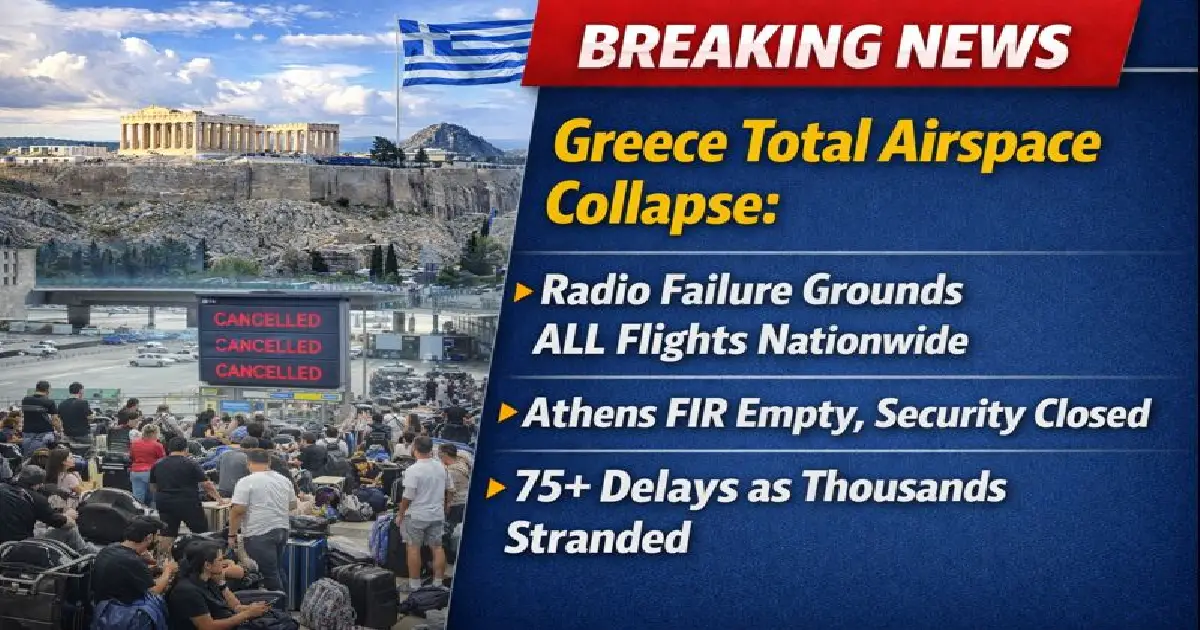
Breaking: Greece’s entire airspace shut down Sunday morning, January 4, 2026 after catastrophic radio frequency failure in Athens Flight Information Region (FIR). ALL takeoffs suspended nationwide since 9 AM local time. Security checkpoints closed at Athens International Airport. Departures impossible. Greek FIR completely empty as flights diverted to Turkey, Italy, Cyprus. Thousands stranded. Partial restoration underway but delays continuing for hours. 75+ flights delayed, 3 major diversions. Outdated infrastructure blamed.
Published: January 4, 2026 (DEVELOPING – Updated 3 PM local) Crisis Started: 9:00 AM Sunday, January 4, 2026 Status: Partial restoration underway, gradual reopening Flights Affected: 75+ delays, 3 diversions, complete shutdown earlier Airports Hit: ALL Greek airports (Athens, Thessaloniki, Heraklion, islands) Root Cause: Radio frequency system failure at Athens/Macedonia control centers
Greece’s aviation system suffered total collapse Sunday morning when critical radio frequency systems failed at the Athens and Macedonia Area Control Centers—making it impossible for air traffic controllers to communicate with pilots anywhere in Greek airspace.
What Happened:
The Hellenic Civil Aviation Authority (HCAA) issued emergency NOTAM (Notice to Airmen): “Frequency Issue in the Athens FIR… flights suspended due to technical problems with communication frequencies… until further notice.”
Eurocontrol zero-rated Greek airspace, extending restrictions until 2 PM UTC (4 PM Greek time).
Athens International Airport “Eleftherios Venizelos”—Greece’s largest and busiest—experienced unprecedented chaos:
What Passengers Saw:
“Chaos and major disruption have been recorded since Sunday morning… passengers gathered early in departure areas describe scenes of crowding, long waits, and uncertainty,” reported Proto Thema.
One Geneva passenger saw their Athens flight cancelled on departure board with no rebooking options.
Today’s Timing Couldn’t Be Worse: Sunday, January 4 ranks among the busiest travel days of the holiday period as travelers return from New Year breaks. Athens and Thessaloniki airports packed with returning vacationers—now all trapped.
Flight tracking websites showed stunning visual: Greece’s Flight Information Region—normally packed with dozens of aircraft—suddenly became a void.
Flight Tracker Data:
Malta’s FIR even restricted entries “due to lack of radar information” from Greece, showing how failures cascade through European airspace.
Eurocontrol Actions:
The problem originated in central radio frequency systems operated by the Hellenic Civil Aviation Authority (HCAA) in cooperation with telecom provider Cosmote.
Systems Affected:
“The central radio-frequency systems of the Athens and Macedonia Area Control Centers” failed, making “safe and regular communication between pilots and air traffic control impossible,” according to official statements.
Why This Is Catastrophic: Modern aviation depends entirely on continuous radio communication between pilots and air traffic controllers. Without it:
Manual Landings: Aircraft already in air when failure occurred had to land “manually”—meaning pilots followed instrument approach procedures without controller guidance, using onboard systems and established protocols for “loss of communications” (Loss of Comm) scenarios.
TCAS Safety Net: Aircraft have Traffic Collision Avoidance System (TCAS) that allows planes to “communicate” with each other and provide separation guidance if controllers can’t—preventing mid-air collisions even when ATC is offline.
“When this happens with one or two aircraft, it’s not such a big problem. The issue is compounded by the fact that this is occurring during peak arrival hours,” explained Grigoris Konstantellos, commercial airline pilot and mayor.
Greek aviation experts immediately blamed aging, outdated infrastructure that aviation authorities failed to modernize despite available funding.
Grigoris Konstantellos, Commercial Airline Pilot: “Unfortunately, the systems of the Civil Aviation Authority are outdated and need immediate modernization, despite the significant funds flowing in from the Eurocontrol system. This incident is an opportunity to wake the system up.”
The Funding Question: Greece collects substantial revenue from Eurocontrol air navigation charges—fees paid by airlines for using Greek airspace. Critics ask why these funds weren’t invested in modernizing critical infrastructure.
Past Warnings:
This failure provides undeniable evidence that the warnings were justified.
By early afternoon (around 1-2 PM local), partial restoration began:
Current Status (3 PM Local):
The Numbers:
Knock-On Effects: Even with systems partially restored, delays will cascade for hours as:
Airlines proceeding with flight rescheduling but warned passengers: “Flight schedules will not return to normal immediately but will be restored gradually.”
If You’re Flying to/from Greece Today:
Check Before Leaving Home:
If You’re Stranded at Greek Airport:
Airlines’ Obligations:
Travel Insurance:
Aegean Airlines (Greek Flag Carrier):
Olympic Air (Aegean Subsidiary):
International Airlines:
Ryanair, easyJet, Wizz Air:
This failure occurred during relatively slow January travel period. The implications for peak summer tourism season (June-September) are terrifying.
Summer Context:
Tourism Industry Concerns:
Greek tourism industry desperately needs assurances this won’t repeat during critical summer revenue season.
Immediate Priorities:
Key Questions:
Political Pressure: Greek government faces intense scrutiny over aviation infrastructure management. Pilot and controller unions demanding immediate modernization funding. Opposition parties calling for investigation into fund allocation.
Greece’s failure exposes vulnerabilities across aging European aviation infrastructure.
Similar Risks:
Wake-Up Call: Aviation experts warn Greece’s failure could repeat elsewhere unless proactive investments made in:
“This incident is an opportunity to wake the system up,” pilot Konstantellos stated—but will European governments listen?
Greece’s complete airspace shutdown Sunday morning—caused by radio frequency system failure at Athens and Macedonia control centers—represents one of the most significant aviation infrastructure failures in modern European history.
The fact that Greece’s ENTIRE national airspace went dark, security checkpoints closed, and thousands were stranded demonstrates how dependent modern aviation is on aging, vulnerable technical systems that Greece failed to modernize despite available funding from Eurocontrol navigation charges.
While partial restoration began by early afternoon, the cascade effects will last days as airlines reposition aircraft, passengers rebook, and confidence in Greek aviation infrastructure suffers damage heading into critical summer tourism season when 30+ million visitors depend on reliable air access.
For travelers, the lessons are clear:
Greece must now prove this was isolated incident, not preview of chronic reliability problems that could devastate its tourism-dependent economy.
Check airline websites for latest flight status. Delays expected to continue throughout Sunday evening and Monday morning as system fully stabilizes.
For More Resources:
Airline Customer Service:
Related Articles:
Posted By : Vinay
Lastest News
2nd Floor, 39, Above Kirti Club, DLF Industrial Area, Kirti Nagar, New Delhi, Delhi 110015



Travel Tourister is a leading Travel portal where we introduce travellers to trusted travel agents to make their journey hasselfree, memorable And happy. Travel Tourister is a platform where travellers get Tour packages ,Hotel packages deals through trusted travel companies And hoteliers who are working with us across the world. We always try to find new and more travel agents and hoteliers from every nook and corners across the world so that you could compare the deals with different travel agents and hoteliers and book your tour or hotel with the one you have chosen according to your taste and budget.
Copyright © Travel Tourister, India. All Rights Reserved

 Call
Call Enquiry